
Unified commercial and enterprise security planning connects cameras, access control, alarms, intercoms, and monitoring through defined operator workflows.

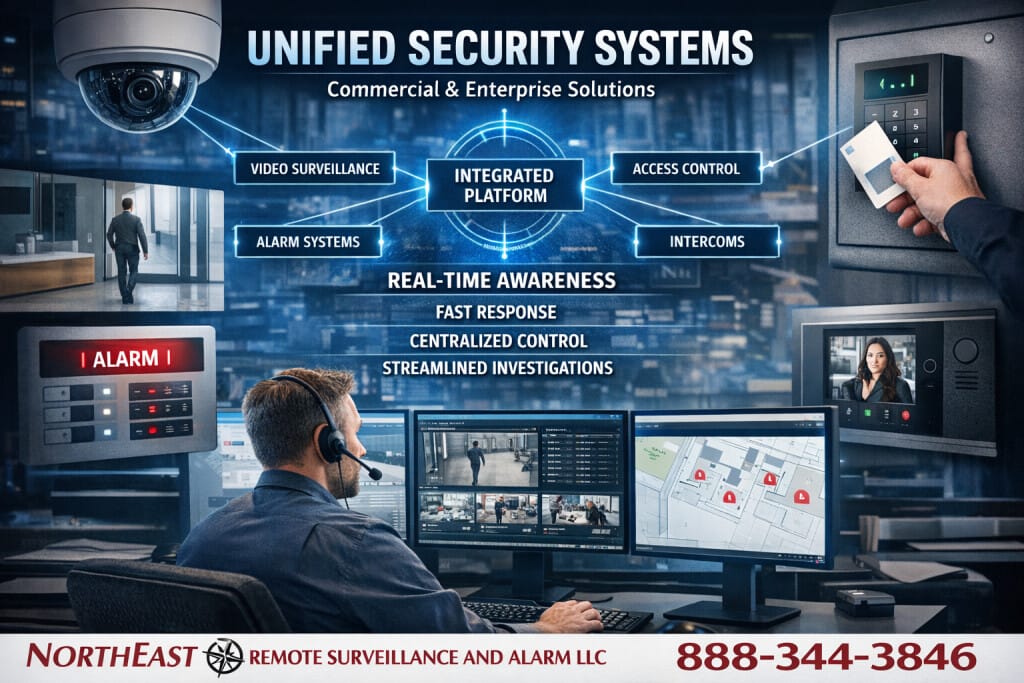
Northeast Remote Surveillance and Alarm, LLC designs unified integrated security systems that bring video surveillance, access control, intrusion detection, intercoms, monitoring, analytics, and reporting into one coordinated security environment.
For an overview of individual technologies, explore Commercial & Industrial Security Services.
Implementation services: this page covers scoping, integrating and commissioning compatible systems.
New to the topic?
Read the unified-security overview.
To prepare requirements, follow the design process.
For the wider enterprise framework, see Enterprise Security Systems Integration.
Unified Security Systems for Commercial and Enterprise Facilities
A unified security system connects the major parts of a building’s security operation so they work together instead of operating as separate silos. Cameras, access control, alarms, intercoms, sensors, and monitoring tools should share context, support faster response, and create clearer incident review.
Unified security planning connects cameras, access control, alarms, and supporting networks into a coordinated platform for commercial, industrial, institutional, and multi-site properties.
Why Siloed Security Systems Create Problems
A siloed security environment forces operators to move between separate systems. Cameras may be in one platform, access control in another, alarms in another, intercoms in another, and reports in another. When an incident happens, staff may need to search video, check door events, review alarm history, compare timestamps, and manually piece together what happened.
That slows response and weakens accountability. The more systems that operate separately, the easier it is for important details to be missed, delayed, or misunderstood.
A unified system reduces that problem by connecting events into one operational view. A door event can be tied to video. An alarm can bring up the correct camera. An intercom call can support controlled entry. A sensor alert can become part of the same incident record.
Unified vs. Integrated vs. Siloed Security
A siloed system means each security function operates separately. The camera system has one login. The access control system has another. The alarm system has another. The intercom system may be completely separate.
An integrated system allows some systems to communicate. For example, a door event may call up video, or an alarm may trigger a camera view. Those connections may still use separate databases, interfaces, and administrative workflows.
A unified system is designed around a shared operational layer.
The goal is one primary interface, one event timeline, shared permissions, consistent event categories and reporting, and connected workflows across video, access control, alarms, intercoms, analytics, and sensors.
What Unified Security Should Include
A properly planned unified security system may include commercial video surveillance, access control, intrusion alarms, intercoms, remote video monitoring, analytics, sensors, reporting, and system health monitoring.
The system should help operators understand what happened, where it happened, who was involved, which door or area was affected, and what response was taken. That level of coordination is especially important in larger buildings, multi-site organizations, warehouses, logistics properties, industrial facilities, and enterprise environments.
The goal is not to force every property into one vendor or one product line. The goal is to create a supportable system architecture where the main security functions can work together cleanly.
Video Surveillance and Access Control Working Together
Video and access control are often the most important systems to unify. Access control tells the business which credential was used, at what door, and at what time. Video can provide context for the activity visible at that location.
When these systems are disconnected, incident review becomes slower. When they are unified, a forced door, held door, denied credential, employee entry, visitor entry, or restricted-area event can be reviewed with associated video.
This helps businesses investigate unauthorized access, employee concerns, vendor entry, after-hours activity, restricted-area movement, and door-related incidents with more confidence.
Alarms, Intercoms, and Monitoring in One Workflow
Unified security becomes even stronger when alarms, intercoms, and monitoring are coordinated with cameras and access control. An alarm event can trigger video review. An intercom call can be paired with live video. A remote operator can verify activity before escalation. A door event can become part of the same incident timeline.
This reduces confusion during active events. Instead of forcing staff to interpret scattered alerts, the system can present the right information together.
For the network foundation that supports connected security platforms, use Network Security for Security Systems for infrastructure planning.
Enterprise Security for Multi-Site Organizations
Multi-site organizations need consistency. A company with several buildings, warehouses, branches, yards, or campuses should define common administration standards while documenting the rules and responsibilities that differ by location.
Unified security systems make it easier to standardize roles, permissions, camera naming, door schedules, alarm response, incident reporting, retention policies, and administrative oversight.
That matters for enterprise buyers because the value is not only in the equipment. The value is in consistent control, repeatable response, faster investigations, and better management across locations.
Unified Security for Warehouses and Logistics Sites
Warehouses, distribution centers, truck yards, loading docks, trailer areas, and logistics properties often need unified security because activity moves quickly across large areas. A single event may involve a door, dock, camera, gate, alarm, badge reader, trailer area, and after-hours alert.
Unified security helps connect those details. Dock door activity can be reviewed with video. Yard activity can be tied to camera coverage. Access-controlled warehouse doors can be reviewed with user activity. After-hours events can be verified before response.
This makes unified security especially valuable for facilities where cargo, employees, vendors, vehicles, restricted areas, and operational continuity all matter.
Unified Security for Manufacturing and Industrial Facilities
Manufacturing and industrial environments often need stronger control around production areas, employee entrances, restricted rooms, equipment spaces, shipping areas, and operational zones. These properties may also need cameras, access control, alarms, intercoms, and sensors to work together during events.
A unified system can help document restricted-area activity, connect access events to video, support after-hours response, and improve review of incidents around production, shipping, service areas, and exterior approaches.
For industrial operations, the system should be designed around uptime, safety, accountability, and long-term supportability.
Unified Security for Municipal, Educational, and Healthcare Properties
Municipal buildings, schools, training facilities, medical offices, and healthcare-related properties often require controlled entry, video visibility, alarm response, intercom communication, staff access control, visitor handling, and strong incident documentation.
Unified systems help these properties manage access, review events, document activity, and support coordinated response across public-facing and staff-only areas.
The system should match the building’s use, privacy expectations, operating hours, and risk profile.
The Technology Foundation Behind Unified Security
A unified security system depends on strong infrastructure. Cameras, access control panels, intercoms, alarm communicators, analytics devices, servers, cloud platforms, and remote access tools all depend on the network behind them.
That means the design should account for cabling, switching, VLANs, firewalls, secure remote access, device separation, system health, power, bandwidth, and long-term scalability.
A weak network foundation can limit even the best security platform. A properly planned foundation makes the system easier to support, expand, monitor, and troubleshoot.
Confirm Compatibility and Failure Behavior
Before selecting a platform, list the exact devices, software versions, supported event connections, required licenses, and parties responsible for support. Confirm which functions the proposed connection actually exposes, including video retrieval, door events, alarm status, and operator permissions. Keep those requirements with the proposal and acceptance records.
Test a representative event from the initiating device through the operator screen and the saved incident record. Check time alignment, authorized access, missing-video behavior, and recovery after a connection is interrupted. Agree which local door and alarm functions must remain available during network or server outages, and have the responsible project team verify that behavior.
Consolidate where the operating benefit justifies the licensing, migration, training, and support requirements. Separate systems may remain appropriate when a proposed connection adds little value or cannot support the required workflow reliably.
Migration From Siloed Systems to Unified Security
Many businesses already have cameras, access control, alarms, and intercoms in place. A unified strategy does not always require replacing everything at once.
The first step is to review the current systems, devices, software, network design, user roles, reporting needs, and incident response process. From there, the business can decide whether to unify through a primary platform, upgrade key systems, replace outdated components, or standardize future deployments.
A phased approach can protect existing investment while moving the organization toward a cleaner, stronger security architecture.
Common Mistakes in Unified Security Planning
One common mistake is buying separate systems without a long-term integration plan. Another is choosing platforms based only on device cost instead of operational value. Another is ignoring the network infrastructure that supports the system.
Other mistakes include weak user permissions, inconsistent naming, poor documentation, no retention planning, no health monitoring, no cyber-physical segmentation, and unclear responsibility between IT, facilities, operations, and security.
A strong unified security plan should solve those problems before the system is installed.
Built for Commercial and Enterprise Security Environments
Northeast Remote Surveillance and Alarm, LLC designs unified integrated security systems for commercial, industrial, warehouse, logistics, manufacturing, municipal, educational, healthcare, and multi-site enterprise environments.
We focus on business and professionally managed facilities that need stronger coordination between video, access control, alarms, intercoms, analytics, monitoring, reporting, and infrastructure. The system should support real operations, not create another disconnected dashboard.
Commercial & Industrial Security Services
Get a Unified Integrated Security System Assessment
If your business is relying on separate camera systems, access control platforms, alarm tools, intercom systems, monitoring workflows, and disconnected reports, Northeast Remote Surveillance and Alarm, LLC can help evaluate the path toward a more unified security environment.
For the next planning step, Request a Security Assessment.
Frequently Asked Questions
What is a unified integrated security system?
A unified integrated security system connects video surveillance, access control, alarms, intercoms, sensors, monitoring, analytics, and reporting into one coordinated security environment.
How is unified security different from basic integration?
Basic integration allows separate systems to communicate in limited ways. Unified security is designed around one operational layer with shared context, consistent workflows, role-based access, event timelines, and coordinated reporting.
What advantages can a unified workflow provide?
A well-configured workflow can reduce dashboard switching and manual event correlation. The benefit depends on supported connections, accurate timestamps, useful camera views, permissions, staff training, and the incidents the team needs to review.
Can existing systems be unified?
Often, yes. Existing cameras, access control systems, alarms, and intercoms may be integrated or migrated depending on the platform, hardware, software, licensing, network design, and long-term goals.
What types of businesses benefit from unified security?
Common examples include warehouses, logistics facilities, manufacturing plants, industrial sites, municipal buildings, schools, healthcare properties, office campuses, business parks, and multi-site commercial organizations.
Does unified security require one vendor for everything?
Not always. Some environments use one primary platform, while others use supported integrations between compatible systems. The key is creating one supportable operational workflow instead of disconnected tools.
Why does network infrastructure matter for unified security?
Unified systems rely on connected devices, servers, cloud platforms, remote access, and management tools. Poor cabling, weak segmentation, bad firewall planning, and limited bandwidth can reduce system reliability and security.
Can unified security help with investigations?
Yes. Unified systems can connect video, door activity, alarms, intercom events, sensor activity, and user actions into a clearer event timeline, making investigations faster and more defensible.
Is unified security useful for warehouses and logistics properties?
Yes. Warehouses and logistics sites often need connected visibility across docks, doors, yards, trailers, gates, alarms, and after-hours activity. Unified security helps tie those events together.
What is the first step toward unified security?
The first step is a security assessment that reviews existing systems, property layout, network infrastructure, user roles, event response, reporting needs, and long-term expansion plans.