Northeast Remote Surveillance and Alarm, LLC builds commercial and industrial security systems for small businesses, growing companies, and enterprise operations.
request a commercial security assessment
We plan around real facilities, daily operations, and long-term customer needs.
Explore Small Business Security Systems for practical protection at a local business, Multi-Site Commercial Security Systems for consistent planning across locations, or Enterprise Security Systems Integration for connected systems and shared administration.
Since 2008, Northeast Remote Surveillance and Alarm, LLC (NERSA) has served businesses, industrial sites, and managed properties. We design, install, monitor, upgrade, and support security and life-safety systems. We also connect systems where that helps the property operate.
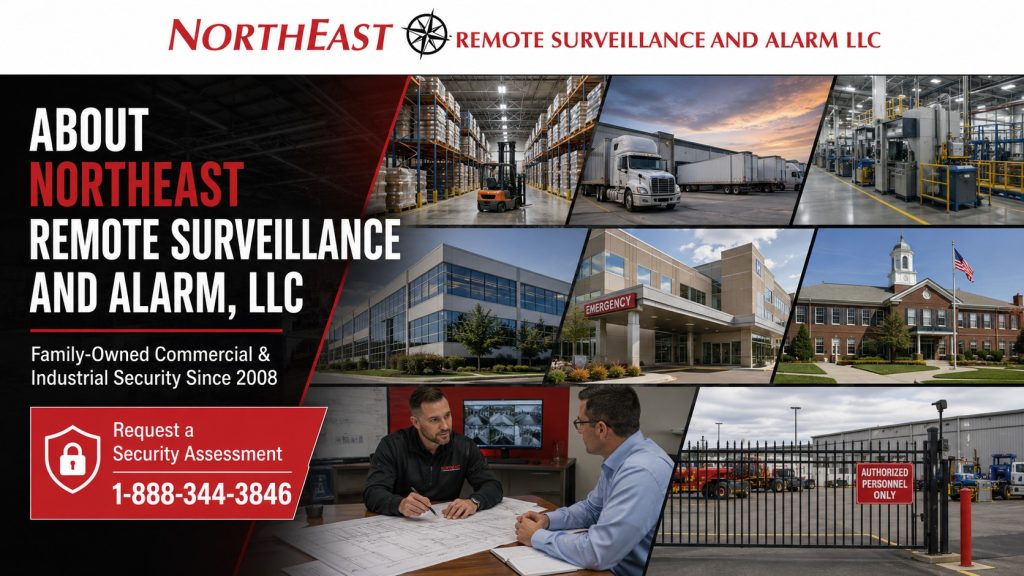
NERSA works with businesses, factories, warehouses, and logistics sites. We also serve institutions, municipalities, healthcare facilities, and organizations with multiple locations. Our work focuses on dependable equipment, clear system controls, and long-term support.
We do not begin with a predetermined camera count, alarm package, access-control platform or product list.
We begin with the facility.
Planning starts with how the property operates. Map where people and vehicles move. Identify areas that need camera coverage or controlled entry. Define who will handle alarms and other events. Then review the wiring, network, power, and life-safety needs. Assign a system manager and plan for future growth.
The objective is not to install disconnected devices.
The goal is a system your team can understand and use. It should work reliably, be practical to service, and support future growth.
Start With the Right NERSA Resource
Use the resource that most closely matches the type of planning your organization needs.
Commercial and Industrial Security Services
For video surveillance, access control, intrusion alarms, fire alarm and life-safety systems, monitoring, intercoms, gates, infrastructure and integrated security, visit Commercial & Industrial Security Services.
Industries and Facility Types
For planning organized around warehouses, manufacturing facilities, logistics operations, offices, healthcare properties, schools, municipalities, industrial parks, contractor operations and other business and professionally managed environments, visit Industries We Serve.
NERSA Service Areas
For Pennsylvania state, regional, city, corridor and selected Mid-Atlantic service coverage, visit NERSA Service Areas.
Security Technologies and Platforms
For manufacturer, platform, cloud-managed, on-premises, compatibility and long-term technology ownership planning, visit Security Technologies & Platforms.
Existing-System Upgrades and Takeovers
For aging, inherited, unreliable, unsupported or poorly documented systems, visit Commercial Security System Upgrades, Retrofits and Takeovers.
Commercial Security Assessment
To review your property’s current equipment and operating needs, request a commercial security assessment.
Who We Are
Northeast Remote Surveillance and Alarm, LLC focuses on security and life-safety systems for commercial, industrial, institutional, and professionally managed apartment properties.
NERSA supports cameras, door and gate access, intrusion alarms, fire and life-safety systems, monitoring, and intercoms. We also plan the cabling, fiber, networks, and power that connect them. Projects can include new installations, upgrades, provider takeovers, and systems across several buildings or sites.
Systems can work on their own where that suits the site. They can also share information when this helps staff manage users, review events, communicate, or respond.
Facility-First Commercial Security Planning
Read about our solutions-consultant approach for the steps between identifying a facility problem and defining a project.
Our association information is available on the Security Industry Association and Electronic Security Association pages.
A warehouse does not operate like a medical office.
A factory, school, municipal building, and office have different needs. Their entrances, users, work hours, loading areas, and existing equipment shape the security plan.
NERSA reviews the property before recommending equipment.
Start with the layout, hours, and people who use the site. Review entrances, restricted rooms, loading areas, parking, and the perimeter. Set the goals for cameras, alarms, and door access. Then check wiring, fiber, networks, power, and life-safety interfaces. Include records and future growth in the plan.
Good planning helps avoid poor camera views and gaps in alarm coverage. It can also prevent confusing user rights, unreliable remote access, and doors that do not work as intended. Leave room for the system to grow.
Commercial and Industrial Specialization
NERSA focuses on businesses, industrial facilities, and professionally managed apartment communities. We do not provide security installations for individual homes or single-family residences.
Commercial sites may have many users, shifts, contractors, and buildings. Loading docks, vehicle gates, commercial doors, fire alarms, and network equipment add further needs. Some organizations also need to manage several locations.
Those operating conditions require systems to be planned around the organization, its property and its procedures rather than around a prepackaged consumer system.
NERSA supports projects ranging from smaller commercial facilities to large warehouses, manufacturing properties, institutions, commercial campuses and multi-site organizations.
Complete-System Coordination
Security devices rarely operate in isolation.
An access-controlled opening involves more than the reader. For example, the controller, locking hardware and door condition affect how it works. Request-to-exit operation, power, communication, permissions and required emergency operation also need review.
A camera depends on placement, lighting, lens selection, network connectivity, recording, retention, user permissions and the evidence the organization expects to obtain.
An intrusion alarm depends on properly identified zones, dependable communication, current users, monitoring information and documented response procedures.
An intercom or gate may depend on communication, video, access control, network connectivity, power and a defined process for determining who may enter.
NERSA evaluates these relationships so the completed environment works as a coordinated system rather than a collection of unrelated products.
For multi-system planning, visit Unified Commercial and Enterprise Security Systems.
Customer Ownership and System Administration
Customers should understand who controls their security systems and how those systems will be administered after installation.
At handover, confirm administrator access and individual user accounts. Record camera names, doors, alarm zones, response contacts, and remote-access steps. Label equipment and network locations. Provide the agreed training, service and warranty details, known limits, and options for future growth.
Cloud-connected systems, mobile applications and remote-management platforms require clear account ownership.
Customers need clear account ownership and system records. Approved staff should know how to add users, remove former employees, and retrieve video. At handover, identify account owners and user roles. Record how credentials and alarm zones are managed and which documents the client receives.
Scalable and Serviceable System Design
A commercial security system should address the current requirement without creating unnecessary complexity or preventing reasonable future expansion.
A smaller business may begin with several cameras, one controlled entrance, a monitored alarm, an intercom or another focused security requirement.
As an organization grows, it may add controlled doors, cameras, credentials or alarm partitions. It may also need remote monitoring, vehicle gates, additional buildings, network infrastructure or new business locations.
Larger organizations may require centralized administration, multi-site video, enterprise access control, role-based permissions, fiber connectivity, standardized documentation and phased migration.
Smaller properties should not be forced into unnecessary enterprise complexity.
Larger organizations should not be limited by systems that cannot support their users, buildings, reporting or future growth.
Facilities and Organizations NERSA Serves
NERSA supports warehouses and distribution centers, logistics and freight facilities, manufacturing plants, and industrial buildings and parks. We also serve commercial offices, multi-tenant properties, healthcare and medical facilities, schools, and municipal and institutional buildings. Other supported sites include contractor facilities, equipment yards, truck and trailer yards, retail businesses, gated commercial properties, multi-building campuses, and multi-site organizations.
Each property requires a different balance of surveillance, controlled access, intrusion protection, fire and life-safety systems, monitoring, communication, infrastructure and administration.
For detailed property-specific planning, visit Industries We Serve.
Before choosing a provider, review our project and support standards.
They explain assessment, testing, records, and handover.
You can also check the project stages and warranty guidance when comparing scope and ongoing support.
How NERSA Approaches a Commercial Security Project
NERSA begins with the property rather than a standard equipment package.
First, review the facility layout, operations and users. Include entrances, restricted areas, loading activity and vehicle movement. Then assess existing equipment, infrastructure and monitoring requirements alongside known concerns and future plans.
NERSA then develops a practical system approach around the required outcome.
Approved projects may involve equipment selection, installation, programming, testing, coordination with responsible project participants, customer training, documentation and preparation for long-term support.
The completed system should be understandable to the people responsible for operating and administering it.
Security Assessment Process
For detailed information about how NERSA evaluates a property before major equipment decisions are made, visit NERSA Security Assessment Process.
Project Delivery Standards
For project coordination, installation, testing, training, documentation and turnover, visit NERSA Project Delivery Standards.
New Installations, Upgrades, Retrofits and Takeovers
NERSA supports completely new installations as well as existing systems that are aging, inherited, unsupported, unreliable or poorly documented.
An existing security system does not automatically require complete replacement.
NERSA can check existing equipment, system accounts, communications, and monitoring records. We then identify what can stay, what needs repair or new settings, and what should be upgraded or replaced.
Existing-System Inspection and Assessment
For evaluation before major replacement decisions are made, visit Commercial Security System Inspection and Assessment.
Upgrades, Retrofits and Takeovers
For modernization, provider transitions, platform migration and phased replacement, visit Commercial Security System Upgrades, Retrofits and Takeovers.
Security Technologies and Platforms
NERSA works with multiple commercial security technologies rather than forcing every property into one manufacturer’s ecosystem.
Technology selection starts with the facility and its existing equipment. Compare video, access-control, credential, intrusion and monitoring requirements. Then review network infrastructure and cloud-managed or on-premises administration. Also consider interoperability, cybersecurity, licensing and serviceability. Multi-location administration, future expansion and long-term ownership should shape the decision.
Technology should support the operating requirements of the property rather than dictate them.
For manufacturer and platform planning, visit Security Technologies & Platforms.
Cybersecurity-Aware Security Administration
Modern security systems may connect to networks, cloud services, remote dashboards, and phone apps. They can hold video, user credentials, and administrator accounts. Plan how those systems and records will be managed.
Responsible administration starts with individual accounts, appropriate authentication and role-based permissions. Remove former users and control vendor access. Also plan secure remote connectivity, software updates and network coordination. Make ownership of the primary system accounts clear.
Physical security and cybersecurity should support one another.
For dedicated guidance, visit Cybersecurity and Data Protection Standards.
Compliance-Aware Security Planning
Commercial security projects can interact with fire alarm operation, emergency egress, accessible entry, electrified door hardware, low-voltage wiring, cybersecurity, privacy, documentation and inspection-sensitive building conditions.
Security equipment does not make a property compliant by itself.
NERSA considers these conditions during system planning while recognizing that formal code interpretation, engineering, permitting, legal advice and final approval remain with the appropriate qualified professionals and authorities having jurisdiction.
For detailed planning, visit Regulatory Compliance and Inspection Readiness.
Where NERSA Works
Pennsylvania is NERSA’s primary service footprint.
NERSA supports commercial and industrial properties across the Lehigh Valley, Greater Reading and Berks County, Greater Philadelphia and Southeastern Pennsylvania, Northeastern Pennsylvania and selected Central Pennsylvania markets.
Selected commercial and industrial projects may also be supported in surrounding Mid-Atlantic markets depending on location, system requirements, project scope, scheduling and long-term support needs.
For complete state, regional, city and corridor coverage, visit NERSA Service Areas.
Why Organizations Choose Northeast Remote Surveillance and Alarm
NERSA works with organizations that need a commercial security provider to assess the whole property. The plan considers how the site runs as well as the equipment it needs.
We start with the facility and its daily work. The plan may cover new equipment, expansion, upgrades, or a provider takeover. We also consider how systems connect, who owns the accounts, and how staff will use them. Clear records, testing, room for growth, and ongoing support are part of that approach.
Long-term performance depends on more than the equipment manufacturer.
Cameras, access control, intrusion alarms, fire alarm systems, monitoring, intercoms, gates, infrastructure, administrator permissions, documentation and service planning must work together.
NERSA’s role is to organize those elements into a dependable commercial security environment that supports the facility’s present requirements and future needs.
Frequently Asked Questions About NERSA
What does Northeast Remote Surveillance and Alarm, LLC do?
NERSA designs, installs, monitors, upgrades, integrates and supports commercial video surveillance, access control, intrusion alarms, fire alarm and life-safety systems, professional monitoring, intercoms, gate security and supporting low-voltage infrastructure.
How long has NERSA been in business?
Northeast Remote Surveillance and Alarm, LLC has served business and professionally managed properties since 2008.
Does NERSA install security systems for single-family homes?
No. NERSA does not provide security installations for individual homes or single-family residences. We serve businesses, industrial facilities, and professionally managed apartment communities, including shared entrances, common areas, and grounds.
What types of properties does NERSA serve?
NERSA supports warehouses, logistics facilities, manufacturing plants, offices, healthcare properties, schools, municipalities, contractor operations, industrial parks, commercial campuses, multi-tenant properties and multi-site organizations.
Can NERSA support both smaller businesses and enterprise organizations?
Yes. Projects may range from several cameras, one controlled entrance or a monitored alarm to larger multi-building and multi-location security environments.
Can NERSA upgrade or take over an existing security system?
Yes. Existing systems can be evaluated to determine what may reasonably be retained, repaired, reprogrammed, upgraded, migrated, integrated or replaced.
Does NERSA work with multiple security technology platforms?
Yes. NERSA works with multiple commercial technologies and selects platforms around the property, existing systems, administration, infrastructure and long-term requirements.
Does NERSA provide commercial fire alarm systems?
NERSA supports qualifying commercial fire alarm and life-safety projects based on the property, project scope, existing conditions and applicable requirements.
Where does NERSA provide service?
Pennsylvania is NERSA’s primary service footprint, with selected commercial and industrial projects supported in surrounding Mid-Atlantic markets.
How does a commercial security project begin?
A project begins with a property-specific assessment of the facility, operations, users, existing systems, infrastructure, known concerns and future requirements.
Request a Commercial Security Assessment
A commercial security project should begin with a clear understanding of the property, existing equipment, operating requirements and known concerns.
A security assessment can help determine whether the appropriate path is a new installation, repair, expansion, upgrade, retrofit, provider takeover, phased modernization or complete system replacement.
Request a Commercial Security Assessment.
Explore Related NERSA Resources
Company and Policy Resources
Review NERSA’s company focus, experience, transparency, correction process, and service terms through these resources.
- Commercial-Only Security Company — Read about the types of properties NERSA serves.
- Corrections Policy — See how reported inaccuracies are reviewed and corrected.
- NERSA Platform and Manufacturer Experience — Review NERSA’s approach to platform fit and compatibility.
- Ownership & Funding Transparency — Find information about company ownership and funding.
- Terms of Service / Terms & Conditions — Review the terms that apply to use of the website and services.
- Why Choose Northeast Remote Surveillance and Alarm, LLC for Commercial Security — Review the company’s stated approach to commercial-security projects.
Work with NERSA
Interested in joining our commercial and industrial security team?
Use the Employee Application to share your installation, service, programming or project-coordination experience and manufacturer training.
Independent installation businesses can use our Contractor Application to present their service territory, licensing, insurance and technical qualifications.
Compliance, Codes & Project Standards
NERSA plans commercial and industrial security work with applicable code, documentation, inspection and authority-having-jurisdiction requirements in mind. Requirements vary by system, property and jurisdiction. These resources support project planning; they do not establish legal compliance, certification or AHJ approval.
Related guidance: Documentation, testing & inspection readiness