A commercial security assessment should do more than identify where cameras could be installed. It should review how the property operates, where risk exists, how people and vehicles move, how systems interact, and whether security, fire alarm, life safety, and supporting infrastructure are ready for long-term commercial use.
Northeast Remote Surveillance and Alarm, LLC provides security, alarm, fire alarm, life safety, access control, video surveillance, monitoring, and low-voltage infrastructure assessments for commercial, industrial, municipal, institutional, warehouse, logistics, healthcare, and multi-site properties across Pennsylvania and the Mid-Atlantic.
This is not a residential sales walkthrough. It is a commercial and industrial assessment designed to help decision-makers understand risk, system readiness, compliance-sensitive conditions, and the right path forward.
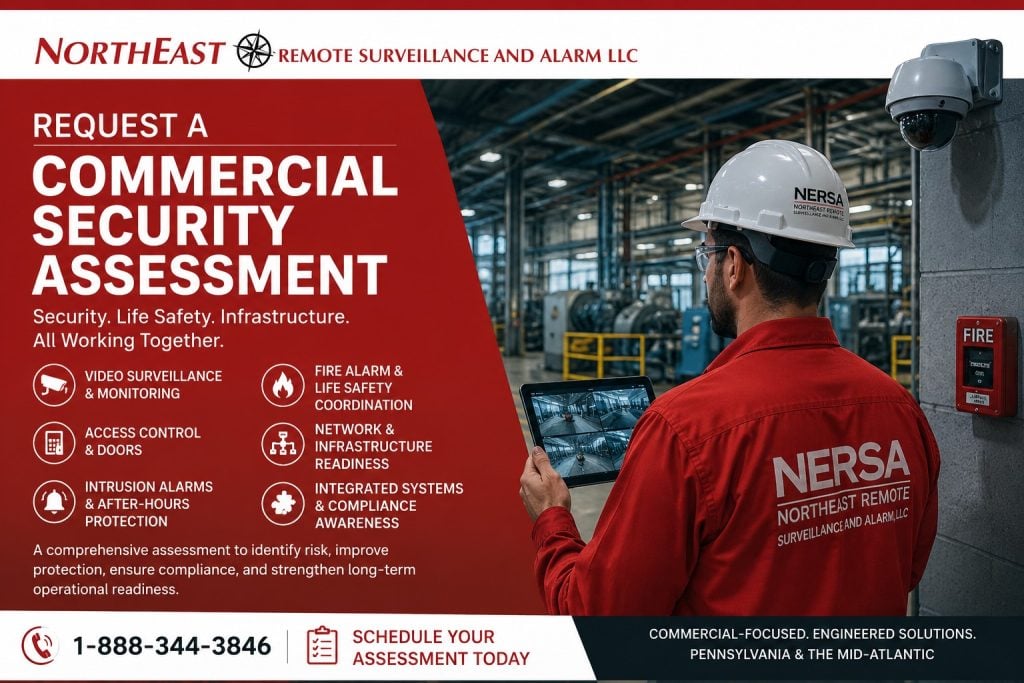
What the Assessment Covers
Video Surveillance and Monitoring
We review camera placement, blind spots, recording needs, retention requirements, video quality, remote access, AI analytics, and monitoring potential. For facilities with after-hours activity, exterior exposure, docks, parking lots, yards, or restricted spaces, video should support usable incident review and stronger operational visibility.
Access Control, Doors, Gates, and Egress
We review controlled doors, gates, credentials, reader locations, restricted areas, employee entrances, visitor flow, audit trails, and emergency door behavior. Access control should improve accountability without creating conflicts with egress, ADA accessibility, fire alarm release, or life-safety requirements.
Intrusion Alarms and After-Hours Protection
We review alarm coverage around doors, interiors, overhead openings, vulnerable access points, restricted rooms, and communication paths. The goal is to improve after-hours awareness, reduce uncertainty, and support more useful response when an alarm event occurs.
Fire Alarm and Life Safety Coordination
We review fire alarm and life-safety considerations that may affect security design, including fire alarm interfaces, notification concerns, monitoring pathways, elevator recall coordination, door release behavior, inspection readiness, and AHJ expectations. Fire alarm work should be treated as life-safety infrastructure, not as a basic add-on.
Low-Voltage, Network, and Communications Infrastructure
We review cabling, pathways, racks, switches, PoE capacity, wireless links, fiber needs, carrier handoffs, segmentation, backup communication paths, and infrastructure scalability. Security systems are only as dependable as the network and low-voltage infrastructure supporting them.
Unified Security and System Integration
We review how cameras, access control, alarms, intercoms, monitoring, fire alarm coordination, and infrastructure can work together. In commercial and industrial environments, disconnected systems often create gaps in visibility, response, reporting, and long-term serviceability.
Compliance and Standards Considerations
Security assessments do not replace code review, engineering, legal advice, or AHJ approval, but they help identify where security design may intersect with compliance-sensitive conditions.
PA UCC, NFPA, OSHA, ADA, and MSHA
For Pennsylvania facilities, the assessment may consider how security work interacts with Pennsylvania UCC requirements, NFPA standards, OSHA-sensitive operating areas, ADA-accessible entry, emergency egress, and life-safety coordination. For mining-related environments, MSHA considerations may also affect site safety and access planning.
ESA, ASIS, and Industry Best Practices
A stronger assessment should be grounded in recognized security-industry practices, not just equipment preferences. NERSA uses a commercial-first approach informed by recognized security, fire alarm, life-safety, and low-voltage infrastructure practices.
Who Should Request an Assessment
This assessment is designed for facilities with operational complexity, compliance exposure, or multiple systems that need to work together. That includes manufacturing plants, warehouses, distribution centers, logistics properties, contractor yards, industrial parks, office buildings, healthcare facilities, schools, municipal buildings, corporate campuses, and multi-tenant commercial properties.
It is especially useful before system upgrades, expansions, renovations, new construction, fire alarm coordination, insurance reviews, recurring security issues, or major changes in building use.
What You Receive
After the assessment, you can expect a practical review of risk areas, system gaps, infrastructure limitations, compliance-sensitive conditions, and recommended next steps. The goal is to provide a clear roadmap for improving visibility, access control, alarm coverage, monitoring, fire alarm coordination, infrastructure readiness, and long-term system reliability.
There is no obligation to proceed with installation.
Why Choose Northeast Remote Surveillance and Alarm, LLC
NERSA works exclusively in commercial, industrial, municipal, institutional, and multi-site environments. We do not install residential alarm kits.
Businesses choose NERSA for commercial-first planning, integrated security design, compliance-aware recommendations, fire alarm and life-safety awareness, low-voltage infrastructure experience, monitoring coordination, documentation discipline, and Mid-Atlantic regional support.
Request a Security Assessment
If your facility needs stronger security, better fire alarm and life-safety coordination, clearer incident review, improved access control, better after-hours protection, or more dependable infrastructure, Northeast Remote Surveillance and Alarm, LLC can help.
Call 1-888-344-3846 or complete the assessment request form to schedule a commercial security, fire alarm, life safety, and infrastructure evaluation.