
The NERSA commercial security knowledge center helps small-business owners, growing companies, and enterprise teams plan cameras, controlled doors, alarms, monitoring, and supporting infrastructure.

Request a Commercial Security Assessment
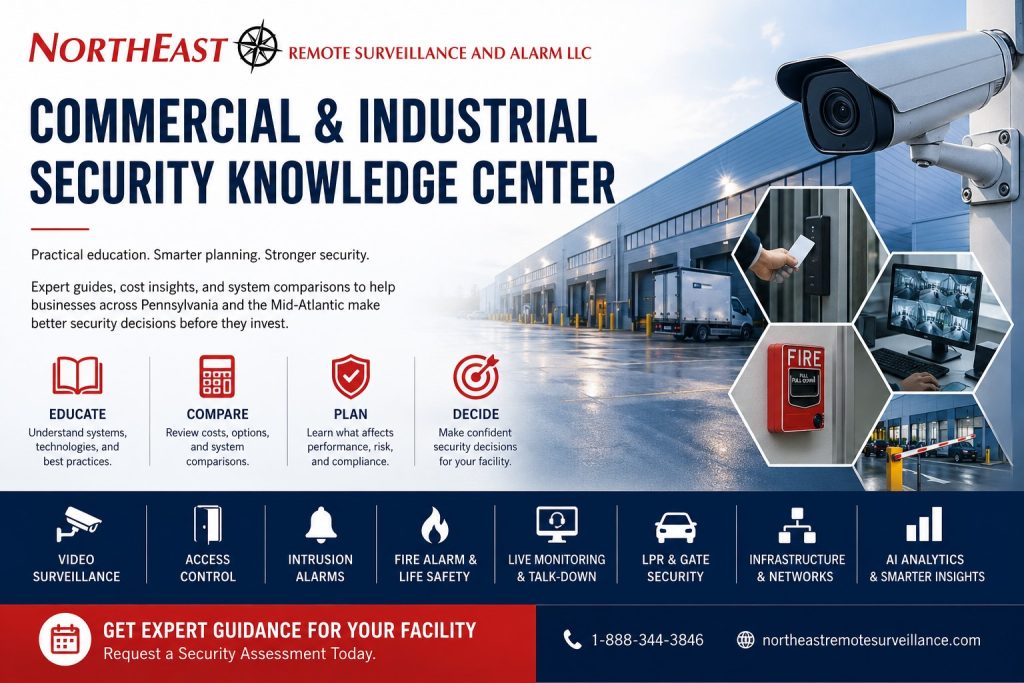
Compare options and prepare useful questions before an assessment or system upgrade.
New to business security?
Start with Small Business Security Systems.
Planning shared systems across a campus or organization?
Use Enterprise Security Systems Integration.
The guides below help you work through individual technology and project decisions.
Choose a Planning Path
To see how installation topics are presented in practice, visit installation videos and field demonstrations.
Use the demonstrations alongside the relevant planning guide when preparing questions about your own site.
Start with the decision you need to make.
These paths connect the broad planning questions with the detailed system guides below.
- New project: use the security assessment process to define the property, users, priorities, and acceptance checks.
- Existing system: review upgrades, retrofits, and takeovers to identify what can remain and what needs attention.
- Technology choice: compare security technologies and platforms for compatibility, administration, licensing, and long-term ownership.
Commercial Security Planning and Assessments
A successful security project begins with understanding the property, operating conditions, existing equipment and desired outcome before specific technology is selected.
For a structured review of facility operations, entrances, restricted areas, parking, existing systems, infrastructure, monitoring and future requirements, visit the NERSA Security Assessment Process.
Commercial Security Costs and Budget Planning
Security-system pricing depends on equipment requirements, installation conditions, infrastructure, licensing, storage, monitoring, door hardware and the complexity of the property.
For practical budgeting information covering commercial camera systems, access control, upgrades and related purchasing decisions, begin with Commercial Security Camera Installation Cost.
Video Surveillance Planning
Commercial video surveillance should be designed around what the organization needs to see, document and investigate rather than around camera quantity alone.
For camera placement, recording, storage, analytics, system architecture and commercial surveillance planning, visit Commercial & Industrial Video Surveillance Systems.
Access Control and Commercial Door Security
Commercial access control involves the entire controlled opening, including credentials, readers, controllers, locking hardware, door contacts, request-to-exit devices, power, software and system administration.
For deeper guidance on credentials, communication standards, door hardware, system architecture and long-term ownership, visit the Commercial & Industrial Access Control Knowledge Center.
Intrusion Alarms, Monitoring and Emergency Response
Commercial intrusion protection should reflect the property, operating schedule, protected openings, users, communication paths, monitoring requirements and expected response.
For alarm panels, opening protection, detection, partitions, communications and expansion planning, visit the Commercial Intrusion Detection Systems Guide.
Commercial Fire Alarm and Life-Safety Systems
Commercial fire alarm projects may involve detection, occupant notification, sprinkler supervision, monitoring, communications, system interfaces, testing, documentation and inspection-sensitive requirements.
For broader planning of commercial fire alarm and life-safety systems, visit Commercial Fire Alarm & Life Safety Systems.
Security Infrastructure, Networks and Connectivity
Modern physical-security systems depend on suitable cabling, fiber, network switching, power, equipment locations, wireless links and responsible system administration.
For cabling, fiber, network pathways, racks, switching, power and future-capacity planning, visit Commercial Security Infrastructure Planning.
Security Technologies and Platforms
The appropriate security platform should be selected after the facility, operating requirements, existing equipment, administrative needs and long-term ownership expectations are understood.
For manufacturer comparisons, cloud-managed and on-premises systems, open architecture, compatibility, credentials, licensing and system ownership, visit Security Technologies & Platforms.
Existing-System Upgrades, Retrofits and Takeovers
Existing cameras, access-control systems, alarms, infrastructure, software, monitoring accounts and documentation should be evaluated before unnecessary replacement is recommended.
For modernization, selective replacement, migration, infrastructure reuse and takeover planning, visit Commercial Security System Upgrades, Retrofits & Takeovers.
Codes, Standards and Inspection Readiness
Commercial security and life-safety projects may interact with emergency egress, accessibility, fire alarm requirements, electrical conditions, equipment sourcing, documentation and inspection processes.
For practical guidance involving standards, project responsibilities and inspection-sensitive conditions, visit Regulatory Compliance & Inspection Readiness.
Use the commercial security compliance and inspection-planning guide to organize controlled-door, system-interface, documentation and review responsibilities for your facility.
Commercial Security Case Studies and Field Resources
Planning guides explain security-system choices, while case-study pages organize those considerations around particular facility and system scenarios.
For project-planning examples organized by facility and system type, visit Commercial & Industrial Security Case Studies.
Security Guidance by Industry and Facility Type
Security requirements can change substantially between warehouses, manufacturing plants, offices, healthcare facilities, schools, municipalities, retail properties and other operating environments.
For security guidance organized around the type of property being protected, visit Industries We Serve.
Commercial Security Service Areas
Organizations looking for security planning based on a particular Pennsylvania region, city or commercial corridor can use NERSA’s geographic service resources.
For regional and local service information, visit NERSA Service Areas.
Commercial Security Systems and Services
Organizations that already know which system or service they require can review NERSA’s commercial security capabilities directly.
For video surveillance, access control, intrusion detection, monitoring, fire alarm, integrated systems and supporting infrastructure, visit Commercial & Industrial Security Services.
Why NERSA Publishes Commercial Security Planning Resources
Commercial security systems may remain in service for many years.
Decisions made during planning can affect installation cost, system reliability, administration, interoperability, recurring licensing, monitoring, network requirements, evidence quality, expansion, maintenance and eventual replacement.
A system that appears inexpensive initially may become difficult to administer or expand if infrastructure, compatibility and long-term ownership are not considered early.
Likewise, complete replacement may not always be necessary when existing cameras, cabling, controllers, door hardware, network equipment or other infrastructure remains useful and supportable.
Northeast Remote Surveillance and Alarm approaches commercial security as facility infrastructure rather than as a collection of unrelated devices.
The objective of this Knowledge Center is to help commercial and industrial organizations understand available options, identify important project questions and make better-informed decisions before installation, expansion or modernization begins.
Frequently Asked Questions About the Commercial Security Knowledge Center
What is the NERSA Commercial & Industrial Security Knowledge Center?
The Knowledge Center provides educational resources covering commercial security planning, assessments, costs, video surveillance, access control, intrusion alarms, monitoring, fire alarm systems, infrastructure, technology platforms, upgrades, compliance and long-term system ownership.
Where should I begin if I do not know which security system I need?
Begin with the NERSA Security Assessment Process when the property and operating requirements need to be evaluated before a specific system is selected.
Does NERSA provide commercial security cost information?
Yes. NERSA publishes planning information covering commercial video surveillance, access control, monitoring, upgrades and other budgeting considerations. Actual project pricing depends on the property and project requirements.
Can NERSA evaluate equipment installed by another company?
Yes. Existing cameras, access control, intrusion alarms, monitoring paths, door hardware, infrastructure, administrator access and documentation can be evaluated before takeover, modernization or replacement decisions are made.
Does an older commercial security system always need to be replaced?
No. Existing equipment may remain useful when it is compatible, supportable, secure, appropriately installed and suitable for the completed system.
Can video surveillance, access control, alarms, intercoms and monitoring work together?
Yes. Compatible systems can be coordinated when doing so provides a practical operational, administrative, investigative or response benefit.
Where can I compare security technologies and platforms?
Visit Security Technologies & Platforms for guidance involving manufacturers, platforms, architecture, compatibility, administration, licensing and long-term ownership.
Does NERSA install single-family home security systems?
No. NERSA does not provide security installations for individual homes or single-family residences. We serve businesses, industrial and institutional facilities, and professionally managed apartment communities, including shared entrances, common areas, and grounds.
Does NERSA provide formal engineering, legal or code-approval services?
NERSA provides practical security and life-safety planning information relevant to commercial projects. Formal engineering, legal interpretation, permitting decisions and final approvals remain with the appropriate qualified professionals and authorities.
For related planning, explore Security System Costs, Comparisons and Buyer Guides.
Request a Commercial Security Assessment
Online research can help an organization understand terminology, compare technologies, estimate budgets and prepare better questions.
A facility-specific assessment becomes important when recommendations depend on actual property conditions, existing equipment, controlled doors, camera distances, lighting, vehicle activity, restricted areas, network infrastructure, monitoring requirements, life-safety interfaces, administration or future expansion.
Northeast Remote Surveillance and Alarm, LLC can review the property, existing systems, infrastructure and project priorities before recommending equipment or a modernization path.
Request a Commercial Security Assessment.
Northeast Remote Surveillance and Alarm, LLC
Commercial & Industrial Security Systems
Small Business Through Enterprise
Explore Related NERSA Resources
These additional guides cover focused product questions, system ownership, retrofit decisions, and facility scenarios. Scenario pages support planning; confirm the documented project details before treating an example as a completed installation.
Explore these comparisons, lifecycle guides, and case-study pages for the question most relevant to your project.
- Capital Planning for Commercial Security — Prioritize security spending and plan work in stages.
- Commercial Alarm Monitoring vs Local Alarm Only — Compare on-site alarm notification with monitored response arrangements.
- Commercial Security Integrator vs DIY Security Systems — Weigh installation, integration and ongoing support responsibilities.
- How NERSA Designs Unified Security Systems — Understand how system design starts with the property’s operating needs.
- Lifecycle Planning for Electrified Door Hardware — Plan inspection, maintenance and eventual replacement of electrified hardware.
- NDAA Cameras vs Consumer Cameras for Commercial Security Systems — Consider procurement requirements alongside camera suitability and support.
- Related Commercial Security Services — Find supporting services when a project extends beyond one system.
- Retrofit vs. Full Door Hardware Replacement — Compare retaining suitable door hardware with replacing the complete opening.
- Security Publishing & Industry Research — Read NERSA’s approach to technical publishing and research.
- Video Surveillance Camera Types for Commercial and Industrial Properties — Compare camera formats against the views and evidence your property needs.
- When Retrofitting Saves Money — Assess when retaining usable equipment can reduce project costs.
- Wireless vs Hardwired Access Control — Compare wiring, power, maintenance and compatibility considerations.
Compliance, Codes & Project Standards
NERSA plans commercial and industrial security work with applicable code, documentation, inspection and authority-having-jurisdiction requirements in mind. Requirements vary by system, property and jurisdiction. These resources support project planning; they do not establish legal compliance, certification or AHJ approval.
Related guidance: NERSA project standards · Documentation, testing & inspection readiness