
NERSA designs and installs truck-yard and loading-dock security systems in Wilkes-Barre, PA, coordinating camera views, controlled entry, and after-hours event handling with your freight operation.

Request a Wilkes-Barre security assessment
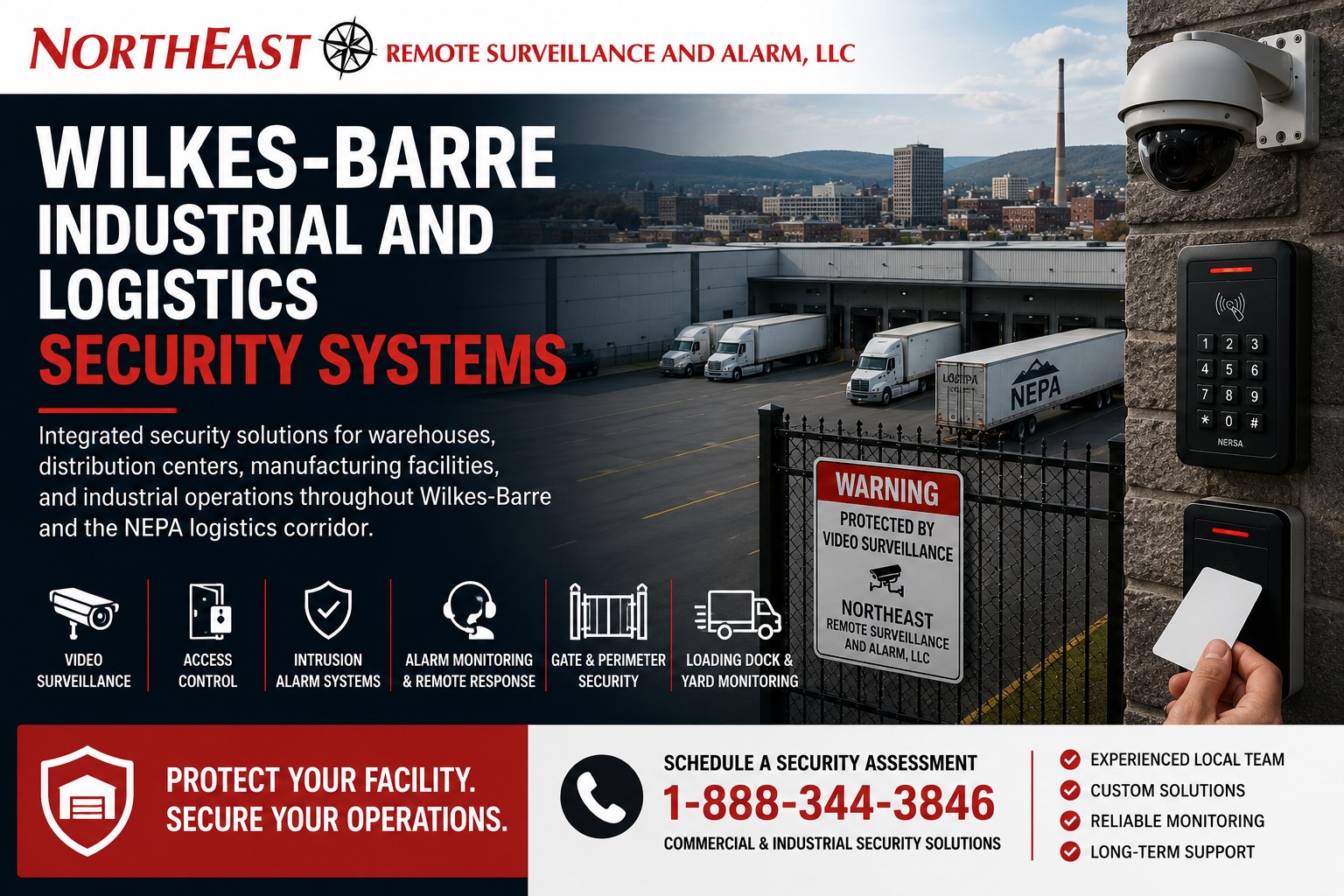
Identify active docks, trailer rows, driver waiting areas, and vehicle routes before selecting equipment. Separate the staff responsible for gate entry, freight release, and incident review.
For the wider facility and its supporting systems, see Wilkes-Barre commercial security systems.
Give each yard area a clear responsibility
Start with a yard drawing that names entrances, waiting areas, trailer rows and loading positions. Identify who manages each area during ordinary operations and when the site is closed. Clear names help drivers receive directions and help staff find the relevant view when a question arises later.
Do not assume that the person controlling the gate also manages trailer placement or freight release. Those responsibilities may belong to different teams. Document how an arrival moves between them so the security arrangement supports an understandable process rather than several disconnected observations.
Separate waiting from active loading
A vehicle waiting for an assignment presents a different question from one positioned at a dock. Review where drivers are told to wait and how they learn that a position is available. The waiting area should have clear instructions and an appropriate way to contact staff.
Consider an arrival during a busy period when the normal waiting location is full. An improvised alternative can create confusion about which vehicle was called or which entrance it should use. Agree on the exception procedure and determine whether available views help staff understand that movement.
Make overnight trailer status understandable
For trailers remaining on the property, identify the operational record that explains their location and status. A parked trailer is not necessarily an unusual event. Whoever reviews an after-hours question needs current information about expected equipment and authorized movement.
Where a trailer is relocated, document the new position and responsible instruction. Camera coverage can help show movement but may not provide readable identification from every angle. If identifying a particular trailer is essential, discuss the necessary detail and feasible placement with the installer.
Review the dock handoff on both sides
Exterior views may show a vehicle positioning or leaving while interior views explain movement from staging toward the door. Decide which parts of that sequence matter for the business’s review needs. A single broad camera should not be expected to establish every detail.
Keep dock labels consistent with shipping and receiving records. If a load changes doors, the operational record should reflect that change. Otherwise, a later reviewer may search an apparently empty dock while the relevant activity occurred elsewhere.
Keep collection approval separate from observation
Determine who authorizes freight release and how substitutions are handled. A familiar carrier or vehicle does not by itself establish that a specific collection is approved. Staff need access to the relevant instructions before goods leave the site.
For a disputed collection, combine release records with the available staging, loading and departure observations. Avoid treating a vehicle image as proof of sealed contents or an undocumented approval. Security evidence should support a careful review rather than encourage conclusions beyond what is visible.
Check the yard under realistic conditions
Parked vehicles and trailers can obstruct views that were clear during installation. Review ordinary occupancy, busy periods and the lighting conditions expected after dark. Decide which views need an overview and which need closer detail.
Discuss glare, approach angles and movement where plate capture or vehicle identification is required. General surveillance and reliable identification are not interchangeable requirements. Record the intended purpose and limitations of each position so staff know which view to use for a particular question.
Coordinate driver communication and building access
Drivers should know which contact handles check-in, where approved facilities are located and what to do if a call is unanswered. Clear directions reduce the need to search the property for assistance. An intercom should reach someone who can make the relevant decision.
Admission to the yard should not automatically permit entry into warehouse or office areas. Coordinate door controls, visitor instructions and staff responsibility. Traffic management and pedestrian safety remain separate site obligations; cameras do not replace appropriate routes, signs or supervision.
Define response when staff are absent
If the business requires active observation, alert review or another response service, confirm its scope separately from recording. Establish operating hours, contact order and permitted actions. Provide current information about expected overnight movements and maintenance visits.
Decide who can verify an unusual event and who takes ownership if the first contact is unavailable. Do not assume a recording system guarantees an immediate response. The plan needs both suitable equipment and a practical human decision process.
Make records easy to preserve
Choose retention around the time transport questions normally take to surface. Align time settings and define who may review or export footage. When several views are involved, assign one person to coordinate preservation so the sequence remains understandable.
Test with a known arrival and follow it through the relevant yard and dock views. Verify exported playback and camera labels on an approved device. Record any gaps honestly rather than assuming a continuous account exists because cameras are installed at several locations.
Keep the arrangement current
Revisit coverage when trailer rows, traffic direction or dock use changes. Name someone to report blocked views, damaged equipment and lighting problems. Bring a yard drawing, overnight equipment procedure and examples of difficult freight questions to NERSA. A useful handover includes tested views, named responsibilities, support contacts and a clear process for future changes.
Discuss your property
For facilities in surrounding communities, see Northeastern Pennsylvania commercial security guide.
Request a Wilkes-Barre security assessment to discuss your property, existing equipment, and priorities.
Compliance, Codes & Project Standards
NERSA plans commercial and industrial security work with applicable code, documentation, inspection and authority-having-jurisdiction requirements in mind. Requirements vary by system, property and jurisdiction. These resources support project planning; they do not establish legal compliance, certification or AHJ approval.
Related guidance: Regulatory compliance & inspection readiness · Warehouse & logistics compliance · Loading-dock compliance planning