
Valmont Industrial Park security planning should establish what an occupied facility already has, what still works and which changes would make the system more useful to its current operators.

Request a commercial security assessment
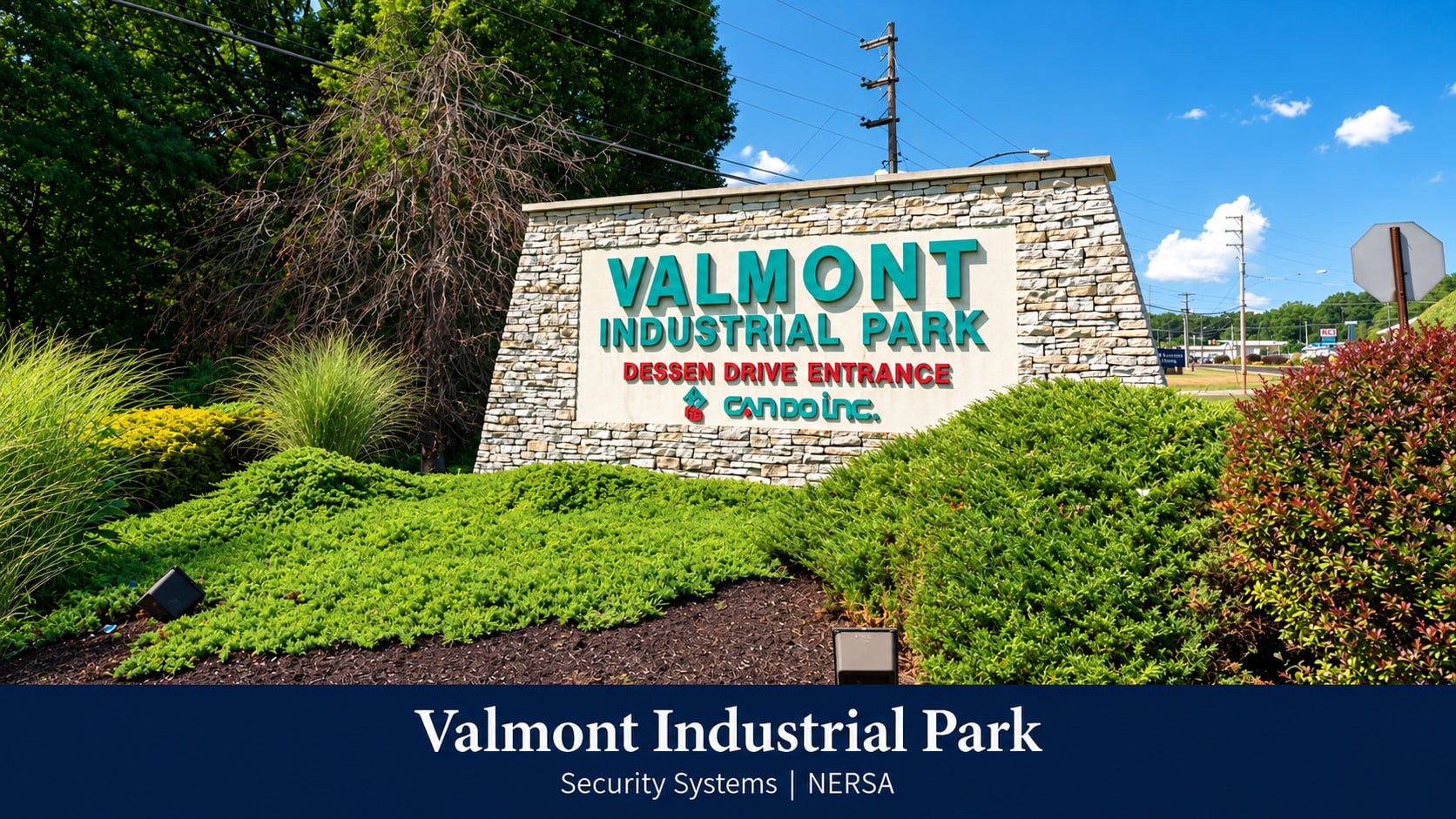
For cameras, controlled entry, alarms and supporting infrastructure across the area, see commercial and industrial security systems in Hazleton.
Place the facility in its local setting
Valmont is CAN DO’s first industrial development and is located in West Hazleton and Hazle Township near Interstate 81 Exit 145.
CAN DO also identifies the CAN BE Innovation Center within the park.
The official Valmont Industrial Park description provides development information and current contacts.
A park’s history does not tell you the age or condition of an individual security system. Begin with the particular address, building use and responsible owner or occupant. The most useful improvement may be a focused repair, a documented takeover or a phased replacement rather than an automatic recommendation to discard everything.
Inventory the existing system before deciding
List cameras, recorders, controlled doors, intrusion equipment, communication paths and supporting cabinets. Identify what staff use successfully and what causes recurring difficulty. A system can display live images while failing to retain the period management needs or making exports unnecessarily difficult.
Ask for available drawings, equipment information and service records through the customer’s authorized contacts. Do not treat an undocumented component as automatically usable or automatically worthless. Its condition, compatibility, support status and ability to meet the proposed requirement need evaluation.
Establish administrator and service ownership
Confirm who owns the equipment, who administers user access and which company supports it. At a leased facility, the owner and occupant may have different responsibilities. A camera serving a common area may not belong to the same organization as equipment inside an individual business.
Account changes should be coordinated through authorized administrators. The assessment should not depend on informal access supplied by a former employee or unrelated tenant. Document the responsible contacts and the customer’s approval process for changes, exports and service visits.
Compare the original layout with today’s operation
Buildings can change use without corresponding changes to security coverage. An entrance may become a shipping door, a former office may become storage or an added partition may block a useful view. Walk the actual routes used by employees, visitors and goods.
Mark the questions current staff cannot answer from existing records.
This distinguishes a placement problem from a recording or training issue.
For stock movement and receiving decisions, use the more detailed Hazleton warehouse security planning to examine the relevant handoffs.
Retain equipment only when it supports the outcome
Reuse should be based on verified suitability. A functioning camera may still provide insufficient detail at the location that matters, while sound cabling or other infrastructure may remain useful. Ask the proposal to distinguish retained components, replaced components and items requiring further testing.
Compatibility should include ordinary administration and support, not simply whether a picture appears during a demonstration. The customer needs to know who supports the finished arrangement and whether retained equipment limits features, recording access or future expansion.
Phase work around occupied operations
For a working manufacturing or distribution facility, plan installation and testing with operations. Identify periods when entrances, production areas or network connections can be affected. Explain temporary operating arrangements and the point at which each stage becomes usable.
A first phase should solve a defined problem without depending on an unspecified later purchase. If a remaining gap cannot be addressed immediately, record it clearly. The customer should be able to compare the benefit, disruption and ongoing support implications of each proposed stage.
Review keys and controlled openings
Changes in staff or occupancy can leave unclear access permissions even when the hardware works. Identify who needs each controlled space and who approves that permission. Review temporary contractor access and shared credentials that are difficult to withdraw selectively.
Door hardware and required exit arrangements need qualified evaluation before changes are made.
For the credential and controlled-door decisions, see commercial access control in Hazleton.
The facility review should identify actual openings and responsibilities rather than prescribe the same reader for every door.
Keep common areas and business areas separate
Where a property contains shared approaches or several occupants, establish who may approve equipment placement and who may see the resulting recordings. An occupant’s need to protect its own space does not automatically authorize changes elsewhere.
For visitor entry, decide whether a common receptionist answers all calls or each business handles its own arrivals. Update directories and remote answering access when occupants change. Building and tenant responsibilities should be written clearly enough that an unanswered call or equipment fault reaches the correct party.
Test improvement with an ordinary event
Choose a representative receiving event, contractor visit or employee entry and ask authorized staff to find it. Check image usefulness, time references, labels and export playback. A comparison based on an actual task is more informative than comparing camera specifications alone.
Set retention and reviewer permissions deliberately. Confirm how relevant footage is preserved when a question arises. If active response or monitoring is required, define it separately; recording equipment by itself does not establish that somebody will watch or respond.
Prepare a practical assessment request
Bring the address, current floor plan, equipment list, ownership contacts and examples of recurring problems. Explain planned tenant changes, renovations or expansion. NERSA can evaluate the proposed work against those conditions and identify which decisions require additional professional input.
Request a clear description of what changes, what stays, who administers the result and who supports it. Valmont location information does not imply an existing NERSA relationship with the park operator or any occupant. Service scope and availability are determined for the specific property.
Discuss your facility
Request a commercial security assessment with the property address, existing equipment and the decisions your team needs help making.
For other locations, explore the Northeastern Pennsylvania industrial park and business center directory.