
McAdoo Industrial Park security planning should make a facility straightforward to manage even when the person responsible for admission, service or incident review is not always on site.

Request a commercial security assessment
For cameras, controlled entry, alarms and supporting infrastructure across the area, see commercial and industrial security systems in Hazleton.
Confirm the exact property and its responsibilities
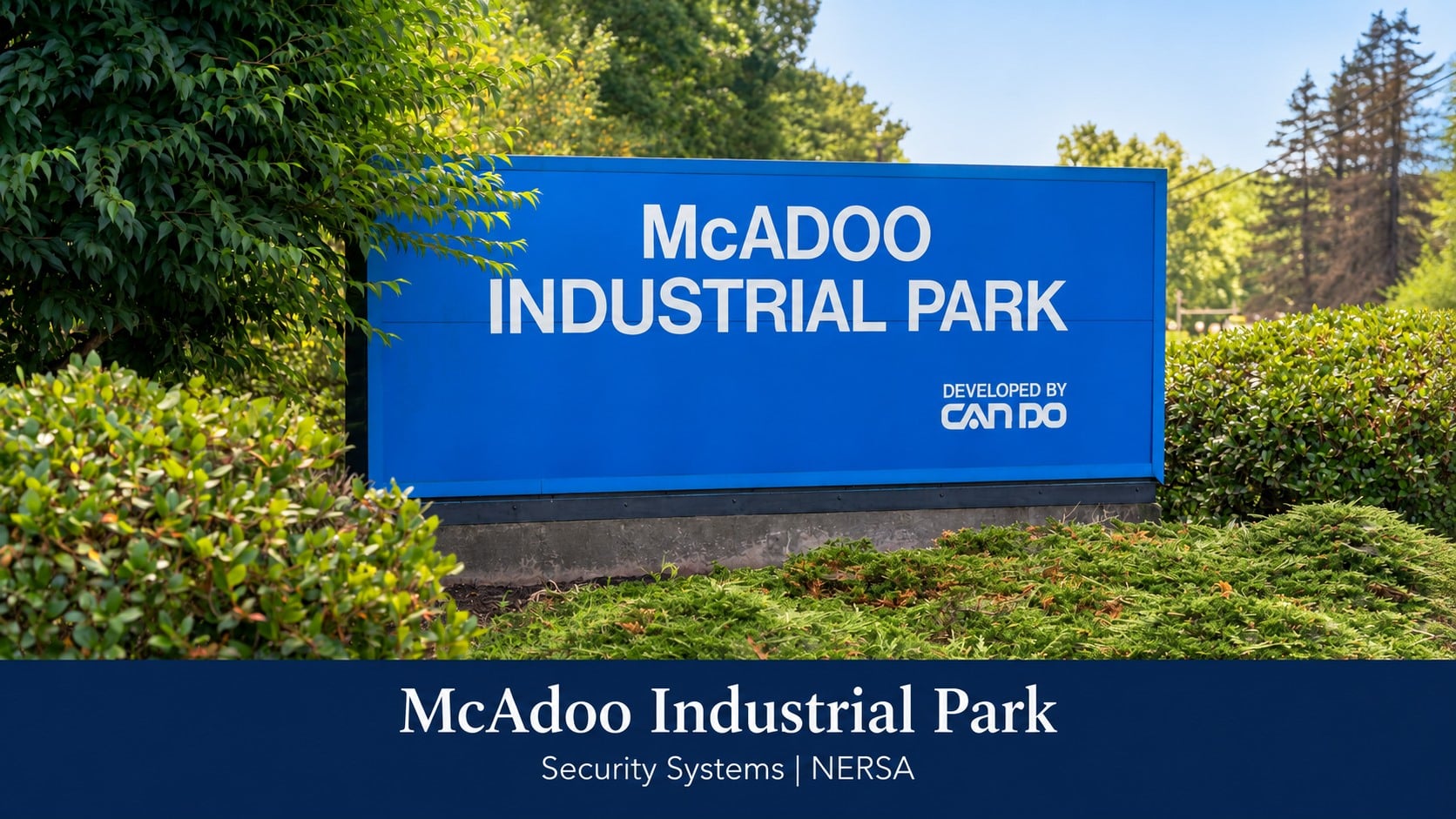
CAN DO identifies McAdoo Industrial Park south of Hazleton near Route 309, with connections to Interstate 81 and Route 424.
Its official McAdoo Industrial Park information describes the park and provides development contacts.
Confirm the actual address and current property details rather than relying on the park name alone.
The security assessment should establish what the customer controls: the building, yard, entrances and any separately managed areas. A smaller or independently operated facility still needs clear responsibilities for access, recordings and support. Equipment should fit that responsibility rather than create a system only one person knows how to use.
Map the ordinary visits
List employees, deliveries, customers and service contractors, including visits outside normal hours. Identify where each group should arrive and who can approve entry. A technician expected by the owner may otherwise reach a locked entrance without anyone on site knowing the appointment exists.
Use simple entrance names and keep directions consistent. If office visitors and freight use different approaches, say so before arrival. The goal is not to complicate a small operation but to prevent every unexpected visit from becoming an improvised phone call and an unrestricted access exception.
Give remote decisions a clear limit
An off-site manager may be able to speak with a caller or review a camera view, but that does not create an on-site escort or receiving team. Decide which requests can be approved remotely and which require a staff member to be present.
For example, a scheduled maintenance visit may require both identity verification and a responsible employee to meet the technician. Remote door release alone does not satisfy the second requirement. Document the permitted action and the fallback when nobody authorized can respond.
Separate vehicle admission from building access
If a property uses a controlled gate, review where vehicles stop, how drivers contact staff and how a declined arrival leaves. Consider the actual vehicle sizes and busy periods. The mechanical gate and protective equipment require qualified review separate from communication and credential choices.
Admission to a yard should not automatically permit access to stores, offices or work areas.
The detailed Hazleton vehicle-entry planning helps distinguish recurring permissions from individual approvals.
Apply it to the customer’s actual entrance rather than assuming the entire park has one shared access arrangement.
Choose a manageable camera arrangement
Identify the questions staff need recordings to answer: whether a delivery arrived, when equipment left a storage area or which entrance was used. Each question suggests a useful view. A wide overview and readable identification detail may require different positions.
Review the views with ordinary vehicles, stored materials and lighting conditions. Explain what will not be visible, especially inside packaging or behind parked equipment. A modest number of well-defined views can be easier to manage than many cameras whose purpose and labels are unclear.
Confirm connections at the intended location
Public information about park utilities does not establish that a particular building or equipment position has the required connection. Evaluate power, network availability and cable routes at the facility. Involve the customer’s IT contact and qualified electrical professionals where appropriate.
If cellular or another alternative connection is considered, test suitability and clarify who supplies and supports the service. Recording and remote viewing may behave differently during an interruption. Ask for the selected system’s actual behavior rather than assuming every function continues whenever one part remains powered.
Decide what after-hours service includes
Recorded images are useful for later review, but active observation or alert response requires a separate agreement. Define the hours, events covered, contact sequence and permitted actions. Keep expectations realistic about what equipment and staff can establish.
An off-site contact needs current information about legitimate visits.
Provide a practical way to update schedules and identify a backup contact.
For those decisions, review remote video monitoring in Hazleton and confirm the scope for the actual property.
Plan for temporary storage or changing work areas
A short project, vacancy or temporary equipment area may justify coverage that will later move or end. Define its duration and the event that changes the need. Avoid treating a temporary camera position as an automatic permanent solution.
Use temporary and mobile surveillance planning to address placement, power, connection, support and removal. Assign authority for relocations so an informal move does not leave the original priority uncovered.
Keep administration usable for a small team
Name the people who may add users, review recordings and request service. Separate daily viewing from administrative privileges. Review access when a contractor finishes or an employee changes roles, and do not rely on an uncertain group sharing the same permanent credential.
Set retention around the time it takes to discover a problem. Test an export and playback on an approved device. Keep equipment names and support contacts understandable to a backup administrator so the system does not become unusable when one person is away.
Prepare for installation and handover
Bring a property drawing, typical visit schedule, current equipment information and the most important unanswered security question to NERSA. Discuss service access and installation timing around ordinary business activity. Ask what existing equipment can be retained and what needs further testing.
Acceptance should demonstrate a normal arrival, an unanswered request and retrieval of a known event. The finished arrangement should identify who acts, what records are available and who provides support. Local park information does not imply that NERSA manages the park or has a relationship with its occupants; work is evaluated for each facility.
Discuss your facility
Request a commercial security assessment with the property address, existing equipment and the decisions your team needs help making.
For other locations, explore the Northeastern Pennsylvania industrial park and business center directory.