Allentown warehouse video recording and retention planning helps staff retrieve, review, and preserve footage when an incident needs investigation.
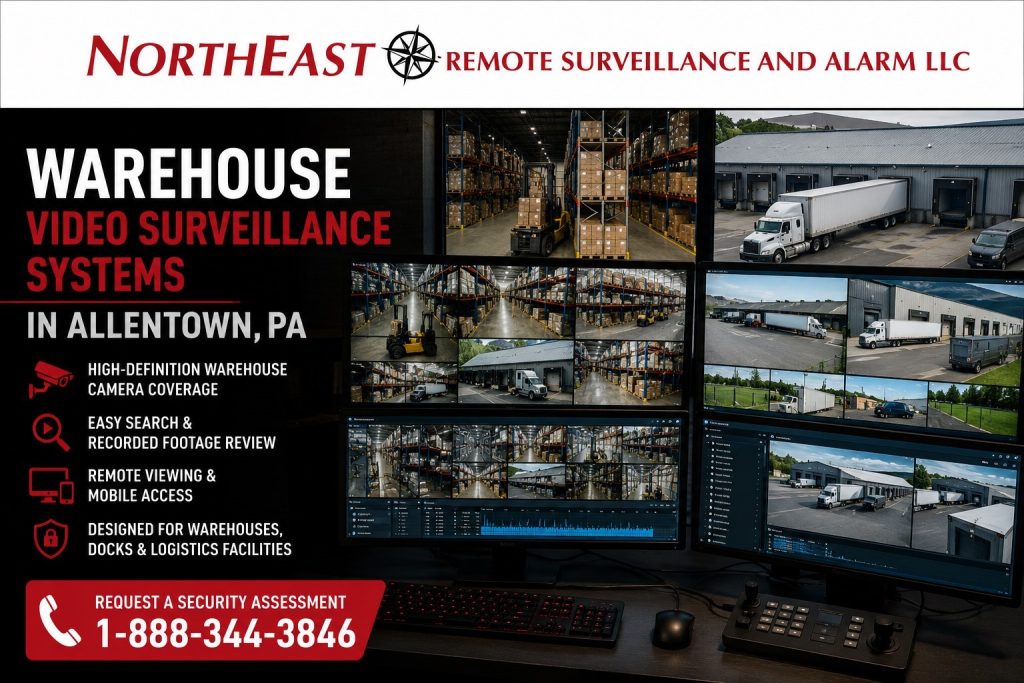
Coordinate this area with the rest of the facility through Allentown warehouse security planning.
Recording That Supports Incident Review
Warehouse video recording systems need reliable recording as well as useful camera views. NERSA plans how staff will find, review and preserve footage from warehouse incidents. First, we review the recorder, camera streams, storage, network and user accounts already in place.
For camera locations, lighting and coverage around docks or aisles, see warehouse security cameras in Allentown.
Plan Retention Around the Review Window
Start with how long your team may need to look back after a loss, shipment dispute or reported incident. Then compare that window with the storage the system can actually provide. Camera count, resolution, frame rate, compression and scene activity all affect capacity.
Continuous recording and event recording use storage differently. For example, a busy dock may record far more activity than a quiet storage room. We check the selected settings and available history instead of assuming every camera retains the same number of days.
Find the Right Footage Across Cameras
Clear camera names and accurate timestamps help staff follow an event from receiving through staging and departure. In addition, synchronized playback can show what happened across several views when the platform supports it.
Search options vary by recorder and software. We test the tools your team will use, including time-based playback and available event filters. Staff should know how to review the relevant cameras without changing recording settings.
Export and Preserve Incident Clips
Routine footage may overwrite as storage fills, so staff need a clear process for preserving relevant clips. We review export permissions, file formats and any player needed to open the files. Next, we test an export on another device to confirm that the video and timestamps remain usable.
An incident procedure should identify who can export footage, where to keep it and who may receive a copy. Keeping the original export alongside working copies helps your team maintain a clear record.
Control Remote Viewing and User Access
Remote viewing lets authorized managers review warehouse video recording systems across shifts or locations. However, live viewing, playback, exports and administration may require different permissions. We set up access around each role and document customer-controlled administrator accounts.
Network performance also affects remote playback and exports. Before handoff, we test access from the intended devices and review account protection options supported by the platform.
Check Allentown Warehouse Video Recording Health
A live camera image does not prove that the recorder has saved footage. Periodic playback checks can reveal missing history, incorrect time settings or recording gaps. Where supported, storage and camera-offline alerts help staff notice faults sooner.
Adding cameras or increasing image quality can shorten retention unless storage grows too. Therefore, expansion planning should review recorder capacity, software licenses and network performance together. Existing equipment may remain useful after compatibility and recording checks.
Set retention from operational questions
Warehouse video retention should start with the time interval in which the business usually discovers a missing shipment, damage, an access dispute or a dock incident. Identify the relevant cameras, hours of activity and internal investigation process; a uniform retention setting across every view is not always necessary or appropriate. Retention must also respect the organization’s privacy, legal, contractual and insurer obligations. Do not advertise a guaranteed number of recording days without verifying the specific storage design and actual encoded video rate.
Calculate the storage demand using real settings
Document each camera’s resolution, frame rate, compression, average and peak bitrate, motion/event recording rules and intended recording hours. Account for storage overhead, system reserved capacity, export needs and failure tolerance where supported. High-detail truck lanes may generate different data rates from a low-motion corridor. Recalculate when new cameras are added or when analytics or encoding settings change. For hosted recording, distinguish local buffering and upstream capacity from the purchased cloud retention period.
Protect evidence integrity and access permissions
Establish who can view, export, delete or change recording schedules, and how that activity is logged. Confirm time synchronization among cameras, recorders and access-control devices. Test whether an exported clip preserves enough information for the intended operational review. Where a recorder or cloud service requires vendor credentials, retain customer-owned administrator recovery and account transfer procedures. Avoid indefinite retention by default; use documented rules for incident holds or deletion when needed.
Commission playback and recovery, not just live viewing
Choose representative dates and times to demonstrate playback, search, clip export and recording after an approved network or power interruption. Inspect video from day, night, moving vehicle and dock backlight conditions to ensure that retained footage contains useful detail. Test storage-health alarms, camera offline reporting and any failover capability claimed by the platform. Provide the owner with a camera schedule, actual retention settings, drive or subscription records, backup procedures and a process for investigating missing footage.
Related Allentown Services
For complete facility planning, review warehouse security systems in Allentown.
For wider camera planning, see commercial security camera systems.
Schedule a Video Assessment
Schedule an assessment to review recording reliability, retention, playback, exports and remote access at your Allentown warehouse.
Compliance, Codes & Project Standards
NERSA plans commercial and industrial security work with applicable code, documentation, inspection and authority-having-jurisdiction requirements in mind. Requirements vary by system, property and jurisdiction. These resources support project planning; they do not establish legal compliance, certification or AHJ approval.
Related guidance: Regulatory compliance & inspection readiness · Warehouse & logistics compliance · NERSA project standards