Manufacturing Security Compliance Planning in Bethlehem, PA

Manufacturing security compliance planning in Bethlehem, PA should be built around access control, fire alarm coordination, emergency egress, video documentation, alarm monitoring, low-voltage infrastructure, cybersecurity awareness, inspection readiness, and long-term service records. Northeast Remote Surveillance and Alarm, LLC helps Bethlehem manufacturing facilities, industrial buildings, warehouses, production spaces, and multi-building properties plan commercial security systems with practical compliance awareness. For broader Bethlehem manufacturing and industrial security planning, start with Manufacturing & Industrial Security Systems in Bethlehem, PA.

Security systems do not make a facility compliant by themselves. They can, however, support better documentation, controlled access, incident review, alarm response, video retention, door activity records, restricted-area accountability, and long-term service planning. NERSA helps Bethlehem manufacturers plan security systems that protect the property while respecting life-safety requirements, building operations, inspection expectations, and the way the facility actually works.

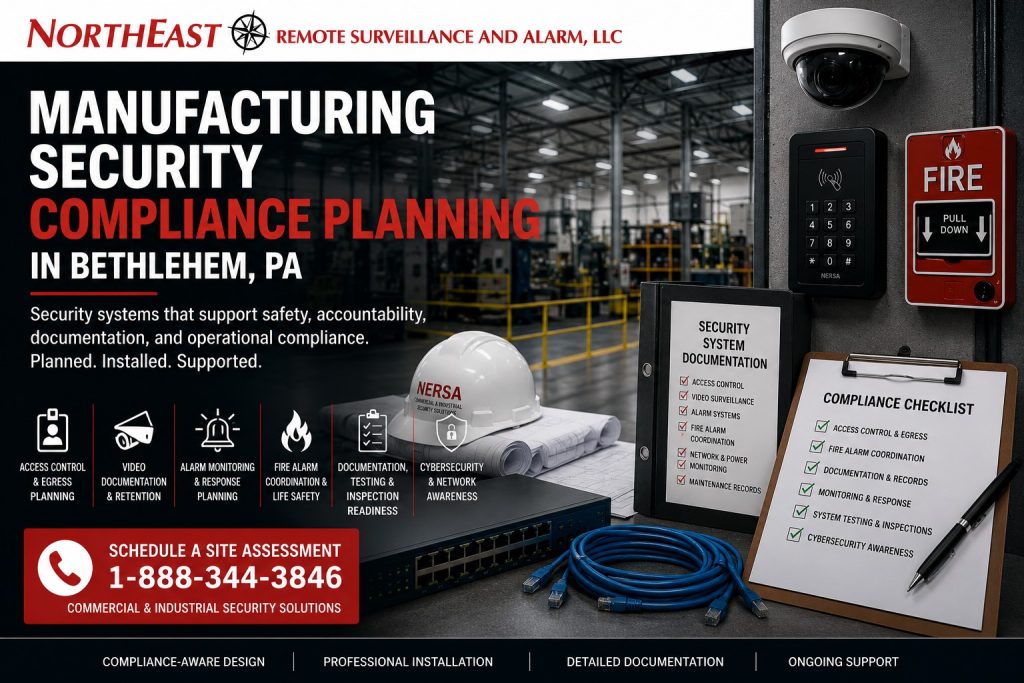
Manufacturing security compliance planning in Bethlehem, PA by Northeast Remote Surveillance and Alarm, LLC showing access control documentation, fire alarm coordination, security cameras, alarm monitoring, low-voltage infrastructure, inspection readiness, and commercial industrial security planning.

Manufacturing Security Compliance Planning for Bethlehem Manufacturing Facilities

Manufacturing facilities are complex environments. A security project may involve production floors, employee entrances, contractor doors, loading docks, overhead doors, restricted rooms, tool rooms, IT rooms, utility spaces, alarm systems, cameras, monitoring equipment, network infrastructure, fire alarm interfaces, and emergency exits.

Compliance-aware planning means those systems are considered together before equipment is installed. Cameras should support documentation. Access control should respect egress. Alarm systems should be understandable and serviceable. Monitoring instructions should be documented. Low-voltage infrastructure should be planned cleanly. Controlled doors should be coordinated with door hardware and fire alarm requirements where applicable.

The goal is not to turn a security page into a code manual. The goal is to help Bethlehem manufacturing facilities avoid common problems that happen when cameras, locks, alarms, monitoring, wiring, and access control are installed without considering the larger building environment.

Why Manufacturing Security Compliance Planning Matters

A manufacturing security system may affect more than security. It can affect daily operations, employee movement, contractor access, emergency response, inspections, service records, incident documentation, network management, and future expansion.

Poor planning can create avoidable problems. A controlled door may create confusion during egress review. A camera system may lack useful retention or documentation. An alarm system may have unclear zones. A monitoring account may not have accurate call lists. A low-voltage installation may be hard to service. A restricted room may have no record of who entered. A fire alarm interface may not be coordinated before the access control hardware is installed.

Compliance-aware security planning helps reduce those risks by making the system easier to understand, easier to inspect, easier to maintain, and easier to support over time.

Security Systems Do Not Replace Code Compliance

Security systems can support compliance-related goals, but they do not replace building codes, fire codes, OSHA requirements, insurance requirements, written policies, safety programs, employee training, emergency procedures, professional engineering, AHJ review, or legal obligations.

A camera can support incident review, but it does not replace a safety program. Access logs can support accountability, but they do not replace HR procedures. Alarm monitoring can support response, but it does not replace fire alarm requirements. Door hardware can improve security, but it must still respect emergency egress and applicable requirements.

NERSA’s role is to help plan commercial and industrial security systems with practical awareness of these issues. For broader compliance routing, visit Regulatory & Compliance for Commercial Security, Fire Alarm & Life Safety.

Access Control, Egress, and Door Hardware Planning

Access control is one of the most important areas for compliance-aware security planning. Manufacturing facilities often need controlled employee entrances, contractor doors, production doors, tool rooms, IT rooms, utility rooms, warehouse doors, shipping offices, and restricted-area doors.

Each controlled door should be reviewed as a complete opening. The reader, credential type, lock, strike, electrified trim, request-to-exit device, door contact, power supply, access control panel, fire alarm interface, emergency egress path, and door hardware all need to work together.

Access control should help the facility manage entry without creating unsafe exit conditions or unnecessary confusion during inspections. For Bethlehem manufacturing access control planning, visit Industrial Access Control in Bethlehem, PA.

Fire Alarm Coordination and Life-Safety Awareness

Manufacturing security projects often intersect with fire alarm and life-safety concerns. Access-controlled doors, electrified locking hardware, alarm communication paths, monitoring equipment, emergency release, power supplies, and documentation may all need to be considered during planning.

Security equipment should not be installed in a way that creates avoidable conflict with emergency egress, fire alarm response, or inspection expectations. If a controlled door requires fire alarm release, that coordination should be considered before installation. If alarm monitoring communication paths are being changed, documentation and service records should be maintained. If a door is part of an exit path, the locking method must be planned carefully.

For Bethlehem-specific fire alarm and security coordination, visit Industrial Fire Alarm Integration in Bethlehem, PA.

Video Surveillance Documentation and Retention Planning

Video surveillance can support compliance-related documentation when it is planned correctly. Cameras can help document incidents, employee movement, contractor activity, restricted-area access, loading dock disputes, forklift movement, after-hours activity, and perimeter events.

A camera system should be designed with useful views, proper placement, appropriate retention goals, management access, naming conventions, recording reliability, and service documentation. Poor camera placement can leave management without useful footage when an incident occurs. Poor naming can make footage difficult to find. Poor retention planning can result in missing video when it is needed.

Video does not replace safety programs, training, supervision, or written procedures. It can, however, support incident review, workplace visibility, and documentation when the system is planned around real facility risks.

Alarm Monitoring, Response Instructions, and Records

Alarm monitoring should be planned with clear documentation. Manufacturing facilities may have office areas, production spaces, warehouse zones, loading docks, overhead doors, employee entrances, restricted rooms, tool rooms, utility rooms, exterior doors, and multi-building areas that all need different monitoring considerations.

Monitoring instructions should match the facility. A forced employee entrance may require one response. A dock door alarm after hours may require another. A restricted room alarm may need manager notification. A trouble signal may require service review. A communication failure may need escalation.

A monitored alarm system should have accurate zones, user records, call lists, response instructions, communication path documentation, and service history. This helps reduce confusion during alarm events and supports better long-term management.

Restricted Rooms, Tool Rooms, and Controlled Spaces

Restricted areas are often important in manufacturing compliance planning because they affect accountability. Tool rooms, maintenance rooms, IT rooms, electrical rooms, utility rooms, chemical storage areas, production control rooms, inventory cages, and sensitive storage areas should not be treated like general building spaces.

These areas may need access control, camera coverage, alarm detection, door position monitoring, user permissions, and activity records. Management should be able to review who entered, when access occurred, whether the door was held open, and whether activity matched the expected schedule.

Restricted-area planning supports internal accountability and helps protect important assets. It also creates cleaner documentation when tools, parts, materials, equipment, or records become the subject of a review.

Contractor and Vendor Access Documentation with Manufacturing Security Compliance Planning in Bethlehem, PA

Manufacturing facilities often allow contractors, vendors, inspectors, utility providers, delivery personnel, service technicians, and maintenance providers into the building. These outside personnel may need access to one area without having access to the entire facility.

Compliance-aware planning can help separate contractor access from employee access. Temporary credentials, scheduled permissions, visitor procedures, camera documentation, intercom verification, gate access, escort procedures, and access logs can all support better accountability.

The goal is to avoid unmanaged access. Outside personnel should be documented, limited where appropriate, and easier to review if a question arises later.

Loading Dock and Shipping Area Documentation

Loading docks are high-activity areas where security, safety, and documentation often overlap. Freight movement, staged materials, trailers, drivers, vendors, forklifts, overhead doors, shipping offices, and after-hours deliveries can all create risk.

Compliance-aware loading dock security planning may include camera coverage, overhead door alarm contacts, access control, intercoms, alarm monitoring, video verification, lighting coordination, and documentation of dock activity. This can help management review delivery disputes, damage claims, missing freight, after-hours movement, and unauthorized access.

A loading dock security plan should support the operation without interfering with shipping and receiving activity.

Low-Voltage Infrastructure and Inspection Readiness

Low-voltage infrastructure affects the long-term reliability and serviceability of a security system. Cameras, access control doors, alarm devices, intercoms, network switches, fiber links, wireless bridges, power supplies, backup power, and monitoring equipment all need clean planning.

Manufacturing buildings can create infrastructure challenges because of high ceilings, machinery, concrete walls, metal structures, long cable paths, production schedules, and multi-building layouts. Poor wiring, poor labeling, poor equipment locations, or undocumented pathways can create service problems later.

For dedicated infrastructure planning, visit Low-Voltage Infrastructure for Bethlehem Manufacturing Security Systems.

Cybersecurity Awareness for Connected Security Systems

Modern security systems are often connected to networks, cloud platforms, remote access tools, mobile apps, monitoring services, video management systems, access control software, and vendor support portals. That means cybersecurity awareness should be part of the planning process.

Cybersecurity-aware security planning may include network separation, strong password policies, user permission management, firmware support, secure remote access, documentation of connected devices, controlled administrator access, and coordination with the facility’s IT team.

Security devices should not create unnecessary risk for the business network. Cameras, recorders, intercoms, access control panels, alarm communicators, and monitoring tools should be installed and managed with long-term support in mind.

Backup Power and Communication Path Planning

Security systems depend on power and communication. If cameras, access control panels, alarm communicators, network switches, monitoring equipment, or recording systems lose power, the facility may lose visibility or control during an important event.

Backup power planning may include UPS equipment, access control power supplies, alarm panel batteries, switch backup power, recorder protection, wireless bridge power support, and communication path planning. The right design depends on the system, the building, the risk, and the runtime expectation.

Communication paths also matter. Alarm monitoring, remote video access, cloud-connected systems, intercoms, and multi-building security equipment all depend on reliable network or cellular communication.

Documentation for Security System Serviceability

A compliance-aware security system should be documented clearly. Documentation may include device locations, camera names, access-controlled doors, alarm zones, user roles, monitoring instructions, communication paths, panel locations, network equipment, cable labels, power supplies, backup power locations, service records, inspection records where applicable, and system changes.

Good documentation helps during service, troubleshooting, training, audits, management changes, renovations, insurance questions, inspections, and future upgrades. Poor documentation can turn a simple service issue into a long investigation.

NERSA plans systems with long-term serviceability in mind so Bethlehem manufacturers can maintain cleaner records and support the system as the building changes.

Inspection Readiness and Facility Reviews with Manufacturing Security Compliance Planning in Bethlehem, PA

Security systems may be reviewed during construction projects, renovations, fire alarm work, access control upgrades, insurance reviews, internal audits, tenant changes, management reviews, service calls, and emergency planning discussions.

Inspection readiness does not mean guaranteeing approval. It means the system is planned, documented, and installed in a way that makes review easier. Equipment should be identifiable. Door behavior should be understandable. Monitoring instructions should be accurate. Access control should be documented. Wiring should be serviceable. Security work that touches life-safety conditions should be coordinated carefully.

A well-documented system is easier to explain, maintain, and improve.

Change Management for Manufacturing Security Systems

Manufacturing facilities change over time. New employees are added. Contractors come and go. Doors are added. Production areas move. Warehouses expand. New cameras are needed. Access permissions change. Alarm zones need adjustment. Monitoring instructions may need updates.

Security compliance planning should include change management. That means keeping records current, updating user permissions, removing old users, documenting device changes, reviewing monitoring instructions, and planning future expansion.

A system that is never updated becomes harder to trust. Long-term compliance-aware planning helps the system stay aligned with the facility.

OSHA-Aware Workplace Security Support with Manufacturing Security Compliance Planning in Bethlehem, PA

Security systems do not replace OSHA compliance, safety programs, employee training, machine guarding, hazard communication, supervision, or workplace procedures. However, cameras, access records, alarm events, and incident documentation can support workplace review when used appropriately.

Manufacturing facilities may use security systems to review forklift movement, restricted-area access, loading dock activity, contractor movement, after-hours incidents, and safety-related events. The system should be planned to support documentation without creating unrealistic expectations about what security equipment can do.

NERSA helps facilities plan security systems as part of a broader operational awareness and documentation strategy.

Manufacturing Areas That May Need Compliance-Aware Security Planning

  • Employee entrances
  • Contractor entrances
  • Visitor entrances
  • Production floor access points
  • Tool rooms
  • Maintenance rooms
  • IT rooms
  • Electrical rooms
  • Utility rooms
  • Mechanical rooms
  • Network closets
  • Loading docks
  • Shipping offices
  • Receiving areas
  • Overhead doors
  • Warehouse spaces
  • Inventory rooms
  • Restricted storage rooms
  • Gate entrances
  • Parking areas
  • Exterior yards
  • Multi-building security points
  • Alarm panels and communicators
  • Security equipment rooms
  • Access-controlled doors
  • Fire alarm interface points

Common Compliance-Aware Security Problems We Help Solve

Bethlehem manufacturers often need help when security systems are installed without enough documentation, access-controlled doors create egress questions, alarm zones are unclear, camera retention is not planned, user permissions are outdated, monitoring instructions are inaccurate, wiring is undocumented, or equipment locations are difficult to service.

Other common issues include shared alarm codes, old users remaining in access control systems, camera names that do not match real locations, no written record of system changes, poor communication path planning, outdated monitoring contacts, and restricted rooms that have no clear access history.

NERSA can evaluate the facility, existing systems, door conditions, camera coverage, alarm monitoring, access control, infrastructure, documentation, and long-term service needs to recommend a practical compliance-aware security plan.

Why Bethlehem Manufacturers Choose NERSA

Bethlehem manufacturers choose Northeast Remote Surveillance and Alarm, LLC because NERSA designs commercial and industrial security systems around real facility conditions. Compliance-aware planning requires understanding how employees, contractors, doors, alarms, cameras, monitoring, restricted rooms, loading areas, infrastructure, and documentation work together.

NERSA focuses on practical system design, controlled access, video documentation, alarm response, fire alarm awareness, egress awareness, infrastructure reliability, cybersecurity awareness, service records, and long-term support. Whether the facility needs a new security system, an upgrade to an older system, documentation cleanup, access control planning, monitoring review, or infrastructure improvements, the design starts with how the building is actually used.

Request a Manufacturing Security Compliance Planning Assessment in Bethlehem

If your Bethlehem manufacturing facility needs compliance-aware security planning, access control review, fire alarm coordination, video documentation, alarm monitoring review, low-voltage infrastructure planning, restricted-area protection, or long-term service documentation, Northeast Remote Surveillance and Alarm, LLC can evaluate the property and recommend a system built around your operation.

Call 1-888-344-3846 to request a manufacturing security compliance planning assessment in Bethlehem, PA.

Manufacturing Security Compliance Planning FAQs

What is manufacturing security compliance planning?

Manufacturing security compliance planning is the process of designing cameras, access control, alarms, monitoring, infrastructure, documentation, and related systems with awareness of life safety, emergency egress, fire alarm coordination, inspection readiness, cybersecurity, and long-term service needs.

Do security systems make a manufacturing facility compliant?

No. Security systems do not make a facility compliant by themselves and do not replace codes, safety programs, fire alarm requirements, emergency procedures, employee training, or AHJ review. They can support documentation, access accountability, alarm response, incident review, and operational awareness.

Why does access control need compliance-aware planning?

Access control affects doors, locking hardware, emergency egress, fire alarm coordination, user permissions, and documentation. Controlled doors should be planned carefully so security does not create avoidable life-safety or inspection issues.

Can cameras support compliance documentation?

Cameras can support incident review, workplace visibility, contractor activity review, restricted-area documentation, loading dock disputes, and after-hours investigations. They do not replace safety programs, supervision, employee training, or written policies.

Why is fire alarm coordination important for security systems?

Some security systems interact with controlled doors, electrified hardware, communication paths, door release, monitoring, or emergency response. Planning should account for fire alarm and life-safety requirements before equipment is installed.

What documentation should a manufacturing security system have?

Documentation may include camera names, device locations, access-controlled doors, alarm zones, user permissions, monitoring instructions, communication paths, cable labels, panel locations, power supplies, backup power, and service records.

Can alarm monitoring support compliance-aware planning?

Yes. Alarm monitoring can support response instructions, event records, communication path supervision, user accountability, video verification, and after-hours protection. Monitoring instructions should be accurate and updated as the facility changes.

Does low-voltage infrastructure affect inspection readiness?

Yes. Clean cabling, labeling, pathway planning, equipment locations, backup power, and documentation can make security systems easier to service, review, expand, and maintain over time.

Can NERSA help with older security systems?

Yes. NERSA can review older cameras, access control systems, alarm panels, monitoring communication, wiring, documentation, and infrastructure to recommend practical improvements or upgrades.

Can compliance-aware security planning help with restricted rooms?

Yes. Restricted rooms, tool rooms, IT rooms, utility rooms, inventory rooms, and sensitive production areas can benefit from access control, camera coverage, alarm protection, door monitoring, user permissions, and activity records.

No. NERSA does not replace the authority of the AHJ, engineer, fire marshal, code official, insurance carrier, safety consultant, or legal advisor. NERSA helps plan and install commercial and industrial security systems with practical compliance awareness.

Does NERSA install residential security systems?

No. Northeast Remote Surveillance and Alarm, LLC focuses on commercial and industrial security systems.

How do I request manufacturing security compliance planning in Bethlehem?

Call Northeast Remote Surveillance and Alarm, LLC at 1-888-344-3846 to request a commercial and industrial manufacturing security compliance planning assessment in Bethlehem, PA.

Schedule a Manufacturing Security Compliance Planning Assessment

Manufacturing security compliance planning should be built around the way people, doors, alarms, cameras, monitoring, fire alarm coordination, restricted areas, documentation, and infrastructure actually work at the facility. Northeast Remote Surveillance and Alarm, LLC can help your Bethlehem manufacturing property plan a security system that supports safer operations, better documentation, controlled access, alarm response, inspection readiness, and long-term serviceability.

Call 1-888-344-3846 to request a manufacturing security compliance planning assessment in Bethlehem, PA.

SEO Title:
Manufacturing Security Compliance Planning in Bethlehem, PA | NERSA

Meta Description:
Manufacturing security compliance planning in Bethlehem, PA for access control, fire alarm coordination, egress awareness, video documentation, alarm monitoring, infrastructure, cybersecurity, and inspection readiness.

Focus Keyphrase:
Manufacturing Security Compliance Planning in Bethlehem PA

Suggested URL:
https://northeastremotesurveillance.com/bethlehem-pa-manufacturing-security-compliance-planning/

Hero Image Alt Text:
Manufacturing security compliance planning in Bethlehem, PA by Northeast Remote Surveillance and Alarm, LLC showing access control documentation, fire alarm coordination, security cameras, alarm monitoring, low-voltage infrastructure, inspection readiness, and commercial industrial security planning.

Scroll to Top
1-888-344-3846