
Hazleton temporary and mobile surveillance should provide useful coverage during a defined project or change in property use, with clear responsibilities for placement, service and removal.

For systems intended to remain with the building, review Hazleton commercial security systems.
Start with the project stages
A temporary camera arrangement should reflect what the property will look like during the work, not only on installation day. Identify the current entrances, storage areas and occupied spaces, then note which ones will move or disappear. A construction project may need different views during site preparation, material delivery and final fit-out.
Define the reason for coverage at each stage. The concern might be an unattended material area, an access point used by several contractors or a vacant building awaiting occupancy. A clear purpose makes it easier to decide when a camera should move, when coverage can end and when permanent equipment is more appropriate.
Choose a suitable location for equipment
Review the proposed position with the people managing the property and project. The location needs useful views and practical service access without interfering with normal movement or planned work. A location that is convenient today may become a delivery route or work area next week.
Discuss physical placement and stability with qualified personnel. Do not assume that mobile equipment can simply be placed anywhere an open space exists. Identify who can authorize relocation and who performs it. Informal moves by unrelated site staff can change the view, damage equipment or create an unsuitable arrangement.
Define what the images must show
Distinguish a broad site overview from a closer view of an entrance or storage area. A wide image may establish that activity occurred but not provide the detail needed to identify a person or particular item. Tell the installer which questions matter most so placement and equipment can be evaluated against them.
Check likely obstructions such as containers, scaffolding, parked equipment and new construction. Review lighting and after-dark conditions. If the site will change substantially, include scheduled view checks or defined review points in the project plan rather than expecting the original camera position to remain useful throughout.
Confirm the power arrangement
Identify available utility power and whether an appropriate connection can be provided. Any electrical work or connection requires the relevant professional review. If the proposal uses a self-contained arrangement, ask about operating assumptions, equipment demand and the site conditions on which expected endurance depends.
Agree who checks operating status and responds when available power becomes insufficient. A temporary system still needs maintenance and a service plan. Ask how interruptions are reported and how quickly the responsible party can investigate, without assuming an advertised battery or charging specification guarantees uninterrupted operation.
Check communication and recording separately
Remote viewing requires a suitable connection, while recording behavior depends on the equipment and configuration. Confirm whether recording continues during a communication interruption and how staff will know the connection has failed. These details should be explained for the proposed system, not assumed from a general product category.
For cellular connectivity, evaluate the intended equipment location and discuss service availability, data needs and account responsibility. For a customer-provided connection, involve IT early. Clearly assign fault investigation so a loss of remote access does not become a dispute over whether the issue belongs to the camera, connection or network.
Coordinate multiple companies carefully
Temporary sites may involve an owner, general contractor, tenants and several trades. Decide which organization controls the system and which individuals need viewing access. Participation in the project does not automatically require unrestricted access to recordings or configuration.
Keep an authorized contact list for service visits, relocations and incident requests. When a contractor finishes, review whether their access should end. The same discipline should apply to temporary remote-viewing accounts as to credentials for a permanent installation.
Clarify whether the service includes response
Recorded video and active observation are different services. If someone is expected to review alerts or respond to activity, confirm the hours, event types, contact order and permitted actions in the proposal. Avoid assuming that the presence of a camera means a person is continuously watching.
Provide current work schedules and explain legitimate activity outside normal hours. A late delivery or approved weekend visit can otherwise be difficult to distinguish from an unexpected event. Keep the responsible contact reachable and establish how changes in site activity are communicated to anyone providing an agreed response service.
Plan for evidence and project completion
Determine how long recordings should be retained and who can request an export. Test retrieval of a known event before the system is needed for an investigation. Camera names should identify the area and remain understandable after equipment moves; document significant relocation dates for later review.
Before collection or reassignment, decide whether any recordings need to be preserved. Confirm what happens to stored data and user accounts when the temporary arrangement ends. Do not wait until equipment has left the property to discover that a relevant period should have been retained.
Compare the full service, not just the equipment
Discuss delivery, setup, connection, support, relocation and removal responsibilities together. Ask how an extended project or additional move affects the agreement. A useful proposal should identify what the customer must provide and which changes require a new discussion.
Bring a site drawing, project schedule, likely storage changes and available utility information to NERSA. At handover, check the intended views, recording retrieval, authorized remote access and reporting of interruptions. Review the arrangement at each major project stage so temporary coverage remains useful as the property changes.
Discuss your property
To discuss the conditions at your property, Request a security assessment.
Camera placement and recording options are explained in Hazleton video surveillance.
For employee credentials and controlled doors, see Hazleton access control.
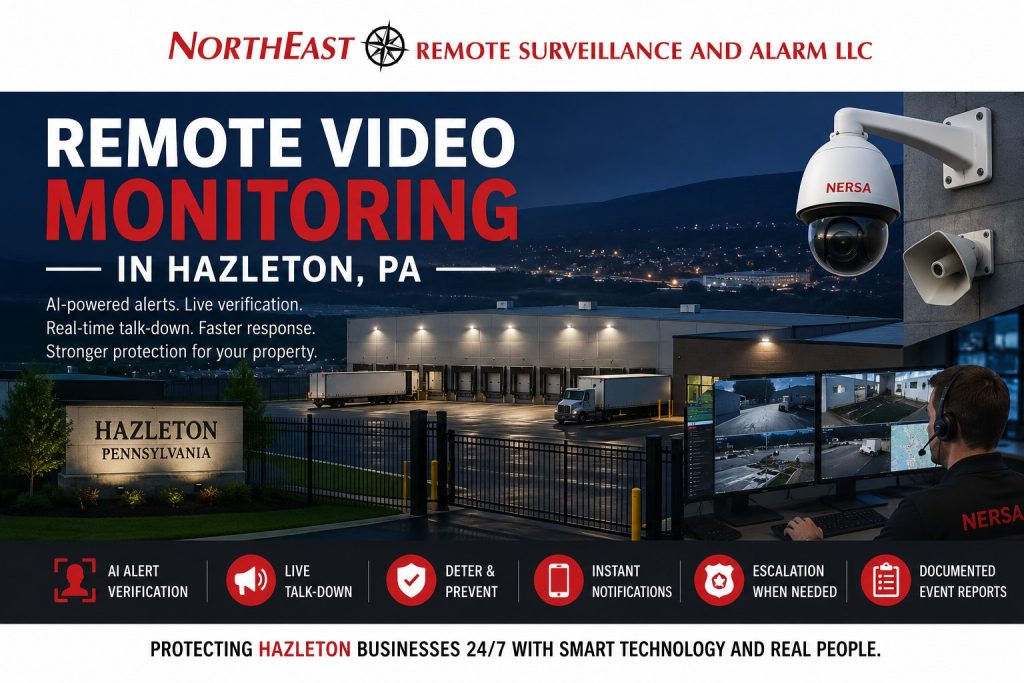
For off-site observation and response planning, review Hazleton remote video monitoring.
To discuss the conditions at your property, Request a security assessment.