
Plan business phones and critical communications around call handling, mobile users, customer contact, critical-line replacement and network readiness.

request a business communications assessment
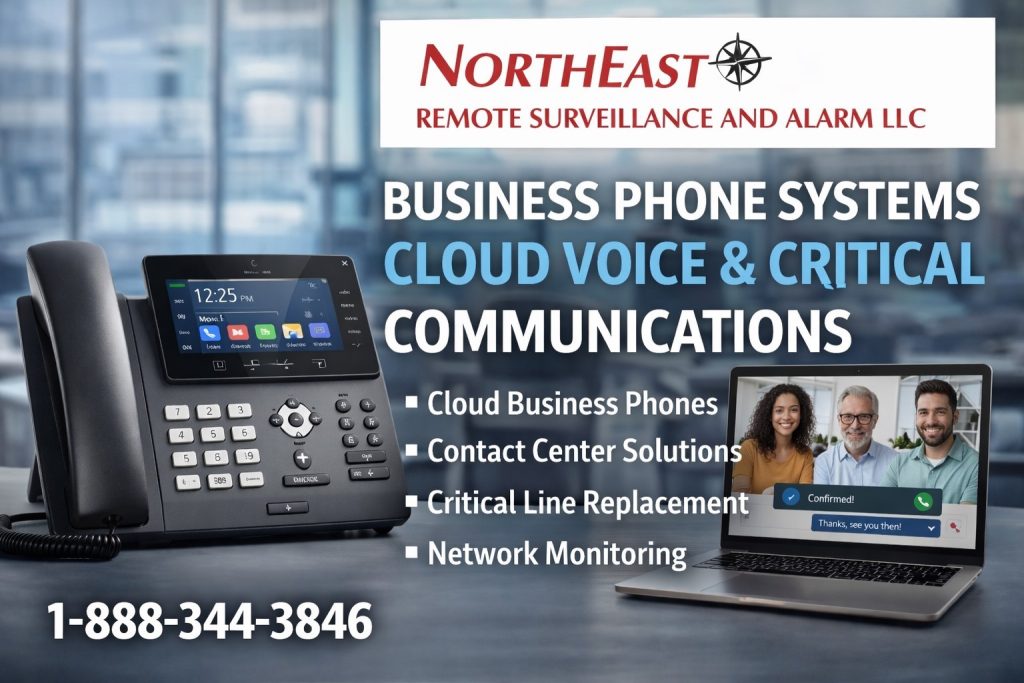
NERSA provides commercial cloud voice, phone systems, contact center support, ePOTS replacement, IP fax and communications planning. We serve offices, warehouses, industrial and municipal properties, healthcare-related facilities, service businesses and multi-site operations. For related planning, start with Commercial Low Voltage and Network Infrastructure Services.
Commercial Business Phone Systems for Modern Operations
Modern businesses need more than a dial tone. They need phone systems that support office users, field staff, remote employees, customer service teams, dispatch activity, after-hours routing, voicemail, texting, video, and centralized administration.
Commercial business phone systems and cloud voice help businesses replace outdated phone service, improve call handling, and support reliable daily communications.
Cloud Business Phone Systems
Cloud business phone systems allow companies to move away from legacy phone equipment and manage users, extensions, call routing, voicemail, mobile apps, and business numbers from a modern platform.
A cloud phone system may support desk phones, mobile apps, softphones, voicemail-to-email, call forwarding, ring groups, auto attendants, business texting, call queues, and remote users. This makes it useful for businesses that need easier administration and better flexibility than older key systems or PBX hardware.
Cloud voice is especially valuable for companies with multiple locations, hybrid workers, service teams, dispatch staff, or employees who need to stay connected away from a single desk.
Hosted PBX and Business VoIP
Hosted PBX and business VoIP systems can replace older on-site phone systems with internet-based calling and cloud-managed features. The system can support internal extensions, direct numbers, department routing, call transfers, voicemail, conference calling, and business continuity options.
The right design depends on the size of the business, call volume, number of users, internet reliability, device needs, and how the company handles calls during business hours and after hours.
A properly planned VoIP system should improve communication without creating new reliability problems.
Contact Center and Customer Call Handling
Some businesses need more than basic phone service. Customer service teams, dispatch offices, intake departments, appointment teams, and sales groups may need contact center tools that provide better call routing, queue management, reporting, analytics, call recording, and supervisor visibility.
A contact center solution can help businesses understand missed calls, abandoned calls, call volume, agent activity, customer wait times, and call outcomes. This is useful for organizations where phone calls directly affect scheduling, service response, sales, support, or customer experience.
Business Texting, Video, and Unified Communications
Modern communications often include more than voice calls. Businesses may need texting, video meetings, team chat, voicemail, mobile apps, and user presence inside one communications environment.
Unified communications can help staff communicate from desk phones, computers, and mobile devices while using company numbers and approved business workflows. This can reduce communication gaps between office staff, remote users, field teams, and managers.
The system should be configured around how the business actually communicates, not just around the number of phones on desks.
Critical-Line Replacement and ePOTS
Many commercial and industrial buildings still depend on older copper-style lines for systems that cannot simply be ignored. These may include alarm lines, elevator phones, fax lines, emergency phones, blue phones, pool phones, backup lines, or other specialty circuits.
Critical-line replacement should be handled differently than ordinary office voice migration. Alarm panels, elevator phones, fax machines, and emergency communication devices may have technical and compliance requirements that need to be reviewed before copper lines are removed.
ePOTS and related replacement options can help businesses modernize critical communication lines while keeping important building systems connected.
IP Fax, ePRI, and Legacy Voice Migration
Some businesses still rely on fax workflows, PRI service, or older voice circuits. These systems may be expensive, difficult to support, or tied to aging carrier infrastructure.
IP fax, ePRI replacement, hosted voice, or hybrid migration planning can help reduce dependence on outdated services while preserving the functions the business still needs. The right path depends on what each line supports, how critical it is, and whether the business can replace, adapt, or phase out the older service.
A successful migration begins with a line audit so every number, device, carrier bill, and dependency is understood before changes are made.
Network Readiness for Voice Systems
Voice quality depends on the network. A cloud phone system may work poorly if the site has weak internet, poor switching, bad Wi-Fi, overloaded circuits, no QoS planning, weak backup power, or no failover strategy.
Network readiness may include reviewing internet service, switches, cabling, PoE capacity, VLANs, firewall settings, wireless coverage, backup power, and failover options. Voice traffic should be planned so calls remain clear, stable, and dependable during normal business use.
For structured cabling, network closets, wireless, firewall, and infrastructure planning, use Commercial Low Voltage and Network Infrastructure Services as the related support page.
Network Monitoring and Communications Visibility
Communications problems are often network problems first. Businesses may need better visibility into internet circuits, WAN performance, LAN performance, latency, packet loss, bandwidth usage, outages, and recurring service issues.
Network monitoring can help identify whether call quality problems are caused by the carrier, local network, internet service, overloaded circuits, or failing infrastructure. This is especially useful for multi-site businesses, call-heavy operations, warehouses, municipal buildings, and service organizations that depend on reliable communications.
Business Continuity and Failover Planning
A business phone system should be planned for outages, not only normal operating conditions. Internet interruptions, power failures, carrier problems, equipment issues, and building disruptions can all affect communications.
Cloud phone systems and critical-line replacement plans may support call forwarding, mobile app access, backup internet, battery backup, failover routing, and alternate answering destinations. The goal is to keep the business reachable when the primary path has a problem.
Multi-Site Communications
Businesses with multiple offices, warehouses, branches, service locations, or regional facilities often need one communications strategy across locations. A cloud phone system can help centralize numbers, extensions, users, call routing, voicemail, reporting, and administration.
Multi-site planning also helps businesses standardize how calls are answered, how departments are routed, how after-hours calls are handled, and how users are managed as the company grows.
Commercial Properties We Support
Northeast Remote Surveillance and Alarm, LLC provides business phone system and critical communications support for business and professionally managed properties that need dependable voice, messaging, critical-line replacement, and network-aware communications planning.
We support offices, warehouses, industrial buildings, logistics facilities, service businesses, municipal properties, healthcare-related operations, multi-tenant commercial buildings, business parks, and multi-site organizations.
Emergency Calling and Number Migration
Before cutover, confirm emergency calling with the voice provider and the people responsible for each property. Review the location associated with fixed phones, how remote users update their location, callback numbers, and any required on-site notifications. Record who maintains these settings when a phone moves, a tenant changes, or a new location opens. Include the behavior of desk phones and calling apps during a power or internet outage in staff instructions.
Arrange any live emergency-call test through the local emergency communications center’s non-emergency contact and the provider’s approved procedure; an unannounced 911 call is not a routine installation test.
The National 911 Program explains how to schedule a test and confirm location information.
For number migration, assign a customer contact who can authorize the port and verify the account details. Agree on the cutover window, temporary call routing, escalation contacts, and the conditions for keeping the old service active. Verify inbound and outbound calling, caller identification, transfers, queues, voicemail, after-hours routing, and any retained fax or specialty line before closing the change. Keep the results with the account and support records.
Get a Business Communications Assessment
NERSA can review your business phone system and communications needs. The assessment may cover cloud voice, hosted PBX, contact center tools, critical lines, alarm communications, elevator phones, IP fax, ePRI replacement, and network visibility.
Frequently Asked Questions
What is a cloud business phone system?
A cloud business phone system is a phone platform managed through the internet instead of a traditional on-site PBX. It can support desk phones, mobile apps, softphones, voicemail, extensions, call routing, and remote users.
What is business VoIP?
Business VoIP uses internet-based calling instead of traditional copper phone lines. It can support office phones, mobile users, extensions, call queues, voicemail, and advanced call handling.
Can a business keep its existing phone numbers?
In many cases, yes. Existing business numbers can often be ported to a new phone provider or cloud voice platform.
What is hosted PBX?
Hosted PBX is a cloud-managed business phone system that provides PBX-style features without requiring the business to maintain a traditional on-site phone server.
Can cloud phones support remote workers?
Yes. Remote employees can often use mobile apps, desktop softphones, or compatible desk phones to make and receive calls using business numbers and extensions.
What is critical-line replacement?
Critical-line replacement is the process of replacing older copper-style lines that support important systems such as alarm panels, elevator phones, fax machines, emergency phones, or backup lines.
Can alarm lines be replaced with ordinary VoIP?
Not always. Alarm lines should be evaluated carefully because many alarm systems require cellular, IP, or purpose-built replacement methods rather than standard office VoIP.
Can elevator phone lines be replaced?
Yes, but elevator phone replacement must be planned carefully because elevator communications are critical systems and may have specific technical and code-related requirements.
Can fax lines be replaced?
Yes. Fax service can often be moved to IP fax, eFax, or adapted analog replacement solutions depending on the business workflow and equipment.
Why does the network matter for VoIP?
VoIP depends on internet and network performance. Latency, jitter, packet loss, weak Wi-Fi, overloaded switches, poor cabling, or bad firewall settings can affect call quality.
Can network monitoring help with phone problems?
Yes. Network monitoring can help identify outages, latency, packet loss, circuit issues, bandwidth problems, and recurring performance problems that may affect voice quality.
What should be reviewed before replacing landlines?
A business should review every line, number, carrier bill, device, fax machine, alarm panel, elevator phone, emergency phone, and critical dependency before starting the migration.
Local VoIP and Landline Replacement Planning in Allentown and Easton
This page is the central resource for commercial VoIP, hosted PBX, cloud voice, and legacy-line replacement across the Lehigh Valley. Allentown and Easton businesses can use the same platform to plan extensions, call routing, mobile users, voicemail, contact-center functions, business continuity, and multi-site administration without creating separate systems for each location.
Local planning should account for the property, network, internet redundancy, emergency and critical lines, existing numbers, paging, fax, elevator or alarm communications, and the sequence for migrating from older copper service.
Review our Allentown service area and Easton service area, or request a business communications assessment.