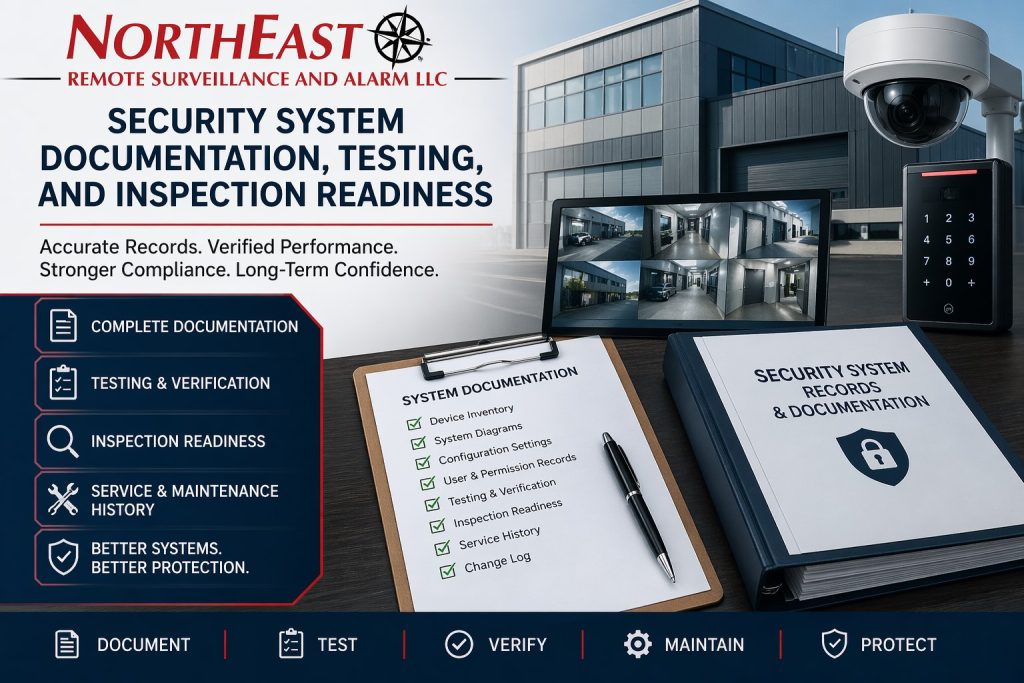
Commercial and industrial security systems should not be judged only by whether they power up, record video, unlock doors, or send alarms. A system also has to be supportable, reviewable, testable, and ready for inspection, service, expansion, and incident response. That is where documentation, testing, and inspection readiness matter.
For commercial buildings, warehouses, manufacturing facilities, logistics properties, and industrial environments, weak records can create real problems even when the hardware itself is decent. Missing device lists, undocumented wiring changes, unclear user permissions, incomplete testing records, and poor turnover packages can all create delays, failed inspections, expensive troubleshooting, liability exposure, and avoidable service problems later.
This page is focused on that narrow issue. It is not a general code page, not a video surveillance page, not an access control page, and not a fire alarm design page. It is a compliance spoke about the records, testing discipline, and readiness practices that help security systems hold up over time. For broader code and standards context, start with the Regulatory & Compliance page.

What This Page Covers
Security system documentation, testing, and inspection readiness usually includes:
- system records
- device lists
- zone and point identification
- camera and door schedules
- wiring and pathway documentation
- user and permission records
- testing procedures
- service and maintenance history
- deficiency tracking
- inspection preparation
- turnover and closeout readiness
The goal is simple. A properly documented system should be easier to inspect, easier to service, easier to expand, easier to troubleshoot, and easier to defend when questions come up later.
Why Documentation Matters in Commercial Security
A commercial security system is not just equipment. It is infrastructure.
That means the system should be understandable after installation, not only during installation. If a business cannot clearly identify what was installed, where it was installed, how it was configured, how it was tested, and who is allowed to change it, the system becomes harder to manage and more expensive to support.
Good documentation helps answer basic but critical questions:
- What devices are installed?
- Where are they located?
- How are they connected?
- What settings matter?
- Who has access?
- What has been changed?
- What has been tested?
- What still needs correction?
Without those answers, routine service becomes slower, future upgrades become riskier, and inspections become harder to pass cleanly.
Documentation Is Part of Compliance, Not Just Administration
One of the biggest mistakes in commercial security is treating documentation like optional office work. In reality, documentation is part of the compliance posture of the system.
A system that is poorly documented is harder to inspect, harder to verify, and harder to maintain correctly. It also becomes harder to prove that work was completed properly, that devices were tested, that settings were intentional, and that users were given the right level of access.
This is one reason documentation belongs in the same conversation as broader [Code & Compliance for Commercial & Industrial Security Systems]. If the physical installation matters, the supporting records matter too.
What a Well-Documented Security System Should Include
System Overview Documentation
At a minimum, there should be a clear summary of what the system includes and what it is intended to do. That should identify the major platforms, major device types, key locations, and any important integrations.
The system should not require guesswork just to understand its basic design.
Device Lists and Location Records
Every system should have a usable record of installed devices and where they are located.
That may include cameras, recorders, network switches, readers, locks, controllers, door contacts, motion detectors, keypads, panels, power supplies, intercom devices, and related infrastructure. A commercial property should not have to physically hunt through the building to understand what was installed.
Wiring and Pathway Records
A strong documentation package should help explain how the system is physically supported.
That does not mean every project needs the same level of drawing detail, but the cable paths, termination points, enclosures, network relationships, and major infrastructure transitions should not be a mystery. If the issue is specifically about wiring methods, pathway discipline, or low-voltage electrical compliance, that belongs more directly under NFPA 70 NEC and Low-Voltage Security System Wiring.
Configuration and Permission Records
A working system can still become a management problem if no one knows how it is configured.
Commercial security systems should have records for user roles, administrative permissions, credential management structure, retention settings where applicable, monitoring or notification logic where applicable, and any important programming choices that affect daily operation.
Testing and Verification Records
A compliant system should not only be installed. It should be tested and documented as tested.
That means there should be a record showing what was checked, what passed, what failed, what was corrected, and what still needs follow-up. Even when the formal testing standard depends on the system type, the underlying principle stays the same: the system should be able to show evidence that it was verified, not merely assumed to be working.
Service, Maintenance, and Change History
Security systems change over time. Cameras are added. Doors are reconfigured. Devices fail. Firmware changes. User permissions shift. Panels are updated. Wiring gets extended. Hardware gets replaced.
Without a service and change history, the system slowly becomes less understandable and less supportable. A stronger program keeps a running record of service work, changes, deficiencies, replacements, and unresolved issues.
What Testing Really Means
Testing is not the same as demonstration.
A quick walk-through showing that a camera displays video or that a door unlocks from a credential does not equal a disciplined testing process. Real testing means the relevant functions are deliberately checked, results are noted, failures are tracked, and corrections are documented.
That mindset matters across surveillance, access control, intrusion, intercom, and integrated systems.
Testing should confirm not only that devices respond, but that the system performs as intended under normal operating conditions and, where relevant, under failure or exception conditions.
What Inspection Readiness Means
Inspection readiness means the system is prepared to be reviewed by the people who may need to evaluate it later.
That can include:
- owners
- facility managers
- security managers
- service technicians
- general contractors
- IT stakeholders
- insurance representatives
- consultants
- inspectors
- authorities having jurisdiction where applicable
- An inspection-ready system is easier to explain, easier to verify, and easier to correct if deficiencies are identified.
It should be possible to review the system without relying on verbal memory from the original installer.
Documentation and Testing by System Type
Video Surveillance Systems
For commercial video systems, inspection readiness usually includes camera location records, recorder and retention settings, user access structure, export authority, network dependencies, storage expectations, and any important configuration decisions. If the issue involves lawful deployment, privacy-sensitive placement, or microphone use, that topic belongs more specifically under Commercial Video Surveillance Compliance.
Access Control Systems
For access control, strong records often include door lists, reader locations, controller relationships, lock and hardware identification, credential structure, user-role management, override conditions, and service history. The goal is to make the door environment understandable without turning the site into a troubleshooting exercise.
Intrusion Alarm Systems
For intrusion systems, documentation may include zone lists, device locations, partition structure, communication paths, keypad assignments, user permissions, monitoring relationships, and records of testing, service, and troubleshooting.
Integrated Security Systems
Where multiple systems work together, documentation becomes even more important. Integration points, dependencies, user roles, event flow, and change history should all be easier to understand, not harder. A unified system with weak records is often more difficult to support than separate systems with strong records.
Common Reasons Systems Fail Readiness Reviews
Commercial security systems usually become harder to inspect and support for predictable reasons.
One common failure is that no real turnover package was created after installation. Another is that changes were made later without updating the original records. Another is that user permissions expanded over time without governance. Another is that testing was performed informally with no usable record of what was verified.
Systems also become harder to defend when there is no device naming standard, no location consistency, no retention policy, no service log, no deficiency list, and no clear ownership of records.
Why This Matters in Commercial and Industrial Environments
Documentation problems become more expensive as properties become more complex.
A small and simple site may tolerate weak records for longer than a warehouse, manufacturing plant, logistics facility, multi-building campus, or industrial property. Larger properties usually involve more devices, more pathways, more users, more integrations, more service events, and more chances for confusion if records are weak.
That is why documentation, testing, and inspection readiness are not secondary issues in commercial and industrial security. They are part of long-term system performance.
How to Keep This Page Narrow
This page should stay focused on records, readiness, and verification.
It should not turn into a full building-code page, a fire alarm standards page, a privacy-law page, or a detailed system design page. When the issue becomes broader code structure, use the Regulatory & Compliance page. When the issue becomes low-voltage wiring methods and power architecture, use NFPA 70 NEC and Low-Voltage Security System Wiring. When the issue becomes larger standards and life-safety framework, use NFPA Standards and Their Impact on Commercial Security, Fire Alarm, and Life Safety Systems].
Build a More Inspection-Ready Security Program
If your facility is installing a new system, cleaning up legacy infrastructure, preparing for upgrades, organizing service records, or trying to make an existing system easier to support, the next step is to review the documentation and testing side of the program before the next inspection, service call, or expansion project exposes the gaps.
Northeast Remote Surveillance and Alarm, LLC helps commercial, warehouse, industrial, and logistics facilities build security systems around real operating conditions, supportable documentation, and long-term readiness.
Call 1-888-344-3846 to schedule a site assessment.
Frequently Asked Questions
What does security system documentation mean?
Security system documentation means keeping clear records of what was installed, where it was installed, how it was configured, how it was tested, and how it is supposed to be supported over time. In a commercial or industrial environment, documentation helps make the system easier to inspect, easier to service, easier to expand, and easier to understand after installation is complete.
Why does documentation matter if the system is already working?
A system that appears to work can still become a major problem if no one can verify what was installed, how it is connected, what settings matter, or who has permission to change it. Documentation matters because it supports troubleshooting, future upgrades, audits, inspections, and long-term maintenance.
What should be included in a commercial security system documentation package?
A strong documentation package usually includes device lists, system summaries, camera or door schedules where applicable, wiring or pathway records, user and permission records, testing notes, service history, change history, and any unresolved deficiencies or follow-up items. The exact level of detail may vary by project, but the system should not be left as a mystery.
What is a turnover package?
A turnover package is the collection of records and information delivered at or near project completion so the owner, manager, or service team can understand and support the system. A poor turnover package often leaves the property dependent on installer memory instead of usable records.
What does testing mean in this context?
Testing means deliberately verifying that the system and its functions perform as intended and recording the results. It is more than a quick demonstration. A disciplined testing process should show what was checked, what passed, what failed, what was corrected, and what still needs follow-up.
Is testing the same as showing the customer that the system turns on?
No. A brief walk-through is not the same as real testing. A camera displaying video, a door reading a credential, or an alarm keypad lighting up does not by itself prove that the system has been fully verified, documented, and prepared for ongoing support.
What is inspection readiness?
Inspection readiness means the system is organized so it can be reviewed, verified, and understood without relying on guesswork. That includes having the records, testing information, and system details available for owners, facility teams, service providers, contractors, consultants, and other parties who may need to evaluate the system later.
What kinds of records should be updated after installation?
Records should be updated whenever devices are added, moved, removed, reprogrammed, renamed, reassigned, or replaced. If the system changes but the records do not, the documentation slowly loses value and the system becomes harder to support over time.
Why is change history important?
Change history matters because commercial security systems do not stay frozen after installation. Cameras get added, doors get reworked, user permissions change, panels get updated, and service events occur. Without a change history, future troubleshooting becomes slower and future upgrades become riskier.
Do user permissions belong in documentation?
Yes. User permissions are part of system governance. A strong documentation package should make it clear who has access, who has administrative authority, who can export footage or reports where applicable, and who is authorized to make system changes.
What happens when a system has weak documentation?
Weak documentation usually leads to slower service, more confusion, harder inspections, avoidable labor, inconsistent testing, weaker accountability, and more difficulty when the system needs to be expanded or repaired. It can also create risk when there is no clear record of what was verified or who changed what.
Why do larger commercial and industrial properties need stronger documentation?
Larger properties usually have more devices, more pathways, more users, more integrations, and more service events. That makes weak documentation more expensive. Warehouses, manufacturing facilities, logistics sites, and multi-building properties typically need stronger records because the system is more complex and the consequences of confusion are greater.
Should service and maintenance visits be documented?
Yes. Service work should leave a record. That record should show what issue was addressed, what was tested, what was changed, what was replaced, what was left unresolved, and whether follow-up is still needed. Without that history, the system becomes harder to manage and prior problems are more likely to repeat.
What is a deficiency list?
A deficiency list is a record of items that are incomplete, not functioning properly, still pending correction, or otherwise in need of follow-up. It helps prevent unfinished issues from disappearing into verbal conversations with no clear ownership or timeline.
Is this page about code compliance or system records?
This page is mainly about system records, testing discipline, and readiness. It supports the broader compliance structure of the site, but it should stay focused on documentation, verification, and inspection preparedness rather than turning into a broader code or standards page.
Does every system need the same level of documentation?
No. The level of detail should match the project, the property, and the complexity of the system. But every commercial and industrial security system should have enough documentation to make the installation understandable, testable, and supportable after the job is complete.
How does this topic relate to future upgrades?
Good documentation makes future upgrades easier because the next phase of work starts with a clearer understanding of the existing system. Without that foundation, expansion work often takes longer, costs more, and creates more risk.
Who benefits from better documentation and testing records?
Owners, property managers, facility managers, operations teams, IT stakeholders, service technicians, general contractors, consultants, and future integrators all benefit when the system is well documented and properly tested. Better records reduce confusion and improve continuity.
What is the main goal of a documentation and readiness process?
The main goal is to make the system easier to understand, verify, support, maintain, and defend over time. A commercial security system should not become less clear the moment the installer leaves.
Is this FAQ legal or code advice?
No. This FAQ is general planning guidance for commercial and industrial security systems. Project requirements, inspection expectations, system type, jurisdiction, and site conditions can all affect what records, testing, and review steps are appropriate.