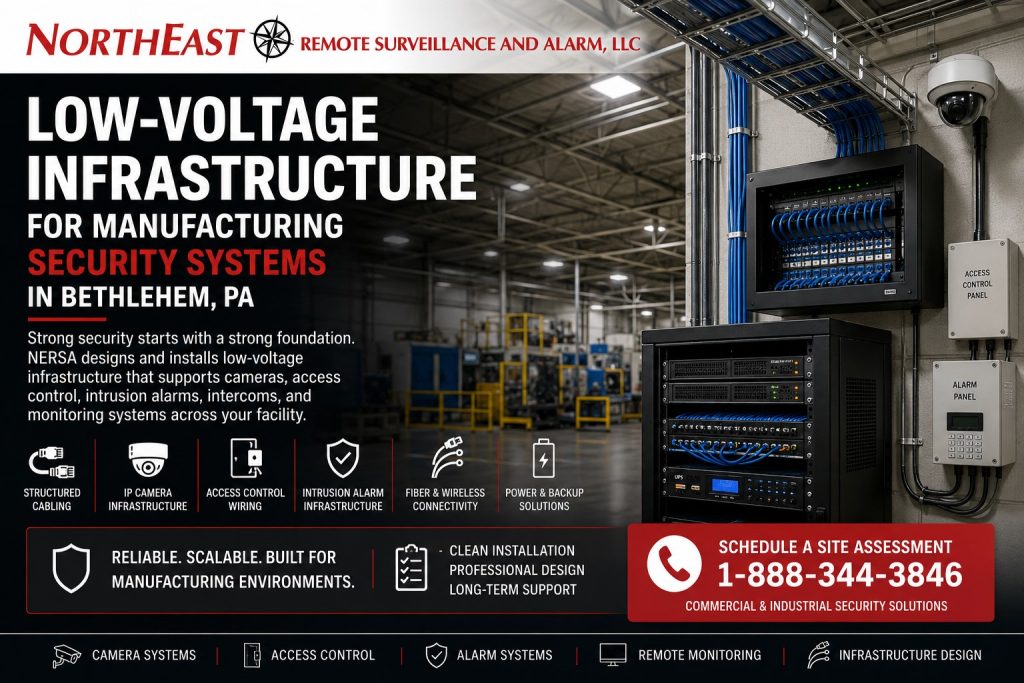
Low-voltage infrastructure for Bethlehem manufacturing security systems should be planned around cameras, access control, intrusion alarms, monitoring equipment, network pathways, fiber, wireless links, PoE switching, equipment locations, backup power, and long-term serviceability. Northeast Remote Surveillance and Alarm, LLC designs commercial and industrial low-voltage infrastructure for Bethlehem manufacturing facilities, warehouses, production buildings, industrial properties, and multi-building operations. For broader Bethlehem manufacturing and industrial security planning, start with Manufacturing & Industrial Security Systems in Bethlehem, PA.
Security systems are only as reliable as the infrastructure supporting them. Cameras, access control doors, alarm devices, intercoms, monitoring equipment, network switches, wireless bridges, fiber links, control panels, and backup power all depend on proper planning before installation begins. NERSA helps Bethlehem manufacturers build low-voltage infrastructure that supports reliable security performance, clean service access, future expansion, and better documentation over time.

Low-Voltage Infrastructure for Bethlehem Manufacturing Facilities
Manufacturing facilities create different low-voltage challenges than small offices or basic commercial buildings. Production spaces may have high ceilings, machinery, metal structures, long cable paths, overhead doors, forklift traffic, dust, vibration, electrical noise, occupied work areas, and limited access during production hours.
A strong low-voltage plan should account for how the facility operates every day. Camera locations, door hardware, access control panels, alarm devices, monitoring equipment, network rooms, fiber paths, wireless bridge locations, conduit routes, and equipment mounting areas should be coordinated before installation begins.
The goal is to create infrastructure that supports the security system now while leaving room for future cameras, doors, buildings, monitoring needs, and system upgrades.
Why Manufacturing Security Infrastructure Needs Dedicated Planning
Security equipment cannot perform well when the infrastructure behind it is poorly planned. A high-resolution camera will not help if the cable path is unreliable. An access control door can become difficult to support if the power supply, reader wiring, door contact, and lock wiring are not planned together. An alarm communicator may fail to perform properly if the signal path, backup power, or equipment location is not considered.
Manufacturing facilities often grow and change. Offices are added. Production areas move. New doors are installed. Warehouses expand. Dock areas change. Additional cameras are needed. New access-controlled doors are added. Remote monitoring requirements increase.
Dedicated infrastructure planning helps reduce future problems by creating a cleaner foundation for expansion, troubleshooting, documentation, and long-term service.
Cabling for Manufacturing Security Systems with Low-Voltage Infrastructure for Bethlehem Manufacturing Security Systems
Low-voltage cabling may support cameras, access control, intrusion alarms, intercoms, speakers, network devices, wireless bridge equipment, alarm communicators, monitoring equipment, and control panels. Each system has different cabling needs, distance limits, power requirements, and service considerations.
Manufacturing buildings may require cable pathways through warehouse ceilings, production areas, offices, mechanical spaces, loading docks, exterior walls, gate locations, equipment rooms, or multiple buildings. Cable should be planned so it can be protected, labeled, tested, documented, and serviced later.
Poor cabling decisions can create long-term problems. Exposed wiring, unclear cable routes, unmarked cables, overloaded network closets, weak terminations, and unsupported pathways can make the system harder to maintain and expand.
Camera Network Infrastructure with Low-Voltage Infrastructure for Bethlehem Manufacturing Security Systems
Security cameras depend heavily on the network infrastructure behind them. Camera quality, recording reliability, remote viewing, analytics, video management, and monitoring all depend on proper cabling, switching, power, bandwidth, and equipment placement.
Manufacturing camera infrastructure may include Cat6 cabling, fiber links, PoE switches, outdoor-rated pathways, junction boxes, wireless bridge links, network closets, NVR locations, UPS backup power, and camera mounting coordination. For camera-specific planning in this Bethlehem manufacturing cluster, visit Manufacturing Security Cameras in Bethlehem, PA.
Camera infrastructure should be planned around useful coverage, not just convenient wiring. Production floors, loading docks, employee entrances, restricted rooms, exterior yards, parking areas, gates, and warehouse spaces may all require different infrastructure choices.
Access Control Infrastructure with Low-Voltage Infrastructure for Bethlehem Manufacturing Security Systems
Access control infrastructure requires careful planning because each controlled door may involve multiple devices. A single door may need a card reader, door contact, request-to-exit device, electrified lock or strike, power supply, access control panel connection, fire alarm coordination, door hardware coordination, and cable pathway planning.
Employee entrances, production doors, warehouse doors, restricted rooms, IT rooms, utility rooms, contractor entrances, loading dock doors, and gates may all need different hardware and wiring. For Bethlehem manufacturing access control planning, visit Industrial Access Control in Bethlehem, PA.
Access control infrastructure should be designed so the system is serviceable. Panels, power supplies, door wiring, and network connections should be placed where technicians can access them without disrupting the facility more than necessary.
Intrusion Alarm Infrastructure with Low-Voltage Infrastructure for Bethlehem Manufacturing Security Systems
Intrusion alarm infrastructure may support door contacts, overhead door contacts, motion detectors, glass break sensors where appropriate, keypads, sirens, panic or duress devices where appropriate, wireless receivers, hardwired zones, repeaters, alarm communicators, and monitoring communication paths.
Manufacturing alarm systems may cover offices, production spaces, warehouse areas, loading docks, overhead doors, restricted rooms, utility spaces, detached buildings, and exterior-connected openings. For Bethlehem alarm planning, visit Industrial Intrusion Alarm Systems in Bethlehem, PA.
Alarm infrastructure should account for partitions, schedules, monitoring paths, service access, and future device expansion. The system should be easy for authorized users to operate and clear enough for technicians to support later.
Fiber Infrastructure for Large Facilities with Low-Voltage Infrastructure for Bethlehem Manufacturing Security Systems
Fiber can be important in manufacturing and industrial environments where long cable distances, multiple buildings, high camera counts, network separation, or bandwidth demands make copper cabling less practical. Fiber may be used to connect warehouses, production buildings, security rooms, gate locations, remote camera poles, detached offices, and equipment rooms.
Fiber planning should consider pathway protection, termination locations, patch panels, equipment racks, switch locations, labeling, testing, spare strands, and future expansion. A clean fiber design can help support cameras, access control networks, intercoms, monitoring systems, and building-to-building connectivity.
For larger Bethlehem properties, fiber can help create a more stable foundation than trying to stretch standard network cabling beyond its practical limits.
Wireless Bridges for Cameras, Gates, and Detached Buildings
Some manufacturing properties need security coverage in places where trenching or new conduit is difficult. Wireless bridge systems can help connect cameras, gates, detached buildings, parking areas, yards, remote poles, guard shacks, and exterior security points when properly designed.
Wireless bridge planning should account for line of sight, mounting height, power availability, bandwidth, weather exposure, interference, network security, service access, and future needs. A wireless link should not be treated like a simple shortcut; it should be engineered as part of the larger security infrastructure.
Wireless bridge systems can be useful, but they must be planned carefully so they support reliable video, access control, monitoring, or intercom traffic.
PoE Switching and Network Rooms
PoE switches power and connect many modern security devices, including cameras, intercoms, some access control equipment, and other network-connected devices. Manufacturing properties may need multiple switch locations depending on the building size, cable distances, camera count, and equipment layout.
Switches should be placed in secure, serviceable locations with proper power, ventilation, labeling, backup power, and network separation where appropriate. Network rooms, IDF rooms, MDF areas, equipment racks, and security enclosures should be planned before installation begins.
A weak switch layout can create service issues later. Overloaded switches, poor labeling, limited ports, poor ventilation, and unplanned power needs can make future expansion harder than it needs to be.
Backup Power and UPS Planning with Low-Voltage Infrastructure for Bethlehem Manufacturing Security Systems
Backup power helps keep critical security equipment running during short power interruptions. Cameras, access control panels, alarm communicators, network switches, wireless bridge equipment, monitoring equipment, and recording devices may all need backup power depending on the design.
UPS planning should account for equipment load, runtime expectations, battery replacement, service access, monitoring needs, and the importance of each device. Not every device needs the same backup plan, but critical infrastructure should be evaluated before installation.
In manufacturing environments, backup power planning is especially important because a short outage can affect cameras, door control, alarm communication, video recording, remote access, and monitoring visibility.
Equipment Rooms, Racks, and Security Panels
Security equipment should be installed in locations that support long-term service. Access control panels, alarm panels, network switches, video recorders, fiber equipment, power supplies, UPS units, wireless bridge equipment, and monitoring communicators should not be scattered randomly throughout the building without documentation.
Equipment rooms and racks should be planned around security, ventilation, cable management, power availability, network connectivity, labeling, and technician access. A clean equipment layout helps reduce service time, troubleshooting confusion, and future upgrade problems.
Manufacturing facilities often need equipment installed around active operations. NERSA helps plan equipment locations so systems can be supported while minimizing disruption to the facility.
Infrastructure for Loading Docks and Overhead Doors
Loading dock areas often require additional infrastructure because they involve overhead doors, dock cameras, exterior walls, truck courts, shipping offices, receiving areas, staged freight, intercoms, access-controlled doors, and alarm contacts.
Dock areas can be difficult because of weather exposure, moving trucks, forklifts, concrete walls, metal doors, long exterior views, and limited mounting options. Cabling, camera placement, alarm devices, conduit paths, and network connections should all be planned before work begins.
A strong dock infrastructure plan helps support video review, alarm monitoring, access control, intercom communication, and after-hours visibility around one of the most active areas of the facility.
Infrastructure for Employee Entrances and Restricted Rooms
Employee entrances and restricted rooms often require both security equipment and clean infrastructure. An employee door may need a reader, camera, door contact, request-to-exit device, electrified hardware, access panel connection, alarm coordination, and monitoring support.
Restricted rooms may need access control, cameras, alarm contacts, motion detection, door monitoring, and reporting. These areas can include tool rooms, IT rooms, utility rooms, maintenance rooms, parts rooms, inventory spaces, and production control areas.
Low-voltage infrastructure should be planned so these controlled spaces can be secured without creating exposed wiring, weak equipment locations, or difficult service conditions.
Infrastructure for Remote Video Monitoring with Low-Voltage Infrastructure for Bethlehem Manufacturing Security Systems
Remote video monitoring depends on reliable camera views, stable network paths, accurate alerting, recording access, and clear communication between equipment and monitoring workflows. If the infrastructure is weak, monitoring can become less reliable.
Manufacturing properties may need monitored video around gates, truck courts, parking lots, loading docks, fence lines, exterior doors, yards, and repeated activity zones. For Bethlehem manufacturing monitoring planning, visit Industrial Remote Video Monitoring in Bethlehem, PA.
Infrastructure planning for monitored video may include camera placement, bandwidth, network switching, lighting awareness, AI-supported event setup, speaker locations where appropriate, and service access.
Network Segmentation and Cybersecurity Awareness
Modern security systems often connect to business networks, cloud services, remote management tools, video platforms, monitoring services, mobile apps, and vendor support portals. Because of that, network planning should include cybersecurity awareness.
Security devices should be installed with attention to network separation, user permissions, password management, firmware support, remote access controls, secure equipment placement, and documentation. The goal is to support security operations without creating unnecessary risk to the business network.
Cybersecurity-aware planning is especially important for facilities with cameras, access control, remote video viewing, monitoring platforms, intercoms, and multi-site management needs.
Documentation and Labeling with Low-Voltage Infrastructure for Bethlehem Manufacturing Security Systems
Documentation is one of the most important parts of a professional low-voltage infrastructure project. A facility should be able to identify cable routes, device locations, panel locations, switch ports, camera names, access control doors, alarm zones, IP addresses where appropriate, rack equipment, power supplies, and backup power locations.
Good labeling helps with service, troubleshooting, future expansion, staff turnover, and system upgrades. Poor documentation can make every future service call harder.
NERSA plans security infrastructure with long-term support in mind so Bethlehem manufacturers have a system that can be understood, serviced, and expanded over time.
Planning Around Production Schedules
Manufacturing facilities often cannot stop operations for security work. Low-voltage installation may need to be planned around production schedules, employee movement, machinery, forklifts, shipping activity, safety requirements, and areas that cannot be disrupted during certain hours.
Infrastructure planning should consider when work can occur, which areas require coordination, how cable paths will be accessed, where lifts may be needed, how equipment will be mounted, and how to limit disruption to active operations.
A practical installation plan helps protect the facility while respecting the work happening inside the building.
Retrofitting Older Manufacturing Buildings with Low-Voltage Infrastructure for Bethlehem Manufacturing Security Systems
Older manufacturing buildings often have a mix of older wiring, building additions, reused spaces, legacy alarm wiring, outdated camera cabling, older phone lines, limited network rooms, and undocumented pathways.
A retrofit project may involve cleaning up existing wiring, replacing old camera runs, upgrading network switches, adding fiber, modernizing alarm communication, creating new access control pathways, or relocating equipment to better service locations.
NERSA can evaluate existing infrastructure and recommend practical improvements without assuming that every system needs to be replaced at once.
Infrastructure for Multi-Building Properties
Bethlehem industrial properties may include multiple buildings, detached offices, storage buildings, guard shacks, truck yards, fenced areas, separate warehouses, or exterior utility spaces. These properties require careful planning so security systems can communicate reliably across the entire site.
Multi-building infrastructure may include fiber, wireless bridges, network segmentation, separate equipment rooms, local power supplies, monitored alarm expansion, intercom communication, and camera coverage across connected areas.
A multi-building plan should identify which systems need to connect, where equipment should be located, how data should travel, how power will be supported, and how the system will be serviced later.
Serviceability and Future Expansion
A security system should not be designed only for the day it is installed. Manufacturing facilities change over time, and the infrastructure should be able to support that change.
Future expansion may include additional cameras, new access-controlled doors, upgraded recording equipment, new alarm zones, added buildings, gate control, intercoms, remote monitoring, fiber extensions, or updated network equipment.
A serviceable design makes those changes easier. Spare capacity, clean labeling, logical cable pathways, accessible panels, organized equipment rooms, and documented network structure can all reduce future problems.
Common Low-Voltage Infrastructure Problems We Help Solve
Bethlehem manufacturing facilities often need help when security systems become unreliable because of poor cabling, outdated wiring, undocumented pathways, weak wireless links, overloaded switches, poor equipment locations, exposed wiring, lack of backup power, or systems that were expanded without planning.
Other common issues include cameras dropping offline, access control panels installed in poor locations, old phone-line alarm communication, unclear alarm wiring, network switches without labeling, wireless cameras with weak connections, and infrastructure that cannot support new equipment.
NERSA can evaluate the building, existing wiring, security equipment, network conditions, service needs, and expansion goals to recommend a practical infrastructure plan.
Low-Voltage Infrastructure NERSA Can Help Plan
- Security camera cabling
- Access control wiring
- Intrusion alarm wiring
- Intercom cabling
- IP speaker infrastructure
- Fiber links
- Wireless bridges
- PoE switching
- Network room planning
- Equipment rack organization
- IDF and MDF planning
- UPS and backup power
- Alarm communication paths
- Door hardware wiring
- Gate security infrastructure
- Exterior camera pathways
- Multi-building connectivity
- Security equipment relocation
- Legacy system cleanup
- Cable labeling and documentation
- Security network planning
- Recording equipment locations
- Monitoring equipment support
Related Bethlehem Manufacturing Security Pages
Manufacturing Security Cameras in Bethlehem, PA
Plan camera coverage for production floors, employee entrances, loading docks, parking areas, restricted rooms, shipping areas, and other manufacturing security points.
Industrial Access Control in Bethlehem, PA
Control employee, manager, contractor, vendor, and maintenance access across manufacturing doors, restricted areas, gates, offices, and warehouse-connected spaces.
Industrial Intrusion Alarm Systems in Bethlehem, PA
Protect manufacturing facilities after hours with door contacts, overhead door protection, motion detection, partitions, monitoring communication, and video verification planning.
Industrial Remote Video Monitoring in Bethlehem, PA
Support after-hours event awareness with monitored video, AI-supported alerts, live response procedures, speaker warnings, and documented escalation instructions.
Why Bethlehem Manufacturers Choose NERSA
Bethlehem manufacturers choose Northeast Remote Surveillance and Alarm, LLC because NERSA designs commercial and industrial security systems around real facility conditions. Low-voltage infrastructure, camera systems, access control doors, intrusion alarms, monitoring equipment, fiber, wireless links, network switches, and equipment rooms all need planning that matches how the property actually operates.
NERSA focuses on practical design, clean installation, documentation, serviceability, expansion planning, and long-term support. Whether the facility needs new camera cabling, access control wiring, alarm infrastructure, network cleanup, fiber connectivity, wireless bridges, or a complete low-voltage security infrastructure plan, the design starts with the building and the systems it needs to support.
Request a Low-Voltage Infrastructure Assessment in Bethlehem
If your Bethlehem manufacturing facility needs security cabling, camera infrastructure, access control wiring, intrusion alarm infrastructure, fiber, wireless bridges, PoE switching, network room planning, backup power, or multi-building connectivity, Northeast Remote Surveillance and Alarm, LLC can evaluate the property and recommend a system built around your operation.
Call 1-888-344-3846 to request a low-voltage infrastructure assessment for a Bethlehem manufacturing security system.
Low-Voltage Infrastructure FAQs
What is low-voltage infrastructure for manufacturing security systems?
Low-voltage infrastructure is the cabling, network equipment, fiber, wireless links, panels, power supplies, backup power, pathways, and equipment locations that support cameras, access control, alarms, intercoms, monitoring systems, and other security devices.
Why do Bethlehem manufacturing facilities need low-voltage infrastructure planning?
Manufacturing facilities often have large spaces, high ceilings, long cable paths, machinery, exterior areas, overhead doors, and multi-building layouts. Planning helps make security systems more reliable, serviceable, and easier to expand.
Can low-voltage infrastructure support security cameras?
Yes. Camera systems may require Cat6 cabling, fiber, PoE switches, wireless bridges, recording equipment, network rooms, UPS backup power, and proper equipment locations.
Can access control doors use the same infrastructure plan?
Yes. Access control infrastructure should be planned with the rest of the security system. Controlled doors may need reader wiring, door contacts, electrified hardware wiring, request-to-exit devices, power supplies, panels, and network connections.
Can NERSA help with fiber for manufacturing security systems?
Yes. Fiber can support long cable distances, multi-building connectivity, high camera counts, remote equipment locations, and network reliability for larger manufacturing and industrial properties.
Can wireless bridges be used for remote cameras or buildings?
Yes. Wireless bridges can connect cameras, gates, detached buildings, yards, parking lots, and exterior security points when line of sight, power, bandwidth, mounting, and service conditions are properly planned.
Why is PoE switching important for security systems?
PoE switches provide network connection and power for many modern security devices, including cameras and some intercom equipment. Proper switch planning supports reliability, bandwidth, expansion, and serviceability.
Does low-voltage infrastructure include backup power?
Backup power may be part of the infrastructure plan for cameras, access control panels, alarm communicators, switches, recording equipment, wireless bridges, and other critical security devices.
Can NERSA clean up older security wiring?
Yes. NERSA can evaluate existing cabling, old alarm wiring, camera wiring, equipment locations, network rooms, and documentation to recommend practical cleanup, replacement, or modernization.
Can low-voltage infrastructure be expanded later?
Yes. A properly planned system can expand to additional cameras, doors, alarm devices, intercoms, buildings, gates, monitoring equipment, network switches, and fiber links as the facility changes.
Does NERSA install general residential cabling?
No. Northeast Remote Surveillance and Alarm, LLC focuses on commercial and industrial security systems.
Schedule a Bethlehem Manufacturing Low-Voltage Infrastructure Assessment
Low-voltage infrastructure should be built around the security systems, building layout, production activity, network needs, cable pathways, equipment locations, and future expansion of the facility. Northeast Remote Surveillance and Alarm, LLC can help your Bethlehem manufacturing property plan infrastructure that supports cameras, access control, alarms, monitoring, fiber, wireless links, backup power, and long-term serviceability.
Call 1-888-344-3846 to request a low-voltage infrastructure assessment for your Bethlehem manufacturing security system.