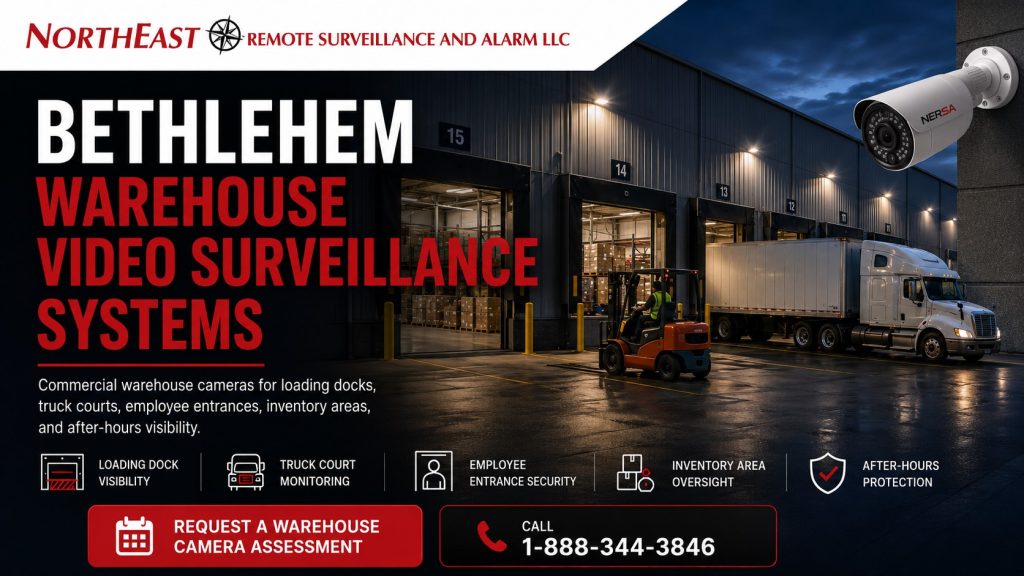
Bethlehem Warehouse Video Surveillance Systems

Commercial warehouse cameras, loading-dock visibility, truck-court coverage, employee-entrance video, inventory-area recording, and after-hours incident review for Bethlehem facilities.

Bethlehem warehouse video surveillance systems should be designed around the movement of employees, drivers, vendors, freight, forklifts, vehicles, inventory, and equipment throughout the property.

A useful warehouse camera system requires more than mounting several wide-angle cameras near the ceiling. Camera placement, viewing distance, lighting, loading-dock activity, warehouse racking, vehicle movement, recording retention, network infrastructure, and the type of evidence management may need after an incident all affect the design.

Northeast Remote Surveillance and Alarm, LLC designs, installs, upgrades, integrates, and supports commercial video surveillance systems for Bethlehem warehouses, distribution properties, logistics operations, mixed office-warehouse buildings, manufacturing-connected warehouses, industrial parks, and multi-building commercial facilities.

This page focuses specifically on warehouse camera planning. For coordinated planning across cameras, access control, intrusion alarms, loading docks, truck yards, gates, monitoring, fire alarm, and infrastructure, visit Warehouse Security Systems in Bethlehem, PA.

For broader citywide planning, visit Commercial and Industrial Security Systems in Bethlehem, PA.

Project availability may depend on property location, warehouse layout, lighting, mounting options, network access, existing equipment, recording requirements, operating schedules, project scope, and long-term support needs.

Request a Bethlehem Warehouse Camera Assessment or call 1-888-344-3846 to discuss your facility.

Warehouse video surveillance systems protecting loading docks, employee entrances, truck courts, inventory areas, and parking lots in Bethlehem, PA.

Warehouse Camera Planning Based on Real Operations

A warehouse is not one uniform camera environment.

The property may include:

  • Employee entrances
  • Visitor and driver entrances
  • Shipping and receiving offices
  • Loading docks
  • Overhead doors
  • Truck courts
  • Trailer positions
  • Warehouse aisles
  • High-value inventory areas
  • Tool and maintenance rooms
  • Packing and staging areas
  • Forklift routes
  • Office-to-warehouse transitions
  • Parking lots
  • Gates and vehicle approaches
  • Exterior storage
  • Detached buildings

Each location may require a different camera objective.

A wide overview camera may help show how an incident developed but may not provide enough detail to identify a person, package, vehicle, or specific action. A tighter camera may provide stronger identification near a door or loading position but cover only a limited area.

A complete design should balance broad operational visibility with the targeted views needed for incident review.


What Warehouse Security Cameras Can Help Document

A properly designed Bethlehem warehouse camera system may help document:

  • Employees and visitors entering the property
  • Drivers arriving at shipping or receiving
  • Vehicles entering or leaving the yard
  • Loading and unloading activity
  • Trailer positioning
  • Freight movement
  • Forklift activity
  • Inventory handling
  • Package staging
  • Restricted-area access
  • Activity near overhead doors
  • Parking-lot incidents
  • Equipment damage
  • Workplace incidents
  • After-hours movement
  • Suspicious exterior activity

Recorded video can support incident review, operational questions, insurance documentation, employee or driver reports, theft investigations, delivery disputes, and security planning.

No camera system can guarantee that every incident will be prevented or that every person, object, vehicle, or plate will be identifiable. Results depend on camera placement, lighting, distance, image quality, recording condition, obstructions, and the circumstances of the event.


Loading-Dock Video Surveillance

Loading docks are among the busiest and most exposed areas of a warehouse.

Dock activity may involve:

  • Drivers
  • Vendors
  • Warehouse employees
  • Forklift operators
  • Staged freight
  • Overhead doors
  • Trailers
  • Shipping paperwork
  • Early deliveries
  • Late pickups
  • After-hours activity

A loading-dock camera plan may include:

  • Exterior trailer and dock views
  • Interior views of overhead doors
  • Shipping-office entrances
  • Freight-staging areas
  • Driver check-in locations
  • Dock approach lanes
  • Cameras covering adjacent employee doors
  • Views supporting alarm verification

The system should help management understand which trailer arrived, which dock was used, who was present, how freight moved, and whether additional camera views contain useful information.

A camera placed too high or too far away may show general dock activity without providing meaningful detail. A stronger design may combine wide dock-overview cameras with targeted views of individual doors, check-in points, or freight-transfer areas.

For deeper planning around dock doors, alarms, access control, freight activity, and after-hours protection, visit Loading Dock Security Systems in Bethlehem, PA.


Truck Courts and Trailer Areas

Truck courts and trailer areas create different camera requirements from indoor warehouse spaces.

Useful views may include:

  • Truck entrances
  • Trailer rows
  • Dock approaches
  • Yard lanes
  • Driver waiting areas
  • Gate lanes
  • Exterior storage
  • Fence lines
  • Rear building approaches
  • Tractor and trailer movement

Camera design should account for:

  • Large vehicle obstructions
  • Headlight glare
  • Trailer height
  • Long viewing distances
  • Nighttime lighting
  • Vehicle turning paths
  • Parked trailers blocking views
  • Weather exposure
  • Network connectivity
  • Mounting and maintenance access

A truck-yard overview camera may provide useful context but may not identify a vehicle or plate at the entrance. A complete system may require separate overview, gate, and targeted vehicle views.


Employee Entrances and Shift Changes

Employee entrances are important warehouse control points.

Camera coverage may help document:

  • Shift-change activity
  • Employee arrivals and departures
  • After-hours entry
  • Doors held open
  • People following employees through entrances
  • Visitor or contractor use
  • Activity around credential readers
  • Incidents near employee parking

Entrance cameras may provide stronger identification opportunities than cameras viewing people from across a warehouse or parking lot.

The video system may also be coordinated with access-control activity so management can compare credential events with nearby camera footage.

Camera placement should avoid unnecessary blind spots caused by doors, vestibules, overhangs, strong backlighting, or people standing too close to the lens.


Warehouse Interior Camera Coverage

Warehouse interiors can be difficult camera environments because of ceiling height, racking, changing inventory, forklift traffic, and large open spaces.

Potential interior camera areas include:

  • Main warehouse aisles
  • Cross aisles
  • Staging areas
  • Packing stations
  • Shipping and receiving zones
  • Inventory cages
  • Tool rooms
  • High-value storage
  • Office-to-warehouse doors
  • Maintenance areas
  • Returns areas
  • Quality-control spaces
  • Interior overhead doors

The camera plan should account for how inventory and equipment may block views over time.

A camera view that is clear when racking is empty may become obstructed after pallets are stored. Forklifts, temporary staging, seasonal inventory, and tall materials can also change the scene.

Multiple targeted views may provide more useful evidence than one high-mounted camera attempting to cover an entire warehouse section.


Forklift Routes and Operational Visibility

Warehouse camera systems may help management review incidents involving forklifts, pedestrians, material movement, racks, doors, and equipment.

Camera coverage may support review of:

  • Forklift travel routes
  • Intersections
  • Pedestrian crossings
  • Dock transitions
  • Staging areas
  • Rack impacts
  • Equipment damage
  • Material-handling incidents
  • Restricted operating zones

Video surveillance does not replace employee training, supervision, workplace procedures, safety programs, barriers, signage, or required protective measures.

Its role is to provide useful visibility and documentation when management needs to understand what occurred.

Camera placement should avoid interfering with operations and should focus on areas where recorded context can support legitimate security and operational objectives.


Inventory, Tool, and Restricted-Area Cameras

Some warehouse areas require stronger documentation than general operating spaces.

These may include:

  • Inventory cages
  • Tool rooms
  • IT rooms
  • Records rooms
  • High-value storage
  • Returns areas
  • Maintenance rooms
  • Controlled stock locations
  • Sensitive customer materials
  • Restricted office areas

Camera coverage may be combined with:

  • Access control
  • Door-position monitoring
  • Intrusion detection
  • Individual employee credentials
  • Restricted schedules
  • Alarm verification
  • Event bookmarks
  • Management review procedures

The system should help document who approached or entered the area, which door was used, when activity occurred, and whether related access-control or alarm information is available.


Parking Lots and Exterior Approaches

Warehouse parking and exterior areas may include:

  • Employee parking
  • Visitor parking
  • Driver parking
  • Truck circulation
  • Building approaches
  • Side and rear entrances
  • Gate lanes
  • Exterior equipment
  • Shared industrial-park roads
  • Pedestrian routes

Camera planning should distinguish between:

  • General parking-lot overview
  • Vehicle identification
  • Pedestrian identification
  • Building-entrance coverage
  • Gate-lane documentation
  • License plate capture
  • Remote-monitoring readiness

A wide parking-lot camera may show the sequence of an incident without providing enough detail to identify a person or read a license plate.

Dedicated plate capture generally requires a controlled lane, appropriate angle, suitable distance, nighttime exposure control, and equipment selected for that purpose.


Nighttime Image Quality and Warehouse Lighting

Many warehouse incidents occur during the periods when lighting is weakest.

A nighttime site review should consider:

  • Loading-dock lighting
  • Truck-court lighting
  • Parking-lot lighting
  • Dark building approaches
  • Bright fixtures in the camera image
  • Headlight glare
  • Reflections from wet pavement
  • Deep shadows
  • Interior warehouse lighting schedules
  • Light entering through dock doors
  • Infrared reflection
  • Seasonal weather
  • Snow and fog

A camera image that looks clear during daylight may provide little useful detail at night.

Possible improvements may include:

  • Repositioning cameras
  • Reducing mounting height
  • Narrowing the field of view
  • Adding targeted cameras
  • Adjusting exposure settings
  • Improving existing lighting
  • Adding dedicated illumination
  • Separating overview and identification objectives

Nighttime performance should be evaluated under actual facility conditions rather than assumed from daytime footage.


AI Video Analytics for Warehouses

AI-supported analytics may help identify selected people, vehicles, or activity without relying only on basic motion detection.

Available features may include:

  • Person detection
  • Vehicle detection
  • Line crossing
  • Restricted-area entry
  • Loitering
  • Direction of travel
  • After-hours movement
  • Gate-lane events
  • Perimeter activity
  • Object classification
  • Search by people or vehicles

Analytics may help reduce alerts caused by general pixel movement, but they still depend on image quality, camera position, lighting, distance, and proper configuration.

Performance may be affected by:

  • Cameras mounted too high
  • Long viewing distances
  • Trailer obstruction
  • Forklift movement
  • Changing warehouse inventory
  • Rain, snow, or fog
  • Insects near cameras
  • Headlights
  • Moving shadows
  • Incorrect detection zones
  • Public-road traffic
  • Legitimate after-hours activity

The business should identify which events matter before analytics are configured.


Recording, Retention, and Incident Review

Warehouse footage should remain available long enough to support realistic reporting and investigation timelines.

Retention planning may consider:

  • Number of cameras
  • Camera resolution
  • Frame rate
  • Continuous or event-based recording
  • Warehouse operating hours
  • Storage capacity
  • Cloud, on-premises, or hybrid recording
  • Business policy
  • Contract requirements
  • Insurance expectations
  • Typical incident-reporting delays

A loss, damage claim, delivery dispute, employee report, inventory issue, or vehicle incident may not be discovered immediately.

The recording platform should also make footage practical to find and export.

Useful capabilities may include:

  • Search by date and time
  • Clearly named cameras
  • Multi-camera playback
  • Event bookmarks
  • People and vehicle search
  • Secure exports
  • Role-based user permissions
  • Audit history
  • Remote access
  • Multi-site management

A camera labeled “Camera 24” is less useful than one labeled “North Shipping Dock Door 6.”

Clear naming and documentation improve daily operation, incident review, service, and future expansion.


Remote Video Monitoring for Warehouse Exteriors

Some Bethlehem warehouses need more than recorded footage.

Properties with recurring trespassing, exterior theft, trailer activity, suspicious vehicles, loading-dock exposure, or limited overnight staffing may benefit from remote video monitoring.

A monitored-video system may combine:

  • Selected exterior cameras
  • AI-supported event alerts
  • Monitoring schedules
  • Operator review
  • Property-specific instructions
  • Responsible-party notification
  • Live audio warnings
  • Documented escalation procedures

Monitoring should focus on areas and hours where active review provides meaningful value.

A warehouse operating through the night requires different event rules from a building that should be empty after closing.

For active event review, live audio warnings, and structured after-hours response, visit Bethlehem Remote Video Monitoring and Live Talk-Down.


Video Surveillance and Other Warehouse Security Systems

Warehouse cameras are strongest when they are coordinated with the other systems protecting the property.

Access Control

Access control can identify credential activity at employee entrances, shipping offices, inventory rooms, IT spaces, and controlled warehouse doors.

Nearby cameras may help management review who used the door and what occurred around the event.

Intrusion Alarms

Intrusion alarms may protect overhead doors, exterior entrances, warehouse interiors, shipping offices, restricted rooms, and after-hours vulnerable areas.

Video may provide additional context around selected alarm events.

Gate Access and Vehicle Documentation

Gate systems, intercoms, overview cameras, and license plate recognition may help document vehicles entering truck yards, employee parking, delivery lanes, or restricted exterior areas.

Remote Monitoring

Selected camera events may enter a monitored workflow for visual verification, audio intervention, contact notification, and escalation according to written instructions.

Integration should make events easier to understand without creating unnecessary complexity for warehouse employees, managers, IT personnel, or service technicians.


Existing Warehouse Camera Upgrades

An existing warehouse camera system should be evaluated when it has:

  • Missing loading-dock views
  • Poor nighttime images
  • Blind spots
  • Cameras mounted too high
  • Views that are too wide
  • Insufficient image detail
  • Failed or damaged cameras
  • Unreliable recording
  • Inadequate retention
  • Outdated analog equipment
  • Unsupported recorders
  • Weak remote access
  • Poor camera naming
  • Repeated network failures
  • No analytics
  • No monitoring readiness
  • Missing system documentation

An upgrade may involve:

  • Repositioning existing cameras
  • Adding targeted dock or entrance views
  • Replacing outdated cameras
  • Improving lighting
  • Expanding storage
  • Upgrading the recorder
  • Adding AI search or event filtering
  • Improving network infrastructure
  • Adding gate or LPR cameras
  • Preparing selected views for remote monitoring
  • Cleaning up camera names and permissions

The best improvement is not always adding the largest possible number of cameras. Better placement, lighting, recording, retention, infrastructure, and incident-review tools may provide greater value.


Network and Low-Voltage Infrastructure

Warehouse camera systems depend on the infrastructure supporting them.

A warehouse project may require:

  • Cat6 or Cat6A cabling
  • Fiber backbones
  • PoE switching
  • Multiple IDF locations
  • Wireless bridges
  • Outdoor-rated links
  • Equipment racks
  • UPS-backed power
  • Surge protection
  • Secure network segmentation
  • Recorder or cloud connectivity
  • Cable and switch documentation

High ceilings, large footprints, metal construction, racking, loading operations, and multiple buildings can make warehouse infrastructure more complex than an ordinary office installation.

Camera locations, switch placement, fiber paths, network capacity, rack space, PoE load, and future expansion should be planned before installation begins.


Privacy, User Access, and Responsible Video Use

Warehouse video surveillance should be used for legitimate security, operational, and incident-review purposes.

Planning should consider:

  • Camera placement
  • Employee expectations
  • Visitor and driver expectations
  • Signage
  • User permissions
  • Remote access
  • Recording retention
  • Video exports
  • Internal policies
  • Cybersecurity
  • Areas where cameras should not be installed

Recorded video should be available only to authorized users with a legitimate business need.

Individual accounts, strong passwords, role-based permissions, secure remote access, software updates, audit history, and documented export procedures can help protect the system and its recordings.


Why Bethlehem Warehouses Choose Northeast Remote Surveillance and Alarm, LLC

Northeast Remote Surveillance and Alarm, LLC is based in Bethlehem and focuses on non-residential commercial and industrial security environments.

NERSA plans warehouse video surveillance around:

  • Warehouse layout
  • Freight movement
  • Loading docks
  • Truck courts
  • Employee entrances
  • Vehicle flow
  • Inventory areas
  • Camera objectives
  • Mounting locations
  • Nighttime visibility
  • Recording retention
  • AI analytics
  • Remote access
  • Monitoring needs
  • Network infrastructure
  • Existing equipment
  • Documentation
  • Future expansion
  • Long-term serviceability

The objective is not to provide the widest possible camera view. It is to create useful visibility and recorded evidence around the areas, activities, and incidents that matter to the warehouse.


Request a Bethlehem Warehouse Camera Assessment

A Bethlehem warehouse camera assessment may review:

  • Building and warehouse layout
  • Employee and visitor entrances
  • Shipping and receiving areas
  • Loading docks
  • Overhead doors
  • Truck courts
  • Trailer positions
  • Warehouse aisles
  • Inventory and restricted areas
  • Forklift routes
  • Parking lots
  • Gate lanes
  • Exterior storage
  • Existing lighting
  • Nighttime image quality
  • Camera mounting options
  • Network and power availability
  • Existing cameras and recording
  • Retention requirements
  • AI analytics
  • Remote-monitoring options
  • Future expansion

Northeast Remote Surveillance and Alarm, LLC can help determine which overview, identification, entrance, dock, yard, parking, gate, and monitored-video views are appropriate for the facility.

Request a Bethlehem Warehouse Camera Assessment or call 1-888-344-3846.


Frequently Asked Questions About Bethlehem Warehouse Video Surveillance

Where should cameras be installed in a warehouse?

Common camera locations include employee entrances, loading docks, shipping and receiving, warehouse aisles, staging areas, inventory rooms, restricted storage, forklift intersections, parking lots, truck courts, gates, and exterior approaches.

The correct layout depends on the facility and the type of evidence required.

How many cameras does a warehouse need?

There is no universal camera count.

The number depends on the warehouse size, ceiling height, racking, docks, entrances, parking areas, truck courts, lighting, obstructions, image objectives, and required retention.

Can one camera cover an entire warehouse?

A wide camera may provide general awareness of a large section, but it may not provide enough detail to identify people, products, vehicles, or specific activity at longer distances.

Large warehouses typically benefit from multiple targeted views.

How high should warehouse cameras be mounted?

The height should match the visual objective.

Higher cameras cover more area but may provide less identifying detail. Lower or targeted cameras may provide better evidence around doors, docks, inventory areas, and incident locations.

Can cameras document loading-dock activity?

Yes. Cameras can help document trailers, drivers, forklifts, freight movement, overhead doors, staged materials, shipping-office entrances, and activity inside and outside the dock area.

Can warehouse cameras capture license plates?

General warehouse or yard cameras may show vehicles without consistently capturing readable plates.

Reliable plate capture usually requires a dedicated LPR view designed around a controlled lane, camera angle, distance, lighting, and vehicle speed.

Can cameras be used around forklift routes?

Yes. Camera placement may support incident review around forklift intersections, warehouse transitions, docks, staging areas, and pedestrian routes.

Video does not replace training, supervision, barriers, signage, or safety procedures.

Do warehouse cameras work at night?

They can, when camera selection, placement, lighting, exposure, and viewing distance are appropriate.

Nighttime performance should be reviewed under actual warehouse and exterior lighting conditions.

Can AI help search warehouse video?

Compatible AI tools may help search for people, vehicles, line crossings, restricted-area events, or other defined activity.

Performance depends on camera position, image quality, distance, lighting, and system configuration.

Can existing warehouse cameras be upgraded?

Often, yes.

Existing cameras may be retained, repositioned, supplemented, or replaced based on image quality, nighttime performance, platform compatibility, recording reliability, network condition, and required evidence.

How long should warehouse video be retained?

Retention depends on camera count, resolution, recording method, storage capacity, company policy, insurance expectations, contractual requirements, and the typical delay before incidents are reported.

Can warehouse cameras be monitored after hours?

Yes. Selected exterior or high-risk cameras may be connected to a remote video monitoring workflow using analytics, schedules, operator review, site instructions, and response procedures.

Can cameras integrate with warehouse access control and alarms?

Yes, where compatible systems and project requirements support coordination.

Video may provide additional context around credential use, forced doors, held-open doors, intrusion alarms, overhead-door activity, gates, and after-hours events.

Can NERSA support both small warehouses and large distribution facilities?

Yes. NERSA can plan a targeted camera system for a smaller Bethlehem warehouse or a larger distribution property with numerous docks, truck courts, parking areas, multiple buildings, extensive infrastructure, and centralized video management.

What happens during a warehouse camera assessment?

An assessment may review entrances, docks, trailer areas, truck flow, aisles, inventory spaces, lighting, mounting options, viewing distances, obstructions, existing equipment, network access, recording, retention, analytics, and monitoring needs.

How does a business begin a Bethlehem warehouse camera project?

Begin with Request a Bethlehem Warehouse Camera Assessment or call 1-888-344-3846 to discuss the facility, current camera system, known blind spots, evidence needs, infrastructure, operating schedule, and future expansion.

Scroll to Top
1-888-344-3846