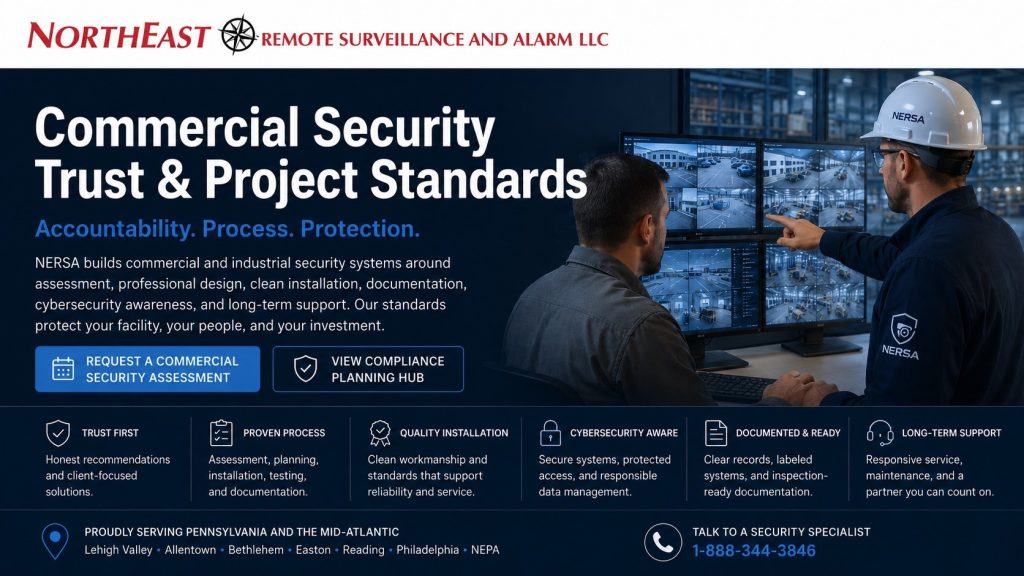
NERSA’s project standards explain how commercial security work is assessed, installed, tested, documented, and supported.
request a commercial security assessment
What a Well-Defined Security Project Includes
Commercial security is not just equipment on a wall. A reliable security project depends on how the system is assessed, designed, installed, tested, documented, secured, supported, and maintained after the initial installation is complete.
Northeast Remote Surveillance and Alarm, LLC works with commercial buildings, warehouses, logistics operations, manufacturing facilities, office properties, healthcare environments, municipalities, schools, contractor yards, and industrial sites that need security systems built around real operational conditions. That means evaluating access points, employee movement, visitor flow, loading areas, parking exposure, perimeter risk, network infrastructure, alarm communication, fire/life-safety coordination, documentation needs, and long-term service expectations before recommending equipment.
These project standards help facility managers, owners, operations directors, procurement teams, IT departments, property managers, and commercial decision-makers who need more than a basic camera or alarm quote. They describe NERSA’s approach to planning, transparency, professional conduct, and long-term accountability.
Why Project Standards Matter
A commercial security system can fail even when the equipment is good if the planning, installation, documentation, permissions, or support process is weak. Poorly labeled wiring, undocumented alarm zones, unclear access permissions, weak passwords, missing training, bad camera angles, outdated contact lists, and unclear service responsibility can create major problems after the job is complete.
NERSA’s trust and project standards are designed to reduce those problems before they happen. The goal is to help each client understand what is being installed, why it matters, how the system supports the facility, who is responsible for administration, and how the system will be supported after turnover.
Company Identity & Professional Standards
NERSA’s company standards explain who we are, how we operate, what type of work we specialize in, and why commercial and industrial clients need a security provider with a process-driven approach.
About Northeast Remote Surveillance and Alarm, LLC
Learn about the company, its commercial and industrial focus, its Lehigh Valley roots, and its role as a regional security partner for facilities that need dependable long-term support.
Commercial and Industrial Security Company Standards
Review the professional standards NERSA applies when designing systems for commercial buildings, warehouses, manufacturing facilities, offices, municipalities, schools, healthcare properties, and industrial operations.
Code of Ethics and Client Commitment
Review NERSA’s commitment to honest recommendations, professional conduct, client privacy, clear communication, responsible system design, and long-term accountability.
Solutions Consultant Approach to Commercial Security
Review why NERSA approaches commercial security as a consulting and planning process instead of simply selling equipment packages.
Security Industry Associations and Professional Standards
Review how professional associations, manufacturer ecosystems, standards awareness, and industry participation support better commercial security planning.
Security Assessment & Project Planning Standards
Strong commercial security projects begin with a careful review of the facility, risk conditions, infrastructure, operations, and long-term support requirements before equipment is selected.
Security Assessment Process
Review how NERSA evaluates commercial and industrial facilities before recommending cameras, access control, alarms, fire/life-safety coordination, monitoring, infrastructure, or system upgrades.
Commercial Security Site Walkthrough Checklist
Explore the areas covered during a commercial security walkthrough, including doors, docks, parking areas, employee entrances, alarm points, camera views, wiring, network infrastructure, and existing equipment.
Risk Review and Security Gap Analysis
Review how NERSA identifies weak access points, blind spots, poor alarm coverage, outdated equipment, unmanaged credentials, documentation gaps, and operational vulnerabilities.
Security Proposal and Scope Development Standards
Review how NERSA builds project scopes around facility risk, operational priorities, infrastructure requirements, budget realities, phasing, and long-term support.
Commercial Security Upgrade Planning
Review how older camera systems, outdated alarm panels, aging access control equipment, weak cabling, and unsupported platforms can be reviewed and upgraded without disrupting operations unnecessarily.
Commercial Access Control Door Hardware Standards
Commercial access control door hardware standards help commercial and industrial facilities plan controlled openings around safe egress, ADA accessibility, electrified locking, fire-rated door coordination, low-voltage wiring, testing, documentation, and long-term access control reliability.
Installation & Project Delivery Standards
NERSA’s installation and project delivery standards focus on clean workmanship, system reliability, serviceability, testing, training, documentation, and professional turnover.
Commercial Security Project Lifecycle
Review the full project path from assessment and design through proposal, scheduling, installation, commissioning, training, documentation, and ongoing support.
Commercial Security Installation Standards
Review NERSA’s expectations for device placement, cabling, mounting, labeling, power planning, network coordination, and clean commercial security installation practices.
Low-Voltage Workmanship Standards
Review how structured low-voltage workmanship affects system reliability, future service, troubleshooting, expansion, and long-term commercial security performance.
System Commissioning and Testing Standards
Review how cameras, access doors, alarm zones, communication paths, remote access, notifications, recordings, monitoring workflows, and user permissions should be tested before turnover.
Client Training and System Turnover Standards
Review how NERSA helps clients understand system operation, user roles, mobile apps, credential management, emergency contacts, documentation, and administrative responsibility.
Service, Support & Lifecycle Standards
Commercial security systems need long-term support after installation, especially when facilities change employees, expand operations, add doors, upgrade networks, replace devices, or experience service issues.
Commercial Security Service and Support Standards
Review how NERSA approaches troubleshooting, service requests, remote diagnostics, documentation review, warranty support, and long-term system care.
Warranty Information for Commercial Security Systems
Review how commercial security warranties typically work, including parts coverage, labor expectations, manufacturer warranties, exclusions, maintenance responsibilities, and support documentation.
Preventive Maintenance for Commercial Security Systems
Review why cameras, recorders, alarm panels, batteries, access doors, credentials, communication paths, and documentation should be reviewed periodically.
Security System Documentation Standards
Review the importance of camera schedules, access control door lists, alarm zone documentation, network diagrams, service records, labeling, and inspection-ready security records.
Emergency Service and Troubleshooting Process
Review how clients can report urgent security system issues and how clear documentation helps service problems get resolved faster.
Cybersecurity, Privacy & Data Protection Standards
Modern commercial security systems often include cloud platforms, remote access, mobile apps, user permissions, camera networks, access control databases, recorded video, monitoring connections, and sensitive operational information.
Cybersecurity Standards for Commercial Security Systems
Review how cybersecurity-aware planning affects passwords, MFA, remote access, administrator permissions, firmware, platform selection, user management, and secure system setup.
Network Security for Security Systems
Review how camera networks should be protected through secure access, responsible account management, network coordination, remote viewing controls, and serviceable infrastructure.
User Permission and Admin Access Standards
Review how commercial security systems should handle administrator rights, user roles, employee turnover, shared logins, credential control, audit trails, and access changes.
Video Retention and Evidence Handling Standards
Review how video retention, export procedures, evidence review, user permissions, incident documentation, and retrieval expectations affect commercial security operations.
Cloud Security and Remote Access Standards
Review how cloud video, mobile credentials, remote viewing, remote support, monitoring access, and account setup should be managed for commercial and industrial facilities.
Compliance-Aware Trust and Documentation
Trust in a commercial security provider also depends on understanding where security systems intersect with compliance, documentation, inspections, fire/life-safety coordination, egress, accessibility, electrical work, and owner responsibility.
For standards-specific guidance, use NERSA’s Regulatory & Compliance Planning for applicable standards and review responsibilities.
Professional project planning coordinates documentation, communication, system support, and compliance review.
Security Industry and Professional Standards
Review NERSA’s membership resources and the organizations’ own records, along with separate security-management guidance from ASIS.
Lehigh Valley Chamber of Commerce Member
The Chamber’s company directory lists Northeast Remote Surveillance and Alarm, LLC as a member since 2017.
Security Industry Association (SIA) Member
The SIA member directory lists NERSA as an integrator member since March 19, 2026.
Electronic Security Association Member (ESA)
ESA included Northeast Remote Surveillance and Alarm in its March 2026 new integrator member announcement.
ASIS International
ASIS International provides guidance on risk assessment, physical security, and workplace violence prevention. Use this resource to understand how security planning connects to your organization’s responsibilities.
Case Studies
For real-world proof of how NERSA designs security around actual site conditions, visit Commercial and Industrial Security Case Studies to see examples of warehouse cameras, access control, remote monitoring, parking lot coverage, loading dock security, and commercial security upgrades built for operating properties.
NERSA Supports Commercial Buyers
Commercial and industrial buyers need to know more than what a system costs. They need to understand whether the security provider can assess the facility correctly, design around operations, coordinate with the right stakeholders, install cleanly, document the system, train users, secure access, and support the system after installation.
NERSA’s trust and project standards are built around those expectations. Whether the project involves video surveillance, access control, intrusion alarms, fire alarm coordination, remote monitoring, low-voltage infrastructure, AI video analytics, gate systems, intercoms, or multi-site security planning, the same principle applies: the system should be planned, installed, documented, secured, and supported properly.
Request a Commercial Security Assessment
The best way to begin a commercial or industrial security project is with a clear review of the facility, operating conditions, existing systems, risk areas, infrastructure, documentation, and long-term support needs.
For the next planning step, request a commercial security assessment with Northeast Remote Surveillance and Alarm, LLC.
Frequently Asked Questions
What are commercial security trust and project standards?
Commercial security trust and project standards are the procedures, expectations, documentation practices, cybersecurity controls, installation practices, service standards, and communication methods that help a security project remain reliable after installation.
Why does a commercial security company need written standards?
Written standards help buyers understand how a company assesses risk, designs systems, installs equipment, tests devices, documents work, trains users, protects access, and supports the system after the project is complete.
Where can I review individual security services?
Explore the individual service guides for video surveillance, access control, intrusion alarms, fire alarms, remote monitoring, and infrastructure.
Where can I review code and compliance guidance?
Use Regulatory & Compliance Planning for code, standards, inspection, documentation, OSHA, ADA, NFPA, NDAA, and Pennsylvania UCC resources.
How does NERSA begin a new commercial security project?
NERSA begins by reviewing the facility, risk areas, operations, access points, existing systems, infrastructure, documentation needs, and long-term support expectations before recommending a security solution.
Why is documentation part of trust?
Documentation helps owners, managers, technicians, inspectors, IT teams, and future service providers understand what was installed, how it is connected, what each device does, and how the system should be maintained or expanded.
Why does cybersecurity matter for physical security systems?
Cybersecurity matters because modern cameras, access control systems, alarm communicators, cloud dashboards, mobile apps, and remote monitoring tools often rely on networks, user accounts, passwords, permissions, and remote access.
What is the next step for a business that wants to work with NERSA?
The next step is to request a commercial security assessment so NERSA can review the property, understand the operational risks, and recommend a practical system plan.