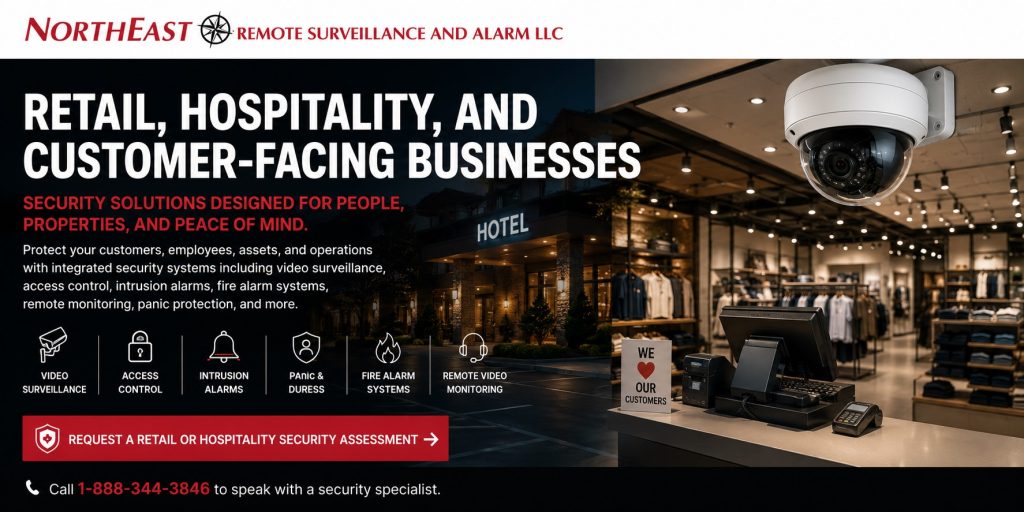
Retail, hospitality, and customer-facing business security systems must protect employees, customers, guests, merchandise, cash-handling areas, offices, stockrooms, service entrances, parking areas, and after-hours operations without making the property difficult or uncomfortable to use.

Request a Retail or Hospitality Security Assessment
Northeast Remote Surveillance and Alarm, LLC designs, installs, integrates, upgrades, monitors, and supports commercial security systems for retail stores, restaurants, hotels, hospitality properties, entertainment venues, franchises, service businesses, and other public-facing commercial environments.
This is NERSA’s primary facility-type planning page for retail, hospitality, and customer-facing businesses.
For security planning organized around other commercial, industrial, institutional, and logistics property types, begin with Industries We Serve.
Security Planning for Customer-Facing Businesses
Public-facing businesses operate differently from warehouses, industrial plants, and private office buildings.
Customers and guests may enter without credentials. Employees move between public and restricted areas. Deliveries arrive through secondary doors. Managers handle cash, records, keys, and system permissions. Cleaning, maintenance, inventory, and vendor activity may continue before opening or after closing.
A retail or hospitality property may also contain:
- Public entrances
- Checkout or service counters
- Point-of-sale areas
- Customer waiting areas
- Dining or gathering spaces
- Guest-service desks
- Employee-only entrances
- Stockrooms
- Receiving areas
- Kitchens and food-service areas
- Administrative offices
- Cash-counting rooms
- IT and telecommunications spaces
- Maintenance rooms
- Exterior patios
- Parking lots
- Delivery lanes
- Waste and recycling areas
- Detached storage or support buildings
The security system must support normal business activity while improving visibility, access accountability, alarm response, incident documentation, employee protection, and after-hours awareness.
NERSA approaches customer-facing business security as commercial infrastructure rather than a collection of unrelated cameras, locks, and alarm devices.
Retail, Hospitality, and Customer-Facing Properties NERSA Supports
NERSA supports qualifying commercial properties such as:
- Retail stores
- Specialty shops
- Shopping-center tenants
- Stand-alone storefronts
- Convenience-oriented businesses
- Restaurants and cafés
- Commercial food-service properties
- Hotels and lodging properties
- Conference and hospitality facilities
- Entertainment venues
- Recreation businesses
- Fitness centers
- Salons and personal-service businesses
- Laundromats
- Automobile sales and service properties
- Professional service locations
- Customer-service offices
- Showrooms
- Franchise operations
- Multi-location retailers
- Public-facing nonprofit facilities
- Mixed retail and office properties
- Commercial properties with public counters
- Tenant spaces within larger commercial buildings
A smaller storefront may need several well-positioned cameras, a commercial intrusion alarm, panic protection, and dependable remote access.
A larger hospitality property or multi-location retail organization may require centralized video management, multiple alarm partitions, role-based access control, parking-lot cameras, fire alarm coordination, remote monitoring, network infrastructure, and standardized administration across many facilities.
For practical planning focused specifically on smaller stand-alone properties, independent operators, and appropriately scaled commercial systems, use Small Business Security Systems.
Layered Security for Public-Facing Commercial Properties
No single camera, alarm, lock, intercom, or monitoring service can address every risk affecting a customer-facing business.
A layered retail or hospitality security system may include:
- Interior video surveillance
- Exterior and parking-lot cameras
- Controlled employee entrances
- Restricted-area access control
- Intrusion detection
- Panic and duress devices
- Door-position monitoring
- Remote video monitoring
- Alarm-event verification
- Visitor or delivery communication
- Fire alarm and life-safety systems
- Environmental-condition alerts
- Secure network infrastructure
- Centralized multi-location management
- Documented user permissions
- Professional monitoring
The correct combination depends on the property, hours of operation, number of employees, customer traffic, merchandise, cash exposure, parking conditions, after-hours activity, existing systems, and responsible management structure.
The objective is not to create unnecessary barriers. Security should support the business and its employees while preserving customer service, accessibility, emergency egress, and normal facility operation.
Video Surveillance for Retail and Hospitality Businesses
Commercial video surveillance can help customer-facing businesses observe entrances, service counters, stockrooms, employee transitions, delivery areas, parking lots, and other locations where incident documentation is important.
Every camera should have a defined purpose.
A camera may be intended to:
- Identify a person entering the property
- Document activity at a service counter
- Review a customer or employee incident
- Observe a merchandise display
- Monitor access to a stockroom
- Document a delivery
- Review after-hours activity
- Verify an intrusion alarm
- Observe a parking area
- Monitor an exterior doorway
- Review cash-handling procedures
- Document activity in a common area
- Support a liability or damage investigation
Installing cameras without defining the intended view can produce broad footage that does not provide the detail required after an event.
Potential camera locations include:
- Main entrances
- Secondary entrances
- Service counters
- Checkout areas
- Customer waiting areas
- Public corridors
- Dining and gathering areas
- Employee entrances
- Stockroom entrances
- Receiving areas
- Administrative corridors
- Cash-handling rooms
- Parking lots
- Sidewalk approaches
- Delivery doors
- Waste and recycling areas
- Exterior patios
- Vehicle lanes
- Detached storage buildings
Camera planning should consider image detail, field of view, lighting, reflections, glass storefronts, display fixtures, seasonal decorations, mounting height, video retention, network capacity, remote access, cybersecurity, and user permissions.
More cameras do not automatically create a stronger system. The layout should prioritize useful identification and incident-review views.
Privacy-Aware Camera Placement
Retail and hospitality businesses must distinguish between legitimate security coverage and privacy-sensitive areas.
Cameras may be appropriate in public entrances, service areas, corridors, lobbies, parking areas, stockrooms, and other operational spaces where the business has a clear security purpose.
Cameras should not be installed in:
- Restrooms
- Changing rooms
- Locker-room changing areas
- Hotel guestrooms
- Other locations where a person would reasonably expect substantial privacy
Properties should also establish policies governing:
- Who may view live video
- Who may search recordings
- Who may export footage
- How long video is retained
- How recordings are shared
- How administrator accounts are controlled
- How system activity is documented
Audio recording, facial analytics, biometric identification, and other advanced features may create additional legal, policy, and privacy considerations. Businesses should review those uses with their responsible legal, human-resources, privacy, and management personnel.
Checkout, Service-Counter, and Cash-Handling Security
Checkout lanes, front desks, reception counters, cash registers, and customer-service positions combine public interaction with employee responsibility.
Security planning for these areas may include:
- Transaction-area cameras
- Customer and employee overview views
- Focused register-position views
- Panic or duress devices
- Restricted access to cash rooms
- Controlled manager offices
- Video retention appropriate to business needs
- Individual system-user accounts
- Incident-export procedures
- Alarm notification
- After-hours intrusion protection
Camera placement should document the overall interaction without unnecessarily capturing payment information, computer screens, confidential records, or other information unrelated to the security objective.
Security technology can assist with incident review, internal investigations, robbery documentation, dispute resolution, and operational oversight. It does not replace proper cash controls, employee procedures, management supervision, payment-security requirements, or responsible business policies.
Employee Entrances and Restricted-Area Access Control
Customer-facing businesses often keep the main public entrance open while restricting staff areas, offices, kitchens, stockrooms, cash rooms, maintenance spaces, and service corridors.
Commercial access control may be appropriate for:
- Employee entrances
- Manager offices
- Cash-counting rooms
- Stockrooms
- Inventory cages
- IT and telecommunications rooms
- Liquor or controlled-product storage
- Maintenance areas
- Housekeeping areas
- Commercial kitchens
- Loading and receiving doors
- Hotel administrative areas
- Mechanical rooms
- Detached storage spaces
- Multi-tenant interior transitions
Access permissions can be assigned according to the employee’s job, location, shift, schedule, or responsibility.
A manager may need broader access than a sales employee. A housekeeping or maintenance employee may need access to service areas without receiving permission to administrative rooms. A contractor may receive temporary access limited to the required opening and work period.
When an employee leaves the organization, the credential can be disabled without immediately rekeying every affected door.
Access control should always be coordinated with the complete opening, including:
- Door and frame condition
- Mechanical locking hardware
- Electrified hardware
- Door-position monitoring
- Request-to-exit devices
- Emergency egress
- Accessibility
- Fire alarm operation
- Backup power
- Door-closing performance
A card reader alone does not correct a damaged door, weak frame, failing closer, or unsuitable lock.
Intrusion Alarms and After-Hours Protection
Retail and hospitality businesses frequently remain vulnerable when closed or operating with reduced staffing.
Potential intrusion points include:
- Main entry doors
- Secondary entrances
- Glass storefronts
- Emergency exits
- Delivery doors
- Roof hatches
- Stockroom doors
- Offices
- Cash rooms
- Detached storage areas
- Drive-through or service windows
- Interior transitions between tenant spaces
A commercial intrusion alarm system may include:
- Door contacts
- Motion detection
- Glass-break detection
- Restricted-room protection
- Individual user codes
- Access-control integration
- Multiple alarm partitions
- Cellular or IP communication
- Backup communication
- Video verification
- Professional monitoring
- Environmental or equipment-condition inputs
The alarm should reflect the way the business actually operates.
Cleaning crews, early deliveries, late-closing managers, overnight employees, contractors, maintenance personnel, and seasonal hours must be considered during zoning and schedule planning.
A restaurant may need separate protection for the dining area, kitchen, office, and liquor storage. A hotel may operate continuously while protecting administrative, storage, or maintenance areas separately. A multi-tenant retail property may require independent partitions for different businesses.
Clear alarm descriptions are important. A message identifying “Rear Receiving Door” is more useful than an unexplained numbered zone.
Panic and Duress Protection
Employees working at service counters, checkout areas, hotel desks, offices, or isolated positions may benefit from properly planned panic or duress devices.
Potential locations may include:
- Front desks
- Checkout counters
- Customer-service stations
- Manager offices
- Cash-handling rooms
- Reception areas
- Drive-through positions
- Late-night employee work areas
- Other locations identified during the assessment
A panic device should not be installed without a defined response procedure.
Management should determine:
- Who receives the signal
- Whether the activation is audible or silent
- What information is transmitted
- How the event is verified
- What responsible parties are contacted
- What employees are expected to do
- How the device is tested
- How accidental activations are handled
No panic system can guarantee a particular emergency outcome. It is one part of a broader program that includes employee training, management procedures, emergency communication, monitoring, and coordination with the appropriate responders.
Parking Lots, Walkways, and Exterior Areas
Customer and employee incidents frequently occur outside the building.
Exterior retail and hospitality security planning may address:
- Customer parking
- Employee parking
- Accessible parking spaces
- Building entrances
- Sidewalk approaches
- Drive-through lanes
- Pickup areas
- Hotel drop-off zones
- Loading and delivery areas
- Exterior patios
- Waste and recycling areas
- Side alleys
- Detached storage
- Building perimeters
- Vehicle entrances and exits
Wide overview cameras may document general movement, but they may not provide clear identification of a person or vehicle.
A stronger design may combine:
- General parking-area views
- Focused entrance cameras
- Vehicle-lane views
- Pedestrian-approach cameras
- Exterior door coverage
- Proper lighting
- Defined retention requirements
- Remote video monitoring where appropriate
The assessment should consider nighttime lighting, vehicle headlights, weather, landscaping, signs, seasonal decorations, mounting height, network distance, and the property’s actual traffic pattern.
Retail Store Security Systems
Retail businesses must balance open customer access with protection of merchandise, employees, restricted areas, and after-hours property exposure.
Retail security planning may address:
- Customer entrances
- Checkout and service counters
- High-value merchandise
- Stockrooms
- Fitting-area approaches
- Manager offices
- Cash handling
- Employee entrances
- Delivery doors
- Parking areas
- Shoplifting or theft investigations
- Internal access accountability
- Intrusion protection
- Alarm verification
- Multi-location administration
Video surveillance should be positioned to provide useful incident evidence without creating inappropriate coverage.
Access control may be more effective than additional cameras for stockrooms, offices, inventory cages, and employee-only areas. Panic devices may support public-facing employees. Intrusion alarms may protect doors, windows, offices, and restricted spaces after closing.
The strongest retail system usually combines several carefully selected layers rather than relying on cameras alone.
Hotel and Hospitality Security Systems
Hospitality properties operate around the clock and must accommodate guests, employees, service vendors, deliveries, events, housekeeping activity, maintenance, and emergency procedures.
Security planning may include:
- Main lobby coverage
- Front-desk security
- Public entrance cameras
- Employee entrances
- Service corridors
- Administrative offices
- Cash-handling areas
- Housekeeping storage
- Maintenance spaces
- Loading and delivery areas
- Parking facilities
- Exterior entrances
- Conference and event spaces
- Panic or duress devices
- Restricted-area access control
- Fire alarm and life-safety coordination
Security-system permissions should be carefully separated.
Front-desk employees may need limited camera or intercom access. Managers may require incident-review permissions. Facilities personnel may need access-control or alarm management without unrestricted authority over all recorded video.
Guestrooms and other privacy-sensitive spaces must remain outside ordinary video-surveillance coverage.
Technology should support guest and employee security without unnecessarily interfering with hospitality operations or creating an institutional environment.
Restaurant and Food-Service Security
Restaurants, cafés, and commercial food-service businesses may combine public dining areas, kitchens, bars, cash handling, deliveries, employee entrances, storage areas, and late operating hours.
Security planning may address:
- Main entrances
- Point-of-sale areas
- Dining-room overviews
- Host and waiting areas
- Bar or service-counter activity
- Kitchen entrances
- Food and beverage storage
- Manager offices
- Delivery doors
- Exterior patios
- Waste areas
- Employee parking
- Intrusion protection
- Panic devices
- Fire alarm coordination
Camera positioning should account for changing lighting, crowded dining areas, decorations, reflections, steam, equipment, and employee movement.
Kitchen and food-service environments may also contain heat, moisture, grease, and cleaning conditions that affect equipment selection and mounting.
Security equipment should not interfere with sanitation, food preparation, required exits, fire-protection systems, or normal restaurant operations.
Entertainment, Recreation, and Service Businesses
Entertainment venues, fitness facilities, salons, studios, recreation businesses, and other customer-facing operations may have changing occupancy, scheduled events, membership access, public counters, locker areas, employee-only spaces, and after-hours risks.
Security planning may include:
- Customer and member entrances
- Reception desks
- Ticket or service counters
- Membership access
- Restricted employee areas
- Equipment storage
- Administrative offices
- Parking lots
- Emergency exits
- Intrusion alarms
- Panic protection
- Fire alarm coordination
Camera coverage should remain outside changing rooms, restrooms, and other privacy-sensitive spaces.
Access control may help manage staff entrances, membership doors, equipment rooms, and after-hours access. Individual credentials can provide better accountability than shared keys or door codes.
Remote Video Monitoring and Alarm Verification
Some retail and hospitality properties may benefit from remote video monitoring around parking areas, delivery entrances, exterior patios, service alleys, waste areas, or other locations exposed after hours.
Depending on the property and approved procedures, monitoring may support:
- Alarm verification
- After-hours video review
- Scheduled camera tours
- Unauthorized-person detection
- Parking-lot activity review
- Delivery-area monitoring
- Live audio warnings
- Responsible-party notification
- Recorded event documentation
Remote monitoring should be designed around useful camera views, defined detection areas, lighting, network reliability, operating schedules, expected legitimate activity, and written escalation instructions.
Analytics can be affected by weather, headlights, animals, reflections, shadows, vegetation, customer activity, delivery traffic, and other conditions. Detection rules should be tested and adjusted for the property.
For broader planning across video surveillance, access control, intrusion alarms, fire alarm systems, intercoms, monitoring, and low-voltage infrastructure, visit Commercial and Industrial Security Services.
Fire Alarm and Life-Safety Coordination
Retail and hospitality properties may require fire alarm detection, occupant notification, sprinkler supervision, monitoring, kitchen-system interfaces, elevator functions, door release, HVAC coordination, emergency communication, testing, and Authority Having Jurisdiction approval.
Fire alarm systems are regulated life-safety systems and must remain separate from ordinary security functions.
Security and fire alarm systems may interact at:
- Access-controlled doors
- Magnetic door holders
- Elevators
- Emergency exits
- Communication systems
- Building-management interfaces
- Monitoring pathways
These interactions must be properly designed, documented, tested, and approved.
An access-control system must not prevent required emergency egress. A routine paging system must not interfere with required fire alarm notification. Security automation must not override life-safety priorities.
Final requirements may involve property management, architects, engineers, fire alarm professionals, kitchen-suppression contractors, elevator providers, mechanical contractors, inspectors, fire marshals, and other responsible parties.
Environmental and Facility-Condition Alerts
Customer-facing businesses may need notifications for selected facility conditions in addition to security events.
Potential monitored conditions include:
- Water leaks
- High or low temperature
- Refrigeration-equipment alarm contacts
- Freezer or cooler trouble
- Power loss
- Sump conditions
- Network equipment trouble
- Communication failure
- Door-left-open conditions
- Selected mechanical-system signals
Environmental notification should not be represented as a replacement for primary refrigeration controls, building-management systems, kitchen controls, process equipment, or required life-safety systems.
When a separate system provides an approved alarm contact, the security or monitoring platform may be able to transmit a secondary notification to designated personnel.
Messages should clearly identify the property, area, condition, recipient, and expected response.
Multi-Location Retail and Hospitality Security
Retail chains, hospitality groups, restaurant operators, and franchise organizations often need consistent security administration across several locations.
A multi-location security program may include:
- Centralized camera access
- Standard camera naming
- Consistent video-retention policies
- Shared access-control roles
- Location-specific alarm partitions
- Individual employee credentials
- Central event reporting
- Standard monitoring instructions
- Role-based administrator permissions
- Consistent documentation
- Coordinated service procedures
- Phased equipment upgrades
Standardization should not force every location into an identical design.
A small storefront, restaurant, hotel, entertainment property, and regional office may have different layouts, hours, risks, infrastructure, and operating requirements.
The objective is to create consistent administration and reporting while allowing each facility to use equipment appropriate for its actual operation.
Security-System Upgrades, Takeovers, and Expansions
Many retail and hospitality businesses have systems installed in stages by several vendors.
Common existing conditions include:
- Mixed camera brands
- Aging recorders
- Poor nighttime video
- Insufficient retention
- Shared passwords
- Unused employee accounts
- Unsupported alarm panels
- Inadequate cellular communication
- Missing panic devices
- Unlabeled alarm zones
- Weak parking-lot coverage
- Obsolete access-control hardware
- Incomplete documentation
- Systems that cannot be managed together
- No consistent multi-location standard
A complete replacement is not always necessary.
NERSA can evaluate:
- What remains dependable
- What can be reused
- Which components are unsupported
- Where immediate security gaps exist
- Whether existing cabling can be retained
- Which systems can be integrated
- How improvements can be phased
- How user and administrator permissions should be reorganized
- What documentation should be created
A phased upgrade may begin with failed recording equipment, uncontrolled employee entrances, poor exterior coverage, unreliable alarm communication, unsupported software, inactive credentials, or critical panic-protection needs.
Network, Cabling, and System Administration
Modern customer-facing business security systems may depend on:
- Structured cabling
- Network switches
- Power over Ethernet
- Equipment racks
- UPS backup
- Cellular communication
- Internet connectivity
- Secure remote access
- Cloud platforms
- Network segmentation
- Accurate time synchronization
- System labeling
- Administrator-account management
Weak infrastructure can cause camera outages, lost recordings, delayed intercom communication, access-control interruptions, and unreliable remote connections.
Security-system access should be limited according to each user’s responsibilities. Default passwords and unnecessarily shared administrator accounts should be removed.
Multi-location organizations should also establish procedures for:
- Adding and removing users
- Reviewing permissions
- Applying software and firmware updates
- Managing remote vendor access
- Preserving configuration backups
- Exporting evidence
- Reviewing system health
- Documenting changes
The NERSA Retail and Hospitality Security Assessment
A retail, hospitality, or customer-facing business security project should begin with an assessment rather than a predetermined equipment package.
The assessment may review:
- Property layout
- Customer and guest movement
- Employee entrances
- Public and restricted areas
- Service counters
- Cash-handling locations
- Stockrooms
- Receiving areas
- Parking lots
- Delivery doors
- Exterior gathering areas
- Existing cameras
- Video quality and retention
- Access-control equipment
- Commercial door hardware
- Intrusion-alarm zones
- Panic or duress devices
- Fire alarm coordination
- Monitoring procedures
- Network and cabling conditions
- Multi-location administration
- User permissions
- Existing documentation
- Known incidents or failures
- Renovation and expansion plans
The objective is to identify where better visibility, stronger access accountability, improved alarm response, dependable communication, more useful incident documentation, or phased modernization can support the business.
Why Retail and Hospitality Businesses Choose NERSA
Northeast Remote Surveillance and Alarm, LLC focuses on commercial, industrial, institutional, and customer-facing business properties—not single-family home alarm packages.
Businesses choose NERSA when they need a security partner that understands:
- Public entrances
- Customer and guest movement
- Employee-only areas
- Cash and merchandise exposure
- Parking-lot security
- Commercial door hardware
- Panic and duress protection
- After-hours intrusion detection
- Remote monitoring
- Fire alarm coordination
- Multi-location administration
- Network infrastructure
- System upgrades
- Long-term serviceability
NERSA supports single storefronts and independent businesses that need practical commercial-grade systems. We also serve hotels, entertainment properties, regional retailers, franchises and multi-location operators. Larger projects may need shared management and infrastructure that can grow.
The objective is not to install the greatest possible number of devices. It is to design a dependable security system matched to the property, operation, responsible users, risks, budget, and long-term requirements.
Request a Retail or Hospitality Security Assessment
Retail, hospitality, and customer-facing business security systems should be planned around actual customers, guests, employees, entrances, restricted areas, cash-handling locations, parking exposure, operating hours, emergency procedures, and infrastructure.
Northeast Remote Surveillance and Alarm, LLC can evaluate new installations, existing cameras, alarm systems, employee access, panic protection, parking-lot visibility, fire alarm coordination, network limitations, multi-location management, and phased upgrade priorities.
Frequently Asked Questions About Retail and Hospitality Security Systems
What security systems can NERSA provide for retail and hospitality businesses?
NERSA can design, install, integrate, upgrade, monitor and support cameras, access control, intrusion alarms and panic or duress devices. Services also cover remote video monitoring, intercoms, fire alarms and selected environmental alerts. Structured cabling and multi-location security platforms can form part of the plan.
What types of customer-facing businesses can NERSA support?
NERSA supports qualifying retail stores, restaurants, hotels, hospitality properties, entertainment businesses, recreation facilities, salons, fitness centers, service businesses, franchise locations, public-facing offices, and multi-location commercial organizations.
Can NERSA support both a small storefront and a large multi-location organization?
Yes. NERSA can design practical commercial-grade systems for smaller independent properties as well as scalable systems for hotels, regional retailers, franchise groups, entertainment properties, and multi-location businesses requiring centralized administration.
Where should cameras be installed in a retail store?
Common locations include entrances, checkout areas, customer-service counters, stockroom entrances, receiving doors, employee entrances, parking areas, and other operational spaces with a defined security purpose. Placement should be based on the view and evidence required.
Can cameras be installed in hotel guestrooms or changing rooms?
No. Cameras should not be installed in hotel guestrooms, restrooms, changing rooms, or other areas where people have a substantial expectation of privacy.
Can access control be used while the main customer entrance remains unlocked?
Yes. Access control can be used on employee entrances, offices, stockrooms, cash rooms, kitchens, maintenance areas, IT rooms, and other restricted spaces while public entrances remain available during operating hours.
Can a retail alarm system account for employees working after hours?
Yes. Proper zoning, alarm partitions, individual user credentials, and schedules can allow authorized employees, cleaners, contractors, or managers to use approved portions of the property while other areas remain protected.
Should customer-facing employees have panic buttons?
Panic or duress devices may be appropriate at service counters, hotel desks, manager offices, cash rooms, and isolated positions. Their use should be based on a facility assessment and supported by documented response procedures and employee training.
Can NERSA upgrade an existing retail or hospitality security system?
Yes. NERSA can assess existing cameras, recorders, access-control equipment, alarms, panic devices, fire alarm interfaces, monitoring paths, cabling, networks, users, and documentation to determine what can be retained, upgraded, integrated, or replaced.
Can multiple retail or hospitality locations be managed together?
Compatible systems may provide centralized video access, credential administration, alarm reporting, site status, user permissions, and standardized documentation across multiple properties.
Does security technology prevent every theft, emergency, or customer incident?
No security system can eliminate every risk or guarantee a particular outcome. Properly planned systems can improve visibility, access accountability, event detection, incident documentation, notification, and response support.
How should a retail or hospitality business begin a security project?
Begin with an assessment of the property, public and employee entrances, customer flow, restricted areas, cash handling, parking, deliveries, operating schedules, existing systems, emergency procedures, network infrastructure, known problems, and future plans.
Request a Retail or Hospitality Security Assessment.
Explore hospitality security planning for an Allentown property.
- Hospitality Security Systems in Allentown, PA — Review local planning for guest access, shared spaces and property security.
Compliance, Codes & Project Standards
NERSA plans commercial and industrial security work with applicable code, documentation, inspection and authority-having-jurisdiction requirements in mind. Requirements vary by system, property and jurisdiction. These resources support project planning; they do not establish legal compliance, certification or AHJ approval.
Related guidance: Regulatory compliance & inspection readiness · Healthcare security compliance · NERSA project standards