Bethlehem Parking Lot Security Camera Systems

Commercial Parking-Lot Surveillance for Vehicles, Pedestrians, Entrances, Drive Lanes, and After-Hours Activity in Bethlehem, PA

Bethlehem parking lot security camera systems should provide useful visibility across employee parking, visitor spaces, public areas, vehicle lanes, pedestrian routes, building entrances, service drives, and exterior approaches during both daytime and nighttime conditions.

Northeast Remote Surveillance and Alarm, LLC designs, installs, upgrades, integrates, and supports commercial parking-lot camera systems for Bethlehem offices, warehouses, manufacturing facilities, healthcare properties, schools, municipal buildings, retail locations, industrial parks, contractor operations, multi-tenant properties, and other non-residential facilities.

Parking-lot surveillance requires more than mounting a few cameras on the side of a building. Camera locations, mounting heights, lens selection, lighting, vehicle movement, pedestrian activity, recording quality, video retention, network infrastructure, and incident-review requirements must all be considered before equipment is selected.

For broader citywide planning, begin with Commercial and Industrial Security Systems in Bethlehem, PA.

Request a Bethlehem Parking-Lot Security Assessment
Call 1-888-344-3846

Commercial and institutional systems only • New installations • Upgrades • Expansions • Integrations • System takeovers

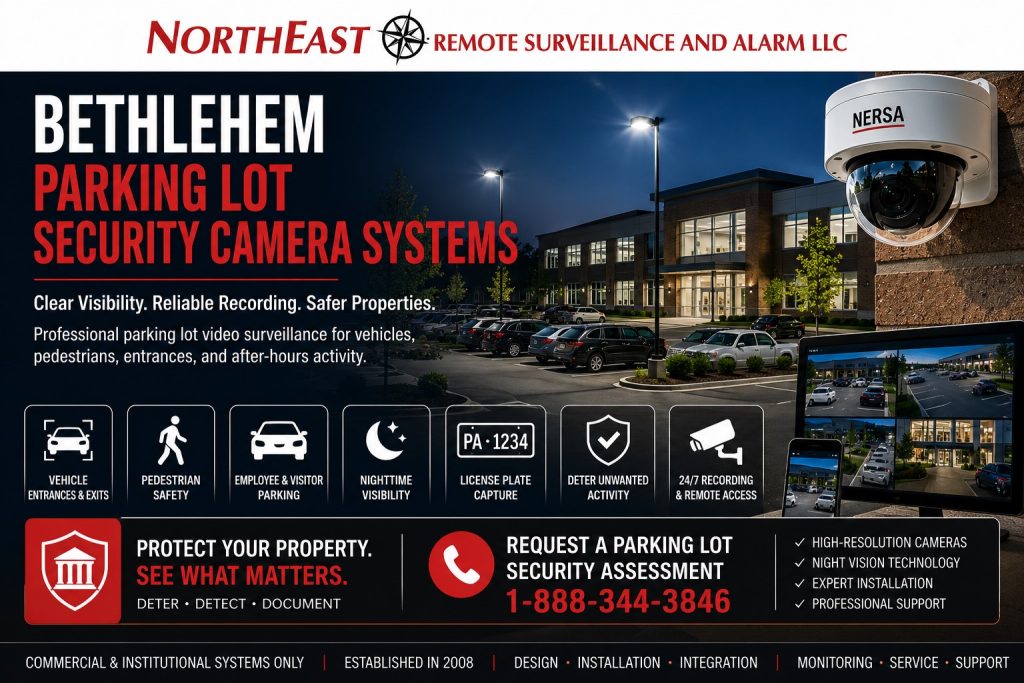
Bethlehem parking lot security camera systems monitoring employee and visitor parking, vehicle entrances, pedestrian routes, building approaches, nighttime activity, license plates, and commercial properties for Northeast Remote Surveillance and Alarm, LLC.

Parking-Lot Security Designed Around the Property

Every Bethlehem parking area operates differently.

A small professional office may need clear coverage of its front entrance, employee vehicles, and rear service area. A healthcare property may need visibility across patient drop-off zones, staff parking, pedestrian routes, and evening entrances. A warehouse or manufacturing facility may require coverage of shift changes, large employee lots, truck approaches, loading areas, and isolated sections of the property.

Parking-lot camera planning may review:

  • Employee parking areas
  • Visitor parking
  • Public parking
  • Accessible parking spaces
  • Building entrances
  • Employee entrances
  • Patient or customer drop-off areas
  • Bus and school arrival zones
  • Vehicle entrances and exits
  • Internal drive lanes
  • Pedestrian routes
  • Sidewalks and crosswalks
  • Rear parking areas
  • Service drives
  • Delivery approaches
  • Overflow parking
  • Detached parking areas
  • Parking garages
  • Vehicle gates
  • Loading-area transitions
  • Building perimeters
  • Exterior gathering areas
  • Lighting conditions
  • Existing cameras and mounting locations
  • Network and power availability
  • Video retention requirements
  • Known blind spots
  • Previous incidents
  • Future property expansion

The objective is not simply to record that activity occurred. The system should provide enough detail to help authorized personnel understand what happened, where it occurred, how people or vehicles moved through the property, and which video should be reviewed.

Overview Cameras and Identification Views

One camera cannot usually provide both a wide view of an entire parking lot and detailed identification across long distances.

A properly designed Bethlehem parking-lot camera system may use several types of views.

Parking-Lot Overview Cameras

Overview cameras help show:

  • General vehicle movement
  • Pedestrian activity
  • Direction of travel
  • Parking-space activity
  • Traffic patterns
  • Building approaches
  • Large-area incidents
  • Activity before and after an event

These views provide context but may not always show enough detail to identify a person or vehicle at the far edge of the image.

Entrance and Exit Cameras

Focused cameras at vehicle entrances and exits may help document:

  • Vehicles entering and leaving
  • Vehicle type and color
  • Direction of travel
  • Arrival and departure times
  • Driver-side activity
  • Gate interactions
  • Visitor or contractor approaches

Vehicle entrance cameras should be positioned around the lane rather than expected to cover the entire parking area.

Pedestrian and Building-Entrance Cameras

Cameras near sidewalks, crosswalks, vestibules, employee doors, and public entrances may provide clearer views of people moving between the parking lot and the building.

These cameras can help document:

  • Who approached the property
  • Which entrance was used
  • Whether someone remained near a doorway
  • Movement between vehicles and the building
  • Activity around employee entrances
  • Incidents near drop-off or pickup areas

The strongest parking-lot design combines wide contextual views with focused cameras at important entrances, lanes, and pedestrian routes.

Daytime and Nighttime Camera Performance

A parking-lot camera that looks clear during daylight may perform poorly after dark.

Nighttime performance can be affected by:

  • Uneven lighting
  • Dark sections of the property
  • Vehicle headlights
  • Reflections from wet pavement
  • Bright building lights
  • Deep shadows
  • Seasonal landscaping
  • Snow and rain
  • Camera distance
  • Mounting angle
  • Infrared reflection
  • Fast-moving vehicles
  • Poor lens selection

NERSA evaluates how the parking area looks during the hours when useful video is most important.

A facility that operates only during daylight has different requirements from a warehouse with overnight shifts, a healthcare property with evening appointments, a municipal building with nighttime meetings, or a manufacturing plant operating continuously.

Camera selection may include low-light capability, wide dynamic range, infrared illumination, supplemental lighting, adjusted shutter settings, or focused cameras for difficult vehicle and entrance conditions.

The goal is usable video—not an image that appears bright but loses important detail.

Parking-Lot Lighting and Camera Coordination

Security cameras and exterior lighting should be planned together.

Additional light does not automatically produce better video. Poorly positioned fixtures can create glare, bright hotspots, reflections, and dark shadows that make people or vehicles more difficult to see.

Lighting review may consider:

  • Fixture placement
  • Light direction
  • Dark parking sections
  • Building-mounted lighting
  • Pole-mounted lighting
  • Vehicle headlights
  • Entrance canopies
  • Trees and landscaping
  • Seasonal changes
  • Light levels near pedestrian routes
  • Motion-activated lighting
  • Utility and maintenance limitations

Camera locations may need to be adjusted after nighttime testing.

A system should be commissioned under real operating conditions rather than evaluated only during daytime installation.

Vehicle Documentation and License Plates

A standard overview camera should not automatically be expected to capture readable license plates.

License plates present a specialized imaging challenge because vehicles move at different speeds, headlights create glare, reflective plate surfaces become bright at night, and wide parking-lot views spread image detail across a large area.

A plate-capture objective may require:

  • A dedicated vehicle lane
  • A controlled field of view
  • Correct camera distance
  • A narrow capture angle
  • Appropriate mounting height
  • Vehicle-speed consideration
  • Specialized exposure settings
  • Dedicated illumination
  • Separate overview video
  • Accurate time synchronization
  • Searchable recording
  • Defined retention requirements

A strong design may use one camera to capture the plate and another to show the vehicle, driver area, lane, and surrounding activity.

General parking-lot surveillance and license plate recognition are related but separate objectives. The facility should decide whether it needs broad vehicle awareness, readable plates at selected lanes, searchable plate data, or a combination of these capabilities.

Employee Parking-Lot Security

Employee parking areas may experience concentrated activity during shift changes, opening and closing, early-morning arrival, late-night departure, and periods when few people are outside.

Camera planning may support:

  • Employee arrival and departure
  • Shift-change activity
  • Pedestrian routes
  • Building approaches
  • Vehicle damage investigations
  • Suspicious vehicle review
  • Unauthorized parking
  • After-hours activity
  • Entrance accountability
  • Coordination with employee access control
  • Incident documentation

Cameras should provide useful views of the routes employees actually use rather than concentrating only on the center of the parking lot.

A camera showing the transition between the employee lot and the controlled entrance may provide more useful information than another distant overview.

Visitor and Public Parking Areas

Visitor parking often connects directly to reception areas, public entrances, service counters, healthcare entrances, school offices, municipal buildings, and multi-tenant lobbies.

Security planning may include:

  • Visitor vehicle approaches
  • Designated visitor spaces
  • Public entrances
  • Accessible parking
  • Drop-off zones
  • Reception approaches
  • Pedestrian crossings
  • After-hours visitors
  • Delivery vehicles
  • Contractor arrivals
  • Ride-share activity
  • Unexpected vehicle activity

Visitor-area cameras should help authorized staff understand how a person arrived, where the vehicle was parked, which entrance was approached, and what occurred around the visit.

Healthcare Parking-Lot Cameras

Healthcare parking areas may serve patients, staff, visitors, delivery personnel, service contractors, and emergency transportation at different times of the day.

Camera priorities may include:

  • Patient drop-off areas
  • Main entrances
  • Staff entrances
  • Accessible parking
  • Evening employee routes
  • Rear service areas
  • Delivery entrances
  • Visitor parking
  • Exterior waiting areas
  • Building approaches
  • Vehicle incidents
  • After-hours activity

Camera placement should respect areas where privacy is expected while still providing appropriate exterior visibility.

School and Educational Parking Areas

Educational properties may have several overlapping vehicle and pedestrian activities during arrival, dismissal, athletics, evening events, and after-school programs.

Parking-area planning may consider:

  • Staff parking
  • Visitor parking
  • Parent pickup lanes
  • Student arrival areas
  • Bus loops
  • Crosswalks
  • Athletic entrances
  • Event parking
  • Administrative entrances
  • Evening activities
  • Detached buildings
  • Playground approaches
  • Vehicle and pedestrian separation

A school parking camera system should support the property’s established arrival, dismissal, visitor, and emergency procedures.

It should not be treated as a replacement for supervision, traffic management, staff training, or emergency planning.

Municipal and Public-Facility Parking Lots

Municipal properties may serve employees, elected officials, contractors, residents, public-meeting attendees, and service vehicles.

Camera coverage may support:

  • Public entrances
  • Employee parking
  • Visitor parking
  • Council-meeting activity
  • Evening events
  • Accessible routes
  • Fleet vehicles
  • Public works areas
  • Community-center parking
  • Service entrances
  • Payment or document-drop areas
  • After-hours activity

The system should preserve appropriate public access while providing useful documentation around municipal assets, employees, and exterior activity.

Warehouse and Manufacturing Parking Lots

Warehouse and manufacturing properties may have large employee lots, multiple shifts, truck activity, contractor vehicles, loading areas, and sections of the property that remain active around the clock.

Camera planning may include:

  • Employee vehicle lanes
  • Shift-change entrances
  • Contractor parking
  • Visitor parking
  • Truck and employee traffic separation
  • Building approaches
  • Exterior break areas
  • Loading-area transitions
  • Remote lot sections
  • Fence lines
  • Gate approaches
  • After-hours vehicle activity
  • Vehicle damage review
  • Suspicious parking
  • Coordination with employee credentials

Parking coverage should remain distinct from truck-yard and loading-dock surveillance. Each area has different movement, distance, lighting, identification, and operational requirements.

Office and Multi-Tenant Parking Areas

Office buildings and multi-tenant commercial properties may share entrances, drive lanes, pedestrian paths, loading areas, and visitor parking among several occupants.

A shared parking-lot system may require:

  • Property-management access
  • Tenant-specific user permissions
  • Shared-camera policies
  • Defined video-retention periods
  • Entrance and lobby coordination
  • Delivery-area coverage
  • Rear employee parking
  • After-hours review
  • Incident-export procedures
  • Camera naming by building or zone
  • Clear responsibility for system administration

Video access should be limited according to each user’s legitimate responsibilities.

A tenant should not automatically receive unrestricted access to every camera across the property.

Camera Mounting Locations

Parking-lot cameras may be installed on:

  • Building walls
  • Entrance canopies
  • Light poles
  • Dedicated camera poles
  • Parking garages
  • Gate structures
  • Detached buildings
  • Utility structures
  • Existing exterior equipment locations

Each mounting option has advantages and limitations.

A building-mounted camera may have dependable power and network access but may be too far from the area requiring detail. A pole-mounted camera may provide a better angle but require trenching, fiber, wireless communication, surge protection, specialized power, and service access.

Mounting decisions should consider:

  • Required viewing distance
  • Camera stability
  • Vibration
  • Weather exposure
  • Service accessibility
  • Tampering risk
  • Lightning and surge exposure
  • Cable pathways
  • Network distance
  • Landscaping
  • Snow-removal activity
  • Future construction
  • Property ownership
  • Utility availability

Camera height should be selected around the required view—not simply placed as high as possible.

Excessive height can produce steep angles that show the tops of vehicles or heads while reducing useful facial and vehicle detail.

Fixed, Multi-Sensor, and PTZ Cameras

Different parking areas may require different camera types.

Fixed Cameras

Fixed cameras provide a consistent recorded view. They are often appropriate for entrances, pedestrian routes, building approaches, parking rows, and vehicle lanes.

Because the view does not change, investigators know that the defined area was continuously recorded.

Multi-Sensor Cameras

Multi-sensor cameras can provide several coordinated views from one mounting point. They may be useful for building corners, large intersections, broad parking sections, and properties where multiple directions must be observed.

Each sensor still needs to be positioned around a defined objective.

Pan-Tilt-Zoom Cameras

PTZ cameras can help authorized users investigate live activity across larger exterior areas. However, a PTZ camera records only the direction in which it is pointed at that moment.

PTZ cameras should not normally replace fixed cameras covering critical entrances, vehicle lanes, or pedestrian routes.

A complete design may use fixed cameras for dependable continuous recording and PTZ cameras for supplemental live investigation.

AI-Enabled Parking-Lot Analytics

AI-supported video analytics may help identify selected types of activity, such as:

  • People entering a defined area
  • Vehicles entering after hours
  • Movement near a building entrance
  • Loitering in selected zones
  • Directional travel
  • Line crossing
  • Activity near a gate
  • Vehicles remaining in restricted areas
  • Recurring exterior movement

Analytics should be configured around real property conditions.

Trees, headlights, weather, shadows, animals, snow, reflections, and normal employee activity can create unnecessary alerts when detection zones and schedules are not properly adjusted.

An AI alert is not the same as confirmed criminal activity. It is an event that may require review under the facility’s established procedures.

Remote Viewing and User Permissions

Commercial parking-lot camera systems may allow authorized personnel to view live or recorded video from approved workstations, web interfaces, or mobile devices.

Remote access should be controlled through:

  • Individual user accounts
  • Strong passwords
  • Multi-factor authentication where supported
  • Role-based permissions
  • Secure network configuration
  • Approved devices
  • Software updates
  • Account removal procedures
  • Access logging
  • Export permissions
  • Periodic user review

Shared administrator passwords create avoidable security and accountability problems.

Property owners and managers should know who can access the system, which cameras each person can view, and whether the user can export or delete video.

Video Recording and Retention

The correct retention period depends on the facility’s operating risks, incident-discovery timeline, storage capacity, camera count, resolution, frame rate, recording method, and organizational policy.

Retention planning should consider:

  • How quickly incidents are normally reported
  • Insurance and investigation needs
  • Employee or visitor complaints
  • Vehicle-damage discovery
  • Weekend and holiday gaps
  • Management review procedures
  • Camera resolution
  • Motion or event recording
  • Continuous recording requirements
  • Cloud or local storage
  • Export and evidence handling
  • Multi-site standards

The recorder should provide enough capacity to meet the actual retention objective under real recording conditions.

A system should not be described as providing a specific retention period until camera settings, recording schedules, storage capacity, and estimated activity have been calculated.

Network, Fiber, Power, and Wireless Connectivity

Large Bethlehem parking lots may extend beyond normal copper-network distances or lack convenient pathways between cameras and the main building.

Infrastructure options may include:

  • Category cabling
  • Fiber-optic cabling
  • Power-over-Ethernet switches
  • Exterior network enclosures
  • Wireless bridges
  • Dedicated camera poles
  • Local power
  • Solar or remote power for selected applications
  • Surge protection
  • Uninterruptible power
  • Equipment grounding
  • Network segmentation
  • Cellular connectivity
  • Managed switches
  • System-health monitoring

Wireless connectivity can be useful when trenching is impractical, but it requires proper line of sight, mounting stability, frequency planning, power, security, bandwidth, and ongoing maintenance.

Infrastructure should be designed with enough capacity for current cameras and reasonable future expansion.

Parking-Lot Cameras and Other Security Systems

Parking-lot cameras can provide stronger operational value when coordinated with other compatible security systems.

Access Control

Cameras near employee entrances may help review credential activity, forced-door events, held-open doors, and movement between parked vehicles and the building.

Intrusion Alarms

Exterior cameras may provide additional context around after-hours alarm events, exterior-door activity, or movement near protected areas.

Gate Access Control

Overview cameras can document vehicles approaching or passing through controlled gates.

License Plate Capture

Dedicated plate cameras may provide searchable vehicle information at selected entrances while overview cameras document the complete vehicle event.

Video Intercoms

A camera system may help provide additional context when a visitor uses an entrance or gate intercom.

Remote Video Monitoring

Selected exterior cameras may be used for scheduled event detection, operator review, responsible-party notification, live audio warnings, or documented escalation when the property requires active after-hours protection.

Integration should support a defined operational purpose rather than add unnecessary complexity.

Existing Parking-Lot Camera Upgrades

An older parking-lot camera system may have unclear nighttime images, weak coverage, unreliable recording, insufficient retention, poor remote access, outdated software, or cameras that no longer match the property’s current layout.

An upgrade assessment may review:

  • Existing camera condition
  • Camera resolution
  • Lens and viewing angles
  • Nighttime performance
  • Blind spots
  • Recorder age
  • Storage capacity
  • Video-retention history
  • Remote-viewing reliability
  • User permissions
  • Password management
  • Network condition
  • Cabling
  • Wireless links
  • Pole condition
  • Surge protection
  • Power supplies
  • Existing licenses
  • Export quality
  • Time synchronization
  • Documentation
  • Expansion capacity

Existing cameras, cabling, poles, fiber, wireless bridges, and network equipment may sometimes be retained when they remain compatible, supportable, properly installed, and appropriate for the new design.

The correct decision should be based on an inspection rather than an assumption that everything must be replaced.

Small Parking Lots and Large Commercial Campuses

NERSA supports parking-lot camera projects for smaller commercial properties and larger multi-building operations.

A smaller office, medical practice, retail property, or contractor shop may need:

  • Several fixed cameras
  • Entrance coverage
  • Employee parking visibility
  • Rear service-area coverage
  • Secure remote access
  • Practical local recording

A larger warehouse, manufacturing campus, school, municipal operation, healthcare property, or industrial park may require:

  • Multiple camera poles
  • Fiber or wireless connections
  • Several recording servers
  • Multi-sensor cameras
  • Vehicle entrance coverage
  • Dedicated plate capture
  • AI analytics
  • Remote monitoring
  • Multi-building administration
  • Role-based user permissions
  • Standardized retention
  • Documented system naming
  • Scalable infrastructure

The system should match the size and complexity of the property without forcing a smaller facility into an unnecessarily complicated platform or limiting a larger operation with equipment that cannot expand.

Why Bethlehem Businesses Choose NERSA

Northeast Remote Surveillance and Alarm, LLC focuses on commercial, industrial, institutional, municipal, healthcare, educational, warehouse, manufacturing, contractor, and multi-site properties.

Parking-lot security planning may consider:

  • Property layout
  • Vehicle movement
  • Pedestrian routes
  • Building entrances
  • Employee schedules
  • Visitor activity
  • Daytime and nighttime lighting
  • Required image detail
  • Incident-review procedures
  • Plate-capture objectives
  • Video retention
  • Remote access
  • User permissions
  • Network infrastructure
  • Camera mounting
  • Monitoring requirements
  • Existing equipment
  • Future expansion
  • Long-term serviceability

The objective is to create a parking-lot surveillance system that provides useful video, manageable administration, dependable recording, and a practical path for future growth.

For broader camera-system planning inside and outside the building, review Commercial Video Surveillance Systems in Bethlehem, PA.

Request a Bethlehem Parking-Lot Security Assessment

A parking-lot camera assessment should review the property before camera models and quantities are selected.

NERSA can evaluate:

  • Employee and visitor parking
  • Vehicle entrances and exits
  • Pedestrian routes
  • Building approaches
  • Accessible parking
  • Exterior lighting
  • Known incident areas
  • Existing camera views
  • Required identification detail
  • Plate-capture objectives
  • Camera poles and mounting locations
  • Cabling and network pathways
  • Fiber or wireless connectivity
  • Recording and retention
  • Remote access
  • User permissions
  • Monitoring requirements
  • Existing equipment
  • Future expansion plans

Request a Commercial Security Assessment or call 1-888-344-3846 to discuss a Bethlehem parking-lot security camera project.

Commercial and institutional systems only • New installations • Upgrades • Expansions • Integrations • System takeovers


Frequently Asked Questions About Bethlehem Parking Lot Security Camera Systems

Where should parking-lot security cameras be installed?

Camera locations should be based on the property’s entrances, vehicle lanes, parking rows, pedestrian routes, building approaches, lighting, viewing distances, incident history, and required image detail. Useful systems commonly combine overview views with focused cameras at entrances and other important areas.

Can one camera cover an entire commercial parking lot?

A camera may provide a broad overview, but it may not provide identification-quality detail across the entire area. Larger lots usually require several coordinated cameras with different fields of view.

Will a standard parking-lot camera capture license plates?

Not reliably in every condition. Plate capture may require a dedicated camera, controlled lane, proper angle, suitable distance, specialized exposure, and separate overview video.

Do parking-lot cameras work at night?

Yes, when the cameras, lenses, lighting, mounting locations, exposure settings, and fields of view are designed around nighttime conditions. Daytime image quality alone does not prove that the system will provide useful nighttime video.

Can parking-lot cameras detect people or vehicles after hours?

Many commercial camera systems support analytics that can detect selected people or vehicle activity within defined areas and schedules. Detection rules should be tested and adjusted around the actual property environment.

Can parking-lot video be viewed remotely?

Many commercial systems support secure remote viewing for authorized users. Access should use individual accounts, strong authentication, appropriate permissions, and properly secured network connections.

How long can parking-lot video be stored?

Retention depends on storage capacity, camera count, resolution, frame rate, recording schedules, activity, compression, and organizational requirements. The system should be calculated around a defined retention objective.

Can existing camera poles or cabling be reused?

Possibly. Existing poles, cabling, fiber, wireless links, cameras, and network equipment should be inspected for condition, compatibility, capacity, placement, and long-term supportability before reuse.

Can parking-lot cameras integrate with gates, access control, or alarms?

Yes, when compatible systems and project requirements support integration. Video may help review gate events, employee entrance activity, forced doors, intrusion alarms, intercom calls, or after-hours movement.

Does NERSA support both small business parking lots and large campuses?

Yes. NERSA supports focused camera systems for smaller commercial properties and scalable systems for warehouses, manufacturing plants, schools, healthcare properties, municipal facilities, industrial parks, and multi-building campuses.

What is the first step in planning a Bethlehem parking-lot camera system?

Begin with a property assessment that reviews vehicle movement, pedestrian routes, entrances, lighting, distances, existing infrastructure, required video detail, retention, remote access, monitoring, and future expansion before equipment is selected.


Scroll to Top
1-888-344-3846