Commercial fire alarm maintenance and repair in Easton, PA help businesses correct panel troubles, failed detection devices, notification faults, monitoring problems, weak batteries, damaged circuits, sprinkler supervisory conditions, and other deficiencies affecting existing life-safety systems. Request an Easton Fire Alarm Service Assessment or call 1-888-344-3846.
Northeast Remote Surveillance and Alarm, LLC evaluates, troubleshoots, maintains, and repairs supported commercial fire alarm systems for Easton offices, medical properties, retail spaces, restaurants, schools, churches, municipal buildings, warehouses, manufacturing facilities, industrial properties, multi-tenant buildings, mixed-use properties, and multi-location organizations.
This page focuses specifically on corrective service and preventive maintenance for an existing commercial or industrial fire alarm system. Service may involve fire alarm control panels, annunciators, smoke and heat detectors, pull stations, notification appliances, communication equipment, power supplies, batteries, sprinkler-monitoring points, field wiring, system programming, and approved building interfaces.
For complete system design, new installation, tenant renovations, notification planning, and broader local life-safety coordination, visit Commercial Fire Alarm Systems in Easton, PA.
Businesses primarily preparing for scheduled testing, monitoring verification, or an inspection should review Fire Alarm Monitoring, Testing, and Inspection Readiness in Easton, PA. Properties whose primary need is panel modernization, communicator replacement, addressable migration, or phased system replacement should visit Easton Fire Alarm Upgrades.
High-bay warehouses, distribution centers, manufacturing plants, and industrial properties needing complete system design should use Warehouse and Industrial Fire Alarm Systems in Easton, PA.
Commercial & Industrial Fire Alarm Service • Panels, Devices, Notification, Monitoring & Batteries • Troubleshooting, Corrective Repair & Deficiency Resolution
Request an Easton Fire Alarm Service Assessment
Call 1-888-344-3846
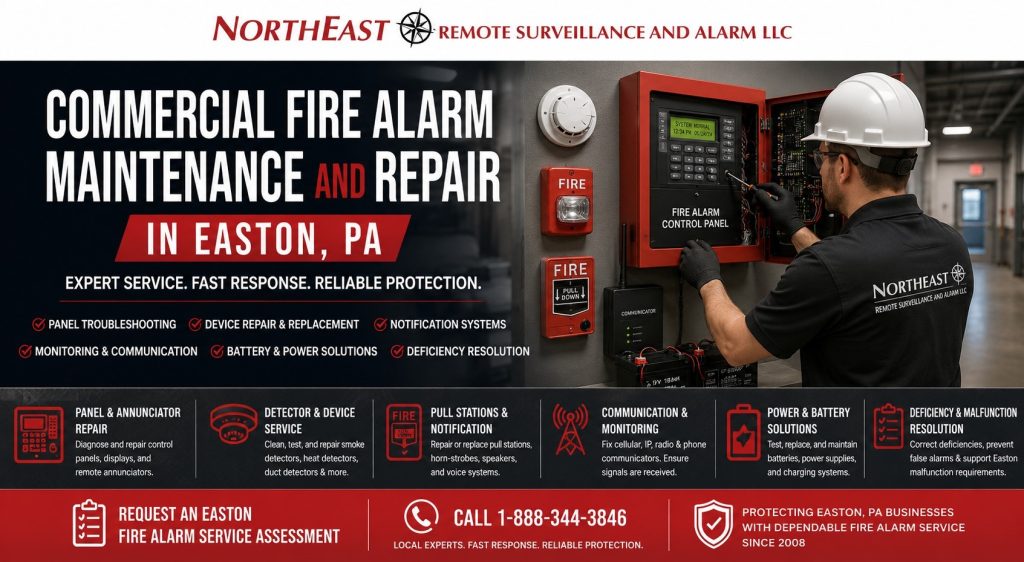
Fire Alarm Service Built Around the Complete System
A commercial fire alarm problem should not be diagnosed by replacing the first device that appears to have failed.
An existing system may depend on:
- Fire alarm control equipment
- Remote annunciators
- Smoke detectors
- Heat detectors
- Duct detectors
- Beam or specialty detection
- Manual pull stations
- Monitor and control modules
- Horns and strobes
- Speakers and speaker-strobes
- Notification power supplies
- Sprinkler waterflow switches
- Valve-tamper switches
- Fire-pump or pressure points
- Cellular, IP, radio, or other approved communication
- Primary and standby power
- Elevator interfaces
- HVAC shutdown
- Door-holder release
- Access-controlled door release
- Field wiring
- System programming
- Monitoring-account information
- Drawings and service records
A trouble displayed at the panel may originate from a field device, damaged cable, failed module, weak battery, communication path, auxiliary power supply, sprinkler component, network change, or approved building interface.
NERSA evaluates the reported condition within the larger system before recommending adjustment, repair, replacement, monitoring correction, specialized-contractor coordination, or broader modernization.
Easton Fire Alarm Service Resources
Commercial Fire Alarm Systems in Easton, PA
Commercial Fire Alarm Systems in Easton, PA is the primary local resource for new systems, occupied-commercial properties, detection, notification, monitoring, tenant changes, renovations, interfaces, and complete life-safety planning.
Fire Alarm Monitoring, Testing, and Inspection Readiness in Easton, PA
Fire Alarm Monitoring, Testing, and Inspection Readiness in Easton, PA addresses planned monitoring verification, functional testing, inspection preparation, responsible contacts, test documentation, power review, and deficiency reporting.
Easton Fire Alarm Upgrades
Easton Fire Alarm Upgrades addresses obsolete panels, unsupported systems, communicator modernization, notification expansion, device migration, addressable upgrades, and phased replacement.
Warehouse and Industrial Fire Alarm Systems in Easton, PA
Warehouse and Industrial Fire Alarm Systems in Easton, PA addresses high-bay spaces, loading operations, large notification areas, specialty detection, production environments, sprinkler supervision, and multi-building industrial facilities.
Fire Alarm Monitoring and Supervision
Fire Alarm Monitoring and Supervision addresses alarm, supervisory, trouble, sprinkler, power, and communication signals along with supervising-station transmission and account coordination.
Commercial and Industrial Fire Alarm Installation
Commercial and Industrial Fire Alarm Installation is NERSA’s broader fire-alarm authority for system planning, installation, monitoring, notification, sprinkler supervision, building interfaces, documentation, testing coordination, and long-term support. NERSA’s current service structure is focused on non-residential commercial and industrial properties. (Northeast Remote Surveillance)
NFPA 72 and Compliance-Aware Planning
Commercial Fire Alarm Systems and NFPA 72 addresses code-conscious monitoring, testing, documentation, service history, trouble conditions, and system responsibility.
Regulatory and Compliance for Commercial Security, Fire Alarm, and Life Safety provides broader guidance involving permits, adopted requirements, documentation, testing, inspection, accessibility, and Authority Having Jurisdiction coordination.
Easton Low-Voltage Security Infrastructure Upgrades
Easton Low-Voltage Security Infrastructure Upgrades may be relevant when damaged cabling, obsolete communication, disorganized pathways, unsuitable equipment locations, or weak supporting infrastructure contribute to a fire alarm problem.
Does your Easton fire alarm have a panel trouble, failed detector, communication fault, weak battery, notification problem, ground fault, or unresolved deficiency? Request an Easton Fire Alarm Service Assessment or call 1-888-344-3846.
When an Easton Property May Need Fire Alarm Service
An existing fire alarm system may require maintenance or repair when:
- The panel displays a trouble condition
- A supervisory condition will not clear
- The system repeatedly enters alarm without an apparent fire
- A smoke or heat detector fails testing
- A pull station is damaged
- A horn, strobe, or speaker does not operate
- Notification appliances activate inconsistently
- A notification circuit shows trouble
- A ground fault appears
- A circuit shows open
- A device is missing from the system
- A point remains disabled
- An annunciator is blank or unresponsive
- The panel repeatedly resets
- The panel date or time is incorrect
- Monitoring does not receive signals
- Monitoring receives the wrong signal description
- Cellular communication fails
- IP communication is interrupted
- A telephone-line communicator no longer operates
- A backup battery is weak, swollen, or leaking
- A power supply reports trouble
- A sprinkler waterflow point does not report correctly
- A valve-tamper point remains supervisory
- A duct detector does not shut down the intended equipment
- An elevator recall function does not perform correctly
- A door holder or controlled door does not release
- A renovation has left devices obstructed or mislabeled
- The system has incomplete documentation
- An inspector identified deficiencies
- Easton classified an activation as a system malfunction
A normal display does not prove that every detector, notification appliance, communicator, battery, supervisory point, and building interface is operating correctly.
Preventive Maintenance Versus Corrective Repair
Preventive maintenance and corrective repair serve different purposes.
Preventive Fire Alarm Maintenance
Preventive maintenance reviews system condition before a known failure disrupts operation or leads to an unresolved deficiency.
Depending on the system and approved scope, maintenance may include:
- Reviewing panel status
- Reviewing event history
- Inspecting control equipment
- Checking annunciators
- Reviewing disabled points
- Reviewing communication status
- Examining batteries
- Reviewing power supplies
- Inspecting accessible field devices
- Reviewing device labels
- Reviewing supervisory points
- Checking documentation
- Reviewing recurring troubles
- Identifying obsolete components
- Identifying unsupported equipment
- Reviewing known inspection deficiencies
- Recommending corrective priorities
Preventive maintenance does not replace required inspection and testing.
Corrective Fire Alarm Repair
Corrective repair addresses a reported failure, trouble, malfunction, or deficiency.
Examples include:
- Replacing a failed detector
- Repairing damaged wiring
- Correcting a ground fault
- Replacing weak batteries
- Repairing a notification circuit
- Replacing a damaged pull station
- Correcting communicator programming
- Repairing a failed power supply
- Correcting panel text
- Replacing a defective module
- Restoring a sprinkler supervisory point
- Correcting an interface relay
- Repairing an annunciator
- Resolving an intermittent trouble
- Correcting an unwanted activation
An assessment may determine that repair is practical, or that modernization provides better long-term value.
Fire Alarm Panel Troubleshooting
The control panel processes initiating devices, supervisory points, notification circuits, building interfaces, communication, power, and event history.
Common panel-related conditions may include:
- Internal panel trouble
- Display failure
- Repeated restart
- Corrupted device text
- Communication loss
- Ground fault
- Open circuit
- Notification circuit fault
- Missing module
- Disabled point
- Power-supply trouble
- Battery trouble
- Keypad or annunciator communication failure
- Software or firmware issue
- Failed input or output
- Event-history problem
- Damaged enclosure
- Heat, moisture, or contamination
- Unsupported control equipment
Troubleshooting may require review of:
- Panel voltage
- Charging circuit
- Batteries
- Field wiring
- Signaling line circuits
- Notification appliance circuits
- Networked panels
- Expansion modules
- Remote annunciators
- Communicators
- Software access
- Programming
- Device compatibility
- Manufacturer support
- Parts availability
A panel that returns to normal after being restarted should not automatically be considered reliable.
Remote Annunciator Maintenance and Repair
Remote annunciators provide fire alarm information at entrances, lobbies, management areas, command locations, or other approved positions.
Service conditions may include:
- Blank display
- Incomplete device text
- Failed audible indication
- Unresponsive controls
- Communication loss
- Missing keys
- Damaged enclosure
- Incorrect date or time
- Obsolete labels
- Trouble not matching the main panel
- Intermittent operation
Repair should verify that the annunciator correctly reports:
- Alarm conditions
- Supervisory conditions
- Trouble conditions
- Device or zone information
- System restoration
- Communication with the main panel
An annunciator is operationally valuable only when its information is accurate and understandable.
Alarm, Supervisory, and Trouble Diagnosis
A commercial fire alarm may display different condition types.
Alarm Conditions
Alarm conditions may originate from:
- Smoke detectors
- Heat detectors
- Pull stations
- Sprinkler waterflow
- Beam detection
- Specialty detection
- Another approved alarm input
Supervisory Conditions
Supervisory conditions may originate from:
- Valve-tamper switches
- Low-air points
- Fire-pump conditions
- Pressure points
- Other monitored fire-protection equipment
Trouble Conditions
Trouble conditions may result from:
- Primary-power failure
- Low battery
- Communication failure
- Open wiring
- Ground fault
- Missing device
- Notification fault
- Disabled point
- Failed power supply
- Internal panel problem
The condition should be identified accurately before corrective work begins.
A supervisory point should not be treated as a routine panel trouble, and a trouble condition should not simply be reset without locating the cause.
Smoke-Detector Maintenance and Repair
Smoke detectors may be affected by:
- Dust
- Construction debris
- Steam
- Aerosols
- Insects
- Moisture
- HVAC airflow
- Detector contamination
- Physical damage
- Incorrect location
- Obstruction
- Wiring problems
- Addressing problems
- Base failure
- Unsupported or expired equipment
- Changed room use
- Ceiling changes
- Renovation work
Corrective service may involve:
- Reviewing event history
- Inspecting the detector
- Cleaning where permitted
- Functional testing
- Replacing the detector
- Replacing the detector base
- Correcting wiring
- Correcting addressing
- Reviewing sensitivity information
- Reviewing the application
- Relocating the device through an approved project
- Updating documentation
A recurring unwanted activation should not be addressed by permanently disabling the detector.
If device location or type is unsuitable for the environment, the correction may require design review, permit work, and AHJ coordination rather than a simple replacement.
Heat-Detector Maintenance and Repair
Heat-detector problems may involve:
- Physical damage
- Incorrect temperature rating
- Incorrect detector type
- Wiring fault
- Base failure
- Improper location
- Contamination
- Water intrusion
- Environmental changes
- Changed room use
- Failed functional test
- Device age or manufacturer support
The replacement device should match the approved application, panel compatibility, environmental conditions, and system programming.
A smoke detector should not automatically replace a heat detector, and a heat detector should not be treated as an interchangeable substitute for smoke detection.
Duct-Detector Service
Duct detectors may require coordination with mechanical equipment and access to HVAC components.
Service conditions may include:
- Detector trouble
- Sampling-tube damage
- Incorrect sampling-tube orientation
- Blocked sampling openings
- Failed remote test station
- Failed remote indicator
- HVAC shutdown failure
- Control-module failure
- Wiring problem
- Incorrect alarm or supervisory classification
- Inaccessible detector
- Dirty sensing chamber
- Changed air handler
- Changed ductwork
Service may require coordination with the building’s mechanical contractor.
A duct detector commonly performs a mechanical-control function and should not automatically be treated as a substitute for open-area detection.
Beam and Specialty Detector Repair
Beam, aspirating, flame, linear heat, or other specialty detection may be used in large or unusual spaces.
Potential service conditions include:
- Alignment failure
- Dirty optics
- Obstruction
- Building movement
- Vibration
- Wiring fault
- Controller trouble
- Power problem
- Changed storage layout
- Changed ceiling condition
- Calibration issue
- Environmental interference
- Unsupported equipment
Specialty detection should be serviced according to its listed application, manufacturer requirements, approved design, and actual environment.
High-bay warehouse and industrial design remains within the dedicated Warehouse and Industrial Fire Alarm Systems in Easton, PA resource.
Manual Pull-Station Repair
Manual pull stations may require service when:
- The device is physically damaged
- The handle or mechanism will not reset
- A protective cover is damaged
- The device is obstructed
- The station is loose
- Wiring is damaged
- The device does not report
- The wrong point text appears
- The device remains in alarm
- A renovation moved the exit or wall
- Replacement keys are unavailable
Repair should verify:
- Physical operation
- Correct panel display
- Correct monitoring signal
- Notification response
- Reset
- Restoration
- Device labeling
- Accessibility
- Documentation
A damaged pull station should not be covered, disconnected, or ignored simply to clear the panel.
Horn, Strobe, and Horn-Strobe Repair
Notification appliances may fail because of:
- Circuit trouble
- Loose connection
- Damaged device
- Failed power supply
- Blown fuse
- Incorrect voltage
- Synchronization problem
- Circuit overload
- Unsupported replacement device
- Obstruction
- Water damage
- Renovation damage
- Incorrect programming
- Changed room layout
Corrective service may involve:
- Circuit testing
- Device replacement
- Wiring repair
- Power-supply review
- Load review
- Synchronization correction
- Program correction
- Battery review
- Documentation updates
Replacing one failed appliance with a visually similar device does not establish compatibility.
The replacement should match the circuit, voltage, synchronization, listing, approved design, and power requirements.
Speaker and Voice-Evacuation System Repair
Voice-evacuation systems may require service involving:
- Amplifier trouble
- Speaker-circuit trouble
- Failed speaker
- Failed speaker-strobe
- Microphone failure
- Message failure
- Zone-selection problem
- Backup-amplifier trouble
- Audio distortion
- Network communication
- Power-supply trouble
- Battery deficiency
- Incorrect message priority
- Incomplete fault supervision
Repair may require testing:
- Prerecorded messages
- Live microphone operation
- Notification zones
- Speaker circuits
- Visual appliances
- Amplifier switchover
- Monitoring
- Standby power
- Restoration
Voice evacuation is different from ordinary business paging.
A normal public-address amplifier or speaker should not be substituted for listed fire-alarm equipment.
Notification Power-Supply Repair
Additional notification appliance circuit power supplies may develop:
- AC power trouble
- Low battery
- Ground fault
- Output failure
- Circuit trouble
- Communication failure
- Synchronization problem
- Blown fuse
- Overloaded circuit
- Charging-circuit failure
- Heat damage
- Enclosure damage
- Missing labels
The main fire alarm panel may remain normal while a remote notification power supply has a local fault.
Every associated supply should be identified, accessible, labeled, and included in the repair and testing scope where affected.
Sprinkler Waterflow Alarm Troubles
Fire alarm systems may monitor sprinkler waterflow through an approved input.
A waterflow problem may involve:
- Failed waterflow switch
- Wiring fault
- Incorrect module
- Incorrect zone text
- Incorrect signal classification
- Delayed or missing transmission
- Failed monitoring communication
- Failed notification
- Device tamper
- Sprinkler-system condition
- Programming issue
- Failed restoration
Fire-alarm service verifies panel, module, communication, and notification response.
Mechanical sprinkler problems, switch replacement responsibilities, valve work, waterflow timing, and sprinkler-system repair may require a qualified sprinkler contractor.
Valve-Tamper and Supervisory Troubles
Valve-tamper points should generally report as supervisory conditions when the monitored valve changes from its normal position.
Problems may include:
- Switch out of adjustment
- Damaged wiring
- Failed monitor module
- Incorrect point description
- Incorrect signal classification
- Valve not fully open
- Device not restoring
- Monitoring record mismatch
- Sprinkler-system work
- Physical damage
The alarm contractor and sprinkler contractor may need to coordinate.
A valve-tamper point incorrectly transmitted as a fire alarm can produce the wrong response and inaccurate event records.
Fire-Pump and Other Supervisory Conditions
Some properties may monitor:
- Fire-pump running
- Fire-pump phase reversal
- Fire-pump power loss
- Low air
- Tank levels
- Pressure conditions
- Other approved fire-protection equipment
Service should identify whether the problem originates in:
- The monitored equipment
- Supervisory switch
- Monitor module
- Field wiring
- Panel programming
- Monitoring account
- Power
- Documentation
NERSA’s scope should remain limited to the fire alarm monitoring and interface equipment unless separate specialized work is included and properly authorized.
Fire Alarm Communication Repair
A monitored system may use:
- Cellular communication
- IP communication
- Radio communication
- Dual-path communication
- Legacy telephone service
- Another approved method
Communication problems may result from:
- Failed communicator
- Inactive account
- Weak cellular signal
- Damaged antenna
- Router replacement
- Firewall change
- Internet-provider change
- Incorrect IP settings
- Failed network equipment
- Lost account ownership
- Power trouble
- Battery trouble
- Panel incompatibility
- Changed monitoring provider
- Incorrect signal programming
- Discontinued telephone service
- Damaged telephone wiring
A communicator showing normal locally does not prove that every required alarm, supervisory, trouble, and restoration signal is received correctly.
Cellular Communicator Repair
Cellular communication problems may involve:
- Weak or changed carrier coverage
- Failed communicator
- Damaged antenna
- Inactive cellular account
- Obsolete communication technology
- Power loss
- Battery deficiency
- Panel connection
- Incorrect programming
- Monitoring-platform mismatch
- Service expiration
- Incorrect account number
Corrective service may involve:
- Signal review
- Antenna review
- Account verification
- Power testing
- Programming correction
- Communicator replacement
- Monitoring coordination
- Signal testing
- Documentation
Communicator replacement is an upgrade when it involves substantial modernization rather than restoration of a supportable device.
IP Communicator Repair
IP fire alarm communication may depend on customer-owned network equipment.
Possible conditions include:
- Router replacement
- Firewall change
- Changed IP address
- Network-segmentation change
- Internet outage
- Failed network switch
- Removed cable
- Changed service provider
- Incorrect port configuration
- Network equipment lacking standby power
- Communicator failure
- Monitoring-account problem
Network changes should be coordinated with authorized IT personnel.
After a repair, affected alarm, supervisory, trouble, communication-failure, and restoration signals should be retested.
Dual-Path Communication Repair
Dual-path systems may use two approved communication technologies.
A problem may occur when:
- One path has failed
- Path supervision is disabled
- The system does not switch paths
- One communicator is inactive
- One path lacks backup power
- Monitoring receives only one path
- Restoration is not reported
- Account programming is incomplete
Both paths should be reviewed.
The presence of two communication modules does not prove that both are active and supervised.
Legacy Telephone-Line Problems
Older systems may depend on traditional telephone communication.
Common problems include:
- Copper service removal
- Telephone-provider conversion
- Shared line changes
- Digital telephone incompatibility
- Line-seizure failure
- Disconnected jack
- Increased line noise
- Dial-tone loss
- Obsolete communicator
- Failed transmission
- Changed telephone number
Easton’s current ordinance states that automatic telephone digital alarm communicator systems must connect through a central-station alarm company rather than City Fire Department emergency lines. (eCode360)
When telephone service is no longer dependable or available, communicator modernization may be more appropriate than repeated repair.
Monitoring-Account Corrections
A communication problem may exist in the monitoring account rather than the field equipment.
Possible account issues include:
- Wrong property address
- Wrong building or suite
- Wrong device descriptions
- Alarm reported as supervisory
- Supervisory reported as alarm
- Outdated contacts
- Wrong call order
- Incorrect passcodes
- Former service provider listed
- Incorrect communicator account
- Missing restoration signals
- Missing trouble signals
- Duplicate accounts
- Wrong property name
Monitoring information should match:
- Panel text
- Device locations
- Drawings
- Property names
- Responsible contacts
- Signal classifications
- Current service responsibility
A correctly operating device can still produce poor response information when account records are inaccurate.
Primary-Power Troubles
Power problems may affect the panel, notification supplies, communicators, amplifiers, and interfaces.
Possible conditions include:
- Tripped breaker
- Failed transformer
- Loose connection
- Failed power supply
- Blown fuse
- Damaged circuit
- Overloaded output
- Incorrect replacement equipment
- Heat damage
- Water damage
- Lost dedicated circuit
- Failed charging circuit
- Unstable building power
Replacing a fuse without identifying why it opened may result in recurring failure or equipment damage.
Power troubleshooting should consider the connected load and affected life-safety functions.
Backup-Battery Maintenance and Replacement
Commercial fire alarm batteries support operation during utility-power interruption.
Battery problems may include:
- Low voltage
- Reduced capacity
- Swelling
- Leakage
- Corroded terminals
- Loose connections
- Failed charging
- Incorrect battery size
- Mixed battery ages
- Missing installation dates
- Repeated battery trouble
- Excessive connected load
Battery service may include:
- Visual inspection
- Age review
- Terminal inspection
- Charging-voltage review
- Capacity or load evaluation
- Replacement
- Date labeling
- Documentation
- Confirmation of restoration
A battery should not be selected solely because it physically fits inside the enclosure.
The panel, communicator, modules, notification supplies, and other loads should be considered.
Ground-Fault Troubleshooting
A ground fault can result from an unintended connection between a system conductor and grounded metal or another grounded path.
Possible causes include:
- Pinched cable
- Damaged insulation
- Water intrusion
- Corroded device
- Loose strand
- Improper splice
- Renovation damage
- Damaged conduit
- Failed module
- Shared pathway problem
- Abandoned wiring
- Incorrect termination
Ground faults can be intermittent and may change with moisture, temperature, vibration, or building activity.
The cause should be located and corrected rather than masked by disabling ground-fault reporting.
Open-Circuit and Wiring Repair
Open-circuit troubles may result from:
- Broken conductor
- Loose terminal
- Removed device
- Failed module
- Incorrect end-of-line component
- Renovation damage
- Cut cable
- Corrosion
- Poor splice
- Device replacement
- Disconnected notification appliance
- Unsupported field modification
Repair should preserve:
- Circuit supervision
- Device compatibility
- Required pathway
- Proper termination
- Labeling
- Documentation
- Approved system operation
Temporary jumpers or undocumented splices should not become permanent corrective work.
Elevator-Recall and Interface Repair
Fire alarm systems may interface with elevator equipment.
Problems may include:
- Recall does not occur
- Elevator recalls to the wrong floor
- Alternate recall fails
- Detector text is incorrect
- Control module fails
- Monitoring does not receive the expected event
- Reset does not restore normal operation
- Elevator work changed the interface
- Shunt-trip coordination is incomplete
- Documentation does not match the system
Repair and retesting may require the elevator contractor, electrical contractor, property representative, design professional, and AHJ.
A single successful elevator movement does not verify the full approved sequence.
HVAC Shutdown and Mechanical-Interface Repair
Fire alarm systems may control or monitor HVAC equipment, fans, dampers, or other mechanical functions.
Service may address:
- Failed duct-detector input
- Fan does not shut down
- Fan does not restart after reset
- Control module failure
- Monitor module failure
- Smoke-control sequence problem
- Damper feedback issue
- Mechanical equipment changes
- Programming mismatch
- Incorrect point text
- Wiring problem
Mechanical interfaces should be tested with the relevant contractors and approved sequence.
A fire alarm technician should not independently redesign a smoke-control sequence during a routine repair.
Door-Holder and Access-Control Interface Repair
Fire alarm systems may release:
- Magnetic door holders
- Magnetic locks
- Selected access-controlled doors
- Stairwell doors
- Other approved electrified hardware
Possible problems include:
- Door holder does not release
- Door does not close
- Controlled door remains locked
- Door unlocks but does not relock correctly
- Relay fails
- Access-control power supply does not release
- Fire alarm reset does not restore the intended state
- Door closer or latch fails mechanically
- Programming changed
- Interface wiring is damaged
Fire alarm operation, emergency egress, fire-rated door function, access control, and physical door hardware must be evaluated together.
For broader controlled-opening planning, visit Commercial Access Control Systems in Easton, PA.
Easton Service-Notification Requirements
Easton’s current alarm ordinance requires notification to the City’s Communications Center before installing, repairing, servicing, altering, replacing, or removing an alarm system or part of one, and notice again when the system is returned to service. Current procedures should be confirmed before work begins. (eCode360)
A controlled service process may include:
- Confirming customer authorization
- Notifying the monitoring provider
- Placing the account on test
- Following current City notification procedures
- Advising affected building representatives
- Completing the approved repair
- Testing affected functions
- Reviewing monitoring receipt
- Restoring the system to normal
- Removing the account from test
- Confirming return to service
- Documenting the completed work
Service-generated signals should not be allowed to create an avoidable emergency response.
Easton Fire Alarm Malfunction Follow-Up
Easton’s current ordinance defines a fire alarm malfunction as an activation resulting from mechanical failure, improper installation, insufficient maintenance, or certain other conditions. When an activation is classified as a malfunction, the ordinance provides for an Affidavit of Service/Repair within 21 calendar days showing that a fire alarm technician examined the system and made a bona fide attempt to identify and correct the cause. Current requirements should be confirmed with the City. (eCode360)
Corrective service may involve:
- Reviewing the Fire Alarm Activation Report
- Identifying the initiating point
- Reviewing panel history
- Inspecting the affected device
- Reviewing environmental conditions
- Checking wiring
- Reviewing power
- Reviewing programming
- Reviewing monitoring records
- Correcting the identifiable cause
- Retesting the affected function
- Verifying signal transmission
- Documenting the repair
- Identifying any remaining deficiency
- Supporting the property owner’s required filing
Resetting the panel without investigating the cause does not establish that the malfunction has been corrected.
False and Repeated Alarm Conditions
Easton’s current ordinance includes fees and enforcement provisions for repeated false or malfunctioning fire alarms and provides a process for corrective documentation. It also authorizes further action when owners fail to address causes or required filings. (eCode360)
Repeated activations may result from:
- Dirty detector
- Incorrect detector application
- Construction dust
- Steam or aerosols
- Damaged pull station
- Ground fault
- Loose wiring
- Failed module
- Sprinkler-system problem
- Waterflow switch problem
- Valve-tamper issue
- Unstable power
- Weak battery
- Communicator failure
- Programming error
- Tenant renovation
- Disabled device
- Poor maintenance
- Incomplete investigation after earlier alarms
Corrective work should address the underlying cause rather than simply silence, bypass, or disable affected equipment.
Easton Responsible Contacts and Property Access
Easton’s current ordinance requires specified owner and emergency-contact information and identifies at least two people authorized to enter and capable of responding to the premises within 30 minutes. It also requires applicable contact changes to be kept current. (eCode360)
Fire alarm maintenance records should therefore include current:
- Property owner
- Property manager
- Tenant representative
- Primary emergency contact
- Backup emergency contact
- Monitoring provider
- Fire alarm service provider
- Building address
- Suite or building designation
- Entry procedure
- Panel and annunciator access
- After-hours telephone numbers
Outdated contacts can delay property access, investigation, reset, restoration, and corrective service.
Inspection Deficiency Repair
An inspection report may identify:
- Failed detector
- Damaged pull station
- Notification appliance failure
- Ground fault
- Low battery
- Communication trouble
- Missing label
- Inaccessible device
- Disabled point
- Failed sprinkler supervisory signal
- Failed waterflow transmission
- Failed interface
- Missing documentation
- Unsupported panel
- Obsolete communicator
- Incomplete record
- Changed building condition
The repair scope should identify:
- The exact deficiency
- Affected device or system
- Required corrective work
- Whether design review is needed
- Whether permit work is needed
- Whether another contractor is required
- Whether shutdown coordination is required
- How the repair will be tested
- What documentation will be updated
Corrective work should be retested and recorded.
A repair does not guarantee approval of unrelated system conditions that were outside the service scope.
Systems Installed by Another Provider
NERSA may evaluate supported fire alarm systems installed or serviced by another provider when the customer is authorized to control the equipment and the platform is accessible and supportable.
An initial assessment may need to determine:
- Panel manufacturer
- Panel model
- Software access
- Programming access
- Monitoring account
- Communicator ownership
- Device compatibility
- Available drawings
- Previous test reports
- Previous inspection reports
- Open deficiencies
- Manufacturer support
- Parts availability
- Existing service agreement
- Customer authorization
A repair request may need to become a formal takeover or upgrade project when essential system access, monitoring ownership, or programming control remains unavailable.
Maintenance and Repair Versus Scheduled Testing
Maintenance and repair correct existing deficiencies, faults, malfunctions, and failed components.
Scheduled testing verifies included system functions.
Testing may identify a problem, but the repair may require:
- Separate authorization
- Replacement parts
- Design review
- Permit work
- Specialized-contractor coordination
- Additional system access
- Retesting
- Updated documentation
Businesses whose primary need is scheduled monitoring verification, inspection preparation, and functional testing should use Fire Alarm Monitoring, Testing, and Inspection Readiness in Easton, PA.
Maintenance and Repair Versus System Upgrade
Repair restores an existing intended function.
An upgrade modernizes the platform or increases capability.
Repair may be appropriate when:
- A supportable detector fails
- Wiring is damaged
- A module has failed
- A battery is weak
- A communicator has a correctable fault
- A notification appliance is damaged
- A relay requires replacement
- Programming is incorrect
- A ground fault can be located
An upgrade may be more appropriate when:
- The panel is obsolete
- Replacement parts are unavailable
- Software is unsupported
- The communicator technology is obsolete
- Failures are recurring
- Documentation cannot be recovered
- The panel cannot support required expansion
- Notification capacity is inadequate
- The system cannot support current monitoring
- Repair cost offers limited long-term value
Modernization remains the primary purpose of Easton Fire Alarm Upgrades.
Maintenance and Repair Versus Provider Takeover
Maintenance assumes that:
- Customer authorization is established
- System ownership is understood
- Monitoring responsibility is known
- Programming access is available where required
- The provider can responsibly service the platform
A takeover focuses on:
- Provider changes
- Account ownership
- Monitoring transition
- Communicator ownership
- Administrator access
- Contact-list cleanup
- Signal mapping
- Documentation recovery
- Establishment of ongoing responsibility
A provider-transition project may uncover repairs, but it should remain separate from routine corrective service.
Maintenance and Repair Versus Tenant Renovation
A repair restores an existing function.
A tenant renovation may change:
- Walls
- Ceilings
- Corridors
- Rooms
- Suite boundaries
- Occupancy
- Detector spacing
- Notification coverage
- Sprinkler points
- HVAC interfaces
- Door-release conditions
- Documentation
Device relocation, added notification, circuit extension, or system redesign may require plans, permits, testing, and approval rather than a routine service call.
Fire Alarm Maintenance for Offices
Office-building service may involve:
- Lobby detectors
- Tenant-suite devices
- Corridor notification
- Server-room detection
- Mechanical-room points
- Elevator interfaces
- Door-release functions
- Remote annunciators
- Shared monitoring
- Tenant renovations
- Property-management contacts
Multi-tenant responsibility should be clarified before service begins.
The landlord may own the base system while tenants are responsible for certain fit-out or access conditions.
Medical Office Fire Alarm Repair
Medical and healthcare-support properties may require coordinated service around:
- Reception areas
- Waiting rooms
- Staff areas
- Treatment-support rooms
- Laboratories
- Records rooms
- Supply areas
- Medication storage
- Imaging-support areas
- Accessible notification
- After-hours operation
Service procedures should minimize disruption while maintaining the required life-safety scope.
A fire alarm repair does not create healthcare regulatory compliance by itself.
Retail and Restaurant Fire Alarm Service
Retail and restaurant properties may require repair involving:
- Public notification
- Kitchen-adjacent detection
- Storage areas
- Employee spaces
- Hood-system interfaces
- Mechanical shutdown
- Tenant improvements
- High ambient noise
- Pull-station damage
- Communicator problems
Kitchen suppression equipment may require a separate qualified contractor.
Fire alarm service may address the monitoring and interface portion when included in the approved system.
School and Educational Fire Alarm Maintenance
Schools may require service involving:
- Classrooms
- Corridors
- Offices
- Libraries
- Cafeterias
- Gymnasiums
- Assembly areas
- Voice evacuation
- Accessible notification
- Multiple buildings
- Door-release interfaces
- After-hours building use
Testing and repair should be coordinated around occupancy, school schedules, emergency procedures, and authorized staff.
Church and Assembly Property Service
Churches, meeting halls, event spaces, and assembly properties may require maintenance involving:
- Large notification areas
- High ceilings
- Voice evacuation
- Stages
- Classrooms
- Kitchens
- Offices
- Public corridors
- Weekend and evening use
- Accessible notification
Repair should consider the building’s acoustics, architecture, occupancy schedule, and approved system design.
Municipal and Institutional Fire Alarm Repair
Municipal and institutional properties may require service involving:
- Public-service areas
- Administrative offices
- Records rooms
- Restricted areas
- Meeting rooms
- Several buildings
- Elevator interfaces
- Access-controlled doors
- Formal documentation
- Procurement or approval procedures
Responsible departments, facility contacts, monitoring information, and service records should be identified before work begins.
Warehouse and Industrial Fire Alarm Repair
Warehouse and industrial systems may present service conditions involving:
- High-bay detection
- Beam detectors
- Large notification circuits
- Sprinkler supervisory points
- Fire-pump signals
- Dust
- Heat
- Moisture
- Vibration
- Production equipment
- Multiple buildings
- Loading operations
- Long cable runs
- Industrial interfaces
The maintenance-and-repair function may serve these systems, while complete warehouse and industrial design remains with Warehouse and Industrial Fire Alarm Systems in Easton, PA.
Multi-Building and Multi-Site Fire Alarm Service
Organizations with several buildings or locations may need:
- Standard service records
- Location-specific panel inventories
- Current communicator records
- Consistent device naming
- Regional contacts
- Central deficiency tracking
- Standard battery records
- Coordinated maintenance schedules
- Location-based monitoring information
- Phased upgrade planning
- Clear account ownership
- Centralized documentation
Not every property must use the same fire alarm platform.
The organization should still maintain a consistent process for reporting troubles, authorizing service, tracking deficiencies, updating contacts, and documenting corrective work.
The NERSA Easton Fire Alarm Service Process
Reported-Condition Review
NERSA begins by identifying:
- Panel message
- Affected device or circuit
- Date and time of the condition
- Whether the issue is constant or intermittent
- Whether monitoring received a signal
- Recent construction or renovation
- Recent network or telephone changes
- Previous service history
- Open inspection deficiencies
- Operational impact
Authorization and Notification
Before service, NERSA confirms customer authorization, monitoring test procedures, building contacts, and applicable Easton notification requirements.
Panel and Event Review
Panel status, event history, active conditions, disabled points, device text, communication, power, and relevant programming are reviewed.
Field Inspection
Affected detectors, pull stations, modules, notification appliances, wiring, power supplies, batteries, supervisory devices, communicators, and interfaces are evaluated.
Corrective Recommendation
NERSA identifies whether the condition requires:
- Adjustment
- Cleaning where appropriate
- Device replacement
- Wiring repair
- Ground-fault investigation
- Battery replacement
- Power-supply repair
- Communication correction
- Programming correction
- Monitoring-account update
- Specialized-contractor coordination
- Permit or design work
- Broader system upgrade
Repair and Functional Verification
Approved corrective work is completed and affected functions are tested.
Testing may include:
- Device activation
- Panel indication
- Notification
- Monitoring transmission
- Supervisory classification
- Trouble reporting
- Communication failure
- Restoration
- Power-loss operation
- Interface operation
- System reset
Documentation and Return to Service
Completed work, replacement parts, tests, deficiencies, remaining recommendations, monitoring status, and return-to-service information are documented.
Information That Helps Before a Service Visit
Useful information may include:
- Property address
- Building or suite
- Panel manufacturer
- Panel model
- Photograph of the panel display
- Exact trouble message
- Date the condition began
- Whether the issue is intermittent
- Monitoring provider
- Whether monitoring received a signal
- Device or area involved
- Recent construction
- Recent electrical work
- Recent network changes
- Previous inspection report
- Fire Alarm Activation Report
- Available drawings
- Administrator or panel access
- Existing service records
- Property contact
- After-hours access procedure
Property personnel should not open fire alarm panels, disconnect communicators, remove detectors, alter wiring, or repeatedly activate emergency devices merely to gather information.
Why Easton Businesses Choose NERSA
Northeast Remote Surveillance and Alarm, LLC has focused on non-residential commercial and industrial security and life-safety systems since 2008. (Northeast Remote Surveillance)
Easton fire alarm maintenance evaluates:
- Control panels
- Annunciators
- Detection devices
- Pull stations
- Notification appliances
- Voice evacuation
- Sprinkler supervision
- Monitoring accounts
- Communication paths
- Power supplies
- Backup batteries
- Ground faults
- Circuit troubles
- Elevator interfaces
- HVAC interfaces
- Door-release functions
- Easton service procedures
- Malfunction documentation
- Inspection deficiencies
- Existing-system supportability
- Future upgrade needs
The objective is not to replace the greatest possible amount of equipment.
The objective is to identify the actual cause of the condition, restore dependable operation when practical, document the corrective work, distinguish repair from modernization, and provide a clear path for continued system responsibility.
Request Commercial Fire Alarm Maintenance or Repair in Easton, PA
If your Easton commercial or industrial property has a panel trouble, failed detector, damaged pull station, notification fault, ground fault, weak battery, communication problem, monitoring issue, sprinkler supervisory condition, failed building interface, unwanted activation, inspection deficiency, or Easton fire alarm malfunction requiring corrective follow-up, Northeast Remote Surveillance and Alarm, LLC can help evaluate the condition.
An Easton fire alarm service assessment may review:
- Fire alarm panel
- Annunciators
- Event history
- Smoke and heat detectors
- Duct or specialty detection
- Manual pull stations
- Horns, strobes, and speakers
- Notification power supplies
- Sprinkler waterflow
- Supervisory points
- Communicator
- Monitoring account
- Primary and standby power
- Ground faults
- Field wiring
- Elevator interfaces
- HVAC shutdown
- Door release
- Existing drawings
- Inspection reports
- Easton activation documentation
- Open deficiencies
- Long-term supportability
Request an Easton Fire Alarm Service Assessment or call 1-888-344-3846.
Frequently Asked Questions About Fire Alarm Maintenance and Repair in Easton, PA
Does NERSA repair commercial fire alarm systems in Easton?
NERSA evaluates, troubleshoots, maintains, and repairs supported fire alarm systems for qualifying commercial and industrial properties in Easton.
Does NERSA service residential smoke alarms?
No. Northeast Remote Surveillance and Alarm, LLC focuses on commercial, industrial, institutional, municipal, healthcare, educational, warehouse, multi-tenant, and other non-residential properties.
Can NERSA repair a system installed by another provider?
Possibly. The customer must be authorized to control the system, and the equipment must be accessible, serviceable, supported, and suitable for responsible repair.
Why does my fire alarm panel show trouble?
Possible causes include power loss, low battery, communication failure, ground fault, open circuit, missing device, notification trouble, disabled point, failed module, or an internal panel condition.
Is a supervisory signal the same as a trouble?
No. A supervisory signal generally reports an off-normal condition in monitored fire-protection equipment. A trouble indicates a fault affecting the fire alarm system.
Can a fire alarm remain in service with a trouble condition?
The significance depends on the trouble and affected function. A qualified review should identify the condition, impairment, required response, notification, and corrective action.
Can NERSA replace failed smoke detectors?
Possibly. Replacement depends on panel compatibility, device availability, approved application, addressing, wiring, and system support.
Can dirty smoke detectors cause unwanted alarms?
Yes. Dust, construction debris, steam, aerosols, airflow, moisture, insects, and environmental conditions can contribute to unwanted activation.
Can a heat detector be replaced with a smoke detector?
Not automatically. Detector selection depends on the approved design, room conditions, occupancy, application, and AHJ requirements.
Can NERSA repair duct-detector problems?
Possibly. Duct-detector service may involve the detector, sampling tube, remote station, wiring, programming, monitoring, and HVAC interface. Mechanical-contractor coordination may be required.
Can a damaged pull station be repaired?
Depending on the damage and equipment, the station may be adjusted, repaired, or replaced with compatible equipment and then functionally tested.
Why are some horns or strobes not operating?
Possible causes include damaged appliances, wiring faults, failed power supplies, circuit overload, synchronization problems, incorrect voltage, blown fuses, or programming issues.
Can NERSA repair voice-evacuation systems?
Possibly. Serviceability depends on the platform, amplifiers, speakers, circuits, programming, power, documentation, and manufacturer support.
Can NERSA fix sprinkler waterflow or tamper troubles?
NERSA may evaluate the fire-alarm modules, wiring, programming, monitoring, and signal classification. Mechanical sprinkler conditions may require a qualified sprinkler contractor.
Can a cellular fire alarm communicator be repaired?
Possibly. The communicator, account, signal coverage, antenna, power, panel connection, programming, and monitoring arrangement should be evaluated.
Can an old telephone-line communicator be replaced?
Often, yes. The panel may support cellular, IP, radio, dual-path, or another accepted communication method. Approval, compatibility, account ownership, power, and signal testing should be reviewed first.
Can NERSA repair an IP fire alarm communicator after a network change?
Possibly. Service may require coordination with the customer’s authorized IT personnel to review addressing, firewall, router, cabling, supervision, power, and monitoring communication.
Can NERSA replace fire alarm batteries?
Yes, when compatible batteries are available and the charging circuit, connected load, equipment condition, and required capacity support replacement.
What causes a fire alarm ground fault?
Possible causes include damaged insulation, moisture, pinched wiring, corrosion, loose conductors, failed devices, improper splices, renovation damage, or abandoned circuits.
Can a ground fault be intermittent?
Yes. Moisture, vibration, temperature, building movement, or intermittent contact with grounded metal can make a ground fault appear and disappear.
Can NERSA repair elevator-recall problems?
Possibly. Fire alarm interface work may require coordination with the elevator contractor, electrical contractor, property representative, and AHJ.
Can NERSA repair HVAC shutdown problems?
Possibly. The fire alarm detector, module, wiring, programming, and monitoring may be evaluated, but mechanical-system work may require the HVAC contractor.
Can access-controlled door-release problems be repaired?
Possibly. Fire alarm relays, access control, locking hardware, power supplies, emergency egress, and physical door operation may require coordinated evaluation.
Must Easton be notified before fire alarm service?
Easton’s current ordinance includes notification requirements before alarm installation or service and again after the system is returned to service. The current procedure should be confirmed before work begins. (eCode360)
What happens after Easton classifies an activation as a malfunction?
Easton’s current ordinance provides for an Affidavit of Service/Repair within 21 calendar days showing that a fire alarm technician examined the system and attempted to identify and correct the cause. Current filing requirements should be confirmed with the City. (eCode360)
Can NERSA help document corrective work after an Easton malfunction?
NERSA can document the supported service and testing performed within the approved scope. The property owner remains responsible for satisfying current City filing and response requirements.
Is fire alarm repair the same as inspection testing?
No. Repair corrects a failure or deficiency. Testing verifies operation. Testing, inspection preparation, and corrective work may require separate scopes.
Is repair the same as a fire alarm upgrade?
No. Repair restores an intended existing function. An upgrade modernizes panels, devices, communication, notification, or system capabilities.
Can an obsolete panel be repaired?
Possibly, but manufacturer support, parts availability, programming access, recurring failures, monitoring compatibility, and long-term value should be evaluated.
Can existing fire alarm wiring be repaired?
Yes, when the fault can be located and a dependable, approved repair is practical. Severely damaged, undocumented, inaccessible, or unsuitable wiring may require replacement.
Can NERSA repair inspection deficiencies?
Possibly. The deficiency, system access, equipment support, design requirements, permits, specialized-contractor responsibilities, and corrective scope must be reviewed.
Does repair guarantee the system will pass inspection?
No. Repair addresses the approved service scope. Final findings and approval remain with the applicable Authority Having Jurisdiction.
Can NERSA support warehouses and industrial facilities?
Yes. NERSA supports fire alarm service for qualifying warehouses and industrial properties, while complete high-bay and industrial system design remains within the dedicated Easton warehouse and industrial fire-alarm page.
Does NERSA support small commercial spaces and larger facilities?
Yes. NERSA supports smaller offices and tenant spaces as well as medical properties, retail buildings, schools, churches, municipal buildings, warehouses, industrial properties, multi-tenant facilities, campuses, and multi-location organizations.
What is the first step?
The first step is an assessment of the reported condition, panel status, affected devices, notification, supervisory points, communication, monitoring, power, batteries, interfaces, documentation, and known deficiencies.