
NFPA 72 fire alarm standards affect how commercial fire alarm and signaling systems are planned, installed, monitored, tested, documented, maintained, and kept ready for inspection.

schedule a fire alarm and life safety assessment for your commercial property
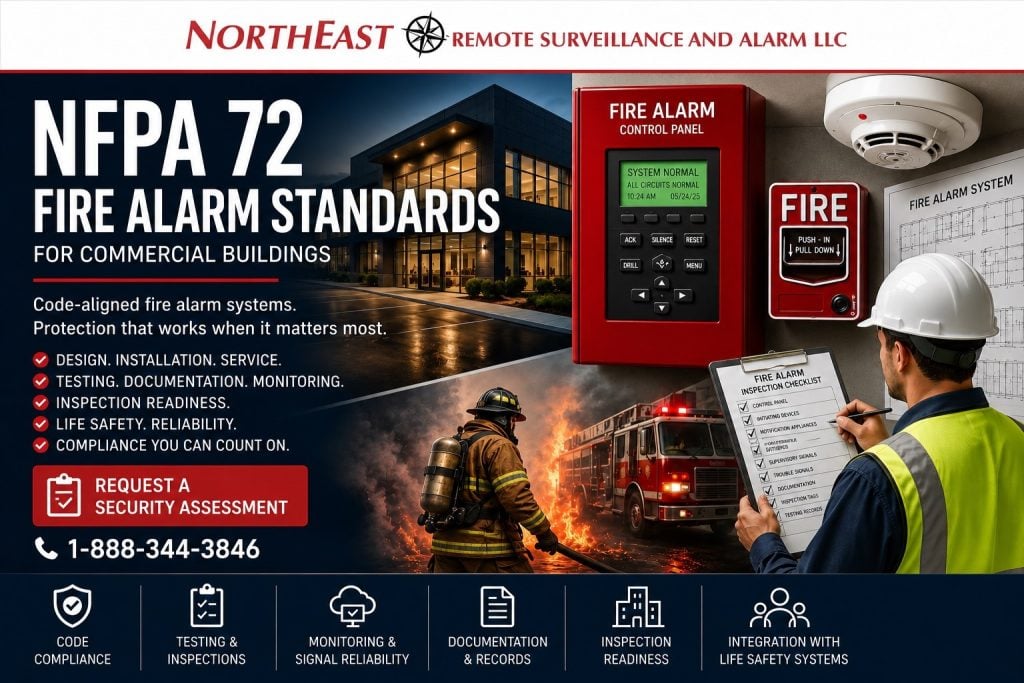
Northeast Remote Surveillance and Alarm, LLC helps commercial, industrial, warehouse, logistics, office, healthcare, retail, and multi-building facilities support fire alarm systems with practical planning, monitoring coordination, documentation review, communicator upgrades, testing support, and inspection readiness.
For the broader fire alarm overview, visit our commercial fire alarm systems page.
For design calculations, device-layout concepts and engineering documentation, use the Fire Alarm System Engineering Guide.
This resource explains how NFPA 72 relates to commercial fire alarm readiness without replacing the authority of the local AHJ, adopted code edition, engineer, fire marshal, or project-specific requirements. NFPA 72 is important, but the actual requirements for a building depend on the adopted code, local enforcement, occupancy, building conditions, system type, and scope of work.
A commercial fire alarm system should not be judged only by whether the panel powers up and shows normal status. The system also needs reliable detection, notification, monitoring, communication, testing, documentation, maintenance, and long-term service support.
What NFPA 72 Means for Commercial Fire Alarm Systems
NFPA 72 is commonly known as the National Fire Alarm and Signaling Code. For commercial buildings, it helps guide how fire alarm systems should perform, how signals should be transmitted, how notification should operate, how inspection and testing should be handled, and how fire alarm records should be maintained.
A commercial fire alarm system is not just a control panel, smoke detectors, pull stations, strobes, horn strobes, and notification devices. It is a life-safety system that needs to be designed around the building, occupancy, detection requirements, notification needs, monitoring path, documentation, inspection process, and emergency response expectations.
NFPA 72 can affect:
- Fire alarm control equipment
- Smoke detection
- Heat detection
- Manual pull stations
- Waterflow monitoring
- Valve tamper supervision
- Duct detector functions
- Notification appliances
- Monitoring and signal transmission
- Trouble and supervisory conditions
- Emergency communication systems
- Inspection records
- Testing records
- Maintenance records
- System documentation
- Device replacement
- Fire alarm modifications
- AHJ coordination
The exact requirements depend on the building and the adopted code path.
Why NFPA 72 Matters for Commercial Properties
NFPA 72 matters because fire alarm systems need to work when the building is occupied, when staff is limited, when the property is closed, and when emergency response depends on accurate signaling.
Poor fire alarm planning can create problems during:
- AHJ inspections
- Annual fire alarm testing
- Tenant fit-outs
- Building renovations
- Property sales
- Insurance reviews
- Service calls
- Emergency response
- Fire alarm communicator replacements
- Panel upgrades
- Device additions
- Monitoring account changes
- Deficiency correction
A commercial fire alarm system should be supportable over time. That means the system should be properly installed, monitored, tested, documented, serviced, and understood by the people responsible for the building.
For installation and service planning, visit commercial and industrial fire alarm installation.
NFPA 72 and Fire Alarm Monitoring
Commercial fire alarm monitoring must be planned carefully because alarm, trouble, supervisory, and related system signals need to reach the correct monitoring arrangement through a reliable communication path.
Monitoring is not just a communicator on the wall. It is part of how the fire alarm system performs when a condition occurs. The system must detect the condition, process the signal, transmit the event, and support the correct response.
NFPA 72-related monitoring concerns may include:
- Alarm signal transmission
- Trouble signal reporting
- Supervisory signal reporting
- Communication path reliability
- Cellular communicator upgrades
- Phone line replacement
- Monitoring account setup
- Emergency contact information
- Signal testing
- Documentation of communication changes
- Central station or supervising station coordination
- AHJ expectations
For monitoring, testing, and readiness support, visit commercial fire alarm monitoring, testing, and inspection readiness.
Fire Alarm Communicators and Phone Line Replacement
Many older commercial fire alarm systems were connected to legacy phone lines. As businesses remove traditional phone service or move away from copper lines, the fire alarm monitoring path may need to be reviewed and replaced.
A fire alarm communicator replacement should not be treated as a casual equipment swap. The facility should confirm that the new communication path is appropriate, the monitoring account is active, alarm and trouble signals are tested, contact information is current, and documentation is updated.
Fire alarm communication review may include:
- Existing communicator condition
- Phone line status
- Cellular fire alarm communicator options
- Dual-path communication where applicable
- Panel compatibility
- Power and battery considerations
- Monitoring account verification
- Signal testing
- Emergency contact updates
- Inspection documentation needs
For dedicated communicator planning, visit fire alarm phone line replacement.
NFPA 72 and Inspection, Testing, and Maintenance
NFPA 72 places strong importance on inspection, testing, maintenance, and records. A commercial fire alarm system should not only be accepted when installed. It should remain testable, serviceable, and ready over time.
Inspection, testing, and maintenance may involve:
- Fire alarm panel review
- Device testing
- Notification appliance testing
- Communicator testing
- Battery and power review
- Trouble condition review
- Supervisory signal review
- Waterflow and tamper signal review where applicable
- Deficiency reporting
- Repair documentation
- Service history review
- Recordkeeping
A system that passed acceptance at one point can still become less reliable later. Devices can age, communication paths can fail, batteries can weaken, service records can scatter, and undocumented changes can make the system harder to support.
For inspection-specific planning, visit fire alarm inspection readiness.
Testing Is More Than Showing the Panel Is Normal
One of the biggest mistakes in commercial fire alarm work is confusing a quick demonstration with proper testing. A normal panel display is important, but it does not prove that every required function, monitored condition, device, notification appliance, communication path, and system interface has been tested correctly.
Fire alarm testing may be needed after:
- New installation
- Panel replacement
- Communicator replacement
- Smoke detector replacement
- Pull station replacement
- Notification appliance changes
- Tenant fit-outs
- Building renovations
- Device additions
- Monitoring account changes
- Service repairs
- Fire alarm system takeovers
- Deficiency corrections
The system should be tested based on the work performed, the adopted code requirements, the system design, and the AHJ’s expectations.
NFPA 72 and Fire Alarm Documentation
Fire alarm documentation is not just paperwork. It is what makes the system easier to inspect, service, troubleshoot, and defend over time.
Commercial fire alarm records may include:
- Fire alarm inspection reports
- Testing records
- Deficiency reports
- Repair history
- Monitoring account information
- Emergency contact lists
- Communicator information
- Signal test records
- Battery records
- Device replacement history
- Panel programming notes where appropriate
- As-built drawings where available
- Zone or point descriptions
- AHJ correspondence where applicable
- Service provider information
Good documentation helps during annual inspections, fire marshal reviews, insurance questions, tenant turnover, renovations, service calls, and future upgrades.
For broader documentation and readiness governance, visit security system documentation, testing, and inspection readiness.
NFPA 72 and Trouble or Supervisory Signals
A commercial fire alarm system may show or transmit trouble and supervisory signals that need to be understood and addressed. These conditions should not be ignored just because there is no active fire alarm.
Trouble conditions may involve:
- Device faults
- Wiring issues
- Ground faults
- Battery problems
- Power supply problems
- Communication path failures
- Panel issues
- Notification circuit problems
- Disabled or missing devices
Supervisory conditions may involve:
- Sprinkler valve tamper signals
- Low air supervisory conditions
- Fire pump signals
- Water tank or pressure-related conditions
- Other supervised fire protection equipment
A building is not truly inspection-ready if trouble and supervisory conditions are ignored, undocumented, or poorly managed.
For more detail, visit fire alarm trouble and supervisory signals.
NFPA 72 Does Not Stand Alone
NFPA 72 is important, but it does not stand alone. Commercial fire alarm projects can also be affected by building code, fire code, electrical code, life-safety requirements, accessibility requirements, local amendments, insurance requirements, and AHJ direction.
A commercial fire alarm project may also involve:
- NFPA 70 electrical requirements
- Building code requirements
- Fire code requirements
- Local amendments
- ADA and accessibility considerations
- Door hardware and egress coordination
- Elevator recall requirements
- Sprinkler monitoring requirements
- Mechanical system shutdown functions
- Fire alarm and access control interfaces
- Low-voltage infrastructure
- AHJ inspection requirements
For wiring, pathways, power, and low-voltage infrastructure planning, visit low-voltage cabling.
Fire Alarm and Access Control Coordination
Commercial fire alarm systems often interact with access control, door hardware, elevator recall, HVAC shutdown, duct detectors, magnetic locks, electrified door hardware, and other building systems. When these systems interact, they need to be planned and documented correctly.
Coordination may involve:
- Fire alarm relay outputs
- Door release functions
- Elevator recall interfaces
- HVAC shutdown functions
- Duct detector connections
- Access control power supplies
- Request-to-exit devices
- Door contacts
- Maglock release
- Emergency egress requirements
- AHJ testing expectations
This is one reason commercial fire alarm work should not be treated as an isolated panel-only project. The system may affect multiple parts of the building.
NFPA 72 for Warehouses, Industrial Buildings, and Multi-Building Sites
Warehouses, logistics facilities, manufacturing buildings, industrial sites, and multi-building commercial properties often have more complicated fire alarm needs than smaller offices or storefronts.
These properties may involve:
- Large open areas
- Loading docks
- Warehouse storage
- High ceilings
- Beam detection
- Multiple notification zones
- Sprinkler monitoring
- Low air supervisory signals
- Multiple tenants
- Detached buildings
- Fire alarm communicators
- Remote annunciation
- Elevator recall
- Fire pump monitoring
- Long cable pathways
- Outdoor or harsh environments
- More complex inspection logistics
For these properties, NFPA 72 readiness is not just about installation. It is about keeping the system monitored, documented, testable, and supportable over time.
Common NFPA 72 Readiness Problems
Commercial fire alarm problems often develop slowly. A building may appear normal at first glance while documentation, monitoring, testing, or service readiness has drifted.
Common readiness problems include:
- Outdated emergency contacts
- Old phone lines still supporting monitoring
- Communicators that have not been tested properly
- Recurring trouble signals
- Supervisory signals that are not understood
- Missing inspection reports
- Open deficiencies with no clear follow-up
- Device changes that were not documented
- Renovations that affected the system
- Incomplete service history
- Unclear zone or point descriptions
- Poor coordination with access control
- No clear responsibility for records
- Multiple vendors with scattered documentation
A focused NFPA 72 readiness review can help identify these issues before they become larger inspection, service, or emergency-response problems.
How NERSA Supports NFPA 72 Fire Alarm Readiness
Northeast Remote Surveillance and Alarm, LLC supports commercial and industrial fire alarm projects with practical planning, monitoring coordination, communicator upgrades, service support, documentation review, testing support, and inspection readiness.
NERSA helps commercial facilities with:
- Fire alarm system review
- Fire alarm installation planning
- Fire alarm repair support
- Fire alarm communicator replacement
- Monitoring path review
- Alarm, trouble, and supervisory signal review
- Inspection readiness
- Deficiency tracking
- Testing coordination
- Documentation cleanup
- Fire alarm and access control coordination
- Low-voltage infrastructure review
- Long-term service planning
Our work is focused on business and professionally managed properties that need reliable systems, clean records, and long-term support.
When to Request a Fire Alarm and NFPA 72 Readiness Review
A commercial property should consider a fire alarm readiness review when:
- A fire alarm inspection is coming up
- A communicator is outdated
- Phone lines are being removed
- The system has recurring trouble signals
- Supervisory signals are not clearly understood
- Inspection records are missing
- The building recently changed ownership
- A tenant fit-out affected the system
- Renovations changed the layout
- New devices were added
- A panel upgrade is being considered
- Monitoring account contacts are outdated
- Service history is unclear
- Multiple vendors have worked on the system
- The building needs better documentation
A readiness review can help the facility understand what it has, what is working, what needs attention, and what should be documented before the next inspection, service call, or emergency event.
FAQs
What is NFPA 72?
NFPA 72 is commonly known as the National Fire Alarm and Signaling Code. It is used for fire alarm and signaling systems, including planning, installation, monitoring, inspection, testing, maintenance, documentation, and emergency communication system requirements.
Does NFPA 72 apply to commercial fire alarm systems?
Yes. NFPA 72 is commonly used in commercial fire alarm planning, installation, monitoring, testing, inspection, and service. The exact requirements depend on the adopted edition, local code requirements, building occupancy, system type, project scope, and AHJ direction.
Who decides which NFPA 72 edition applies?
The applicable edition is determined by the adopted code and the authority having jurisdiction. A project should always be reviewed against the local requirements in effect for that property.
Does NFPA 72 cover fire alarm testing and inspection?
Yes. NFPA 72 includes requirements related to inspection, testing, maintenance, and records for fire alarm and signaling systems. Commercial properties should maintain usable records showing what was tested, what passed, what failed, what was corrected, and what still needs follow-up.
Is NFPA 72 the only standard that affects fire alarm work?
No. NFPA 72 is important, but commercial fire alarm work may also be affected by building code, fire code, electrical code, life-safety requirements, local amendments, accessibility requirements, insurance requirements, and AHJ direction.
Does NFPA 72 affect fire alarm monitoring?
Yes. NFPA 72 affects fire alarm monitoring, signal transmission, trouble signals, supervisory signals, communication paths, testing, and documentation. A monitored system should be reviewed as part of the complete fire alarm program.
Can NERSA help prepare a commercial fire alarm system for inspection?
Yes. NERSA can help review commercial fire alarm equipment, monitoring paths, documentation, service history, trouble conditions, supervisory signals, testing needs, communicator concerns, and repair requirements so the property is better prepared for inspection and long-term operation.
Can NERSA help replace old fire alarm phone lines?
Yes. NERSA can help review and replace outdated fire alarm phone line monitoring paths with appropriate fire alarm communication options, including cellular communicator solutions where applicable.
Related NFPA Guidance
Explore the NFPA standards directory for related commercial security and life-safety guidance.
Request a Fire Alarm and Life Safety Assessment
If your commercial building needs fire alarm installation, repair, monitoring review, communicator replacement, inspection preparation, system documentation, or life-safety coordination, NERSA can help.
Contact Northeast Remote Surveillance and Alarm, LLC to schedule a fire alarm and life safety assessment for your commercial property.
Commercial | Industrial | Fire Alarm | Life Safety | Security | Low Voltage
Code Note
This resource is general informational content for commercial planning purposes. The adopted code edition, local amendments, authority having jurisdiction, project scope, building conditions, occupancy, and actual system configuration control the requirements for any specific project.