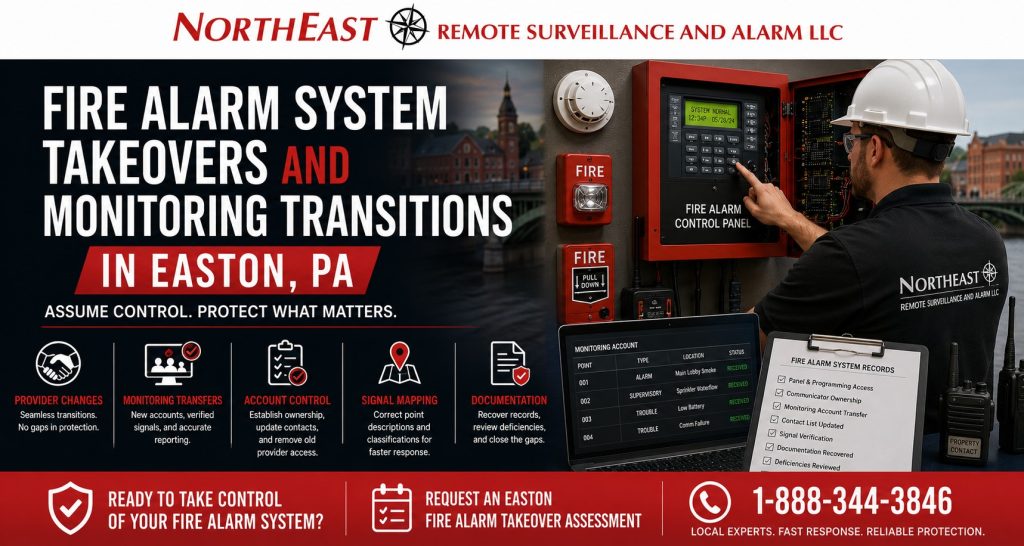
Fire alarm system takeovers and monitoring transitions in Easton, PA help commercial property owners establish authorized control over inherited life-safety equipment, change service or monitoring providers, update responsible contacts, verify required signal transmission, recover system records, and create a clear path for continuing support. Request an Easton Fire Alarm Takeover Assessment or call 1-888-344-3846.
Northeast Remote Surveillance and Alarm, LLC evaluates supported fire alarm systems for Easton offices, healthcare properties, retail spaces, restaurants, schools, churches, municipal buildings, warehouses, manufacturing facilities, industrial properties, mixed-use buildings, multi-tenant properties, commercial campuses, and multi-location organizations assuming responsibility for existing equipment or changing providers.
This page focuses specifically on customer authorization, equipment and account ownership, provider transitions, monitoring-account transfers, communicator control, responsible-contact migration, point and signal mapping, programming access, documentation recovery, deficiency review, signal verification during cutover, and establishment of ongoing service responsibility.
For new fire alarm design, detection, occupant notification, tenant renovations, sprinkler supervision, and complete local life-safety planning, visit Commercial Fire Alarm Systems in Easton, PA.
Businesses keeping their current provider and primarily needing scheduled signal testing, inspection preparation, or monitoring verification should visit Fire Alarm Monitoring, Testing, and Inspection Readiness in Easton, PA.
Properties needing corrective service should use Commercial Fire Alarm Maintenance and Repair in Easton, PA. Modernization of obsolete panels, communicators, notification equipment, or unsupported devices belongs under Easton Fire Alarm Upgrades.
Commercial & Industrial Fire Alarm Takeovers • Provider and Monitoring Changes • Account Control, Signal Verification, Documentation & Long-Term Support
Request an Easton Fire Alarm Takeover Assessment
Call 1-888-344-3846
What Is a Commercial Fire Alarm Takeover?
A commercial fire alarm takeover is the authorized evaluation and transition of an existing life-safety system installed, programmed, monitored, or serviced by another provider.
The process should establish:
- Who owns the fire alarm equipment
- Who controls the monitoring account
- Who owns the communicator and related service account
- Whether the customer is authorized to change providers
- Whether panel and software access are available
- Which provider currently holds programming files or passwords
- Whether the installed platform remains supportable
- Which alarm, supervisory, and trouble signals are monitored
- Whether point descriptions match the building
- Whether responsible-party contacts are current
- Whether required documentation is available
- Whether unresolved deficiencies remain
- Whether previous building changes were documented
- Whether NERSA can responsibly establish continuing service
A takeover is not simply changing the monitoring telephone number or reprogramming one communicator field.
The equipment, monitoring account, signal classifications, customer authorization, communicator ownership, responsible contacts, documentation, programming access, deficiencies, and ongoing service responsibilities should be reviewed as one controlled transition.
When an Easton Property May Need a Fire Alarm Takeover
A commercial property may need a takeover or monitoring transition after:
- Purchasing an existing building
- Leasing a property with an installed system
- Taking over a former tenant space
- Changing fire alarm service providers
- Changing monitoring companies
- Acquiring another business location
- Replacing a property-management company
- Losing contact with the original installer
- Discovering that no one has administrator access
- Finding that another provider controls the communicator
- Discovering outdated emergency contacts
- Receiving unexplained monitoring signals
- Losing legacy telephone service
- Finding incomplete drawings or test records
- Discovering disabled devices
- Finding unresolved inspection deficiencies
- Consolidating several properties under one provider
- Preparing an inherited system for repair or modernization
A panel may display System Normal while the customer lacks control over the monitoring account, programming database, communicator, service credentials, emergency contacts, or system records.
A structured takeover assessment identifies those conditions before the organization relies on the system during an emergency.
Easton Fire Alarm Takeover Resources
Commercial Fire Alarm Systems in Easton, PA
Commercial Fire Alarm Systems in Easton, PA is the primary local parent for new systems, occupied-commercial properties, detection, notification, monitoring, sprinkler supervision, renovations, emergency interfaces, and complete life-safety planning.
Fire Alarm Monitoring, Testing, and Inspection Readiness in Easton, PA
Fire Alarm Monitoring, Testing, and Inspection Readiness in Easton, PA addresses scheduled functional testing, monitoring verification, inspection preparation, responsible contacts, batteries, documentation, and deficiency reporting when no provider change is the primary objective.
Commercial Fire Alarm Maintenance and Repair in Easton, PA
Commercial Fire Alarm Maintenance and Repair in Easton, PA addresses failed devices, panel troubles, ground faults, notification faults, communication problems, batteries, supervisory conditions, and corrective service.
Easton Fire Alarm Upgrades
Easton Fire Alarm Upgrades addresses obsolete panels, communicator modernization, device migration, addressable conversion, notification expansion, unsupported equipment, and phased replacement.
Warehouse and Industrial Fire Alarm Systems in Easton, PA
Warehouse and Industrial Fire Alarm Systems in Easton, PA addresses high-bay spaces, industrial conditions, specialty detection, large notification areas, sprinkler supervision, production environments, and multi-building industrial facilities.
Fire Alarm Monitoring and Supervision
Fire Alarm Monitoring and Supervision addresses alarm, supervisory, trouble, sprinkler, power, and communication signals along with supervising-station transmission and monitoring-account planning.
Commercial and Industrial Fire Alarm Installation
Commercial and Industrial Fire Alarm Installation is NERSA’s broader fire-alarm authority for commercial and industrial system design, installation, monitoring, notification, sprinkler supervision, emergency interfaces, documentation, and long-term support.
Changing fire alarm or monitoring providers, assuming control of an inherited system, or consolidating several Easton properties? Request an Easton Fire Alarm Takeover Assessment or call 1-888-344-3846.
Authorization, Ownership, and Customer Control
NERSA must work with an authorized representative of the property owner, tenant, municipality, institution, management organization, or business responsible for the fire alarm system.
The transition may require confirmation of:
- Property ownership
- Authorized tenancy
- Property-management authority
- Authority to modify the fire alarm
- Authority to change monitoring
- Ownership of the installed communicator
- Ownership of cellular, radio, IP, or cloud accounts
- Existing service agreements
- Existing monitoring agreements
- Panel programming access
- Software database ownership
- Customer and monitoring passcodes
- Landlord and tenant responsibilities
- Responsibility for shared building systems
NERSA does not bypass security controls, assume ownership of provider-controlled accounts, or alter fire alarm programming without proper authorization.
When access or ownership remains unclear, coordination may be needed with:
- The building owner
- Current or former service provider
- Current or former monitoring company
- Panel manufacturer
- Communicator provider
- Property-management company
- Former tenant
- Design professional
- Other authorized parties
Some systems transfer cleanly. Others require account releases, programming recovery, communicator replacement, database reconstruction, or phased modernization.
Taking Control of an Inherited Fire Alarm System
A new owner, tenant, or property manager may inherit a system without receiving enough information to operate or support it responsibly.
Management may not know:
- Who installed the system
- Who currently monitors it
- Whether monitoring is active
- Who owns the communicator
- Who controls the software database
- Which responsible contacts are listed
- Which devices or circuits are disabled
- Whether sprinkler signals are monitored
- Whether building interfaces exist
- Whether former tenants remain in the records
- Whether old telephone lines are still required
- When batteries were last replaced
- Whether inspection deficiencies remain open
- Whether renovations were documented
- Whether current drawings exist
- Whether the platform remains supported
The system should not be accepted solely because the panel appears normal.
The takeover assessment should establish what the system protects, where its signals are transmitted, who controls it, what records exist, which deficiencies remain, and whether a dependable service relationship can be established.
Changing Fire Alarm Service Providers
A property may change providers because of:
- Slow service response
- Poor communication
- Recurring unresolved conditions
- Incomplete system records
- Monitoring problems
- Provider-controlled accounts
- Limited platform support
- Ownership or management changes
- Multi-site consolidation
- Upcoming renovations
- A need for clearer commercial support
- A need to coordinate fire alarm and controlled doors
A provider change should be managed carefully so the property is not left with an unmonitored or unsupported life-safety system.
The transition may involve:
- Confirming customer authorization
- Reviewing the existing service relationship
- Identifying the installed platform
- Recovering available programming records
- Confirming panel supportability
- Confirming communicator ownership
- Establishing the new monitoring account
- Updating responsible contacts
- Reviewing point and device descriptions
- Testing required transition signals
- Identifying disabled equipment
- Reviewing open deficiencies
- Removing obsolete provider access
- Documenting the completed handoff
The objective is a controlled transition—not an abrupt disconnection followed by incomplete programming or uncertain monitoring.
Monitoring-Account Transitions
Changing monitoring requires more than opening a new account.
The transition should address:
- Correct property name
- Correct street address
- Building and suite identification
- Fire alarm panel information
- Communicator information
- Alarm signals
- Supervisory signals
- Trouble conditions
- Sprinkler waterflow points
- Valve-tamper points
- Other approved supervisory points
- Responsible contacts
- Contact order
- Passcodes
- Special property conditions
- Testing instructions
- Communication-failure reporting
- Effective transition date
The monitoring account should match the panel and installed system.
A signal should not arrive as a generic point or the wrong room, suite, riser, building, or signal classification.
Panel programming, monitoring records, point descriptions, building labels, and customer documentation should be aligned.
Avoiding a Monitoring Gap
A monitoring transition should be scheduled to minimize interruption.
Planning may include:
- Confirming when the existing account will end
- Establishing the replacement account before cutover
- Confirming the communicator or replacement path
- Placing the appropriate account on test
- Following applicable Easton notification procedures
- Informing authorized building representatives
- Programming the approved transition
- Testing required signals
- Confirming monitoring receipt
- Correcting rejected or mislabeled signals
- Restoring the system to normal
- Removing the account from test
- Confirming return to service
- Documenting the cutover
The prior monitoring path should not be removed until the replacement path is active and the required signals have been verified.
Local notification without dependable signal transmission does not provide a complete monitoring transition.
Easton Transition Coordination
Provider and monitoring transitions may involve panel access, communicator changes, account testing, or temporary out-of-service conditions.
The transition plan should account for current Easton procedures concerning:
- Customer and property information
- Responsible contacts
- Service-company information
- Notification before certain system work
- Return-to-service communication
- Central-station alarm communication
- Corrective documentation for known malfunctions
- Maintaining current contact information
Project-specific requirements should be confirmed with the applicable Easton officials before work begins.
The takeover should leave the customer with current records and a clear understanding of who is responsible for monitoring, service, property response, and future changes.
Responsible-Party and Contact Migration
Monitoring contacts often become outdated after employee, ownership, tenant, or management changes.
Common problems include:
- Former employees remain listed
- Telephone numbers are disconnected
- The call order is incorrect
- No after-hours contact is available
- Contacts are assigned to the wrong property
- Former tenants remain listed
- No one is authorized to enter the building
- No one understands the fire alarm panel
- Regional contacts are missing
- Property-management contacts are outdated
The customer should identify:
- Property owner
- Property manager
- Facility manager
- Tenant representatives where applicable
- Primary responsible contact
- Backup responsible contacts
- After-hours contacts
- Telephone numbers
- Contact order
- Access procedures
- Monitoring passcodes
- Authority to silence or reset the system
- Authority to place the account on test
- Authority to approve service
NERSA can help organize and implement the approved information, but the authorized customer remains responsible for deciding who should be listed.
Communicator Ownership and Transferability
The installed communicator may be:
- Customer-owned
- Provider-owned
- Leased
- Connected to a provider-controlled cellular account
- Connected to customer network infrastructure
- Registered to an inactive account
- Unsupported by the proposed monitoring provider
- Dependent on legacy telephone service
The takeover should establish:
- Manufacturer and model
- Communication technology
- Equipment ownership
- Service-account ownership
- Transferability
- Carrier or network support
- Panel compatibility
- Power source
- Battery support
- Monitoring destination
- Account status
- Long-term platform support
A communicator may need to be released, transferred, reactivated, reprogrammed, or replaced.
Communicator modernization belongs under the upgrade page when substantial equipment replacement or technology migration becomes the primary need.
Cellular, IP, and Dual-Path Transitions
Cellular Communication
A cellular transition may require review of:
- Communicator compatibility
- Cellular generation
- Carrier support
- Account ownership
- Antenna location
- Signal quality
- Panel connection
- Power
- Battery load
- Signal reporting
- Communication-failure reporting
- Restoration
IP Communication
An IP transition may require coordination with authorized IT personnel concerning:
- Network port
- Addressing
- Router or firewall conditions
- Internet service
- Network segmentation
- Equipment ownership
- Backup power
- Communication supervision
- Monitoring compatibility
- Failure and restoration reporting
Dual-Path Communication
A dual-path transition should confirm:
- Primary path
- Secondary path
- Path supervision
- Failure reporting
- Path switching
- Monitoring receipt
- Restoration
- Power support
- Ownership of both services
The presence of multiple communication modules does not prove that every path is active and mapped correctly.
Replacing Legacy Telephone Monitoring
Some inherited systems continue to depend on traditional telephone lines.
A transition may be appropriate when:
- Copper service is being discontinued
- Telephone costs are increasing
- Communication troubles are occurring
- The communicator is obsolete
- The monitoring provider is changing
- The property changed ownership
- Signal transmission is inconsistent
The project may require:
- Panel compatibility review
- Replacement communicator
- New service activation
- Power and battery review
- Programming
- Monitoring-account changes
- Signal verification
- Updated documentation
The existing path should remain in place until the approved replacement is activated and verified.
Signal and Point Mapping
The takeover should confirm the relationship among:
- Physical device or monitored condition
- Fire alarm panel text
- Remote annunciator text
- Monitoring-account description
- Signal classification
- Drawings
- Test reports
- Service records
Useful descriptions may include:
- Main Lobby Smoke Detector
- Suite 204 Pull Station
- North Sprinkler Riser Waterflow
- First-Floor Valve Tamper
- Elevator Lobby Smoke Detector
- Rooftop Unit 3 Duct Detector
- Rear Stair Door Release
Weak descriptions include:
- Zone 1
- Smoke 4
- Module 7
- Back Area
- Old Office
Incorrect or vague descriptions can create confusion during monitoring, service, inspection, and emergency response.
Point-description corrections may require programming access, updated records, and transition testing.
Alarm, Supervisory, and Trouble Classifications
A takeover should confirm that monitored signals are classified correctly.
Alarm Signals
Alarm signals may include:
- Smoke detection
- Heat detection
- Manual pull-station activation
- Sprinkler waterflow
- Other approved alarm inputs
Supervisory Signals
Supervisory signals may include:
- Valve-tamper conditions
- Low-air points
- Fire-pump conditions
- Other approved off-normal fire-protection conditions
Trouble Signals
Trouble signals may include:
- Primary-power failure
- Low battery
- Communication failure
- Ground fault
- Open circuit
- Missing device
- Notification fault
- Disabled point
A valve supervisory point should not report as a fire alarm, and an alarm point should not be entered as a routine trouble signal.
Panel, Software, and Database Access
Commercial fire alarm systems may require specialized:
- Programming software
- Databases
- Passwords
- Interface cables
- Licensing
- Manufacturer authorization
- Software versions
- Programming backups
The takeover should determine:
- Whether the customer owns the programming database
- Whether a current backup exists
- Who has programming access
- Whether the former provider will release files
- Whether passwords are available
- Whether the software remains supported
- Whether remote access exists
- Whether former-provider access can be removed
- Whether device text can be updated
- Whether programming changes require retesting
A monitoring account change does not establish complete customer control when no authorized provider can access or responsibly support the panel programming.
Documentation Recovery
An inherited system may lack:
- Approved drawings
- As-built drawings
- Riser diagrams
- Point or device lists
- Sequence of operations
- Battery calculations
- Voltage-drop calculations
- Monitoring records
- Sprinkler point lists
- Interface information
- Inspection reports
- Test reports
- Deficiency records
- Repair records
- Programming databases
- Service history
The takeover assessment should identify what is available and what is missing.
Some records may be reconstructed through field review and programming access. Approved engineering, permit, or design documents may require coordination with the prior provider, owner, design professional, or AHJ.
Documentation recovery does not automatically recreate an approved design record.
Existing Deficiencies and Impairments
A takeover may uncover:
- Disabled devices
- Bypassed circuits
- Ground faults
- Failed detectors
- Notification troubles
- Communication problems
- Weak batteries
- Missing labels
- Unsupported equipment
- Incomplete point text
- Unresolved inspection deficiencies
- Unrecorded renovations
- Sprinkler supervisory problems
- Failed building interfaces
The transition should identify:
- What condition exists
- What function is affected
- Whether the condition is documented
- Whether correction is practical
- Whether another contractor is responsible
- Whether the condition requires repair
- Whether modernization is appropriate
- Whether permit or design work may be required
- Whether retesting is necessary
A takeover should not silently carry unknown disabled points or unresolved deficiencies into the new monitoring account.
Corrective work belongs under the maintenance page, while modernization belongs under the upgrade page.
Signal Verification During Cutover
A transition should verify the signal types applicable to the installed system.
Testing may include:
- Smoke alarm
- Heat alarm
- Pull-station alarm
- Sprinkler waterflow
- Valve-tamper supervisory
- Other supervisory points
- Primary-power failure
- Low battery
- Communication failure
- Device or circuit trouble
- Signal restoration
- Panel reset
- Included building interfaces
Testing one smoke detector does not verify the entire transition.
Each applicable signal should be reviewed for:
- Correct monitoring account
- Correct property
- Correct point description
- Correct signal classification
- Correct restoration
- Correct responsible-contact procedure
Detailed recurring testing and inspection preparation remain the responsibility of the dedicated readiness page.
Provider Access and Account Security
A provider change should identify and address obsolete access where the system and authorization permit.
This may include:
- Former monitoring accounts
- Former remote-service access
- Former cellular accounts
- Former cloud accounts
- Shared administrator credentials
- Provider-owned software connections
- Old contact lists
- Former property-management users
The customer should understand:
- Who owns the system accounts
- Who has administrator rights
- How access is recovered
- What the customer controls directly
- What recurring services are required
- What happens if the provider changes again
- Where current records are stored
Clear ownership reduces future transition risk.
Multi-Site Monitoring Consolidation
Organizations with several locations may inherit different:
- Panels
- Monitoring providers
- Communicators
- Point descriptions
- Responsible contacts
- Software platforms
- Service agreements
- Documentation standards
- Open deficiencies
A multi-site transition may determine:
- Which systems can remain
- Which communicators are transferable
- Which monitoring accounts can be consolidated
- Which contacts are regional
- Which contacts are site-specific
- Which properties require repair
- Which properties require upgrades
- How point names should be standardized
- How account ownership should be documented
- How future acquisitions should be handled
Standardization does not always require immediate replacement of every system.
A phased plan can prioritize unsupported, unreliable, poorly documented, or higher-risk locations.
Takeover Versus Monitoring Readiness
A monitoring-readiness project verifies an existing approved account, system, communicator, contacts, and signals while the provider relationship remains substantially unchanged.
A takeover primarily involves:
- Changing service responsibility
- Changing monitoring responsibility
- Customer authorization
- Equipment and account ownership
- Communicator transfer
- Programming access
- Contact migration
- Signal remapping
- Provider-access removal
- Establishing ongoing support
The takeover may include transition testing, but scheduled inspection and recurring system verification remain with the readiness page.
Takeover Versus Maintenance and Repair
A takeover establishes control, monitoring, account ownership, records, and continuing responsibility.
Maintenance and repair correct:
- Failed devices
- Panel troubles
- Ground faults
- Notification faults
- Weak batteries
- Communication failures
- Supervisory conditions
- Building-interface failures
- Malfunction causes
A takeover assessment may identify repair needs, but corrective service should remain a separate approved scope.
Takeover Versus Fire Alarm Upgrade
A takeover establishes responsibility for the current system.
An upgrade modernizes:
- Control panel
- Annunciator
- Communicator
- Detection devices
- Notification equipment
- Power supplies
- Software
- Unsupported equipment
- System capacity
The takeover page should identify modernization needs without becoming a second upgrade page.
Takeover Versus New Installation
A new installation begins without a practical existing platform or involves complete system replacement.
A takeover begins with installed equipment that must be evaluated for:
- Ownership
- Authorization
- Condition
- Compatibility
- Monitoring
- Programming
- Documentation
- Supportability
Complete replacement may be necessary when:
- The system cannot be accessed lawfully
- The panel is obsolete
- Programming cannot be recovered
- Parts are unavailable
- The communicator is unsupported
- Equipment is unreliable
- Provider-controlled accounts cannot be transferred
- Continued use creates unreasonable limitations
The decision should be based on the actual system rather than an automatic assumption that every inherited fire alarm must be removed.
The NERSA Easton Fire Alarm Takeover Process
Authorization and Information Collection
NERSA identifies the authorized customer representative and gathers available information concerning:
- Property ownership
- Current provider
- Current monitoring company
- Panel
- Communicator
- Software
- Responsible contacts
- Agreements
- Drawings
- Reports
- Deficiencies
- Known system conditions
Existing-System Assessment
The panel, annunciators, general device inventory, notification, monitored sprinkler points, power supplies, batteries, communicator, monitoring, programming access, and overall supportability are reviewed.
Monitoring and Ownership Review
NERSA reviews:
- Property information
- Monitoring account
- Communicator
- Signal map
- Responsible contacts
- Account ownership
- Communication path
- Testing procedure
- Provider-transition requirements
Documentation and Deficiency Review
Available plans, point lists, databases, reports, service history, and open deficiencies are reviewed.
Transition Recommendation
The customer receives a determination of:
- What can remain
- What authorization remains necessary
- What records or credentials are missing
- What requires correction
- What should be replaced
- How monitoring can be transitioned
- Which signals should be verified
- Whether repairs or upgrades are separate requirements
- Whether ongoing support can be established
Monitoring Setup and Cutover
Approved monitoring, communication, contact, and programming changes are coordinated.
Signal Verification
Applicable alarm, supervisory, trouble, communication, power, restoration, and included interface signals are checked through the new arrangement.
Account and Contact Cleanup
Property information, responsible contacts, call order, passcodes, service-company information, and account instructions are updated according to customer authorization.
Documentation and Handoff
The completed transition should identify:
- Panel and communicator
- Equipment and account ownership
- Monitoring provider
- Service provider
- Responsible contacts
- Signal descriptions
- Verified transition signals
- Programming-access conditions
- Documentation received
- Open deficiencies
- Repair or upgrade recommendations
- Continuing service responsibilities
Why Easton Businesses Choose NERSA
Northeast Remote Surveillance and Alarm, LLC focuses on non-residential commercial and industrial security and life-safety systems.
Fire alarm takeover planning evaluates:
- Customer authorization
- Equipment ownership
- Monitoring ownership
- Fire alarm panel
- Communicator
- Programming access
- Monitoring account
- Signal classifications
- Responsible contacts
- Point descriptions
- Existing documentation
- Open deficiencies
- Repair requirements
- Upgrade requirements
- Multi-site needs
- Long-term supportability
The objective is not simply to move an account from one monitoring provider to another.
The objective is to give the customer clearer system control, verified communication, current contacts, accurate monitoring information, known ownership, organized records, documented deficiencies, and a defined long-term service relationship.
Request an Easton Fire Alarm Takeover Assessment
If your Easton property inherited a fire alarm system, is changing service or monitoring providers, lacks programming access, has outdated responsible contacts, uses provider-controlled communication, depends on old telephone service, is consolidating several locations, or needs to determine whether existing equipment can be supported, Northeast Remote Surveillance and Alarm, LLC can evaluate the transition.
An Easton fire alarm takeover assessment may review:
- Customer authorization
- Panel and annunciators
- Communicator
- Monitoring account
- Signal classifications
- Responsible contacts
- Equipment ownership
- Account ownership
- Programming and software access
- Sprinkler-monitoring points
- Primary and standby power
- Existing documentation
- Previous reports
- Open deficiencies
- Provider access
- Repair requirements
- Upgrade requirements
- Multi-site standardization
Request an Easton Fire Alarm Takeover Assessment or call 1-888-344-3846.
Frequently Asked Questions About Fire Alarm Takeovers and Monitoring Transitions in Easton, PA
What is a commercial fire alarm takeover?
A commercial fire alarm takeover is the authorized evaluation and transition of an existing system installed, programmed, monitored, or serviced by another provider.
Is a takeover the same as a fire alarm upgrade?
No. A takeover establishes system control, provider responsibility, monitoring, ownership, contacts, signal mapping, documentation, and continuing support. An upgrade modernizes equipment or capabilities.
Can NERSA take over every fire alarm system?
No. The system must be authorized, accessible, supportable, and suitable for continued use. Locked, obsolete, damaged, proprietary, or unsupported platforms may require correction or replacement.
Does NERSA take over residential smoke alarms?
No. NERSA focuses on commercial, industrial, institutional, municipal, healthcare, educational, warehouse, multi-tenant, and other non-residential properties.
Do we need the existing installer password?
Programming or installer access may be necessary. Recovery options depend on the system, ownership, prior provider, manufacturer, software, and customer authorization.
Can NERSA bypass a password held by another provider?
NERSA does not bypass system security without proper authorization. Recovery may require coordination with the owner, previous provider, manufacturer, monitoring company, or another authorized party.
Can monitoring be changed without replacing the panel?
Often, yes. The panel, communicator, programming access, account ownership, monitoring compatibility, and system condition must be evaluated.
Can an existing communicator be reused?
Possibly. It must be compatible, supported, transferable or activatable, properly owned, and suitable for the new monitoring arrangement.
Can old telephone-line monitoring be replaced?
Often, yes. Compatible systems may support cellular, IP, radio, dual-path, or another accepted communication method.
Will the fire alarm be offline during the transition?
The transition should be planned to minimize interruption. The exact process depends on the current account, communicator, new monitoring setup, authorization, notification requirements, and signal testing.
Can responsible contacts be updated during the transition?
Yes. The authorized customer should review responsible contacts, call order, telephone numbers, passcodes, access procedures, and service-company information.
What signals should be verified during the cutover?
Applicable transition testing may include alarm, sprinkler waterflow, supervisory, trouble, primary-power, low-battery, communication-failure, restoration, and included building-interface signals.
Does testing one smoke detector verify the entire transition?
No. One detector does not verify all alarm, supervisory, trouble, communication, restoration, sprinkler, power, or interface signals.
Can monitored sprinkler signals be transferred?
Possibly. Waterflow, valve-tamper, low-air, fire-pump, and other points should be identified, correctly classified, mapped, and tested.
Can point descriptions be corrected?
Possibly. Programming access, system capabilities, device locations, approved documents, and retesting requirements should be considered.
Can disabled devices simply be transferred?
Unknown or disabled points should first be identified and evaluated. An impairment should not be silently carried into the new monitoring arrangement.
What happens to the former provider’s remote access?
Obsolete or unauthorized access should be identified and removed where ownership, authorization, platform access, and system capabilities permit.
Can multiple buildings be moved to one monitoring provider?
Often, yes. Each property should be reviewed for panel compatibility, communicator ownership, point mapping, contacts, documentation, deficiencies, and site-specific procedures.
Can existing equipment remain?
Equipment may remain when it is compatible, dependable, supported, accessible, properly installed, and suitable for the property’s approved requirements.
What happens if the panel is obsolete?
NERSA can identify whether continued limited support is practical or whether the panel and related equipment should be modernized through a separate upgrade project.
Does a takeover include every repair?
Not automatically. The assessment may identify corrective work, but repairs, replacement parts, permits, design, specialized contractors, and modernization may require separate authorization.
Does a takeover clear prior inspection deficiencies?
No. Existing deficiencies should be reviewed, documented, corrected where authorized, retested, and closed through the appropriate process.
Can missing documentation be recovered?
Possibly. Some records can be reconstructed through field review and programming access. Approved design or permit records may require the prior provider, owner, design professional, or AHJ.
Does NERSA support small commercial properties and enterprise facilities?
Yes. NERSA supports smaller offices and tenant spaces as well as healthcare properties, schools, churches, municipal buildings, warehouses, industrial properties, mixed-use buildings, campuses, and multi-location organizations.
What is the first step?
The first step is an authorized assessment of the panel, communicator, monitoring, account ownership, responsible contacts, signal map, programming access, documentation, deficiencies, and long-term support requirements.
he primary need is modernization.