Distribution centers in Berks County need security systems designed around inbound freight, outbound shipments, employee access, driver activity, loading docks, trailer staging, yard visibility, restricted areas, and after-hours exposure. Northeast Remote Surveillance and Alarm, LLC designs, installs, upgrades, integrates, monitors, and supports commercial security systems for distribution centers, third-party logistics facilities, freight terminals, cross-dock operations, fulfillment properties, and multi-building logistics sites throughout Reading and Berks County.
NERSA focuses on commercial, industrial, municipal, institutional, healthcare, logistics, and enterprise environments. We do not install residential security systems.
For broader planning across warehouses, manufacturing facilities, truck yards, industrial parks, and other industrial properties, start with our Berks County Industrial & Logistics Corridor Security Systems page.
Request a Physical Plant Security Assessment or call 1-888-344-3846.
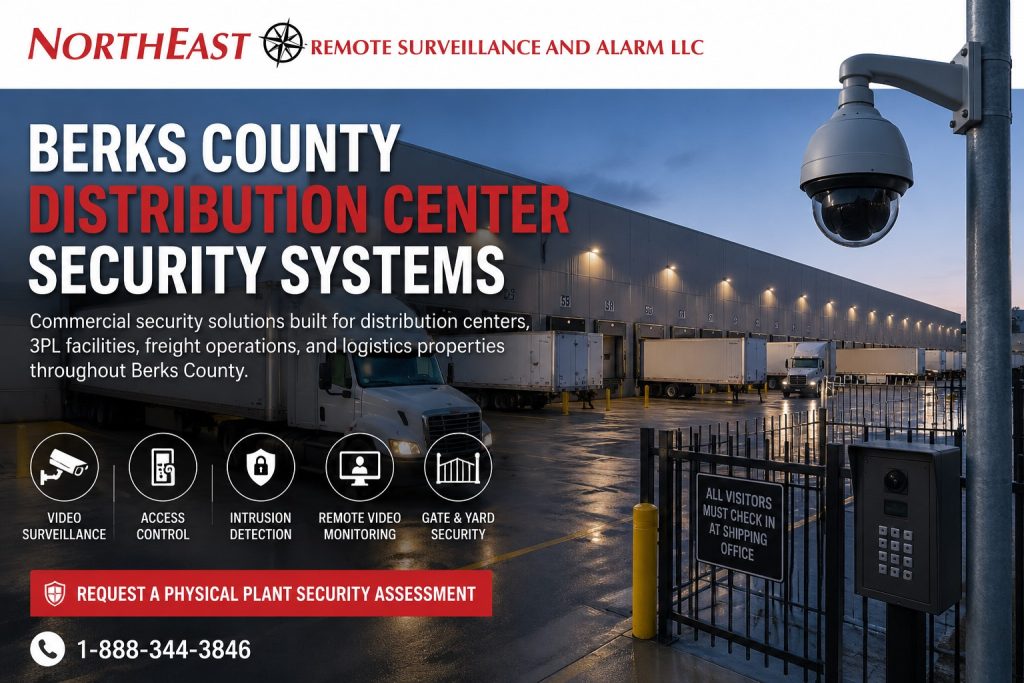
Security Planning for Active Distribution Operations
A distribution center security system should be planned around how the facility actually operates. A building moving trailers all day and night has different requirements than a smaller warehouse with predictable daytime traffic. A cross-dock facility handling continuous inbound and outbound movement has different visibility, access, and incident-documentation needs than a lower-volume storage building. A multi-tenant logistics property has different credential, monitoring, and infrastructure requirements than a single-user distribution site.
A properly planned system should account for:
- Employee entrances and shift changes
- Driver check-in and visitor arrival
- Shipping office and dispatch activity
- Truck entrances and controlled vehicle access
- Trailer staging and yard movement
- Loading docks and overhead doors
- Cross-dock and transfer activity
- Freight staging and exception areas
- Restricted offices, cages, and IT spaces
- Parking lots and pedestrian approaches
- Exterior blind spots and perimeter exposure
- Alarm response and after-hours procedures
- Existing cameras, panels, readers, and infrastructure that may be reusable
- Future expansion, building additions, or additional dock positions
The objective is not simply to place cameras around the building. The objective is to create a security system that supports accountability, incident review, controlled access, after-hours awareness, and long-term facility management.
How Distribution Centers Differ From Standard Commercial Properties
A distribution center has constant movement between the building and the outside environment. Employees, visitors, carriers, trailers, vendors, forklifts, and deliveries may all be active at the same time. That creates operating conditions that often require more deliberate planning than a typical office or small commercial building.
Security planning may need to address:
- High trailer turnover
- Frequent overhead-door activity
- Shared yard space
- Driver waiting and staging areas
- Multiple shifts
- Seasonal labor changes
- Visitor and contractor access
- Freight disputes
- Product shortage claims
- Exterior theft exposure
- Cargo security
- Parking-lot safety concerns
- Detached buildings or remote gates
- Network extension between equipment locations
Security systems should support the operation without slowing down shipping and receiving unnecessarily. Camera placement, credential permissions, alert handling, and monitoring procedures should reflect how managers actually run the facility.
Facility Areas That Need Focused Protection
Truck Entrances and Vehicle Access Points
Many distribution centers need better control and documentation at truck entrances, employee vehicle entrances, service gates, and after-hours access points.
A vehicle-entry plan may include:
- Overview video of approaching traffic
- Documentation of gate events
- Driver call-in or intercom procedures
- Scheduled access by user or vehicle type
- Access control for employee or vendor gates
- Searchable vehicle records where appropriate
- Clear evidence of when a truck or vehicle entered or exited
- After-hours review of unexpected vehicle activity
When a site needs stronger vehicle documentation, camera placement should be designed around lane position, vehicle speed, lighting, and the exact point where a plate or vehicle image needs to be captured. A general overview camera should not automatically be expected to provide reliable plate identification in every lane condition.
Loading Docks and Shipping Areas
Loading docks are one of the most important parts of a distribution center security plan. This is where trailers arrive, doors open, freight transfers occur, employees and drivers interact, and many disputes or claims originate.
A useful loading-dock layout may need to document:
- Trailer approach and dock position
- Exterior dock-door activity
- Interior shipping and receiving movement
- Overhead-door openings
- Freight staging and exception lanes
- Driver-side activity
- Pedestrian side-door use
- Movement between dock lanes and storage areas
- Activity immediately before and after an incident
One wide shot of an entire dock wall may provide general awareness but still fail to deliver the detail needed during an investigation. Camera positions should be selected based on the incidents the facility may actually need to review, such as product shortages, damage claims, unauthorized loading, trailer access, and off-hours dock activity.
Trailer Yards and Staging Areas
Trailer yards often present long sight lines, changing obstructions, inconsistent lighting, weather exposure, and frequent vehicle repositioning. These factors can make standard camera layouts less effective.
A trailer-yard security plan may involve:
- Yard overview cameras
- Dedicated views at entry and exit points
- Coverage of trailer staging rows
- Monitoring of fence lines or exposed edges
- Documentation of equipment movement
- Event-based alerts after hours
- Lighting-aware design for low-light conditions
- Defined response procedures for trespassing or suspicious activity
The goal is to improve visibility into who entered the yard, when equipment moved, where a trailer was placed, and what happened before or after a reported event.
Facilities concerned about theft exposure should also review our Cargo Theft Prevention Systems for Warehouses and Distribution Centers page.
Employee Entrances and Interior Access
Distribution centers often need stronger control over employee movement, especially when the property has multiple entrances, office areas, warehouse access points, dispatch spaces, or restricted support rooms.
Access control can help manage:
- Employee entrances
- Shift-based permissions
- Temporary labor and seasonal staffing
- Supervisor or management access
- Restricted offices
- Shipping and dispatch areas
- Server and communications rooms
- Inventory cages
- Maintenance rooms
- Multi-building access rights
A properly planned access-control system can reduce reliance on mechanical keys, simplify credential changes, improve accountability, and provide a record of door activity when an incident must be reviewed.
The physical opening still matters. Readers, locks, electrified hardware, request-to-exit devices, contacts, and related equipment should be selected around the actual door and how it is used.
Visitor, Contractor, and Driver Entry
Visitors, service providers, vendors, contractors, and truck drivers do not all need the same level of access. A facility may need designated entry paths and different procedures for each group.
A planned entry process may include:
- Front-office or shipping-office check-in
- Video intercom communication
- Remote release for approved entry
- Temporary credentials
- Restricted routes through the building
- Escort requirements
- Time-limited permissions
- Camera verification around the entry point
This helps the facility control who enters, where they go, and how their arrival is documented.
Freight Staging, Returns, and Exception Areas
Some of the most important evidence in a distribution center comes from the spaces where freight is staged, held, returned, separated, or investigated. These may include short-term staging lanes, exception areas, quality-review sections, hold areas, damaged-product zones, and temporary storage positions.
These spaces may require:
- Camera coverage selected around the exact activity that matters
- Controlled access if the area contains high-value product
- Clear visibility into who entered and when
- Evidence of movement into or out of the area
- Recording retention that supports delayed incident discovery
The required detail should be matched to the purpose of the space. A general aisle overview is different from the type of coverage needed to investigate a repeat product-loss issue.
Offices, Dispatch, and IT Spaces
Distribution centers frequently include office suites, dispatch areas, management offices, communications rooms, security workstations, and network closets. These spaces may hold business records, shipping information, system hardware, user credentials, and infrastructure that should not be openly accessible.
Security planning may include:
- Controlled access to sensitive rooms
- Camera coverage at entrances
- Intrusion protection after hours
- Limited access for authorized personnel only
- Organized and labeled cabling
- Backup power or communication protection where needed
Protecting these spaces helps support both business operations and the reliability of the security system itself.
Security Systems Commonly Used at Distribution Centers
Video Surveillance
Video surveillance is often the foundation of a distribution center security system because it helps management document activity across entrances, docks, yards, staging areas, parking lots, and restricted spaces.
Useful camera coverage should be based on the actual objective of each view, such as:
- General awareness
- Person identification
- Vehicle documentation
- Trailer activity review
- Dock incident review
- Exterior perimeter awareness
- Parking-lot safety review
- Searchable evidence during an investigation
Mounting height, lighting, lens selection, scene activity, and the exact location of the event all matter. The goal is not maximum camera count. The goal is usable evidence.
Access Control
Access control helps manage doors and gates across one building or several connected structures. It can organize permissions around shifts, departments, job roles, and restricted spaces while reducing the long-term problems caused by unmanaged keys.
This is especially useful at properties with:
- Several employee entrances
- Office and warehouse separation
- Dispatch or shipping offices
- Shared buildings
- Temporary labor
- High turnover
- Contractors or vendor access
- After-hours cleaning or maintenance crews
Intrusion Detection
Intrusion detection helps protect the facility when areas are closed or lightly staffed. A distribution center may need alarm protection for selected doors, office areas, dispatch spaces, support rooms, utility areas, or detached structures.
Alarm design should reflect how the property is occupied. A facility that remains active in one area while another area is closed may need different scheduling or partitioning than a building that shuts down completely at night.
Remote Video Monitoring
Some distribution centers need more than recording and alerts sent to a manager’s phone. Remote video monitoring can support properties that want stronger after-hours awareness around exterior areas, parking lots, yards, gates, docks, and building approaches.
Monitoring procedures should be selected around the property’s actual risks and approved response process, not simply around generating the highest number of alerts.
Facilities that need active after-hours visibility can also review our Remote Video Monitoring and Live Talk-Down page.
Structured Cabling and Infrastructure
Distribution center security depends on infrastructure. Cameras, controlled doors, network equipment, intercoms, gates, wireless links, and remote equipment locations all rely on cabling and communications pathways that can support the system over time.
A project may require:
- CAT6 or CAT6A cabling
- Fiber connections
- PoE switching
- Building-to-building communication
- Equipment enclosures
- Wireless bridge connections
- Labeled pathways and organized terminations
- Capacity for future expansion
The supporting infrastructure should be evaluated before deciding what can be reused and what should be replaced.
Distribution Center Security System Upgrades and Takeovers
Many logistics facilities already have cameras, recorders, access-control hardware, alarm panels, network equipment, or legacy infrastructure in place. Before removing everything, the existing system should be evaluated.
A review may identify reusable assets such as:
- Existing cabling
- Selected camera locations
- Door hardware
- Readers
- Enclosures
- Power supplies
- Fiber runs
- Equipment-room locations
It may also reveal limitations such as:
- Unsupported equipment
- Inadequate storage
- Poor night visibility
- Bad camera angles
- Unmanaged credentials
- Incomplete documentation
- Unreliable communications
- Lack of administrator control
- Expansion limitations
For modernization planning, review our Commercial Security System Upgrades, Retrofits and Takeovers page.
The goal is to retain what is dependable and worth keeping while correcting the equipment or infrastructure that limits security, usability, or long-term support.
How NERSA Plans a Distribution Center Security Project
Facility and Operational Review
NERSA begins by learning how the property operates. That includes employee flow, truck traffic, visitor procedures, shift schedules, shipping volume, restricted areas, recurring concerns, after-hours exposure, and future expansion plans.
Existing-System Assessment
Installed cameras, recorders, readers, locks, alarm devices, cabling, switching, fiber, and communication pathways are reviewed to determine what is reusable, what should be tested further, and what is limiting performance.
Risk and Coverage Planning
The facility is divided into operating areas such as entrances, yards, docks, parking areas, offices, staging spaces, support rooms, and detached structures. Each area is assigned a purpose, such as identification, access control, vehicle documentation, incident review, or after-hours response.
Infrastructure and Expansion Planning
The design should account for network capacity, cable pathways, building distances, equipment locations, storage requirements, power, remote communication, and long-term growth.
Installation, Testing, and Training
Completed systems should be tested under realistic conditions, including the lighting, activity, and schedules that matter to the facility. Management should receive the information needed to retrieve video, manage users, review events, and request service or expansion.
Distribution Center Security for One Building or a Larger Logistics Operation
A smaller logistics building may need a focused combination of cameras, controlled employee entrances, alarm protection, and after-hours monitoring.
A larger property may require:
- Multiple entrances
- Many dock positions
- Trailer-yard visibility
- Several access-controlled areas
- Gate documentation
- Office and warehouse separation
- Expanded recording capacity
- Multi-building communications
- Centralized user management
- Standardized naming and documentation
- Coordinated monitoring across the property
NERSA can support both smaller commercial logistics facilities and larger enterprise-scale distribution operations. The design is based on the property, its workflows, and its risk profile rather than forcing every site into the same package.
Distribution Center Security Throughout Berks County
NERSA serves commercial and industrial properties throughout Reading, West Reading, Wyomissing, Muhlenberg Township, Exeter Township, Cumru Township, Spring Township, Sinking Spring, Shillington, Birdsboro, Fleetwood, Kutztown, Hamburg, Bethel, Tilden Township, and surrounding Berks County communities.
Projects may involve a single distribution building, a cross-dock operation, a 3PL facility, a freight terminal, a multi-building logistics property, or a larger industrial campus.
Mentioning these communities does not imply that NERSA maintains an office in each municipality. Service is provided through NERSA’s established regional operation.
Why Berks County Distribution Facilities Choose NERSA
Since 2008, Northeast Remote Surveillance and Alarm, LLC has focused on commercial and industrial security design, installation, upgrades, integration, monitoring, and long-term support.
NERSA’s approach emphasizes:
- Commercial and industrial work rather than residential packages
- Planning around actual distribution-center operations
- Useful evidence rather than generic camera placement
- Coordination between cameras, access control, alarms, monitoring, and infrastructure
- Evaluation of existing equipment before replacement
- Scalable planning for one building or multiple locations
- Clear communication with facility, operations, and IT personnel
- Long-term serviceability and expansion
Request a Berks County Distribution Center Security Assessment
If your distribution center, 3PL property, cross-dock facility, freight terminal, or logistics building needs better camera coverage, access control, intrusion protection, yard visibility, after-hours monitoring, or an upgrade to an existing system, NERSA can help evaluate the property and recommend the right path forward.
Request a Physical Plant Security Assessment or call 1-888-344-3846.
Frequently Asked Questions About Berks County Distribution Center Security Systems
What types of facilities does this page cover?
This page is focused on distribution centers, 3PL operations, cross-dock facilities, freight terminals, fulfillment properties, and related logistics sites throughout Berks County.
Does NERSA install residential security systems?
No. Northeast Remote Surveillance and Alarm, LLC focuses on commercial, industrial, municipal, institutional, healthcare, logistics, and enterprise environments.
What parts of a distribution center usually need the most security attention?
Common priority areas include truck entrances, loading docks, trailer yards, employee entrances, visitor check-in points, freight staging areas, dispatch offices, restricted rooms, parking lots, and building approaches.
Can cameras be used to help review freight claims or dock incidents?
Yes. When the system is designed around the actual movement of trailers, doors, freight, and staging activity, video can help management review damage claims, shortage questions, unauthorized access, and after-hours activity.
Can access control be used for employee entrances and restricted interior areas?
Yes. Access control can help manage employee entrances, office-to-warehouse transitions, dispatch spaces, support rooms, IT rooms, and other restricted areas. Permissions can be organized by shift, department, job role, or temporary assignment.
Can NERSA help secure truck yards and trailer staging areas?
Yes. Yard and trailer areas may need overview cameras, entry documentation, low-light planning, event-based alerts, and monitoring procedures designed around how the exterior space is actually used.
Can remote video monitoring be limited to nights and weekends?
Yes. Monitoring can be scheduled around the property’s actual hours of concern, such as nights, weekends, holidays, or low-staff periods.
Can an existing distribution center security system be upgraded instead of replaced?
Sometimes. Existing cameras, cabling, door hardware, readers, power supplies, fiber, and other infrastructure should be evaluated for condition, compatibility, and long-term usefulness before replacement is recommended.
Can NERSA support a multi-building logistics property?
Yes. Multi-building properties may require fiber, wireless links, distributed equipment, centralized management, shared monitoring procedures, and scalable access-control planning.
Can security installation be phased around active operations?
Yes. Larger projects may be planned in phases so security improvements can be completed while the distribution center remains active.
Can NERSA support both a smaller logistics building and a larger enterprise facility?
Yes. A smaller property may need a focused combination of cameras, controlled doors, alarms, and monitoring, while a larger operation may need a broader system with more buildings, more dock coverage, additional infrastructure, longer retention, and centralized management.
How does a Berks County distribution center security project begin?
It begins with a site assessment. NERSA reviews the property, operating workflows, existing systems, infrastructure, risk areas, and future needs before recommending a commercial security design.