Manufacturing access control systems in Allentown, PA help industrial facilities control employee entrances, production areas, maintenance rooms, inventory spaces, hazardous locations, administrative offices, and other restricted parts of the property. Northeast Remote Surveillance and Alarm, LLC designs access control around shift schedules, employee roles, contractor procedures, door hardware, facility workflow, audit requirements, and future expansion. For broader planning involving commercial credentials, readers, controllers, permissions, software, and multi-door management, start with Commercial Access Control Systems in Allentown, PA.
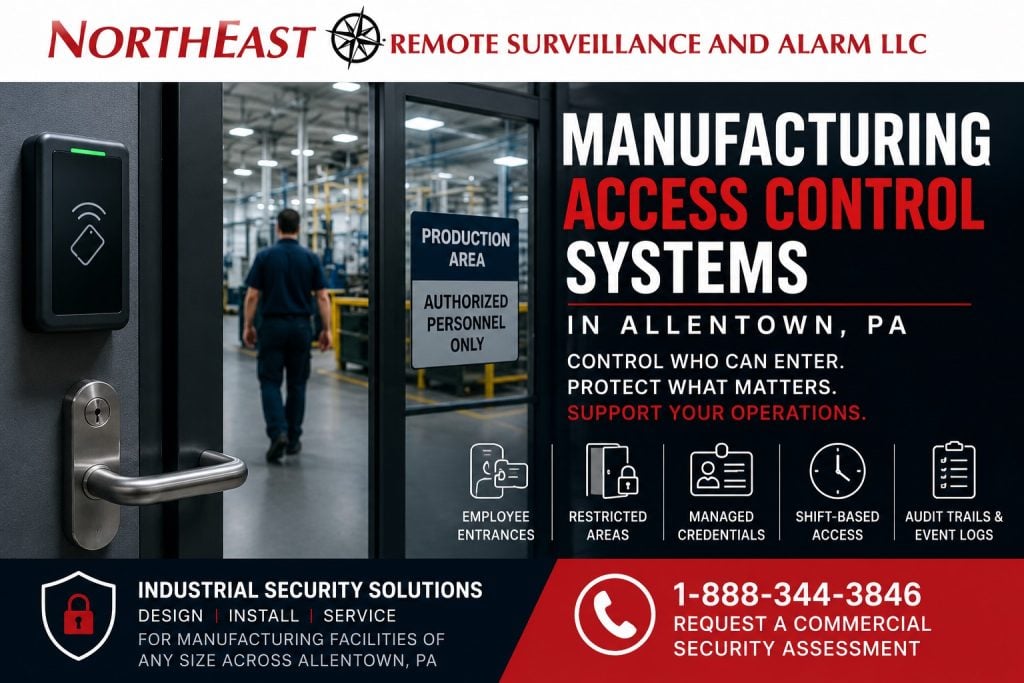
Access Control Designed for Allentown Manufacturing Facilities
Manufacturing facilities have access-control requirements that extend beyond securing a front office door. Employees may enter through several shift entrances, contractors may need temporary access, maintenance teams may require after-hours permissions, and supervisors may need entry to restricted production, inventory, utility, or equipment areas.
A properly designed manufacturing access control system helps facility management determine:
- Who may enter the property
- Which doors each user may access
- When access is permitted
- Which production or support areas are restricted
- How temporary workers and contractors are managed
- How lost credentials are disabled
- How entry activity is documented
- How access changes when employees change roles
- How multiple buildings or facilities are administered
The objective is not simply to install readers on doors. The objective is to create an access structure that supports security, production, personnel movement, accountability, and daily manufacturing operations.
What This Manufacturing Access Control Page Owns
This page focuses specifically on applying commercial access control inside manufacturing and industrial environments in Allentown.
It owns the manufacturing-specific planning associated with:
- Shift-based employee entry
- Production-area permissions
- Restricted manufacturing zones
- Maintenance and utility-room access
- Tool, parts, and material storage
- Quality-control areas
- Engineering and technical departments
- Contractor and vendor permissions
- Temporary-worker access
- Administrative and production separation
- Multi-building manufacturing campuses
- Manufacturing access event records
- Facility-specific credential management
- Industrial door and opening coordination
This page does not own general access-control system planning, detailed door-hardware selection, commercial gate systems, platform-wide modernization, or broad manufacturing security design.
Those subjects remain with their dedicated Allentown hubs and supporting spindles.
Why Manufacturing Facilities Need Purpose-Built Access Control
Manufacturing operations often involve multiple departments, shifts, employee classifications, contractors, production processes, and levels of authorization.
A system designed for a small office may not provide the structure required for:
- First, second, and third shifts
- Weekend production
- Temporary labor
- Maintenance callouts
- Contractor projects
- Restricted machinery areas
- High-value materials
- Controlled inventory
- Engineering departments
- Quality laboratories
- IT and network rooms
- Chemical or hazardous-material storage
- Tool rooms
- Mechanical and electrical rooms
- Separate warehouse and production functions
Manufacturing access control should reflect how the facility operates during normal production, shift changes, shutdowns, maintenance periods, emergencies, and after-hours activity.
Employee Entrance Access Control
Employee entrances are among the most important controlled openings at a manufacturing facility.
A managed employee entrance can help replace traditional keys and uncontrolled entry with individually assigned credentials. The system can identify the employee, evaluate the assigned schedule, record the event, and release the door when access is permitted.
Employee entrance systems may support:
- Keycards and fobs
- Mobile credentials
- PIN-based access
- Individual schedules
- Department-based permissions
- Shift-based entry
- Holiday schedules
- Temporary access
- Lost-card deactivation
- Former-employee removal
- Door-held-open alerts
- Forced-door notifications
- Entry event history
The system should be designed to handle peak traffic during shift changes without creating unnecessary delays or encouraging employees to hold doors open.
Shift-Based Access Permissions
Manufacturing plants frequently operate across several shifts, and not every employee requires access at every hour.
Access permissions may be structured around:
- First-shift employees
- Second-shift employees
- Third-shift employees
- Weekend crews
- Maintenance teams
- Supervisors
- Plant management
- Shipping and receiving personnel
- Office employees
- Temporary workers
- Contractors
- Cleaning crews
- Emergency-response personnel
A production employee may be authorized to use one entrance during assigned shift hours, while a maintenance supervisor may require broader access at any time. Administrative employees may need office and employee-entry access without permission to enter production-support or equipment areas.
Individual permissions reduce dependence on shared keys, common door codes, and informal access procedures.
Production-Area Access Control
Some manufacturing facilities need to limit who may enter the production floor or specific manufacturing departments.
Production-area access control may help facilities:
- Separate public and employee areas
- Restrict visitors from active production
- Control access to specialized processes
- Limit entry during maintenance operations
- Restrict access during equipment testing
- Prevent unauthorized movement between departments
- Document entry into sensitive areas
- Support internal safety procedures
- Manage contractor access to active work zones
The system should support production without creating unnecessary obstacles for authorized employees.
Readers, locking hardware, door monitoring, schedules, and emergency egress should be coordinated around the function of each opening.
Restricted Manufacturing Areas
Manufacturing properties may include areas where access should be limited to trained, authorized, or assigned personnel.
Controlled areas may include:
- Electrical rooms
- Mechanical rooms
- Boiler rooms
- Control rooms
- Tool rooms
- Maintenance shops
- Engineering departments
- Server and network rooms
- Quality-control laboratories
- Chemical storage
- Parts storage
- High-value inventory
- Prototype areas
- Research and development rooms
- Production management offices
- Calibration rooms
- Equipment-control areas
- Records storage
Access can be assigned by department, responsibility, shift, certification, or management approval.
Restricting access to these areas can improve accountability while helping management understand who entered and when.
Contractor and Vendor Access
Manufacturing facilities regularly depend on outside contractors, service companies, equipment technicians, delivery personnel, and vendors.
Permanent employee credentials should not automatically be issued to every outside worker. Contractor access should be structured around the work being performed and the period during which access is required.
A controlled contractor process may include:
- Temporary credentials
- Expiration dates
- Limited schedules
- Approved entry doors
- Restricted departments
- Escort requirements
- Project-specific permissions
- After-hours limitations
- Credential return procedures
- Immediate deactivation
- Entry history
A contractor servicing production equipment may need access to one entrance, one maintenance area, and one production department without receiving broad access to offices, inventory, or unrelated areas.
Temporary-Worker Access
Manufacturing operations may use temporary or seasonal labor during production increases, special projects, or staffing transitions.
Temporary-worker credentials should be individually assigned whenever practical. Shared cards and shared PINs make it difficult to determine who entered the facility or to remove one person’s access without affecting others.
A managed system can support:
- Individual temporary credentials
- Automatic expiration
- Shift-specific permissions
- Limited door access
- Department assignments
- Rapid credential removal
- Lost-credential response
- Agency-worker identification
- Event reporting
Temporary access should be easy for administrators to issue and remove without weakening accountability.
Access Control for Maintenance and Utility Areas
Maintenance personnel may require access to areas that general production or office employees do not need.
These areas may include:
- Electrical distribution rooms
- Mechanical rooms
- Roof access
- Compressor rooms
- Boiler rooms
- Utility spaces
- Equipment-control rooms
- Maintenance storage
- Spare-parts rooms
- Tool storage
- Building automation equipment
- Fire protection rooms
Maintenance access may also need to remain available outside normal production hours.
The system should allow authorized maintenance personnel to perform their work without granting unnecessary permissions across the entire facility.
Tool, Parts, and Inventory Control
Manufacturing facilities may store valuable tools, replacement components, raw materials, finished products, electronics, proprietary equipment, or controlled inventory.
Access control can help restrict entry to:
- Tool cribs
- Parts rooms
- Maintenance inventory
- Raw-material storage
- Finished-goods areas
- High-value component storage
- Calibration-equipment rooms
- Controlled supply rooms
- Secure cages
- Shipping documentation areas
Access records do not replace inventory procedures, but they can provide useful information about who entered a controlled area and when.
Door position monitoring can also help identify doors that are forced open, held open, or left unsecured.
Administrative and Production Separation
Many manufacturing properties include offices, conference rooms, reception areas, production floors, warehouses, and support departments within the same building.
Access control can help create logical separation between:
- Visitors and production personnel
- Office employees and manufacturing areas
- Warehouse workers and administrative offices
- Contractors and unrestricted departments
- Production staff and sensitive records
- General employees and executive offices
- Public entrances and employee entrances
The system should allow authorized movement while reducing unnecessary access to areas unrelated to an employee’s responsibilities.
Keycard and Fob Access for Manufacturing Plants
Keycards and fobs remain common credential options for industrial facilities.
They can be assigned to individual users and configured around:
- Employee role
- Department
- Shift
- Building
- Door group
- Contractor status
- Temporary assignment
- Management level
Lost or stolen credentials can be disabled without changing locks or reissuing keys to the entire workforce.
Manufacturing facilities with existing cards or fobs may also be able to standardize credentials across employee entrances, production areas, offices, and selected exterior access points when system compatibility supports it.
Mobile Credentials for Manufacturing Employees
Mobile credentials allow compatible smartphones to function as managed access credentials.
They may be appropriate for:
- Management personnel
- Supervisors
- Engineers
- Maintenance teams
- Traveling employees
- Multi-site administrators
- Approved contractors
- Selected office personnel
Mobile credentials can reduce dependence on physical cards, but they should be selected around actual manufacturing operations.
Considerations include:
- Employee phone policies
- Personal-device restrictions
- Protective gloves
- Production-floor phone rules
- Wireless communication
- Reader compatibility
- Credential enrollment
- Battery condition
- User support
- Shared-device procedures
A mobile credential may work well for managers and maintenance teams while physical credentials remain more practical for production employees.
Biometric Access Control in Manufacturing Environments
Biometric readers may be considered for selected high-security or restricted locations, but they should not automatically be applied to every manufacturing entrance.
Potential considerations include:
- Required security level
- Employee enrollment
- Environmental exposure
- Dust and contamination
- Gloves and protective equipment
- Cleaning procedures
- User privacy
- Credential fallback
- Emergency procedures
- Throughput during shift changes
- Integration with the access platform
Biometric technology should be evaluated around the operational environment and the specific access problem being addressed.
Door Hardware and Industrial Opening Coordination
A credential and reader cannot compensate for a door that does not close, latch, lock, or release correctly.
Manufacturing openings may involve:
- Hollow-metal doors
- Exterior personnel doors
- Aluminum storefront doors
- Fire-rated doors
- Stairwell doors
- Exit devices
- Panic hardware
- Electrified trim
- Electric strikes
- Electrified locksets
- Magnetic locks where appropriate
- Request-to-exit devices
- Door position contacts
- Power-transfer hardware
- Access-control power supplies
Heavy use, vibration, temperature changes, dust, moisture, damaged frames, and poor alignment can affect door performance.
For openings where egress, fire alarm interfaces, accessible entry, inspection readiness, documentation, or AHJ coordination may influence the design, review Compliance-Aware Security Planning in Allentown, PA.
The objective is to secure manufacturing areas without interfering with safe exiting, door operation, life-safety functions, or long-term serviceability.
Door Position Monitoring and Access Events
Manufacturing access control should record more than whether a credential was accepted.
Door position contacts and related monitoring can help identify:
- Door opened
- Door closed
- Door forced open
- Door held open
- Invalid credential
- Access outside schedule
- Repeated denied attempts
- Controller communication problems
- Selected lock or device faults
This information can help management review unusual activity and identify doors that are being propped open or are not operating correctly.
Event history is most useful when credentials are individually assigned and user records are kept current.
Visitor Access Inside Manufacturing Facilities
Visitors may need access to conference rooms, training areas, offices, plant tours, production departments, or equipment areas.
A visitor-access process may include:
- Reception verification
- Temporary badges
- Limited-duration credentials
- Escort-only areas
- Approved entry doors
- Restricted schedules
- Visitor expiration
- Contractor differentiation
- Badge return procedures
Visitors should not receive broader facility access than necessary.
Access control can support the visitor process, but it should be coordinated with reception procedures, employee responsibilities, safety requirements, and the physical layout of the facility.
Multi-Building Manufacturing Campuses
Some Allentown manufacturers operate several buildings, production areas, warehouses, offices, or support facilities on one property.
A unified access platform can help manage:
- Shared employees
- Building-specific permissions
- Production and warehouse separation
- Maintenance access
- Common credentials
- Central administration
- Temporary users
- After-hours entry
- Different shift schedules
- Campus-wide reporting
- Administrator roles
- Emergency access procedures
The system should allow users to move where their responsibilities require without giving every employee unrestricted access to the entire campus.
Multi-Site Manufacturing Access Control
Manufacturers with several facilities may benefit from standardized access-control management.
A multi-site platform can help centralize:
- Employee credentials
- User removal
- Department permissions
- Plant-specific access
- Regional management access
- Contractor credentials
- Temporary access
- Access schedules
- Event review
- Administrator rights
- Naming standards
- Expansion procedures
A regional manager may need access to several facilities, while a production employee may be limited to one Allentown building.
System architecture should support growth without requiring the organization to rebuild its access structure each time another door, department, building, or facility is added.
Integration With Manufacturing Security Systems
Access control is one layer of a broader manufacturing security program.
Manufacturing facilities may also need:
- Video surveillance
- Intrusion detection
- Perimeter monitoring
- Remote video monitoring
- Loading-dock coverage
- Parking-lot surveillance
- Gate access
- License-plate capture
- Fire alarm coordination
- Network and communications infrastructure
For broader protection involving production floors, exterior areas, warehouses, intrusion detection, video surveillance, and facility-wide security planning, review Manufacturing Facility Security Systems in Allentown, PA.
This page remains focused on controlling and documenting physical access to manufacturing doors, departments, and restricted areas.
Access Control and Video Verification
Access-control events can become more useful when properly coordinated with video surveillance.
Video may help authorized personnel review:
- Who used a credential
- Whether another person followed through the door
- Why a door was held open
- Whether a contractor entered the correct area
- What occurred during a denied-access event
- Whether a credential was shared
- What happened before or after a forced-door alarm
The camera system and access-control system should be planned around the events the manufacturer actually needs to verify.
A camera pointed generally toward a hallway may not provide the same evidence as a view designed specifically around a controlled opening.
Existing Manufacturing Access Control Systems
Many manufacturing facilities already have readers, cards, keypads, controllers, electric locks, or older access-management software.
Common problems may include:
- Former employees remaining active
- Shared credentials
- Unknown administrator accounts
- Inconsistent door names
- Limited audit history
- Outdated card technology
- Unreliable readers
- Unsupported controllers
- Poor shift scheduling
- Doors that do not latch
- Missing door contacts
- Weak contractor procedures
- Separate systems in different buildings
- Incomplete documentation
Manufacturing-specific corrections may involve permissions, schedules, credential management, door monitoring, or selected opening improvements.
Projects involving platform-wide controller replacement, credential migration, communications, software modernization, or broad system replacement remain under the dedicated Access Control System Upgrades in Allentown, PA spindle.
Manufacturing Access Control Assessment Process
A manufacturing access-control assessment should begin with facility operations rather than a predetermined equipment package.
NERSA reviews:
1. Facility Layout
Employee entrances, production areas, warehouses, offices, maintenance rooms, restricted departments, utility spaces, and separate buildings.
2. Employee Movement
Shift changes, department movement, production workflow, supervisor access, maintenance callouts, and after-hours entry.
3. User Groups
Employees, temporary workers, contractors, vendors, managers, maintenance teams, office personnel, visitors, and emergency responders.
4. Controlled Openings
Door type, frame condition, locking hardware, exit devices, traffic level, environmental exposure, and monitoring requirements.
5. Credential Strategy
Cards, fobs, mobile credentials, PINs, biometrics, temporary credentials, and credential-removal procedures.
6. Permissions and Schedules
Departments, shifts, restricted areas, weekends, holidays, maintenance periods, and temporary access.
7. Event Requirements
Access records, denied attempts, forced doors, held-open doors, alerts, reporting, and video verification.
8. Infrastructure
Controllers, power supplies, network connections, cabling, wireless communication, backup power, and equipment enclosures.
9. Future Expansion
Additional doors, departments, production lines, buildings, users, and manufacturing locations.
This process helps prevent systems that are technically functional but poorly matched to the facility’s daily operation.
Why Allentown Manufacturers Choose NERSA
Since 2008, Northeast Remote Surveillance and Alarm, LLC has designed, installed, upgraded, expanded, and supported commercial and industrial security systems throughout Allentown and the Lehigh Valley.
NERSA focuses on commercial, manufacturing, industrial, warehouse, institutional, municipal, and multi-site environments rather than residential alarm packages.
We evaluate the complete manufacturing access workflow, including:
- Employee entrances
- Shift schedules
- Production departments
- Restricted areas
- Temporary workers
- Contractor procedures
- Credential technology
- Door hardware
- Egress operation
- Door monitoring
- Controller architecture
- Network requirements
- Access-event history
- Video coordination
- Multi-building management
- Future expansion
- Long-term serviceability
NERSA supports new manufacturing access-control installations, existing-system takeovers, credential corrections, employee-entry improvements, restricted-area control, door additions, phased projects, contractor-access programs, and multi-site standardization.
The objective is a dependable access-control system that strengthens accountability without creating unnecessary obstacles for production, employees, management, or maintenance teams.
Frequently Asked Questions About Manufacturing Access Control Systems in Allentown, PA
Can NERSA install manufacturing access control for small businesses and large industrial facilities?
Yes. Northeast Remote Surveillance and Alarm, LLC designs manufacturing access control systems for small production businesses, growing manufacturers, single-building plants, large industrial facilities, multi-building campuses, enterprise operations, and multi-site manufacturing organizations. Systems can be planned around current requirements while preserving a practical path for additional employees, departments, doors, buildings, production areas, and locations.
What is manufacturing access control?
Manufacturing access control manages who may enter employee doors, production departments, maintenance rooms, inventory spaces, administrative offices, restricted areas, and other controlled parts of an industrial facility.
How is manufacturing access control different from general commercial access control?
The underlying technology may be similar, but manufacturing systems must account for shift changes, production workflow, temporary labor, contractors, heavy-use doors, restricted industrial areas, maintenance access, environmental conditions, and multi-building operations.
Can access permissions be assigned by employee shift?
Yes. Permissions can be structured around first, second, or third shift, weekends, holidays, departments, job responsibilities, and approved after-hours access.
Can temporary workers receive individual credentials?
Yes. Temporary workers can receive individually assigned credentials with limited doors, specific schedules, department permissions, and automatic expiration dates.
Can contractors receive temporary manufacturing access?
Yes. Contractor credentials can be limited by project, building, department, schedule, door, and expiration date. Access should be removed when the work is completed.
Can production areas be restricted from office employees and visitors?
Yes. Access permissions can separate offices, production floors, warehouses, maintenance spaces, engineering departments, inventory rooms, and other parts of the facility.
Can employees use one credential at several buildings?
Often, yes. A compatible access platform can assign one credential to selected doors or buildings while preventing access to unauthorized locations.
Can access control work with existing manufacturing doors?
In many cases, yes. Existing openings should first be reviewed for door condition, frame condition, locking hardware, latch alignment, exit devices, power pathways, egress operation, and monitoring requirements.
Can manufacturing access control record forced or held-open doors?
Yes. Door position contacts and properly configured software can report forced-door and door-held-open events at monitored openings.
Can access events be connected to security camera video?
Yes. Compatible access-control and video systems can help authorized personnel review footage associated with credential use, denied access, forced doors, or held-open events.
Can access control be used for tool rooms and parts storage?
Yes. Tool rooms, parts rooms, inventory spaces, maintenance storage, high-value materials, and controlled supply areas can be restricted to approved employees.
Can NERSA take over an access control system installed by another company?
Yes. NERSA can evaluate existing readers, credentials, controllers, software, permissions, door hardware, power supplies, wiring, network communications, and system documentation. The recommended approach may involve correction, continued support, phased modernization, or replacement.
Can one system manage several manufacturing locations?
Yes. A scalable platform can centralize credentials, users, permissions, schedules, administrator roles, reporting, and credential removal across multiple manufacturing locations.
Does NERSA install residential access control?
No. Northeast Remote Surveillance and Alarm, LLC focuses on commercial, manufacturing, industrial, warehouse, municipal, institutional, and multi-site security environments.
Who installs manufacturing access control systems in Allentown, PA?
Northeast Remote Surveillance and Alarm, LLC designs, installs, upgrades, integrates, and supports manufacturing access control systems for Allentown production facilities, industrial properties, warehouses, manufacturing campuses, and multi-site commercial operations.
Request Manufacturing Access Control Planning in Allentown, PA
If your Allentown manufacturing facility needs controlled employee entrances, shift-based permissions, restricted production-area access, contractor credentials, temporary-worker management, tool-room security, door monitoring, multi-building administration, or a more accountable process for managing facility entry, Northeast Remote Surveillance and Alarm, LLC can help.
NERSA will review the facility layout, employee movement, controlled doors, production workflow, shifts, contractors, credentials, hardware, monitoring requirements, infrastructure, and future expansion needs before recommending an appropriate approach.
Request a Commercial Security Assessment or call 1-888-344-3846 to discuss manufacturing access control systems in Allentown, PA.