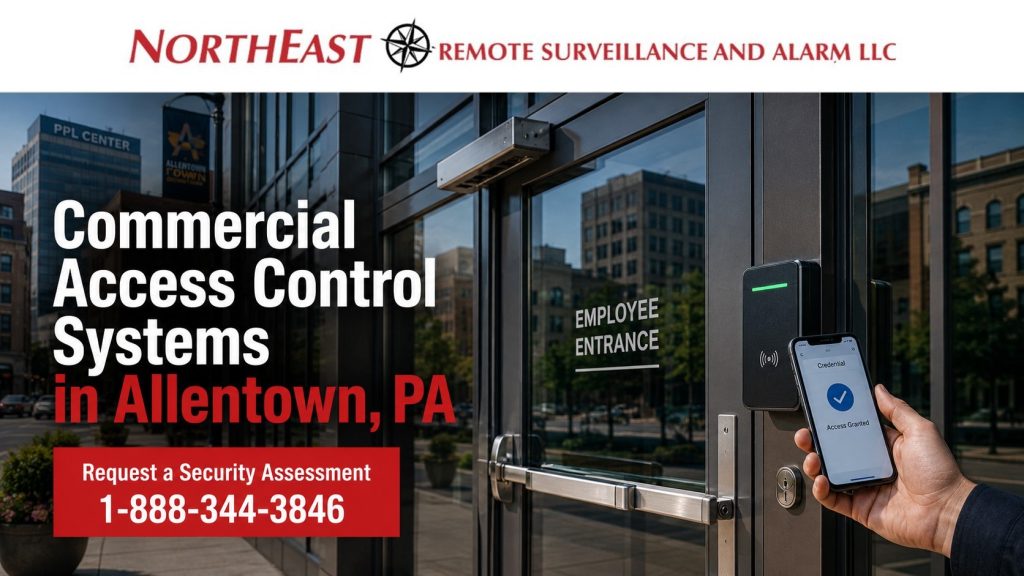
Commercial Access Control Systems in Allentown, PA

Commercial access control installation helps Allentown businesses control who may enter selected doors, gates, rooms, and buildings; when access is permitted; and how entry activity is documented.

Northeast Remote Surveillance and Alarm, LLC designs, installs, expands, upgrades, retrofits, integrates, and supports access control systems for commercial, industrial, institutional, municipal, healthcare, warehouse, manufacturing, office, retail, and multi-location properties throughout Allentown and the surrounding Lehigh Valley.

Serving Allentown from nearby Bethlehem and focused on commercial and industrial security since 2008, NERSA supports projects ranging from one controlled employee entrance to multi-door, multi-building, and enterprise access-control environments.

A properly planned system may include cards, key fobs, mobile credentials, PINs, readers, keypads, controllers, management software, electric strikes, electrified locks, exit-device hardware, door-position contacts, request-to-exit devices, power supplies, battery backup, cabling, network communication, video intercoms, gate access, camera integration, permissions, schedules, and audit records.

Request a Commercial Access Control Assessment or call 1-888-344-3846.

For cameras, intrusion alarms, fire alarm systems, monitoring, intercoms, gates, and broader facility protection, visit Commercial Security Systems in Allentown, PA.

Commercial and industrial systems only • New installations • Upgrades • Expansions • Takeovers • Single-door through enterprise systems

Commercial access control systems in Allentown, PA with card reader, mobile credential, electrified door hardware, and NERSA branding.

Commercial Access Control Designed Around the Property

A dependable access-control system begins with the facility, its doors, its users, and its operating procedures—not with a predetermined reader or software package.

Traditional keys can be lost, copied, shared, or retained after employment ends. Rekeying may become expensive when staff, tenants, contractors, or vendors change. Mechanical keys also provide little control over schedules and generally do not create a useful record of door activity.

Electronic access control allows authorized administrators to issue an individual credential, remove access without rekeying every affected opening, assign permissions by role or department, limit access by day or time, establish temporary access, manage several buildings, and review granted or denied entry attempts.

The system must still be understandable and manageable after installation. Shared credentials, poorly organized permission groups, weak administrator security, unsuitable locking hardware, incomplete documentation, and unclear software ownership can undermine otherwise capable equipment.

The objective is not simply to replace keys. It is to create a controlled-entry environment that remains secure, reliable, serviceable, and practical as the organization changes.

What a Complete Commercial Access Control Installation Includes

A complete installation coordinates the credential, reader, controller, software, locking hardware, door condition, power, communication, user permissions, and documentation associated with each controlled opening.

Credentials and Readers

Credentials may include cards, fobs, mobile devices, PINs, or supported multi-factor methods. Readers and keypads must match the credential strategy, operating environment, security requirements, and expected path for future upgrades.

Controllers and Management Software

Door controllers apply permissions and schedules, operate locking hardware, monitor selected door conditions, and store or report access events. The management platform allows authorized users to add or remove credentials, organize access groups, change schedules, review activity, and manage one or several locations.

Electrified Locking Hardware

The physical opening may use an electric strike, electrified lockset, electrified trim, exit-device-compatible hardware, magnetic lock where appropriate, or another properly selected arrangement. The correct choice depends on the door, frame, latch, exit device, fire rating, traffic, egress requirements, accessibility, and daily operation.

Door Monitoring and Request to Exit

Door-position contacts can report whether a door is open or closed. Request-to-exit devices support the intended release and event operation. Properly configured systems may report forced-door, held-open, communication, and selected power conditions.

Power, Cabling, and Network Communication

Readers, locks, contacts, controllers, intercoms, and management platforms depend on suitable power supplies, batteries, distribution, cabling, pathways, network communication, switching, equipment locations, and protection from avoidable damage or disconnection.

Administration and Documentation

Door names, controller assignments, credentials, permission groups, schedules, administrator accounts, licensing, network requirements, power supplies, customer responsibilities, testing results, and system turnover information should be documented.

The Controlled Door Must Work as One System

The reader is only one part of an access-controlled opening. A modern credential cannot correct a damaged frame, worn hinge, weak closer, misaligned latch, unsuitable strike, unreliable exit device, inadequate power supply, or door that does not close and relatch consistently.

Before equipment is selected, each proposed opening should be reviewed for:

  • Door and frame construction
  • Existing locks and exit hardware
  • Fire rating and required door operation
  • Latch alignment and closer performance
  • Traffic volume and user movement
  • Interior and exterior exposure
  • Emergency egress
  • Accessibility
  • Request-to-exit operation
  • Door-position monitoring
  • Power transfer
  • Cabling pathway
  • Fire alarm or emergency-release coordination
  • Expected service and maintenance

This opening-by-opening approach helps prevent a common failure: installing a capable reader and controller on a door that remains mechanically unreliable.

Use Commercial Door Access Control Systems in Allentown, PA for employee entrances, interior restricted rooms, service doors, shared openings, and multi-door business entry.

Review Access Control Door Hardware in Allentown, PA for electric strikes, electrified trim, locksets, exit-device coordination, door contacts, request-to-exit devices, power transfer, and opening-specific hardware.

New Installations, Expansions, Takeovers, and Retrofits

New Commercial Access Control Installation

A new project should begin with a door-by-door and user-by-user review rather than a reader count. The design should address current requirements without forcing a small property into an oversized platform or limiting a larger facility with a system that cannot expand.

Planning may include the number and type of openings, user groups, operating schedules, credential preferences, restricted areas, visitors, contractors, network availability, power, cabling, software administration, video or alarm integration, and future buildings or locations.

Additional Doors and Buildings

Adding a door requires more than installing another reader. Existing controller capacity, licensing, reader compatibility, credential technology, power, battery capacity, cabling, network communication, door hardware, permission groups, documentation, and future expansion should be reviewed before the new opening is added.

Access Control Upgrades and Retrofits

An existing system may need modernization when readers, credentials, controllers, software, locking hardware, communication, or user administration no longer supports the organization.

The correct project may be a focused reader or credential upgrade, controller replacement, software migration, door-hardware retrofit, permission cleanup, cloud transition, additional doors, or phased modernization rather than complete replacement.

For detailed planning, use Commercial Access Control Upgrades and Retrofits in Allentown, PA.

System Takeovers and Existing-Equipment Reuse

A takeover assessment can determine whether another provider’s readers, controllers, software, licenses, accounts, locks, cabling, power supplies, credentials, and documentation can be supported, transferred, reprogrammed, upgraded, or reused.

Existing equipment should not be discarded automatically, but reuse should depend on condition, compatibility, manufacturer support, account ownership, licensing, credential security, network architecture, documentation, and future serviceability.

Cloud-Managed, On-Premise, and Hybrid Access Control

The right architecture depends on how the organization wants to manage users, own accounts, protect data, support outages, integrate locations, and maintain the system.

Cloud-Managed Access Control

Cloud-managed platforms may simplify browser or mobile administration, remote credential changes, centralized multi-site management, software updates, and system-health awareness.

Before selecting a cloud platform, the customer should understand recurring licensing, account ownership, administrator control, internet-outage behavior, local credential storage, event retention, data export, cybersecurity, service cancellation, and future migration.

The customer should not discover after installation that the installer controls the only administrative account.

On-Premise Access Control

On-premise systems may be appropriate when an organization requires customer-controlled servers, local database ownership, internal information-technology administration, specific data practices, existing enterprise infrastructure, or local integrations.

The organization must also plan for backups, software updates, cybersecurity, secure remote access, licensing, server maintenance, and eventual hardware or operating-system replacement.

Hybrid and Multi-Site Environments

A hybrid structure may combine local processing with centralized administration or use different architectures at different properties. A main facility may retain an existing locally managed system while smaller locations use cloud-managed access.

The decision should be based on operations, compatibility, administration, cybersecurity, cost, network design, and long-term support—not on the assumption that one architecture is automatically best.

Credentials, Permissions, and Employee Offboarding

Credential technology should support both security and daily administration.

Cards and fobs remain practical for many businesses because they are familiar, individually assigned, easy to deactivate, and suitable for one-door through multi-building systems. Review Keycard and Fob Access Control Systems in Allentown, PA for card issuance, reader planning, user permissions, and credential replacement.

Mobile credentials may reduce physical badge handling and support remote enrollment, but the organization should evaluate device policies, privacy, lost or replaced phones, reader compatibility, licensing, Bluetooth or network dependencies, and fallback entry. Review Mobile Credential Access Control Systems in Allentown, PA for smartphone-based access planning.

PINs may be useful for selected doors, gates, or temporary workflows, but shared codes weaken accountability. Higher-security openings may use an individually assigned credential, a credential plus PIN, or another supported multi-factor method.

A commercial organization should also define:

  • Who may approve and issue access
  • Which doors each role may use
  • Which schedules apply
  • How contractors and temporary users are handled
  • How lost credentials are reported
  • How quickly former employees are removed
  • Who may change permission groups
  • Who may review or export event history
  • How administrator accounts are protected
  • Who owns the software account and licensing
  • How inactive credentials are reviewed
  • How changes are documented

Electronic access control makes changes easier, but it does not replace a disciplined administrative process.

Access Control for Allentown Commercial and Industrial Properties

Warehouses and Distribution Centers

Warehouse access control may separate employee entrances, shipping offices, warehouse floors, inventory rooms, IT spaces, maintenance areas, high-value storage, dock-adjacent doors, and exterior personnel entrances.

Permissions may differ for office employees, warehouse staff, supervisors, temporary labor, drivers, contractors, maintenance personnel, and after-hours users. Review Warehouse Access Control Systems in Allentown, PA for warehouse-specific planning.

Manufacturing and Industrial Facilities

Manufacturing access control may protect employee entrances, office-to-production transitions, tool rooms, laboratories, quality-control areas, electrical and mechanical rooms, raw-material storage, finished-goods areas, contractor entrances, and restricted process spaces.

Industrial conditions can affect reader selection, hardware, wiring, enclosures, power, network communication, dust, moisture, vibration, temperature, and physical protection.

Offices and Multi-Tenant Buildings

Office systems may manage common entrances, employee doors, tenant suites, records rooms, server rooms, storage areas, stairwell doors, amenity spaces, parking entrances, and after-hours access.

Multi-tenant planning should clearly define which doors belong to property management, which openings belong to tenants, who issues credentials, who may review events, and who owns the equipment, software, and service relationship.

Healthcare and Medical Properties

Healthcare access control may protect staff entrances, records areas, medication or supply rooms, laboratories, administrative spaces, IT rooms, employee-only areas, and public-to-clinical transitions.

Planning should account for public and staff circulation, privacy-sensitive operations, visitor communication, accessibility, after-hours entry, emergency procedures, and role-based permissions.

Schools, Municipal Buildings, and Institutions

Schools, municipal properties, libraries, community buildings, and other institutions must balance legitimate public access with controlled staff areas, records, equipment, administrative rooms, and emergency procedures.

Projects may involve controlled primary entrances, staff credentials, visitor communication, exterior-door management, department-specific permissions, after-hours schedules, and approved emergency functions.

Vehicle Gates and Visitor Entry

Vehicle gates require different planning from standard doors because traffic flow, gate operators, safety devices, intercoms, vehicle detection, emergency access, queuing, weather, and exterior communication must be considered.

Use Commercial Gate Access Control Systems in Allentown, PA for fenced lots, contractor yards, delivery entrances, employee parking, fleet areas, and controlled vehicle access.

Visitor entry may include audio or video intercoms, reception answering, mobile answering, directory calling, remote release, delivery procedures, and after-hours instructions. The process should identify who answers, how the visitor is verified, which opening is released, and what happens when the intended employee is unavailable.

Integration With Video Surveillance, Intrusion Alarms, and Intercoms

Access control manages authorization. Other systems provide different layers of protection and information.

Compatible video surveillance can provide visual context for denied access, forced doors, held-open doors, visitor releases, after-hours entry, suspected credential sharing, gate activity, and restricted-area events. Review Commercial Video Surveillance Systems in Allentown, PA when door events need associated video.

Intrusion alarms can protect selected doors, areas, and interior zones when a building or department is closed. Access control does not replace intrusion detection, and intrusion detection does not replace controlled user permissions.

Intercoms can support visitor verification and authorized release at lobbies, delivery doors, gates, and remote entrances. Gate systems may coordinate credentials, intercoms, cameras, remote release, and approved safety functions.

Selected locking arrangements may also require coordination with fire alarm operation, emergency release, egress, accessibility, or approved building functions. The required arrangement depends on the opening, occupancy, hardware, approved documents, and authority having jurisdiction.

Integration should solve a defined operational need. It should not be added merely to make a project appear more complex.

City of Allentown | Samsara

Commercial Access Control Costs and Proposal Planning

Access-control cost is determined by the complete opening and project scope rather than by the reader price alone.

Budget factors may include:

  • Number and type of controlled openings
  • Door and frame condition
  • Existing locks and exit hardware
  • Electric strikes, electrified locks, or electrified trim
  • Readers and credentials
  • Controller and licensing requirements
  • Door-position and request-to-exit devices
  • Power supplies and battery backup
  • Cabling distance and pathway difficulty
  • Network communication
  • Cloud or software licensing
  • Intercom, gate, camera, or alarm integration
  • Fire alarm and egress coordination
  • Existing equipment that can be reused
  • Programming, testing, documentation, and training
  • Continuing service and support

Review Commercial and Industrial Access Control Cost for broader budgeting guidance.

A professional proposal should identify each controlled door or gate, credential type, reader, controller, software platform, locking hardware, door monitoring, power, cabling, network requirements, licensing, customer account ownership, integrations, reused equipment, excluded work, testing, training, documentation, warranty, and support responsibilities.

Comparing only reader count and total price can hide major differences in door hardware, infrastructure, licensing, commissioning, and long-term ownership.

The NERSA Access Control Planning and Installation Process

1. Facility and Opening Review

NERSA reviews the property, proposed openings, existing doors, restricted areas, traffic, operating schedules, visitors, contractors, and administrative requirements.

2. User and Credential Planning

Employees, managers, temporary workers, vendors, contractors, tenants, and multi-site users are organized into appropriate permission groups and schedules.

3. Hardware and Infrastructure Evaluation

The project evaluates doors, frames, locks, exit devices, closers, request-to-exit devices, contacts, cabling, power, batteries, networks, equipment locations, and usable existing components.

4. System Design

The design establishes readers, controllers, credentials, locking hardware, power, communication, software, access groups, schedules, administration, and approved integrations.

5. Installation and Programming

Equipment is installed and configured around the approved scope and the actual operating requirements of the property.

6. Testing and Commissioning

Each opening should be tested for valid and invalid credentials, schedules, permissions, locking and release, closing and relatching, door-position reporting, request-to-exit operation, forced and held-open events, power, communication, and applicable emergency functions.

7. Documentation, Training, and Support

Authorized customer representatives receive instruction and documentation for the functions included in the project. Continuing support can address user changes, additional doors, repairs, platform updates, licensing, and future expansion.

Why Allentown Businesses Choose NERSA

Northeast Remote Surveillance and Alarm, LLC focuses on commercial and industrial security rather than residential alarm packages.

NERSA plans access control around:

  • The complete commercial door opening
  • Actual employee, visitor, vendor, and contractor movement
  • New installations and existing-system conditions
  • Door hardware, power, cabling, and networks
  • Cloud, on-premise, and hybrid administration
  • Customer ownership of accounts and licensing
  • Credential governance and employee offboarding
  • Emergency egress and life-safety coordination
  • Video, alarm, intercom, and gate integration where useful
  • Testing, documentation, training, and long-term service
  • One-door businesses through enterprise and multi-site organizations

The objective is not to install the greatest number of readers. The objective is to provide dependable doors, manageable permissions, appropriate credentials, useful records, clear ownership, proper documentation, and a system the organization can operate and expand over time.

Request a Commercial Access Control Assessment in Allentown

A property-specific assessment can identify the right doors, hardware, credentials, architecture, permissions, infrastructure, integrations, and upgrade priorities before equipment is selected.

NERSA can review a proposed new system, an inherited installation, an expansion, a provider change, a door-hardware problem, a credential migration, or a phased retrofit.

Request a Commercial Access Control Assessment or call 1-888-344-3846.

Commercial and industrial systems only • New installations • Upgrades and retrofits • Expansions • Takeovers • One door through enterprise


Frequently Asked Questions About Commercial Access Control in Allentown, PA

What does commercial access control installation include?

A complete installation may include credentials, readers, controllers, management software, locking hardware, door contacts, request-to-exit devices, power supplies, batteries, cabling, network communication, programming, testing, documentation, and training.

Can NERSA install access control on one commercial door?

Yes. NERSA supports focused one-door projects as well as multi-door, multi-building, campus, and multi-location access-control systems. A one-door system should still be planned around the opening, credential, power, administration, documentation, and future needs.

Can an existing commercial door be retrofitted for access control?

Often, yes. The door, frame, lock, latch, exit device, closer, fire rating, egress requirements, power transfer, and cabling pathway must be evaluated before the correct hardware is selected.

Can existing readers, controllers, locks, or cabling be reused?

Sometimes. Reuse depends on condition, compatibility, manufacturer support, licensing, account ownership, credential security, wiring, power, network architecture, documentation, and future serviceability.

Can NERSA take over a system installed by another provider?

NERSA can inspect an inherited system to determine whether its accounts, licensing, controllers, readers, credentials, software, door hardware, wiring, programming, and documentation can be supported, transferred, corrected, upgraded, or replaced.

Is cloud access control better than an on-premise system?

Neither architecture is automatically best for every organization. The decision should reflect administration, account ownership, outage behavior, cybersecurity, IT resources, data practices, integrations, licensing, and long-term cost.

Can different employees receive different door permissions?

Yes. Supported systems can organize permissions by individual, role, department, shift, door, area, building, schedule, or location. Users should receive the access required for their responsibilities without unnecessary building-wide permissions.

Can access control integrate with cameras and intrusion alarms?

Yes, when compatible systems and project requirements support it. Video can provide context around door events, while intrusion alarms can protect selected openings and areas when the property is closed or lightly staffed.

Does access control need to account for emergency egress?

Yes. Controlled openings must be planned around required door operation, emergency egress, accessibility, fire-rated construction, locking hardware, fire alarm interfaces, approved release functions, and applicable authority requirements.

What affects the cost of commercial access control?

Major cost factors include the number and type of doors, locking hardware, door condition, readers, credentials, controllers, software, licensing, cabling, network communication, power, integrations, testing, documentation, training, and reusable existing equipment.

How does an Allentown access control project begin?

Begin with a property-specific assessment. Call 1-888-344-3846 or request an assessment to discuss the doors, users, credentials, schedules, hardware, existing equipment, integrations, administration, and future plans.

Scroll to Top
1-888-344-3846