Office building video surveillance systems in Allentown, PA help property owners, employers, facility managers, and commercial tenants improve visibility, document incidents, investigate activity, and protect entrances, lobbies, shared areas, parking facilities, equipment, records, and business operations.
Northeast Remote Surveillance and Alarm, LLC designs, installs, expands, upgrades, and supports commercial video surveillance systems for single-tenant offices, multi-tenant office buildings, professional-service properties, medical office buildings, administrative facilities, corporate offices, mixed-use commercial buildings, and office campuses throughout Allentown and the surrounding Lehigh Valley.
This page focuses specifically on video surveillance for office buildings and professional commercial properties. For broader planning across warehouses, manufacturing facilities, retail properties, industrial buildings, parking areas, and other commercial environments, begin with Commercial Security Camera Systems in Allentown, PA.
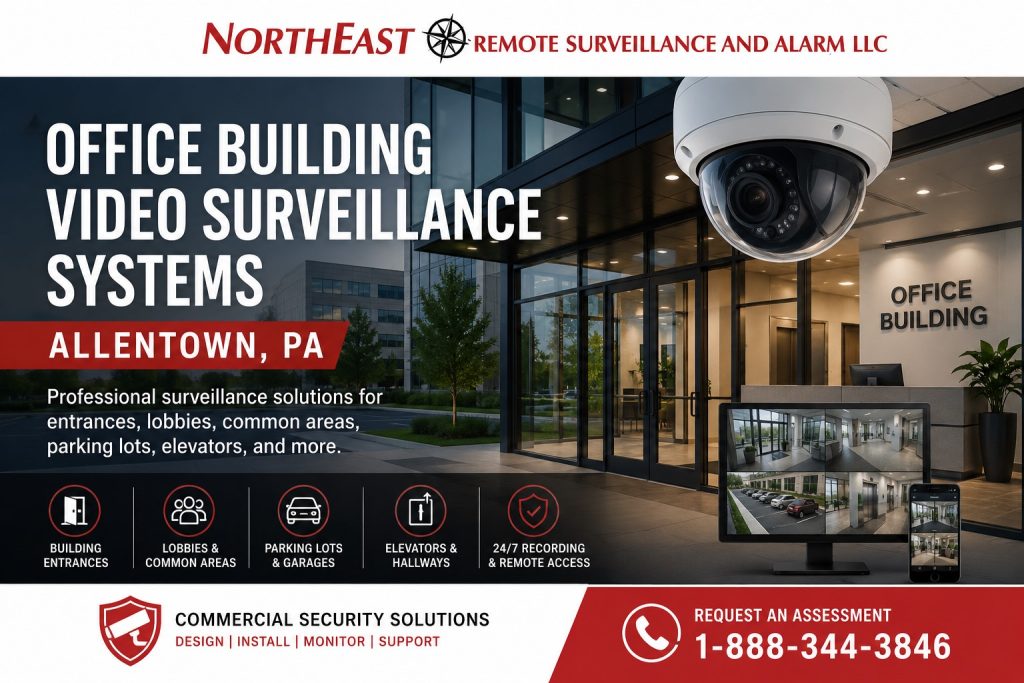
Video Surveillance Designed Around Office Building Activity
Office buildings have different surveillance requirements than warehouses, manufacturing facilities, retail stores, and logistics properties.
An office camera system may need to document employees, visitors, contractors, deliveries, after-hours access, shared entrances, tenant movement, parking activity, package handling, and activity around restricted rooms without unnecessarily recording private workspaces.
A properly planned office surveillance system should consider:
- Building occupancy and operating hours
- Single-tenant or multi-tenant use
- Employee and visitor movement
- Shared entrances and common areas
- Reception and visitor-management procedures
- Deliveries and package handling
- Parking-lot and garage exposure
- After-hours access
- Restricted administrative and technology areas
- Existing network and low-voltage infrastructure
- Recording retention requirements
- Remote-access permissions
- Future tenant or building changes
The objective is not simply to install cameras throughout the building. Each camera should serve a defined security, documentation, or operational purpose.
Common Office Building Security Concerns
Office properties may experience concerns involving:
- Unauthorized entry
- Tailgating through secured doors
- After-hours activity
- Door-propping incidents
- Package and delivery disputes
- Theft from common areas
- Vandalism
- Vehicle damage
- Parking-lot incidents
- Employee or visitor disputes
- Contractor and vendor movement
- Access to restricted rooms
- Shared-tenant concerns
- Unexplained property damage
- Activity around emergency exits
- Incident reconstruction
Video surveillance can help establish what occurred, when it happened, who was present, and how people moved through the property.
Office Building Entrance Cameras
Main entrances are among the most important surveillance locations in an office building.
Entrance cameras may help document:
- Employees arriving and leaving
- Visitor activity
- Delivery personnel
- Contractors and service providers
- After-hours entry
- Tailgating
- Door-propping
- Unauthorized access attempts
- Activity associated with controlled-door events
- Movement between exterior approaches and interior lobbies
Camera placement should account for:
- Door direction
- Exterior sunlight
- Interior lighting
- Glass reflections
- Mounting height
- Facial detail
- Walking direction
- Available field of view
- Distance from the camera to the entrance
A wide-angle overview camera may document the entire entrance area, while a second camera may be required when identification-level detail is important.
Lobby and Reception Area Video Surveillance
Lobby and reception cameras can help document visitor activity, deliveries, waiting areas, disputes, and movement toward elevators, corridors, tenant suites, or controlled areas.
Coverage may include:
- Reception desks
- Visitor waiting areas
- Main lobby entrances
- Elevator approaches
- Directory and check-in areas
- Package-delivery locations
- Shared tenant entrances
- Security or concierge desks
Camera placement should provide useful visibility without unnecessarily recording documents, computer screens, private conversations, or employee work areas.
Hallway and Common-Area Cameras
Common-area cameras may be appropriate in corridors, vestibules, elevator lobbies, building connectors, shared entrances, and other spaces used by multiple tenants or departments.
These cameras may help document:
- Direction of travel
- Time of arrival or departure
- Movement between floors
- Activity before and after an incident
- Access to restricted corridors
- After-hours movement
- Contractor activity
- Building-service activity
Long corridors may require cameras at more than one location to reduce blind spots and provide usable detail in both directions.
Elevator and Stairwell Approach Coverage
Office properties may require cameras around:
- Elevator entrances
- Elevator lobbies
- Stairwell doors
- Emergency-exit approaches
- Service-elevator entrances
- Ground-floor elevator banks
The purpose is generally to document movement into and out of these areas rather than to place cameras inside locations where privacy, building policy, or operating conditions make surveillance inappropriate.
Ceiling height, lighting, architectural finishes, camera mounting, and cable access should be evaluated before equipment is selected.
Parking Lot and Parking Garage Surveillance
Parking areas are frequently among the highest-risk portions of an office property.
Camera coverage may be planned for:
- Employee parking
- Visitor parking
- Accessible parking spaces
- Building entrances
- Parking-garage entrances
- Vehicle lanes
- Pedestrian walkways
- Remote parking sections
- Loading and delivery areas
- Vehicle access gates
- Building approaches
- After-hours activity
Exterior surveillance requires careful planning around:
- Camera distance
- Lighting
- Weather
- Mounting height
- Vehicle speed
- Field of view
- Nighttime image quality
- Network connectivity
- Available power
- Pole and building mounting
A general overview camera may show that an incident occurred without providing enough detail to identify a person, vehicle, or license plate. Each camera should be selected around a specific viewing objective.
Delivery, Mailroom and Package-Area Cameras
Office buildings may receive mail, packages, food deliveries, replacement equipment, supplies, and contractor materials throughout the day.
Video surveillance may be appropriate around:
- Delivery entrances
- Mailrooms
- Package shelves
- Reception delivery areas
- Courier drop-off locations
- Service corridors
- Rear entrances
- Tenant package rooms
- Loading areas
Recorded video can help determine:
- When a package arrived
- Where it was placed
- Who entered the area
- When an item was removed
- Whether the delivery reached the correct tenant
- What occurred during a delivery dispute
Camera placement should provide clear activity documentation without unnecessarily capturing sensitive documents or computer screens.
Restricted Office and Administrative Areas
Some office-building areas require additional protection because they contain sensitive information, infrastructure, equipment, inventory, or business records.
These areas may include:
- IT rooms
- Server rooms
- Records-storage rooms
- Telecommunications spaces
- Equipment rooms
- Cash-handling areas
- Human-resources departments
- Controlled supply rooms
- Executive-area entrances
- Maintenance rooms
- File-storage areas
Camera coverage should generally focus on the entrance and activity around the controlled area rather than unnecessarily monitoring the interior of private workspaces.
Multi-Tenant Office Building Video Surveillance
Multi-tenant office properties require a clear distinction between building-wide surveillance and tenant-controlled security systems.
Property-management cameras may cover:
- Exterior entrances
- Main lobbies
- Elevator banks
- Shared corridors
- Parking areas
- Loading entrances
- Package locations
- Service areas
- Mechanical areas
- Building perimeters
Individual tenants may require separate cameras covering:
- Suite entrances
- Reception areas
- Internal common spaces
- Restricted rooms
- Business-specific activity
A properly organized multi-tenant surveillance system should establish:
- Who owns the cameras and recorder
- Who can view live video
- Who can review recordings
- Who can export video
- Which cameras belong to property management
- Which cameras belong to individual tenants
- How permissions are assigned
- How tenant changes are handled
- Who is responsible for service and maintenance
Users should only receive access to the cameras and functions required for their responsibilities.
Camera Types for Office Buildings
Dome Cameras
Dome cameras are commonly used in lobbies, reception areas, corridors, elevator approaches, and interior common spaces.
Their compact appearance can work well in professional office environments while providing wide-angle or adjustable coverage.
Turret Cameras
Turret cameras may be used in interior and exterior locations where flexible positioning, dependable nighttime performance, and straightforward servicing are important.
Bullet Cameras
Bullet cameras are commonly used around parking areas, building exteriors, loading entrances, alleys, and longer-distance exterior locations.
Multi-Sensor Cameras
Multi-sensor cameras can provide several fixed views from one mounting location.
They may be useful around:
- Large lobbies
- Building corners
- Parking areas
- Open exterior approaches
- Large shared spaces
Panoramic Cameras
Panoramic or fisheye cameras may provide broad situational awareness in large lobbies, elevator-bank areas, reception spaces, and open common areas.
The required image detail should be evaluated before a panoramic camera is selected.
Pan-Tilt-Zoom Cameras
PTZ cameras may be appropriate for large parking areas, office campuses, and exterior spaces where active observation is required.
A PTZ camera should not automatically replace fixed cameras because it can only observe one direction at a time.
Recording, Storage and Video Retention
Office-building surveillance systems should be designed around how long recorded video needs to remain available.
Retention depends on:
- Number of cameras
- Camera resolution
- Frame rate
- Compression settings
- Continuous or motion-based recording
- Hours of activity
- Amount of movement
- Available storage
- Incident-reporting timelines
- Business requirements
An office property may not discover theft, property damage, an access concern, or a tenant dispute immediately.
Storage should be calculated around how long it normally takes the organization to identify and investigate an incident.
NERSA can evaluate:
- Current storage usage
- Required retention
- Camera resolution
- Recording schedules
- Motion settings
- Hard-drive capacity
- Recorder limitations
- Future expansion needs
Storage should be planned before installation rather than adjusted after important video has already been overwritten.
Remote Video Access
Authorized users may need secure access to live and recorded video from:
- Management offices
- Security desks
- Remote computers
- Mobile devices
- Corporate offices
- Other business locations
Remote access may be provided for:
- Property owners
- Building managers
- Facility personnel
- Security teams
- Corporate management
- Authorized tenant representatives
- Approved investigators
User permissions should be limited according to responsibility.
A tenant should not automatically receive access to cameras covering another tenant’s space, and a general employee should not receive administrative control of the surveillance system.
Camera Naming and System Organization
Office-building camera systems should be organized so authorized users can quickly locate the correct view during an incident.
System organization may include:
- Descriptive camera names
- Floor-based groups
- Exterior-camera groups
- Parking-area groups
- Tenant-specific permissions
- Property-management views
- Mobile-user permissions
- Export restrictions
- Administrator limitations
- Camera maps
- Incident-review procedures
Names such as “Camera 14” or “Channel 23” provide little value during an emergency or investigation.
Clear names such as “First Floor Main Lobby Entrance” or “South Parking Lot Building Approach” make the system easier to operate and support.
Video Surveillance and Controlled Office Entrances
Video surveillance may be coordinated with access control, visitor entry, intercom, gate, and intrusion-alarm systems.
Applications may include:
- Reviewing video associated with a door event
- Monitoring visitor-intercom activity
- Verifying after-hours access
- Documenting door-propped-open events
- Covering credentialed employee entrances
- Reviewing alarm activity
- Monitoring parking-gate access
- Associating video with restricted-room entry
Integration depends on equipment manufacturers, software platforms, licensing, network configuration, and existing system compatibility.
Video surveillance should complement access control and intrusion detection rather than attempt to replace their functions.
Expanding an Existing Office Camera System
Office buildings often require additional cameras after:
- Renovations
- Tenant changes
- Parking-area expansions
- Entry modifications
- Lobby redesigns
- New package rooms
- Additional floors
- New controlled doors
- Increased after-hours activity
- Changes in building use
Expansion work may involve:
- Adding entrance cameras
- Covering a new tenant suite
- Extending surveillance to another floor
- Adding parking-area cameras
- Covering a renovated lobby
- Adding package-room coverage
- Increasing recorder capacity
- Adding network switches
- Expanding PoE capacity
- Increasing video retention
For projects focused specifically on extending a functioning surveillance platform, visit Video Surveillance System Expansions and Additional Cameras in Allentown, PA.
Network and Low-Voltage Infrastructure
Modern IP surveillance systems depend on properly designed network and low-voltage infrastructure.
Office-building projects may require:
- Category cabling
- Managed PoE switches
- Network cabinets
- Equipment racks
- Fiber connections
- Wireless building links
- UPS backup power
- Surge protection
- Secure network segmentation
- Additional uplinks
- Organized patch panels
- Labeled cabling
- Properly supported pathways
Camera reliability can be affected by:
- Insufficient PoE power
- Overloaded network switches
- Poor cabling
- Unstable network connections
- Improper remote-access configuration
- Undersized storage
- Unprotected exterior pathways
The camera system and supporting infrastructure should be planned together.
Privacy-Aware Camera Placement
Office video surveillance should be designed around legitimate security and operational objectives.
Camera planning should avoid unnecessary views into:
- Restrooms
- Changing areas
- Private medical or wellness spaces
- Areas where privacy is reasonably expected
- Computer screens containing sensitive information
- Confidential documents
- Private employee workspaces without a defined purpose
Building owners and employers should maintain appropriate workplace policies, signage, permissions, and internal procedures based on their organizational requirements.
NERSA focuses on equipment selection, system design, installation, and camera placement. Property owners and employers remain responsible for determining their legal, employment, privacy, and policy obligations.
Office Properties We Support
NERSA provides office-building video surveillance services for:
- Single-tenant office buildings
- Multi-tenant office properties
- Corporate offices
- Professional-service firms
- Medical office buildings
- Administrative facilities
- Mixed office and warehouse properties
- Commercial business parks
- Municipal offices
- Institutional offices
- Technology companies
- Call centers
- Office campuses
- Multi-location businesses
Systems can be designed for smaller professional offices, multi-floor office buildings, large commercial properties, multi-building campuses, and organizations requiring standardized surveillance across several locations.
Why Allentown Businesses Choose NERSA
Northeast Remote Surveillance and Alarm, LLC focuses on commercial and industrial security systems.
Our office-building video surveillance planning considers:
- Property layout
- Employee and visitor movement
- Entrances and lobbies
- Shared tenant areas
- Parking and exterior exposure
- Recording retention
- Network and PoE capacity
- Remote access
- User permissions
- System documentation
- Future tenant changes
- Expansion requirements
- Long-term serviceability
The objective is to provide dependable visibility and useful recorded evidence without creating unnecessary cameras, confusing system layouts, excessive user access, unsupported equipment combinations, or infrastructure limitations.
Frequently Asked Questions
Where should cameras be installed in an office building?
Common locations include entrances, lobbies, reception areas, elevator approaches, shared corridors, parking areas, delivery entrances, mailrooms, package areas, stairwell entrances, IT-room entrances, and exterior building approaches. Final placement should be based on the property layout and the specific activity that needs to be documented.
Should cameras be installed inside individual offices?
That depends on the business purpose, property policies, tenant arrangements, privacy expectations, and operational requirements. Many office-building systems focus on entrances, common areas, restricted-room entrances, and exterior locations rather than individual workspaces.
Can property management and tenants have different camera permissions?
Yes. A properly configured system can provide property management with building-wide access while limiting tenants to cameras associated with their own suites or authorized areas.
Can office cameras be coordinated with access control?
Some camera and access-control platforms can associate video with door events, credentials, alarms, intercom calls, and after-hours activity. Compatibility and licensing should be evaluated during system planning.
How long should office-building video be retained?
Retention depends on the building’s incident-reporting timeline, number of cameras, resolution, recording settings, available storage, and organizational requirements. Storage should be calculated before installation.
Can cameras be added to an existing office surveillance system?
In many cases, yes. The recorder, software, licenses, storage, network capacity, PoE power, camera compatibility, and cabling should be reviewed before additional cameras are installed.
Can office-building cameras cover parking areas?
Yes. Exterior surveillance can cover parking lots, garages, building approaches, walkways, loading areas, service entrances, gates, dumpsters, and other exterior locations. Camera type, lighting, mounting, distance, network access, and nighttime performance must be considered.
Does NERSA support both small offices and large office properties?
Yes. NERSA supports smaller professional offices, multi-tenant buildings, corporate facilities, multi-floor properties, large office campuses, and multi-site organizations requiring standardized surveillance, centralized management, remote access, extensive storage, and scalable network infrastructure.
Request an Office Building Video Surveillance Assessment
If your Allentown office building needs improved entrance visibility, lobby coverage, parking-lot surveillance, common-area cameras, package-room monitoring, restricted-area documentation, remote viewing, or additional camera coverage, Northeast Remote Surveillance and Alarm, LLC can evaluate the property and develop a commercial video surveillance plan.
For broader citywide planning across video surveillance, access control, intrusion alarms, monitoring, intercoms, upgrades, and supporting infrastructure, visit Commercial Security Systems in Allentown, PA.
Call 1-888-344-3846 to request an office building video surveillance assessment.
Commercial systems only • Office buildings • Multi-tenant properties • Entrances and lobbies • Parking areas • Recording and remote access