
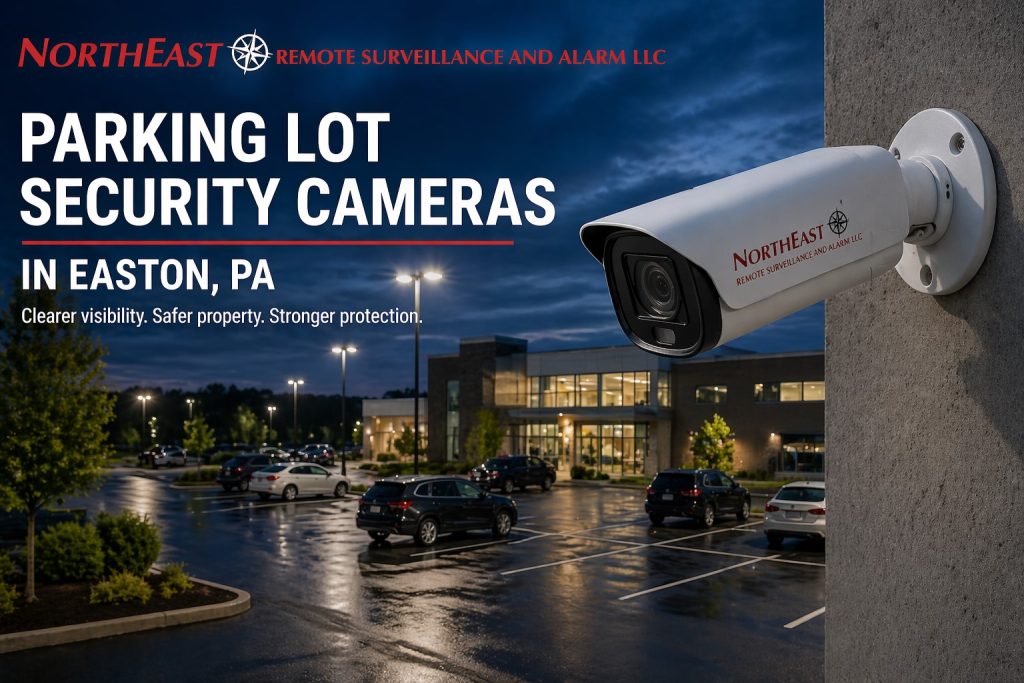
NERSA plans parking lot security camera coverage in Easton, PA for parking bays, pedestrian routes, building approaches, and after-hours activity.

For the complete range of related systems, start with the Easton commercial video surveillance guide.
This page focuses on parking-area surveillance and incident review.
Parking-lot coverage starts with the incident to review
A useful camera plan begins with the event a manager may need to understand. For example, the goal may be to review vehicle damage, follow a person from a walkway to an entrance, or document activity near a parked fleet. Each goal needs a clear view and enough detail.
The site walk separates wide overview views from closer identification views. It also checks travel paths, parked vehicles, trees, signs, glare, and seasonal changes. This process keeps each camera tied to a defined purpose.
What the assessment covers
- Parking bays, pedestrian routes, and building approaches
- Day and night lighting, headlight glare, weather, and shadows
- Mounting height, viewing angle, blind spots, and service access
- Image detail for people, vehicles, and incident review
- Recording retention, authorized users, exports, and privacy
- Network capacity, power protection, health alerts, and recovery tests
The final design should be tested with sample day and night footage. The team should confirm how quickly authorized staff can find and export an event. Written labels, camera names, and review steps make the system easier to use.
A practical plan
First, start with a marked site plan and a short list of common incidents. Then set coverage zones, image goals, retention, and user access. Finally, after installation, test each view in normal weather and during the busiest operating period.
For controlled vehicle lanes, review Easton gate and vehicle entry cameras.
For plate capture, compare the Easton LPR camera design and Easton LPR records and operations guides.
See the Easton video surveillance services or return to the Easton commercial security services for related services.
Design Parking Coverage for Evidence, Not Device Count
Parking areas mix parked vehicles, walking routes, entrances and moving traffic. Identify the incidents the owner must be able to reconstruct: an impact in a drive aisle, theft from a vehicle, activity near an employee entrance, or an encounter between a driver and pedestrian. Map the likely travel routes and time of day for each event. A wide lot overview is valuable for context but often needs a closer view at the pedestrian path or building entrance.
Parked vans, trucks, trees and signs can hide cameras during normal occupancy. Walk the lot when spaces are full, identify where tall vehicles regularly park and note the distance to areas that must provide detail. Document poles, wall mounts, cable routes, exterior power and safe access for maintenance. Where the property uses a vehicle gate, coordinate but do not confuse general parking coverage with the separately scoped lane or plate cameras.
Lighting, Retention and Incident Review
Check actual footage at dusk, under lot lighting and in full darkness. Headlights and reflective surfaces can cause lost detail, while digital zoom does not recover information never captured by the lens. Test a person walking from the lot to an entrance and a vehicle using the intended aisle. Record sample images at the agreed distances, including areas where an obstruction remains unavoidable.
Discuss how staff will find an event when it is reported a day or a week later. Recording duration, frame rate, camera resolution and storage capacity must be planned together. Provide readable camera names, synchronized time and a tested export procedure. Restrict access to authorized personnel and avoid unnecessary views into neighboring properties. Review the layout when parking patterns, trees or the operating hours change.
Parking camera questions
Can one camera cover an entire commercial parking lot?
It might provide an overview, but detailed evidence at distant entrances or parking rows often requires focused supplemental views. Confirm requirements with representative recorded footage.
Do parking cameras need license plate recognition?
Not automatically. Plate capture is useful only when a specific vehicle-lane business requirement exists, and it needs different lens, mounting and nighttime validation from broad lot coverage.
Request an Easton assessment
NERSA can review your Easton parking lot and recommend camera coverage based on its vehicle routes, lighting, and pedestrian activity.
Request a security assessment.
Compliance, Codes & Project Standards
NERSA plans commercial and industrial security work with applicable code, documentation, inspection and authority-having-jurisdiction requirements in mind. Requirements vary by system, property and jurisdiction. These resources support project planning; they do not establish legal compliance, certification or AHJ approval.
Related guidance: Regulatory compliance & inspection readiness · Video surveillance compliance · NERSA project standards