
Commercial security systems work best when they are designed around the property, the people using it and the operating conditions that create the actual security requirement.

Request a Commercial Security Assessment
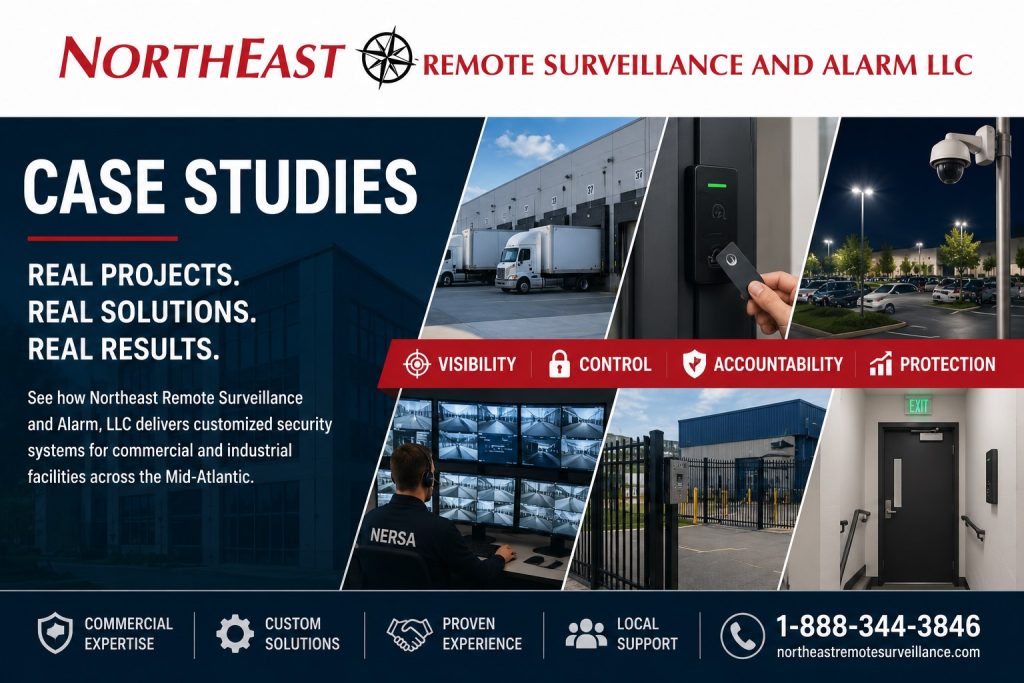
Real-World Security Planning for Warehouses, Offices, Loading Areas, Commercial Properties and Industrial Facilities
A warehouse with loading docks, trailer activity and employee entrances presents different challenges than an office building with a shared lobby and restricted rooms. A truck yard operating overnight requires a different security approach than a commercial parking area or an interior-controlled entrance.
Northeast Remote Surveillance and Alarm, LLC designs commercial and industrial security systems around those differences.
These case studies provide practical examples of how video surveillance, access control, remote monitoring and related security technologies can be applied to real commercial operating environments without unnecessarily exposing sensitive customer information.
For broader educational planning resources, visit the Commercial & Industrial Security Knowledge Center.
Commercial & Industrial Systems Only • New Installations • Upgrades • Retrofits • Takeovers
Scranton Project Experience: Village Park Apartments
NERSA has serviced Village Park Apartments in Scranton since 2008.
Cameras cover every property entrance, roads, areas around apartment units, play areas, the community center and maintenance buildings.
Services also include access control and intrusion alarms.
Read the Village Park Apartments security case study.
Security Systems Designed Around Real Properties
Commercial security planning should not begin with a predetermined number of cameras, a generic alarm package or the assumption that every controlled entrance operates the same way.
The property should come first.
Depending on the facility, planning may consider:
- Property type
- Operating hours
- Employee movement
- Visitor activity
- Loading and receiving operations
- Vehicle traffic
- Restricted areas
- Existing security equipment
- After-hours exposure
- Lighting
- Door conditions
- Network infrastructure
- Monitoring requirements
- Remote administration
- Previous security concerns
- Future expansion
Those conditions help determine where greater visibility, stronger entrance control, better documentation, improved event response or system modernization can provide a practical benefit.
The case studies below show how those decisions can differ from one commercial environment to another.
Featured Commercial & Industrial Security Case Studies
Midea Warehouse: Lehigh Valley Managed Alarm
Explore the Midea warehouse managed alarm case study, covering 76 overhead doors and 27 personnel doors in the Lehigh Valley.
The Laundry Hub: Automated Laundromat in Warminster
Explore The Laundry Hub case study for Alarm.com video surveillance, intrusion protection, automated opening, scheduled entry control, and automation for lights, fans, and signs.
Mama’s Pizza: Small Business, Multiple Locations
See how structured cabling supports phones, point-of-sale systems, customer entertainment, and daily operations, alongside video surveillance, mobile and remote viewing, and intrusion detection in the Mama’s Pizza multi-location security case study.
Warehouse Security Camera Upgrade
See how an existing warehouse surveillance environment can be evaluated for improved camera coverage, recording and useful visibility around loading areas, entrances and facility operations in the Warehouse Security Camera Upgrade Case Study.
Loading Dock Camera Coverage
Explore security-camera planning for an operating environment where freight, trailers, employees, forklifts, overhead doors and shipping activity converge in the Loading Dock Camera Coverage Case Study.
Truck Yard Remote Video Monitoring
Review how remote video monitoring can support after-hours visibility across gates, trailer areas, drive lanes, fence lines and exterior property in the Truck Yard Remote Video Monitoring Case Study.
Commercial Parking Lot Security Cameras
See how parking-area camera planning can address vehicle movement, pedestrian routes, entrances, drive lanes, lighting conditions and usable incident documentation in the Commercial Parking Lot Security Camera Case Study.
Office Building Access Control & Video Surveillance
Explore how access control and video surveillance can support employee entrances, visitor activity, restricted areas, parking and after-hours building access in the Office Building Access Control and Camera Case Study.
What a Commercial Security Case Study Should Explain
A useful case study should show more than the equipment installed.
The real value is understanding the relationship between the property, the problem being addressed and the security approach selected for that environment.
A well-constructed commercial security case study may explain:
- The type of property
- How the property operates
- The security concern
- Existing equipment or infrastructure
- Important installation conditions
- The general system approach
- How the completed system supports the facility
- What could be retained or upgraded
- Operational considerations
- Future expansion requirements
The purpose is to provide enough information to understand the project without publishing a detailed security blueprint.
Property Conditions Matter
Security risk is rarely distributed evenly throughout a commercial property.
A warehouse may have excellent interior visibility but poor coverage at one loading area.
An office may have strong camera coverage but no reliable way to control access to an employee-only area.
A truck yard may have adequate building cameras while its trailer rows, fence line and gate remain difficult to observe after hours.
A commercial parking area may need fewer cameras with better placement rather than simply adding more devices.
The condition of the property should determine the security strategy.
That is why two businesses with similar square footage can require very different systems.
The Security Challenge Comes Before the Equipment
Commercial security projects often begin because an organization has a specific operating problem.
Examples may include:
- Poor camera coverage
- Aging recording equipment
- Uncontrolled mechanical keys
- Unauthorized after-hours access
- Limited dock visibility
- Exterior theft exposure
- Parking incidents
- Inadequate alarm verification
- Unsupported security equipment
- Limited remote administration
- Facility expansion
- Poor system documentation
The equipment should be selected after the problem is understood.
A camera, card reader, intrusion detector or monitoring service is useful only when it supports a clearly defined security or operational requirement.
Security Systems May Use Several Technologies
Depending on the property and project requirements, a commercial security solution may involve:
- Video surveillance
- Access control
- Intrusion detection
- Professional alarm monitoring
- Remote video monitoring
- Live talk-down
- Intercoms
- Gate control
- Credential management
- Network infrastructure
- Cabling and fiber
- Communications
- Supporting power equipment
Not every property requires every technology.
The objective is to identify which systems provide a practical benefit for the facility and how those systems should operate together.
New Systems, Upgrades and Retrofits
A commercial security project does not always require complete replacement.
Many facilities already have cameras, recorders, access-control components, alarm devices, cabling, network equipment, door hardware or communications infrastructure installed.
Existing equipment should be evaluated before deciding what should remain.
A modernization project may involve:
- Replacing obsolete cameras
- Improving camera placement
- Upgrading an NVR
- Expanding recording storage
- Adding controlled entrances
- Modernizing access-control hardware
- Replacing unsupported alarm equipment
- Adding remote monitoring
- Reusing serviceable cabling
- Improving network connectivity
- Expanding an existing system
- Consolidating older equipment
Useful existing infrastructure may sometimes be retained when it remains reliable, compatible and suitable for the completed system.
That evaluation can reduce unnecessary replacement while still addressing the actual weakness in the existing security environment.
Protecting Customer Security Information
Commercial security projects can involve information that should not be publicly disclosed.
NERSA may therefore present case studies anonymously when identifying the customer, facility or exact system configuration would reveal unnecessary security information.
Information that generally should remain private includes:
- Passwords
- Alarm codes
- Exact alarm-zone lists
- Detailed camera maps
- Known blind spots
- Access-control schedules
- Employee credential information
- Monitoring call lists
- Detailed response procedures
- Network credentials
- Sensitive equipment locations
- Other information that could weaken the customer’s security
A case study can still explain the facility type, operating challenge, security approach and practical outcome without exposing sensitive details.
Customer confidentiality takes priority over publishing unnecessary technical information.
Commercial and Industrial Properties Can Require Very Different Security Approaches
NERSA works with qualifying commercial, industrial and institutional properties where security requirements can differ substantially.
Properties may include:
- Warehouses
- Distribution centers
- Manufacturing facilities
- Industrial properties
- Office buildings
- Multi-tenant commercial properties
- Contractor facilities
- Truck yards
- Loading docks
- Parking areas
- Healthcare properties
- Schools and institutions
- Municipal facilities
- Commercial campuses
- Multi-location organizations
Security planning should reflect the actual environment rather than assuming the same system design will work everywhere.
Security Planning Beyond the Equipment
The long-term usefulness of a security system depends on more than the devices installed.
Day-to-day operation may also depend on:
- User permissions
- Employee turnover
- Credential administration
- Opening and closing procedures
- Alarm response instructions
- Video-retention requirements
- Remote-access permissions
- Network availability
- Backup communications
- Power conditions
- Property lighting
- Door condition
- Gate operation
- Equipment accessibility
- Documentation
- Ongoing service
These operating details can determine whether a system remains practical years after installation.
A well-designed project should consider who will manage the system, how it will be used and how changes will be handled after installation is complete.
What to Look for When Reviewing a Security Case Study
A case study is most useful when it helps your organization think about its own property.
Consider:
- Is the property type similar to ours?
- Is the operating schedule similar?
- Do we have the same type of entrances or exterior exposure?
- Are we dealing with an existing system or a new installation?
- Do we have similar loading, vehicle or employee activity?
- Is the problem primarily visibility, access, detection or response?
- Could useful existing infrastructure be retained?
- Who will administer the completed system?
- How might our requirements change later?
The objective is not to duplicate another property’s system.
The objective is to understand how security decisions can be adapted to your own facility.
Frequently Asked Questions About Commercial Security Case Studies
What is a commercial security case study?
A commercial security case study is a practical example showing how a security requirement was evaluated and how security technology was applied to the property and its operating conditions.
Why are commercial security case studies useful?
They can help property owners, facility managers and operations teams understand how cameras, access control, monitoring and related systems are applied in actual commercial environments rather than viewing technology only as individual products.
Does NERSA identify customers in its case studies?
Customer information may be included when appropriate and authorized, but many commercial and industrial case studies are better presented anonymously to protect sensitive security information.
Will NERSA publish exact camera locations or alarm zones?
Not when doing so could create unnecessary security risk. A case study can explain the design strategy without publishing detailed camera maps, alarm zones, access schedules, passwords or other sensitive information.
Can existing security equipment be incorporated into an upgrade?
Potentially. Existing cameras, cabling, door hardware, network equipment, alarm devices and other components can be evaluated for condition, compatibility and continued serviceability.
Are case studies only about video surveillance?
No. Commercial security projects may involve video surveillance, access control, intrusion alarms, remote monitoring, intercoms, gate control, infrastructure and other security technologies.
Does every security project require a complete system replacement?
No. Existing infrastructure may remain useful when it is reliable, compatible, supportable and appropriate for the completed system.
Does NERSA provide residential security systems?
No. Northeast Remote Surveillance and Alarm, LLC focuses on commercial, industrial, institutional and other qualifying nonresidential security projects.
Request a Commercial or Industrial Security Assessment
Every useful security case study begins with a real property and a real operating requirement.
If your warehouse, industrial facility, office, loading area, truck yard, parking area, multi-tenant property or other commercial site needs improved visibility, better entrance control, stronger alarm protection, remote monitoring or modernization of an existing system, Northeast Remote Surveillance and Alarm, LLC can evaluate the property and develop a security approach around the way the facility actually operates.
Request a Commercial Security Assessment.
Northeast Remote Surveillance and Alarm, LLC
Commercial & Industrial Security Systems
View installation videos and field demonstrations for examples of equipment operation.
- NERSA Installation Videos & Field Demonstrations — View installation and field-demonstration material alongside the written examples.