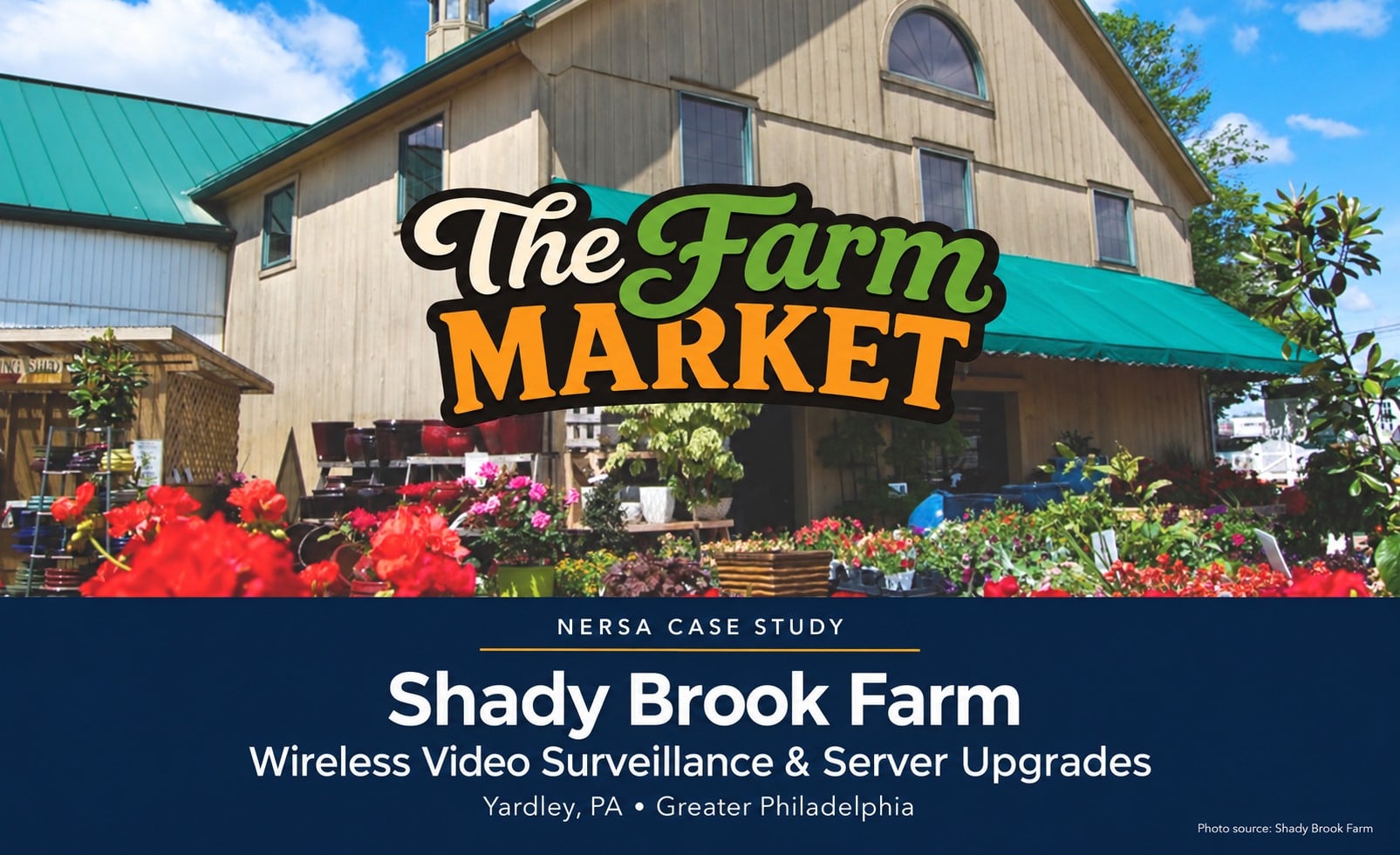
At Shady Brook Farm in Yardley, Pennsylvania, video surveillance serves needs that extend beyond property protection.
Connecting Security with Daily Operations
Missing products, undocumented activities, staffing requirements, employee activity, and customer interactions all create situations where a clear visual record can help management understand what happened and determine an appropriate response.
Northeast Remote Surveillance and Alarm, LLC (NERSA) addressed these priorities through video surveillance connected by point-to-point and point-to-multipoint wireless bridges, server upgrades, and AI-enabled cameras. The project brought together camera technology, network connectivity, and supporting server infrastructure to support motion-based recording, incident searches, and video review.
For this Greater Philadelphia property, the focus was practical: connect surveillance across the site and make recorded activity more useful to the people responsible for security and daily operations.
The Challenge: Missing Information When It Matters
When products go missing, management needs more than assumptions. Understanding the circumstances may require reviewing movement through an area, establishing a timeline, or comparing observed activity with available business records. Video can contribute to that process without automatically establishing why an item is missing or who is responsible.
Undocumented activity presents a related challenge. An event may occur outside a manager’s immediate view, and the accounts provided afterward may be incomplete. A usable recording gives authorized staff another source of information when assessing a concern, resolving uncertainty, or deciding whether further investigation is necessary.
Staffing and customer interactions add operational considerations. Managers may need to understand when activity increases, where employees are working, and how a particular interaction unfolded. The surveillance project addressed these needs alongside the broader responsibility to protect the property and document security events.
Wireless Bridges Connect the Surveillance System
NERSA connected video surveillance through a combination of point-to-point and point-to-multipoint wireless bridges.
These connections provide network paths between surveillance equipment and the systems used to receive, record, or manage video.
A point-to-point wireless bridge links two locations. Within a surveillance network, this approach can connect a camera location or a group of devices to another network endpoint. It provides a focused connection where the design calls for communication between two defined points.
Point-to-multipoint connectivity supports multiple remote endpoints communicating with a central location. This arrangement can serve a distributed camera layout where several viewing positions need connectivity within the same overall surveillance system.
Using both approaches allows the network design to reflect the relationship between camera locations and supporting infrastructure. The purpose is to establish suitable connections for the required video traffic, rather than treating every camera position as an identical installation.
Wireless connectivity still requires planning around distance, obstructions, mounting, interference, capacity, and power at each endpoint. A wireless bridge provides a data connection; it does not eliminate the need to account for those installation conditions.
Server Upgrades Support the Broader System
The Shady Brook Farm project also included server upgrades.
Camera improvements and network connections form only part of a surveillance solution.
Supporting servers and network infrastructure must be considered alongside the video workload and the functions expected from the system.
Recording, storage, playback, and video management requirements can place different demands on infrastructure. Their relationship matters when planning an upgrade: adding cameras or changing recording settings can affect the resources needed to support the complete system.
The server work was part of the project’s broader modernization effort. It complemented the wireless surveillance connections and AI-enabled cameras, addressing the infrastructure behind the views that staff use.
For an organization evaluating a similar project, server planning should begin with operational requirements. The relevant questions include which video functions are needed, how authorized users will access recordings, and what storage and system capacity the selected configuration requires.
AI-Enabled Cameras for Motion Recording and Review
NERSA included AI-enabled cameras to support more accurate motion-based recording and more efficient incident search and review. The objective was to make the surveillance system more useful when management needs to find activity associated with a particular concern.
Motion-based recording depends on how the camera and recording system are configured. AI capabilities can help distinguish relevant activity from other changes in a scene, subject to the features supported by the equipment and the conditions at each location.
That distinction matters in daily use. A recording system should help staff focus their attention on events worth reviewing. Appropriate detection settings can support that objective, while camera positioning and scene conditions remain essential to useful results.
Incident review also requires context. An alert or search result provides a starting point for examination, not a complete explanation. Authorized staff should review the relevant footage and surrounding sequence before reaching conclusions about an event.
Documenting Products, Employees, and Customer Interactions
For missing-product concerns, surveillance provides a way to examine recorded activity within the areas covered by cameras. Management can use relevant footage to help establish timing and understand visible movement, alongside inventory information and other available records.
For previously undocumented activities, the value lies in creating a visual reference. Rather than relying solely on recollection, authorized reviewers can examine what the camera recorded and identify questions that require additional information.
Employee activity and staffing requirements introduce another use for that record. Video may help managers understand activity patterns, review coverage during a particular period, or assess the circumstances surrounding an operational issue. Staffing decisions still require consideration of workload, schedules, responsibilities, and information beyond the camera view.
Customer interaction documentation can similarly support a balanced review of concerns. Relevant footage may help clarify the visible sequence of an encounter, subject to camera coverage and recording quality. Reviewing the surrounding activity helps management consider the context of each interaction and identify appropriate follow-up steps.
A Coordinated Approach to Security
The project combines several functions that depend on one another. Cameras capture activity, wireless bridges carry video across network connections, and server infrastructure supports the selected system functions. AI-enabled features assist with identifying and locating activity for review.
The strength of this approach is coordination. A useful camera view needs an appropriate connection, and a recorded event needs an accessible review process. Considering those elements together keeps the project focused on how management will actually use the system.
At Shady Brook Farm, the documented scope addresses security and operational visibility through that combination of technologies. It provides a practical example of surveillance modernization organized around business concerns rather than equipment alone.
Planning a Similar Surveillance Upgrade
Businesses facing missing products, gaps in documentation, or difficult incident searches can begin by identifying the questions their current system cannot answer. Those questions help define camera coverage, connectivity, recording, and review priorities.
A clear project scope also helps align expectations between management and the installation team. Define the activity each view should capture, the people permitted to access recordings, and the process for requesting review. These decisions connect technical choices to everyday responsibilities and give the business a consistent basis for evaluating the system as operations, staffing patterns, and surveillance needs change over time across the property and its various activities.
NERSA develops surveillance solutions around the property, existing infrastructure, and operational requirements.
For businesses in Yardley, Bucks County, and Greater Philadelphia, a coordinated assessment can identify where wireless connections, server improvements, and AI-enabled cameras may support a more useful security system.
Explore our commercial and industrial security case studies, Greater Philadelphia security services, commercial video surveillance systems, and security system upgrades.