Freight terminal and cross dock security systems in Easton, PA should be designed around fast freight transfer, multiple active bay lines, truck turnover, dispatch visibility, restricted terminal spaces, forklift movement, and short-dwell freight activity. Northeast Remote Surveillance and Alarm, LLC designs and installs freight terminal and cross dock security systems for Easton operations that need stronger visibility, better freight documentation, tighter restricted-area control, and clearer review of high-speed terminal activity. For broader citywide planning across cameras, alarms, access control, monitoring, and integrated commercial security, start with Easton Commercial and Industrial Security Systems.
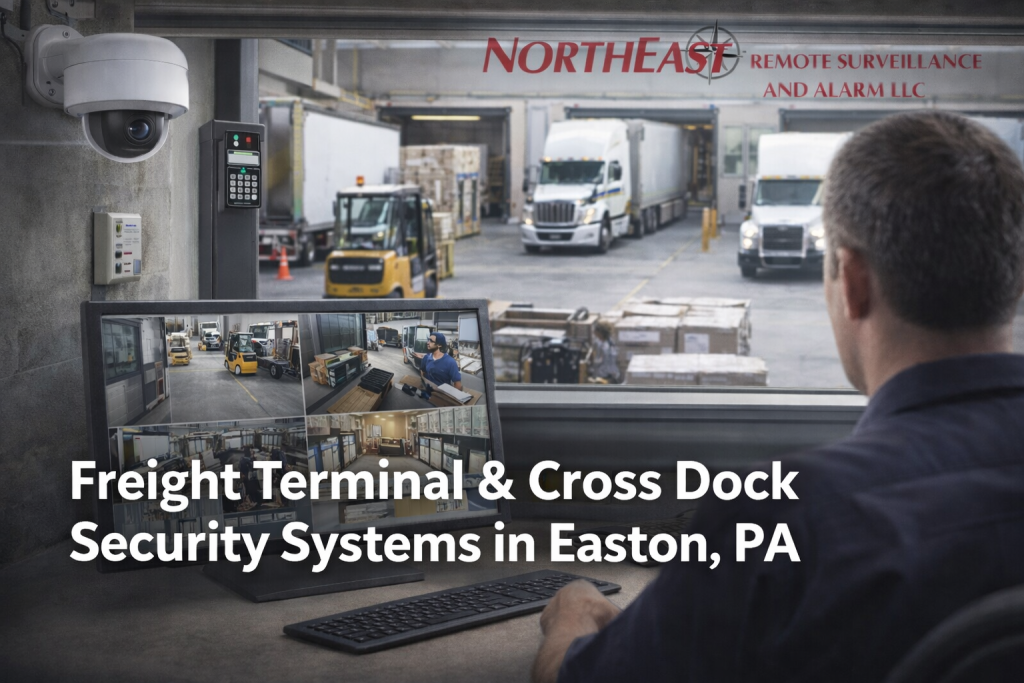
Security Built Around Multi-Door Freight Flow
A freight terminal moves differently than a standard warehouse or single loading dock. Freight may arrive through one group of doors, cross the floor quickly, and leave through another.
Trucks cycle in and out, door assignments change, forklifts move continuously, and supervisors need usable visibility across a wide operating zone.
Because freight often has limited dwell time, missed visibility can quickly become lost accountability. A properly designed system should help document which bay lines were active, how freight moved across the floor, who entered restricted spaces, and whether activity matched authorized operations.
Where Freight Terminal Security Matters Most
Inbound and Outbound Bay Lines
Freight terminals often depend on multiple active door groups. Camera coverage and event review should support inbound doors, outbound doors, active bay lines, door assignments, and trailer-at-door activity.
The goal is to make freight movement easier to review when questions come up about timing, handling, damage, shortages, or unauthorized activity.
Cross-Floor Transfer Lanes
Cross dock operations need visibility across the lanes where freight moves from inbound to outbound. These transfer areas are often active, crowded, and fast-moving.
Security planning should help document how freight crossed the terminal, where it moved, and whether the transfer matched expected workflow.
Sort Areas and Forklift Movement
Sort areas, staging points, and forklift travel paths are critical to terminal accountability. These zones often determine whether freight is routed correctly, handled properly, or exposed during movement.
A strong layout should support review of forklift traffic, transfer points, sort activity, and the movement of freight across the terminal floor.
Dispatch and Restricted Terminal Spaces
Dispatch rooms, terminal offices, supervisor areas, equipment rooms, IT closets, records spaces, and restricted support areas may need tighter control than the open freight floor.
Access control can help limit who enters sensitive terminal spaces while creating a record of entry activity.
Cameras for Bay Lines, Transfer Lanes, and Sort Flow
Freight terminal cameras should do more than provide a wide view of the building. A useful system should show active bay lines, transfer floor movement, forklift traffic, dispatch-facing areas, and the points where inbound freight becomes outbound freight.
In Easton cross dock environments, detail matters because freight moves quickly and questions often come after the shipment has already left.
When the main need is dock-door visibility, trailer-at-bay review, and overhead-door activity, use Loading Dock Security Cameras in Easton, PA.
Shipping, Receiving, and Freight Handoff Control
Freight terminal security connects closely with shipping and receiving, but the focus is not the same. Freight terminal security covers multi-door movement, cross-floor transfer, bay-line review, carrier timing, and terminal-scale accountability.
Shipping and receiving security focuses more narrowly on handoff areas, receiving counters, shipping desks, staging zones, check-in points, and release areas.
For shipment handoff zones and internal processing areas, use Shipping and Receiving Area Security in Easton, PA.
Vehicle Turnover and Carrier Accountability
Freight terminals often need better documentation of vehicle timing. Carrier arrivals, departures, linehaul movement, vendor traffic, driver activity, and gate events can all affect freight accountability.
Vehicle documentation can help management review which vehicles entered, when a carrier arrived, when a truck left, whether activity occurred during an expected time window, and whether vehicle movement matched terminal records.
For searchable vehicle records at entrances, exits, gate lanes, and carrier arrival points, use [License Plate Recognition Systems in Easton, PA].
After-Hours and Reduced-Staff Terminal Oversight
Many terminal vulnerabilities increase outside the busiest part of the day. Late linehaul arrivals, early departures, overnight carrier movement, reduced staffing, and recurring off-hours activity can make it harder to track what is happening across the terminal.
A freight terminal security system should support visibility around active bay lines, trailer-at-door activity, transfer floor movement, restricted support rooms, carrier arrivals, dispatch areas, and interior movement during reduced staffing.
The right system should match the actual terminal schedule, not a generic after-hours assumption.
Upgrading Freight Terminal and Cross Dock Security
Many Easton freight terminals already have cameras, access control, or monitoring in place, but the system may no longer match the operation. Door groups may have changed, traffic may have increased, shifts may have expanded, or older camera angles may no longer support useful freight review.
An upgrade may include better bay-line coverage, improved transfer-lane visibility, stronger dispatch-area documentation, restricted-room access control, license plate documentation, improved remote access, better retention, or redesigned camera views around current freight flow.
The best upgrade is not always more equipment. The best upgrade is better coverage of the areas where freight movement, carrier timing, restricted access, and accountability matter most.
Built for Easton Freight and Cross Dock Operations
Northeast Remote Surveillance and Alarm, LLC designs freight terminal and cross dock security systems around how the Easton facility actually moves freight.
Door count, transfer lane layout, dock flow, dispatch process, shift structure, restricted rooms, carrier turnover, forklift movement, and after-hours activity all affect the final design.
The system should help management review bay activity, transfer movement, carrier timing, restricted-space access, and off-hours terminal activity without slowing down normal freight operations.
Request Freight Terminal & Cross Dock Security in Easton, PA
If your Easton freight terminal or cross dock operation needs stronger bay-line visibility, better transfer-lane review, clearer carrier documentation, restricted-space control, or more dependable after-hours oversight, Northeast Remote Surveillance and Alarm, LLC can help.
Call 1-888-344-3846 or use Request a Security Assessment to schedule a freight terminal and cross dock security review.
Frequently Asked Questions
What is freight terminal security?
Freight terminal security is security planning for multi-door freight operations where trucks, freight, forklifts, dispatch areas, restricted rooms, and transfer lanes need better visibility and accountability.
What is cross dock security?
Cross dock security focuses on facilities where freight moves quickly from inbound doors to outbound doors with limited storage time. The system should support transfer visibility, bay-line review, and freight accountability.
How is freight terminal security different from loading dock security?
Loading dock security focuses more narrowly on dock doors, trailer-at-bay activity, dock aprons, and overhead-door exposure. Freight terminal security covers broader multi-door operations, transfer lanes, dispatch visibility, carrier turnover, and terminal-scale freight movement.
How is cross dock security different from shipping and receiving security?
Shipping and receiving security focuses on handoff areas, receiving counters, release points, staging zones, and internal processing areas. Cross dock security focuses on fast freight transfer across multiple active bay lines and transfer lanes.
What should cameras cover in a freight terminal?
Cameras should cover active door groups, inbound and outbound bay lines, cross-floor transfer lanes, sort areas, forklift corridors, dispatch-facing areas, restricted terminal rooms, and after-hours activity points.
Is access control useful in a freight terminal?
Yes. Access control can help protect dispatch rooms, terminal offices, supervisor spaces, equipment rooms, records areas, and other restricted support spaces.
Is license plate recognition useful for freight terminals?
Yes. LPR can help document carrier arrivals, departures, vehicle timing, and recurring truck movement at facilities with frequent freight activity.
Does this page replace warehouse security?
No. Warehouse security is broader building-level protection. This page stays focused on freight terminals, cross dock transfer, active bay lines, dispatch visibility, carrier timing, and short-dwell freight movement.