Sprinkler monitoring and fire alarm supervision in Easton, PA help commercial and industrial property owners transmit waterflow alarms, valve-tamper supervisory conditions, fire-pump signals, low-air conditions, system troubles, and other approved fire-protection events through a properly coordinated fire alarm system. Request an Easton Sprinkler Monitoring Assessment or call 1-888-344-3846.
Northeast Remote Surveillance and Alarm, LLC supports the fire-alarm monitoring and supervision side of commercial sprinkler protection for Easton offices, medical properties, retail spaces, restaurants, schools, churches, municipal buildings, warehouses, manufacturing facilities, industrial properties, multi-tenant buildings, mixed-use properties, commercial campuses, and multi-location organizations.
This page focuses specifically on:
- Sprinkler waterflow alarm monitoring
- Valve-tamper supervision
- Low-air and pressure supervisory points
- Approved fire-pump signals
- Fire alarm monitor modules
- Point descriptions and signal classification
- Supervising-station communication
- Fire alarm panel programming
- Power and battery support
- Functional signal testing
- Monitoring-account documentation
- Coordination with sprinkler contractors
- Deficiency identification
- Existing-system transitions and expansions
This page does not cover sprinkler-system design, hydraulic calculations, pipe installation, sprinkler-head replacement, valve repair, fire-pump mechanical service, or sprinkler inspection performed by a sprinkler contractor.
For complete fire-alarm design, occupant notification, detection, monitoring, renovations, and broader local life-safety planning, visit Commercial Fire Alarm Systems in Easton, PA.
High-bay warehouses, distribution centers, manufacturing plants, and industrial properties requiring complete system design should use Warehouse and Industrial Fire Alarm Systems in Easton, PA.
Commercial & Industrial Sprinkler Monitoring • Waterflow Alarms, Valve-Tamper Supervision, Low-Air & Fire-Pump Signals • Communication, Testing & Documentation
Request an Easton Sprinkler Monitoring Assessment
Call 1-888-344-3846
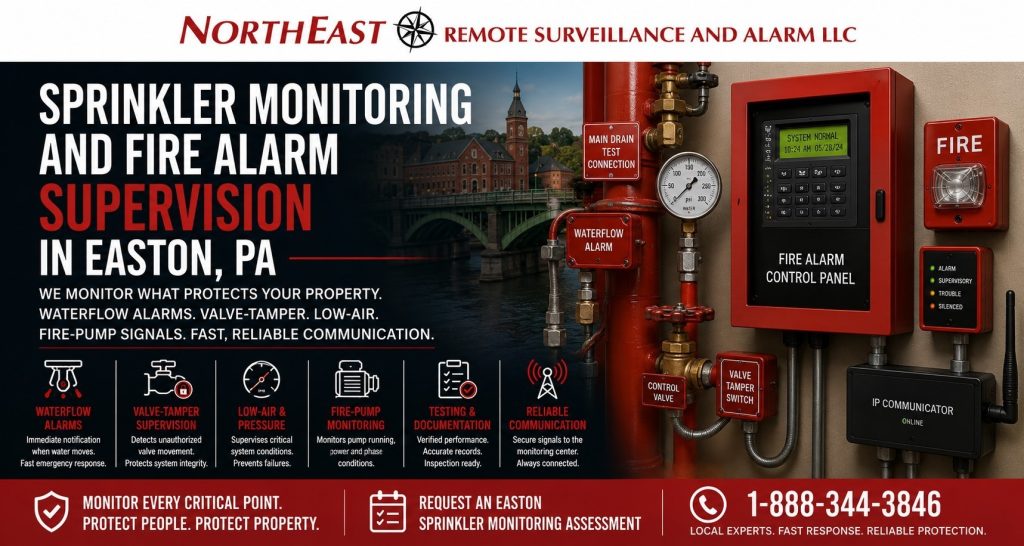
Fire Alarm Supervision Built Around the Complete Sprinkler System
A sprinkler-monitoring project should not be approached by connecting several switches to spare alarm-panel zones without first reviewing the building and the installed fire-protection equipment.
A complete monitoring arrangement may depend on:
- Fire alarm control equipment
- Sprinkler risers
- Waterflow switches
- Valve-tamper switches
- Dry-pipe or preaction conditions
- Low-air switches
- Pressure switches
- Fire-pump supervisory points
- Monitor modules
- Signaling-line circuits
- Conventional initiating circuits
- Panel programming
- Remote annunciators
- Local occupant notification
- Communication equipment
- Supervising-station accounts
- Responsible-party contacts
- Primary and standby power
- Testing procedures
- Accurate system documentation
A waterflow switch may operate correctly while the fire alarm monitor module fails to report.
A monitor module may report locally while the supervising station receives the wrong point description or signal classification.
A valve-tamper switch may display at the panel but fail to transmit as a supervisory condition.
The complete path—from sprinkler device through the fire alarm panel, communicator, monitoring account, responsible contacts, event records, and restoration—should be coordinated and tested.
Easton Sprinkler Monitoring Resources
Commercial Fire Alarm Systems in Easton, PA
Commercial Fire Alarm Systems in Easton, PA is the primary local parent for occupied-commercial fire-alarm design, installation, detection, notification, sprinkler supervision, tenant changes, monitoring, and emergency interfaces.
Warehouse and Industrial Fire Alarm Systems in Easton, PA
Warehouse and Industrial Fire Alarm Systems in Easton, PA addresses high-bay spaces, distribution centers, manufacturing facilities, industrial environments, large sprinkler systems, fire-pump points, specialty detection, and multi-building properties.
Fire Alarm Monitoring, Testing, and Inspection Readiness in Easton, PA
Fire Alarm Monitoring, Testing, and Inspection Readiness in Easton, PA addresses planned signal verification, responsible contacts, inspection preparation, monitoring communication, power, batteries, documentation, and deficiency reporting.
Commercial Fire Alarm Maintenance and Repair in Easton, PA
Commercial Fire Alarm Maintenance and Repair in Easton, PA addresses failed monitor modules, incorrect supervisory points, communication problems, panel troubles, wiring faults, weak batteries, incorrect signal descriptions, and corrective fire-alarm service.
Easton Fire Alarm Upgrades
Easton Fire Alarm Upgrades addresses obsolete panels, communicator modernization, additional sprinkler-monitoring capacity, unsupported modules, device migration, notification expansion, and phased replacement.
Fire Alarm System Takeovers and Monitoring Transitions in Easton, PA
Fire Alarm System Takeovers and Monitoring Transitions in Easton, PA addresses provider changes, inherited systems, communicator ownership, account transfers, responsible contacts, signal mapping, and monitoring cutovers.
Fire Alarm Waterflow and Tamper Monitoring
Fire Alarm Waterflow and Tamper Monitoring is NERSA’s broader non-local resource for waterflow alarms, valve-tamper supervision, signal classifications, monitoring, documentation, and system coordination. (Northeast Remote Surveillance)
Fire Alarm Monitoring and Supervision
Fire Alarm Monitoring and Supervision addresses alarm, supervisory, trouble, sprinkler, power, communication, elevator, and other approved signals transmitted through commercial fire-alarm monitoring systems. (Northeast Remote Surveillance)
Sprinkler System Monitoring
Sprinkler System Monitoring provides broader planning guidance involving sprinkler risers, fire alarm panels, waterflow, valve tamper, supervising-station communication, and responsible-property management. (Northeast Remote Surveillance)
Does your Easton property need new waterflow monitoring, valve-tamper supervision, corrected point descriptions, communicator testing, or an evaluation of inherited sprinkler-monitoring equipment? Request an Easton Sprinkler Monitoring Assessment or call 1-888-344-3846.
What Sprinkler Monitoring Does
A sprinkler system can begin controlling a fire through water discharge, but the building also needs a way to report relevant sprinkler conditions through the approved life-safety system.
Sprinkler monitoring may help report:
- Water movement caused by sprinkler activation
- A sprinkler control valve moved from its normal position
- Low air in a dry-pipe or preaction system
- Fire-pump operation
- Fire-pump power or phase conditions
- Pressure conditions
- Equipment or circuit trouble
- Communication failure
- Primary-power failure
- Low battery
- Other approved fire-protection events
These conditions should be separated into the correct signal classifications.
Waterflow is generally treated as an alarm condition.
Valve tamper and many fire-protection equipment conditions are generally treated as supervisory conditions.
Failed modules, damaged wiring, power loss, communication failure, and circuit problems are generally treated as trouble conditions.
The approved design, adopted requirements, system programming, and AHJ direction determine the final treatment of each point.
Sprinkler Waterflow Alarm Monitoring
A waterflow switch detects water movement within a sprinkler system under defined operating conditions.
When properly coordinated with the fire alarm system, a waterflow event may:
- Report to the fire alarm control panel
- Display a specific sprinkler zone or riser
- Activate approved occupant notification
- Transmit an alarm signal to the supervising station
- Create an event record
- Support emergency response procedures
- Restore after the sprinkler system returns to normal
Waterflow point descriptions should identify the protected area clearly.
Useful descriptions may include:
- Main Sprinkler Riser Waterflow
- First-Floor East Waterflow
- Suite 204 Sprinkler Waterflow
- North Warehouse Waterflow
- Manufacturing Building 2 Waterflow
- Parking-Level Sprinkler Waterflow
Weak descriptions include:
- Zone 3
- Flow 1
- Module 8
- Old Riser
- Back Building
Clear descriptions help monitoring personnel, firefighters, property managers, inspectors, sprinkler contractors, and fire-alarm technicians understand which system activated.
Waterflow Signal Coordination
A complete waterflow monitoring sequence may involve:
- Water moves through the sprinkler piping.
- The sprinkler waterflow switch operates.
- The fire alarm monitor module or initiating circuit detects the condition.
- The fire alarm panel identifies the point.
- Approved occupant notification activates.
- The communicator transmits the alarm.
- The supervising station receives the correct property and point information.
- Monitoring procedures are followed.
- The condition is documented.
- The signal restores after the sprinkler system and alarm system are returned to normal.
A local panel alarm does not prove that the monitoring center received the correct signal.
A received monitoring signal does not prove that occupant notification, point text, restoration, and related functions operated correctly.
The full sequence should be evaluated within the approved testing scope.
Valve-Tamper Supervision
A valve-tamper switch monitors whether a sprinkler control valve remains in its normal operating position.
If the valve begins moving from its normal position, the fire alarm system may report a supervisory condition.
Valve-tamper supervision may apply to:
- Main control valves
- Floor control valves
- Riser valves
- Post-indicator valves
- Outside-screw-and-yoke valves
- Butterfly valves
- Other approved sprinkler control valves
The point description should identify the valve and area.
Useful descriptions may include:
- Main Sprinkler Control Valve Tamper
- First-Floor East Valve Tamper
- North Warehouse Riser Valve Tamper
- Building 2 Post-Indicator Valve Tamper
- Suite 300 Floor-Control Valve Tamper
A generic Tamper 1 description provides limited operational value.
Why Valve Supervision Matters
A sprinkler control valve moved from its required normal position can impair all or part of the sprinkler system.
The fire alarm supervisory signal can provide notice that the monitored valve condition requires attention.
The supervisory signal does not repair the valve, determine why it moved, or restore sprinkler protection.
The property should maintain a response procedure identifying:
- Who receives the supervisory event
- Who has authority to inspect the condition
- Which sprinkler contractor should be contacted
- Whether an impairment procedure is required
- How the condition is documented
- How restoration is verified
- Who updates responsible parties
The mechanical valve and sprinkler system remain within the sprinkler contractor’s responsibility.
The fire alarm contractor evaluates the monitor module, wiring, programming, panel indication, communication, and supervising-station signal.
Alarm, Supervisory, and Trouble Signals
Sprinkler-related points should be classified correctly.
Alarm Signals
Possible sprinkler-related alarm signals include:
- Waterflow
- Approved pressure-related alarm input
- Other approved fire-alarm initiating conditions
Supervisory Signals
Possible sprinkler-related supervisory signals include:
- Valve tamper
- Low air
- Fire-pump running
- Fire-pump power trouble or phase conditions where classified as supervisory
- Low water level
- Pressure conditions
- Other approved off-normal fire-protection points
Trouble Signals
Trouble signals may indicate:
- Open wiring
- Ground fault
- Missing monitor module
- Communication failure
- Low battery
- Power failure
- Failed notification circuit
- Internal panel problem
- Disabled point
- Other fire alarm system fault
The point text, panel programming, annunciator display, monitoring account, responsible-party procedure, and test records should all use the correct classification.
Monitor Modules and Sprinkler Interfaces
Addressable fire alarm systems often use monitor modules to supervise sprinkler switches and other contact-based fire-protection devices.
A monitor-module installation may require review of:
- Module compatibility
- Device address
- Point description
- Wiring supervision
- End-of-line supervision
- Mounting location
- Environmental protection
- Accessibility
- Circuit routing
- Sprinkler-switch connection
- Tamper resistance
- Panel programming
- Signal classification
- Monitoring-account mapping
- Documentation
A module should not be placed where water, condensation, physical damage, or lack of access makes future service difficult.
The module address and point text should correspond to the actual sprinkler device.
Conventional Sprinkler Monitoring Circuits
Some systems use conventional initiating circuits or zone modules to monitor sprinkler points.
Planning may include:
- Circuit supervision
- End-of-line components
- Separate alarm and supervisory circuits
- Point identification
- Multiple devices on one circuit
- Wiring condition
- Zone descriptions
- Panel capacity
- Monitoring descriptions
- Future troubleshooting
Combining numerous unrelated devices under one generic zone can make it difficult to determine which riser, valve, or building generated the signal.
The existing architecture and approved design should guide whether circuits remain grouped or require more specific monitoring.
Low-Air Supervision
Dry-pipe and preaction sprinkler systems may use air pressure to maintain system operation.
An approved low-air switch may report a supervisory condition when pressure falls below the intended threshold.
Low-air monitoring may require coordination among:
- Sprinkler contractor
- Fire alarm contractor
- Property representative
- Monitoring provider
- Design professional
- AHJ
The sprinkler contractor should establish and verify the mechanical operating conditions.
The fire alarm contractor may address:
- Monitor module
- Wiring
- Point text
- Signal classification
- Panel programming
- Supervising-station transmission
- Restoration
- Documentation
A recurring low-air supervisory condition should not be handled by repeatedly resetting or bypassing the fire alarm point.
The underlying sprinkler-system condition requires appropriate evaluation.
Dry-Pipe and Preaction System Monitoring
Dry-pipe and preaction systems may have additional monitored conditions depending on their design.
Possible points may include:
- Waterflow
- Low air
- Valve tamper
- Releasing-panel conditions
- Air pressure
- Detection-system interfaces
- System trouble
- Power conditions
- Other approved alarm or supervisory points
These systems may involve specialized sprinkler, releasing, detection, and fire-alarm equipment.
Responsibilities should be defined before service or testing begins.
NERSA’s scope should remain limited to the supported fire-alarm control, monitoring, communication, wiring, and interface portion unless another specialized scope is explicitly included.
Fire-Pump Supervision
Commercial and industrial properties may monitor approved fire-pump conditions.
Possible signals may include:
- Fire pump running
- Controller power failure
- Phase reversal
- Other controller or system conditions
The final signal classification and sequence depend on the approved design and applicable requirements.
Fire-pump monitoring may involve:
- Fire-pump controller
- Supervisory contacts
- Fire alarm monitor modules
- Point descriptions
- Panel programming
- Monitoring communication
- Primary and standby power
- Test coordination
- Documentation
Fire-pump mechanical and controller service may require the appropriate fire-pump, sprinkler, electrical, or specialized contractor.
The fire alarm scope should not be represented as complete fire-pump installation or repair.
Pressure and Tank-Level Supervision
Some properties may monitor approved:
- Pressure conditions
- Tank levels
- Reservoir conditions
- Pump conditions
- Other fire-protection equipment
Each point should have:
- Defined purpose
- Correct signal classification
- Clear device description
- Identified responsible contractor
- Defined monitoring procedure
- Approved testing method
- Accurate documentation
A pressure-related supervisory point should not be generically labeled as Sprinkler Trouble when more specific information is available.
Local Notification and Sprinkler Waterflow
Waterflow may be part of the fire alarm’s occupant-notification sequence.
Depending on the approved system, a waterflow event may activate:
- Horns
- Strobes
- Horn-strobes
- Speakers
- Speaker-strobes
- Voice evacuation
- Remote annunciators
- Other approved notification functions
Notification planning is owned by the primary Easton commercial or warehouse/industrial fire-alarm pages.
This spindle remains focused on the sprinkler-monitoring and supervisory signal path.
A waterflow project that requires substantial new notification design may become a broader fire alarm expansion or upgrade.
Supervising-Station Communication
Sprinkler-related alarm and supervisory events may be transmitted through:
- Cellular communication
- Internet Protocol communication
- Radio communication
- Dual-path communication
- Another accepted and compatible method
Communication planning should evaluate:
- Panel compatibility
- Communicator compatibility
- Account ownership
- Cellular or network conditions
- Communication supervision
- Power
- Battery support
- Signal classification
- Monitoring-point descriptions
- Restoration reporting
- Current responsible contacts
- Long-term service support
A communicator displaying normal status at the property does not prove that every sprinkler point reaches monitoring correctly.
Each relevant alarm, supervisory, trouble, and restoration signal should be verified within the approved scope.
Monitoring-Account Point Mapping
The monitoring account should match the installed sprinkler and fire alarm system.
The takeover, installation, or expansion process may require confirming:
- Property name
- Property address
- Building or suite
- Sprinkler riser
- Waterflow point
- Valve-tamper point
- Low-air point
- Fire-pump point
- Signal classification
- Fire alarm panel
- Communicator account
- Responsible contacts
- Call order
- Passcodes
- Testing procedure
- Restoration
A panel should not display North Riser Waterflow while the monitoring account identifies the point as South Valve Tamper.
Incorrect signal mapping can cause inaccurate response information and difficult troubleshooting.
Responsible Contacts and Property Response
The property should maintain current responsible contacts for monitored fire-alarm and sprinkler conditions.
Contact records may include:
- Property owner
- Property manager
- Facility manager
- Building engineer
- Tenant representative
- Primary emergency contact
- Backup contact
- After-hours contact
- Fire alarm service provider
- Sprinkler contractor
- Monitoring provider
- Entry or key procedures
- Authority to silence and reset
- Authority to place the account on test
Easton’s current alarm ordinance includes owner, service-company, responsible-contact, and response information requirements. It also addresses notifications surrounding alarm-system service and the handling of classified malfunctions. Current project procedures should be confirmed with the City. (eCode360)
Easton Service and Testing Coordination
Testing waterflow, tamper, low-air, fire-pump, or related signals may generate monitoring events and local notification.
A controlled process may include:
- Confirming customer authorization
- Coordinating the sprinkler contractor
- Notifying the monitoring provider
- Placing the fire alarm account on test
- Following current Easton notification procedures
- Informing affected occupants and property representatives
- Activating the approved sprinkler condition
- Confirming fire alarm panel response
- Confirming monitoring receipt
- Confirming signal classification and point description
- Restoring the sprinkler device
- Confirming fire alarm restoration
- Returning the system to normal
- Removing the account from test
- Documenting results and deficiencies
Easton’s ordinance addresses notice before certain alarm-system installation, repair, service, alteration, replacement, or removal activities and notification when the system is returned to service. (eCode360)
Waterflow Testing Coordination
Waterflow testing may involve:
- Inspector’s test connection
- Sprinkler contractor
- Fire alarm panel
- Local notification
- Monitoring communication
- Alarm timing
- Point description
- System restoration
- Documentation
The sprinkler contractor controls the mechanical test and evaluates the sprinkler system.
The fire alarm contractor may verify:
- Monitor module input
- Panel alarm
- Notification sequence
- Monitoring transmission
- Correct signal classification
- Point description
- Event history
- Restoration
Fire-alarm verification does not replace the sprinkler contractor’s inspection and testing responsibilities.
Valve-Tamper Testing Coordination
Tamper testing may verify that:
- The sprinkler valve supervisory switch operates
- The monitor module detects the condition
- The panel identifies the correct valve
- The signal reports as supervisory
- The monitoring account receives the correct point
- The point restores after the valve returns to its required position
The sprinkler contractor should control and evaluate the valve.
The fire alarm contractor should evaluate the signal path and monitoring response.
A valve should not be operated casually or left in an impaired position after testing.
Signal Restoration
A sprinkler alarm or supervisory test is incomplete until restoration is verified.
Restoration may require:
- Sprinkler switch returning to normal
- Monitor module restoring
- Panel clearing
- Supervisory or alarm condition clearing
- Monitoring center receiving restoration
- Notification returning to normal
- Responsible contacts receiving appropriate information
- System reset
- Updated test record
A signal that activates but does not restore correctly can leave the fire alarm in an abnormal condition.
Primary and Standby Power
Sprinkler-monitoring equipment depends on the fire alarm system’s primary and standby power.
Power planning may include:
- Fire alarm panel
- Monitor modules
- Communicator
- Remote annunciator
- Notification power supplies
- Network equipment where applicable
- Auxiliary fire alarm power supplies
- Backup batteries
An expansion that adds numerous monitor modules or communication equipment may affect:
- Panel load
- Auxiliary power
- Battery calculations
- Available capacity
- Standby duration
- Alarm load
- Enclosure capacity
Battery capacity should reflect the final installed system rather than the original configuration before expansion.
Point Labeling and Riser Identification
Clear physical and programmed labels support:
- Monitoring
- Firefighter response
- Inspection
- Testing
- Maintenance
- Troubleshooting
- Multi-building management
- Future renovations
Useful labels may identify:
- Building
- Floor
- Suite
- Riser
- Valve
- Sprinkler zone
- Device type
- Fire alarm module
- Panel point
- Monitoring description
Labels should remain consistent among:
- Sprinkler riser
- Waterflow switch
- Valve switch
- Fire alarm monitor module
- Panel text
- Annunciator text
- Drawings
- Monitoring records
- Inspection reports
- Service records
Multiple Risers and Zoned Sprinkler Systems
Larger properties may have:
- Multiple sprinkler risers
- Floor-control assemblies
- Tenant-specific zones
- Separate buildings
- Warehouse and office zones
- Dry and wet systems
- Preaction systems
- Fire-pump equipment
- Several monitored valves
Each monitored point should be specific enough to identify the affected area.
Grouping numerous risers under one generic point may reduce the usefulness of the system during an activation or service condition.
The final design should consider panel capacity, module addresses, circuit organization, monitoring records, and future expansion.
Multi-Tenant Sprinkler Monitoring
Multi-tenant properties may divide responsibilities among:
- Property owner
- Property manager
- Tenant
- Sprinkler contractor
- Fire alarm contractor
- Monitoring provider
The project should clarify:
- Who owns the sprinkler equipment
- Who owns the fire alarm panel
- Who controls panel programming
- Who controls the monitoring account
- Who receives waterflow alarms
- Who receives supervisory conditions
- Who responds after hours
- Who corrects sprinkler deficiencies
- Who corrects fire alarm deficiencies
- Who retains records
- How tenant names are updated
A suite change should not leave monitoring points assigned to a former tenant or outdated area description.
Mixed-Use Properties
Mixed-use buildings may combine:
- Retail
- Offices
- Restaurants
- Residential sections
- Parking
- Storage
- Institutional areas
- Shared common spaces
The sprinkler-monitoring design should reflect the complete building system.
Point descriptions, notification, monitoring, tenant responsibilities, sprinkler zones, and emergency contacts should not be planned as unrelated systems when they share common risers or fire alarm equipment.
Warehouse and Distribution Properties
Warehouse sprinkler monitoring may involve:
- Several risers
- Large waterflow zones
- Dock areas
- High-bay storage
- Office and warehouse separation
- Dry-pipe systems
- Fire pumps
- Low-air supervision
- Valve-tamper points
- Detached buildings
- Multiple shifts
- Regional facility contacts
Complete warehouse fire-alarm architecture belongs under Warehouse and Industrial Fire Alarm Systems in Easton, PA.
This spindle owns the monitoring and supervision of the sprinkler-related points.
Manufacturing and Industrial Properties
Industrial facilities may have sprinkler-supervisory conditions affected by:
- Production processes
- Dust
- Heat
- Moisture
- Vibration
- Multiple buildings
- Utility spaces
- Fire pumps
- Dry systems
- Preaction systems
- Special hazards
- Restricted equipment areas
The fire alarm monitoring scope should be coordinated with the appropriate sprinkler, suppression, engineering, and facility personnel.
Offices and Multi-Tenant Buildings
Office-building sprinkler monitoring may involve:
- Main riser waterflow
- Floor-control valve tamper
- Tenant sprinkler zones
- Parking-level points
- Mechanical-room equipment
- Shared monitoring
- Property-management contacts
- Tenant naming changes
Renovations and tenant fit-outs may require new sprinkler points or updated monitoring descriptions.
For renovation-related work, visit Tenant Fit-Out and Renovation Fire Alarm Systems in Easton, PA.
Medical and Healthcare Properties
Healthcare-support properties may require careful coordination around:
- Occupied patient areas
- Public spaces
- Staff areas
- After-hours operation
- Multiple sprinkler zones
- Accessible notification
- Responsible contacts
- Impairment procedures
- Monitoring
- Inspection records
Sprinkler monitoring supports the approved life-safety system but does not by itself create healthcare regulatory compliance.
Schools, Churches, and Institutional Properties
Educational, assembly, municipal, and institutional properties may involve:
- Several floors
- Multiple buildings
- Voice evacuation
- Shared risers
- Fire pumps
- Public occupancy
- Evening and weekend use
- Numerous responsible contacts
- Formal testing and documentation
The property should maintain a clear response procedure for waterflow alarms, supervisory events, system troubles, and sprinkler impairments.
New Sprinkler Monitoring Installations
A new sprinkler-monitoring project may begin after:
- A sprinkler system is installed
- A building is renovated
- A tenant sprinkler zone is added
- A new riser is installed
- A dry-pipe system is added
- A fire pump is installed
- Another building is added
- An unmonitored system requires supervision
- A fire alarm panel is installed
- Existing local-only equipment is being monitored
Planning may review:
- Fire alarm panel
- Available point capacity
- Monitor modules
- Waterflow switches
- Valve-tamper switches
- Low-air points
- Fire-pump points
- Point descriptions
- Circuit pathways
- Communication
- Monitoring account
- Primary and standby power
- Drawings
- Testing responsibilities
- AHJ requirements
The fire alarm monitoring design should follow the approved sprinkler and life-safety requirements.
Adding Sprinkler Points to an Existing Fire Alarm
An existing panel may be expanded to monitor additional:
- Waterflow switches
- Valve-tamper switches
- Low-air switches
- Fire-pump points
- Pressure points
- New risers
- New tenant zones
- Additional buildings
Expansion planning should evaluate:
- Panel point capacity
- Signaling-line capacity
- Conventional circuit capacity
- Monitor-module compatibility
- Available addresses
- Power
- Batteries
- Communicator support
- Monitoring-account capacity
- Programming access
- Existing documentation
- Future growth
An available physical space inside the panel does not automatically establish system capacity.
Sprinkler Monitoring Upgrades
An upgrade may be appropriate when:
- The panel is obsolete
- Monitor modules are unsupported
- Point descriptions are unclear
- Several devices share one vague zone
- Communication depends on old telephone lines
- Monitoring records are inaccurate
- Batteries are inadequate
- Expansion capacity is exhausted
- Existing field wiring is unreliable
- Documentation is missing
- The system cannot support required supervision
Modernization belongs under Easton Fire Alarm Upgrades when replacing or restructuring existing equipment becomes the primary objective.
Sprinkler Monitoring Maintenance and Repair
Corrective service may be needed when:
- Waterflow does not report
- Valve tamper does not report
- A supervisory point does not restore
- The wrong point text appears
- Monitoring receives the wrong classification
- A monitor module is missing
- Field wiring is damaged
- The panel shows trouble
- The communicator fails
- A battery is weak
- A module is damaged by moisture
- A renovation changed the sprinkler system
- Monitoring records are outdated
Fire-alarm-side corrective service belongs under Commercial Fire Alarm Maintenance and Repair in Easton, PA.
Mechanical sprinkler correction belongs with the appropriate sprinkler contractor.
Sprinkler Monitoring Takeovers
A property may inherit sprinkler-monitoring equipment after:
- Purchasing a building
- Changing monitoring providers
- Changing fire alarm providers
- Acquiring another location
- Changing property managers
- Taking over a tenant space
- Discovering missing documentation
A takeover may review:
- Panel and modules
- Communicator ownership
- Monitoring account
- Signal classifications
- Point descriptions
- Responsible contacts
- Sprinkler contractor information
- Test records
- Disabled points
- Open deficiencies
- Programming access
- Documentation
Provider and monitoring transitions belong under Fire Alarm System Takeovers and Monitoring Transitions in Easton, PA.
Sprinkler Monitoring Versus Sprinkler Installation
These are different scopes.
Fire Alarm Sprinkler Monitoring
This may include:
- Monitor modules
- Fire alarm wiring
- Panel programming
- Point descriptions
- Alarm and supervisory classification
- Communicator programming
- Monitoring-account coordination
- Signal testing
- Fire alarm documentation
Mechanical Sprinkler Work
This may include:
- Piping
- Sprinkler heads
- Valves
- Riser assemblies
- Hydraulic design
- Fire pumps
- Air compressors
- Dry valves
- Preaction valves
- Mechanical testing
- Sprinkler inspection
- Mechanical repair
NERSA should not be presented as the sprinkler installer unless that exact work is within the company’s actual authorized scope.
Sprinkler Monitoring Versus Fire Alarm Monitoring
Sprinkler monitoring is one part of a broader commercial fire-alarm monitoring system.
The broader fire alarm account may also transmit:
- Smoke alarms
- Heat alarms
- Pull-station alarms
- Duct-detector events
- Communication failure
- Primary-power failure
- Low battery
- Notification trouble
- Ground fault
- Other approved signals
The sprinkler spindle stays focused on waterflow, valve tamper, fire-protection supervisory points, and their fire-alarm monitoring path.
Sprinkler Monitoring Versus Inspection Readiness
This page focuses on the design, installation, coordination, and operation of monitored sprinkler points.
The inspection-readiness page owns:
- Scheduled testing preparation
- System records
- Responsible contacts
- Test forms
- Battery review
- Full signal verification
- Building-interface testing
- Deficiency reporting
- AHJ coordination
A sprinkler-monitoring project may include testing, but it should not become a duplicate inspection-readiness page.
Sprinkler Monitoring Versus Maintenance and Repair
This page owns sprinkler-monitoring system planning and coordination.
The maintenance page owns:
- Failed modules
- Wiring faults
- Incorrect point text
- Communication trouble
- Battery failure
- Ground faults
- Panel troubles
- Corrective fire alarm service
Mechanical sprinkler repairs remain outside both pages unless separately and properly included.
Sprinkler Monitoring Versus Fire Alarm Upgrade
This page owns the fire-alarm supervision of sprinkler conditions.
The upgrade page owns:
- Obsolete panel replacement
- Communicator modernization
- Addressable migration
- Module replacement programs
- Circuit restructuring
- Battery and power modernization
- Broad documentation cleanup
- Phased system replacement
The NERSA Easton Sprinkler Monitoring Process
Property and System Review
NERSA reviews the building, fire alarm panel, sprinkler risers, monitored devices, communication, monitoring account, power, batteries, existing records, and project objective.
Responsibility and Scope Review
The project identifies:
- Property owner
- Property manager
- Fire alarm contractor
- Sprinkler contractor
- Monitoring provider
- Design professional
- Responsible contacts
- AHJ requirements
- Mechanical and fire alarm scope boundaries
Point and Device Review
Waterflow switches, valve-tamper switches, low-air points, fire-pump points, pressure points, monitor modules, wiring, and panel programming are identified.
Signal and Naming Plan
Each point is assigned:
- Physical location
- Device type
- Fire alarm point
- Signal classification
- Panel description
- Monitoring description
- Responsible response procedure
Fire Alarm Installation and Programming
Approved monitor modules, wiring, panel programming, communicator mapping, and related fire alarm equipment are installed or configured.
Monitoring Coordination
The monitoring account is updated with the approved property, point, signal, contact, and procedure information.
Functional Signal Verification
The sprinkler contractor and fire alarm contractor coordinate applicable activation, panel response, monitoring transmission, restoration, and documentation.
Documentation and Handoff
The completed project may document:
- Monitored sprinkler points
- Module addresses
- Panel descriptions
- Signal classifications
- Monitoring descriptions
- Communicator information
- Responsible contacts
- Test results
- Open deficiencies
- Contractor responsibilities
- Future service information
Why Easton Businesses Choose NERSA
Northeast Remote Surveillance and Alarm, LLC focuses on commercial and industrial security and life-safety systems rather than residential alarm packages.
Easton sprinkler-monitoring planning evaluates:
- Fire alarm panel
- Waterflow alarm points
- Valve-tamper supervision
- Low-air conditions
- Fire-pump signals
- Monitor modules
- Point descriptions
- Alarm and supervisory classifications
- Communication paths
- Monitoring accounts
- Responsible contacts
- Primary and standby power
- Testing coordination
- Sprinkler-contractor responsibilities
- Existing deficiencies
- Documentation
- Future expansion
The objective is not to connect the greatest possible number of sprinkler switches to an alarm panel.
The objective is to create clear point identification, correct signal classification, dependable communication, current monitoring information, coordinated testing, documented responsibilities, and a system the property can maintain over time.
Request an Easton Sprinkler Monitoring Assessment
If your Easton office, medical property, retail building, restaurant, school, church, municipal building, warehouse, manufacturing facility, industrial site, multi-tenant property, or mixed-use building needs waterflow monitoring, valve-tamper supervision, low-air monitoring, fire-pump signal supervision, additional monitor modules, updated monitoring descriptions, a communicator review, or an evaluation of inherited sprinkler-monitoring equipment, Northeast Remote Surveillance and Alarm, LLC can help evaluate the fire-alarm scope.
An Easton sprinkler-monitoring assessment may review:
- Fire alarm panel
- Annunciators
- Sprinkler risers
- Waterflow switches
- Valve-tamper switches
- Low-air points
- Fire-pump points
- Monitor modules
- Field wiring
- Point descriptions
- Signal classifications
- Communicator
- Monitoring account
- Responsible contacts
- Primary and standby power
- Existing drawings
- Test records
- Open deficiencies
- Sprinkler-contractor coordination
- Future expansion
Request an Easton Sprinkler Monitoring Assessment or call 1-888-344-3846.
Frequently Asked Questions About Sprinkler Monitoring and Fire Alarm Supervision in Easton, PA
What is sprinkler monitoring?
Sprinkler monitoring uses the commercial fire alarm system to receive and transmit approved waterflow, valve-tamper, low-air, fire-pump, and other sprinkler-related alarm or supervisory conditions.
Does sprinkler monitoring install or repair sprinkler piping?
No. Fire-alarm sprinkler monitoring covers modules, wiring, programming, signal classification, communication, monitoring, and related documentation. Mechanical sprinkler work requires the appropriate sprinkler contractor.
What is a sprinkler waterflow alarm?
A waterflow alarm reports water movement within the sprinkler system through the approved fire alarm and monitoring arrangement.
What is a valve-tamper supervisory signal?
A valve-tamper supervisory signal reports that a monitored sprinkler control valve has moved from its normal position.
Is valve tamper the same as a fire alarm?
No. Valve tamper is generally a supervisory condition rather than a fire alarm. Final classification should match the approved system and AHJ requirements.
What is a low-air supervisory signal?
A low-air signal may report reduced air pressure in a dry-pipe or preaction sprinkler system.
Can a fire alarm monitor a fire pump?
Fire alarm systems may monitor approved fire-pump conditions such as running, power loss, phase reversal, or other specified points.
Who repairs a failed waterflow switch?
The sprinkler contractor generally handles the mechanical sprinkler switch or piping condition. The fire alarm contractor may evaluate the module, wiring, programming, panel indication, and monitoring signal.
Who repairs a failed valve-tamper switch?
The responsible sprinkler contractor should evaluate the valve and mechanical switch. The fire alarm contractor may evaluate the monitoring module, wiring, point description, panel response, and signal transmission.
Can sprinkler points be added to an existing fire alarm panel?
Possibly. Panel capacity, module compatibility, available addresses, circuits, programming access, communication, power, batteries, and monitoring support should be evaluated first.
Can one fire alarm panel monitor several sprinkler risers?
Yes, when the panel has appropriate capacity and each point is correctly designed, supervised, programmed, identified, and tested.
Should every sprinkler riser have a specific point description?
Specific descriptions improve monitoring, service, testing, inspection, and emergency understanding. Final naming should match the installed and approved system.
Can sprinkler waterflow activate horns and strobes?
It may, depending on the approved fire alarm sequence. Notification design remains part of the broader fire alarm system.
Can waterflow and tamper signals use the same point?
They generally serve different functions and signal classifications. The approved design should identify how each condition is supervised and reported.
Can sprinkler monitoring use cellular communication?
Yes, when the panel, communicator, monitoring provider, power, account, and approved system support cellular transmission.
Can sprinkler monitoring use IP communication?
Yes, when the system, network, monitoring provider, communication supervision, and approval requirements support IP transmission.
Can a legacy telephone-line communicator be replaced?
Often, yes. The panel may support cellular, IP, radio, dual-path, or another accepted method. Compatibility and signal testing should be reviewed first.
Should the monitoring provider be notified before sprinkler testing?
Yes. The account should be placed on test and applicable property and Easton notification procedures should be followed before generating signals.
Must a sprinkler contractor be present for waterflow testing?
Coordination with a sprinkler contractor is often appropriate because the mechanical sprinkler system and test connections are outside the ordinary fire alarm scope.
Does fire alarm testing replace sprinkler inspection?
No. Fire-alarm testing verifies the fire alarm response to the sprinkler device. It does not replace the sprinkler contractor’s inspection and testing responsibilities.
Can NERSA correct wrong sprinkler point descriptions?
Possibly. The device location, programming access, panel capabilities, monitoring account, drawings, and retesting requirements should be evaluated.
Can NERSA repair sprinkler-monitoring wiring?
Possibly. NERSA may evaluate supported fire alarm modules, field wiring, programming, communication, and related fire alarm equipment.
Can NERSA take over sprinkler monitoring installed by another provider?
Possibly. The customer must be authorized, and the panel, communicator, modules, monitoring account, programming, records, and equipment must be accessible and supportable.
What happens if the panel is obsolete?
The existing system may require modernization under a separate Easton fire alarm upgrade project.
Does sprinkler monitoring prevent sprinkler impairments?
No. Monitoring can report approved off-normal conditions. It does not physically prevent a valve from closing or correct a mechanical sprinkler problem.
Can a tenant renovation affect sprinkler monitoring?
Yes. New sprinkler zones, floor-control assemblies, risers, suite names, valves, and waterflow points may require new modules, programming, monitoring updates, testing, and documentation.
Can one monitoring account cover multiple buildings?
Often, yes, but each building and point should be clearly identified, mapped, documented, and tested.
Does NERSA support warehouses and industrial facilities?
Yes. NERSA supports qualifying commercial and industrial fire-alarm monitoring projects, while complete high-bay and industrial system design remains with the dedicated Easton warehouse and industrial fire-alarm page.
Does NERSA install residential sprinkler systems?
No. Northeast Remote Surveillance and Alarm, LLC focuses on non-residential commercial, industrial, institutional, municipal, healthcare, educational, warehouse, multi-tenant, and related facilities.
What is the first step?
The first step is an assessment of the fire alarm panel, sprinkler points, modules, communication, monitoring account, signal classifications, responsible contacts, power, batteries, documentation, and project responsibilities.
ction Readiness in Easton, PA when the primary need is scheduled system testing or inspection preparation.
Use Commercial Fire Alarm Maintenance and Repair in Easton, PA when the primary need is corrective service.
Use Fire Alarm System Takeovers and Monitoring Transitions in Easton, PA when the primary need is changing providers or transferring monitoring responsibility.