Fire Alarm Inspection Readiness for Commercial Buildings helps management stay organized before testing, service, monitoring review, AHJ coordination, documentation requests, or system changes. Northeast Remote Surveillance and Alarm, LLC supports fire alarm inspection readiness as part of regulatory compliance and inspection readiness for commercial security systems for offices, warehouses, manufacturing facilities, schools, municipal buildings, healthcare properties, logistics sites, and multi-building commercial facilities. This page focuses on preparing the fire alarm system documentation, monitoring information, communication paths, device records, service notes, and inspection support details that building owners and facility managers may need when review time comes.
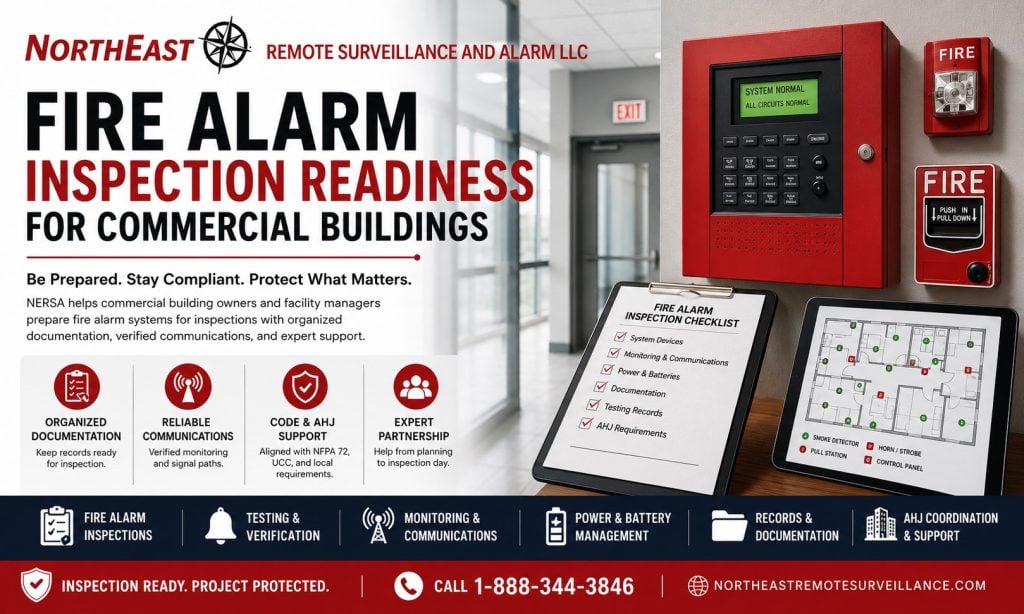
Fire Alarm Inspection Readiness for Commercial Properties
A fire alarm inspection is easier to support when the system is documented, labeled, serviceable, and understood before the inspector, service provider, fire marshal, code official, or facility manager asks for information.
Inspection readiness is not only about whether the fire alarm panel is working at that moment. It also involves system records, monitoring information, device locations, communicator status, trouble history, prior service notes, testing records, and whether the responsible people know how the system is configured.
Fire alarm inspection readiness may involve:
- Fire alarm panel information
- Monitoring account information
- Communicator information
- Cellular or IP communication path details
- Legacy phone line replacement notes
- Device location records
- Notification appliance information
- Alarm, supervisory, and trouble signal records
- Testing records
- Service history
- Battery replacement records
- Inspection reports
- System labels
- As-built documentation when available
- Fire alarm interface notes
- Access-controlled door release information
- Emergency communication details
- AHJ-facing documentation
- Owner and facility manager handoff information
The goal is to reduce confusion, avoid preventable delays, and help the building owner understand what information may be needed before and after inspection activity.
Inspection Readiness Is Not the Same as Fire Alarm Testing
Inspection readiness supports fire alarm testing, but it is not the same thing as performing a full fire alarm inspection, test, or maintenance service.
Fire alarm testing confirms whether system components operate as required during a scheduled test or service event. Inspection readiness focuses on whether the building owner, facility manager, or responsible party has the information, documentation, access, and coordination needed to support that process.
For full fire alarm monitoring, testing, inspection, and service support, visit fire alarm monitoring, testing, and inspection.
Inspection readiness can help answer questions such as:
- Where is the fire alarm panel?
- Who monitors the system?
- What communication path does the system use?
- Are signals transmitting correctly?
- Are prior inspection records available?
- Are service notes documented?
- Are trouble conditions understood?
- Are device locations identified?
- Are access-controlled doors tied to fire alarm release?
- Are communication changes documented?
- Does the facility know who to contact during inspection or trouble events?
A building that is ready for inspection is easier to service, easier to review, and easier to support long term.
Fire Alarm Documentation That Should Be Organized
Poor documentation can create problems during inspections, service calls, renovations, tenant changes, monitoring changes, and emergency response planning. A facility manager should not have to guess where devices are located, who monitors the system, or what communication path is active.
Useful fire alarm documentation may include:
- Fire alarm panel make and model
- Panel location
- Annunciator location
- Monitoring company information
- Account number or site reference
- Communicator make and model
- Cellular or IP communicator information
- Phone line or VoIP replacement notes
- Alarm, supervisory, and trouble signal information
- Device location list
- Zone or point descriptions
- Notification appliance locations
- Sprinkler monitoring information when applicable
- Elevator recall coordination notes when applicable
- Fire alarm interface notes
- Access control release notes
- Battery replacement records
- Prior inspection reports
- Service records
- Open deficiency notes
- AHJ correspondence when applicable
- Responsible contact list
Documentation should be easy to locate. If records are scattered across emails, invoices, old reports, unlabeled folders, or different vendors, the building may appear less prepared than it actually is.
Fire Alarm Monitoring and Communication Path Readiness
Fire alarm monitoring depends on a reliable communication path. When phone lines are removed, cellular communicators are added, IP communicators are installed, internet service changes, or monitoring accounts are updated, the system should be verified and documented.
Communication path readiness may include:
- Monitoring account confirmation
- Central station contact information
- Cellular communicator signal status
- IP communicator status
- Dual-path communication review
- Legacy phone line status
- VoIP compatibility concerns
- Trouble signal review
- Test signal verification
- Communication failure history
- Backup power support
- Router or network dependency review
- Documentation of communication changes
For phone line and communication upgrades, visit legacy phone line replacement and VoIP services.
A fire alarm communication path should never be assumed. If a carrier change, internet change, phone service change, or communicator replacement occurs, the system should be tested and documented so the building owner knows signals are being transmitted properly.
Panel, Device, and Zone Documentation
Fire alarm panels, devices, zones, and points should be documented clearly enough that facility managers and service providers can understand what the system is reporting.
Panel and device documentation may include:
- Main fire alarm control panel location
- Remote annunciator location
- Smoke detector locations
- Heat detector locations
- Manual pull station locations
- Duct detector locations
- Monitor module locations
- Control module locations
- Sprinkler tamper and flow switch information
- Notification appliance areas
- Zone descriptions
- Point descriptions
- Trouble conditions
- Disabled or bypassed device notes
- Prior service history
- Device replacement records
A trouble signal is harder to resolve when zone labels are unclear or device descriptions are outdated. Clean labeling and updated records make the system easier to inspect, service, and troubleshoot.
Battery, Power, and Backup Communication Readiness
Fire alarm systems depend on power and backup power. Batteries, power supplies, communicators, network equipment, and supporting devices should be reviewed as part of inspection readiness.
Readiness planning may involve:
- Fire alarm battery replacement records
- Battery date labels
- Power supply locations
- NAC power supply locations
- Communicator backup power
- Network equipment backup power
- UPS information when applicable
- Generator coordination when applicable
- Power trouble history
- Low battery trouble history
- Surge or power event notes
- Equipment room access
For broader backup power and communication planning, visit backup power and communication path planning.
Power and communication documentation can help identify whether a trouble condition is a fire alarm equipment issue, a power issue, a communication issue, or an infrastructure issue.
Access-Controlled Doors and Fire Alarm Release Documentation
Commercial fire alarm systems may interact with access-controlled doors, magnetic locks, electrified hardware, emergency release devices, or building security systems. These interfaces should be documented clearly because they may be reviewed during inspection, service, or AHJ coordination.
Fire alarm and access control coordination may involve:
- Maglock release
- Fire alarm relay interface
- Emergency release buttons
- Request-to-exit devices
- Electric locking hardware
- Door position monitoring
- Access control power supplies
- Door release sequence notes
- Stair door or egress door considerations
- Fire-rated opening awareness
- Testing after installation or service changes
For controlled door and egress planning, visit access control egress and life safety compliance.
A fire alarm interface should be tested, labeled, and documented so future service providers understand how the fire alarm and access control systems interact.
AHJ Coordination and Inspection Support
The authority having jurisdiction may be a local code official, fire marshal, municipality, building department, third-party inspection agency, or other reviewing authority. Fire alarm inspection readiness often depends on having the right documentation available before review or inspection activity.
AHJ coordination may involve:
- Inspection scheduling support
- Monitoring documentation
- Signal transmission confirmation
- Device information
- Fire alarm panel information
- Communicator information
- Testing reports
- Service records
- Deficiency records
- Door release documentation
- Fire alarm interface notes
- Owner contact information
- Emergency contact information
- Follow-up documentation after corrections
For inspection-sensitive project coordination, visit AHJ coordination for commercial security and fire alarm projects.
NERSA does not replace the AHJ, engineer, architect, fire alarm designer, code consultant, legal advisor, or governing authority. Our role is to help plan, document, test, support, and coordinate fire alarm-related security and monitoring work in a way that respects the review environment.
Inspection Readiness After Fire Alarm Service or System Changes
Fire alarm inspection readiness should be reviewed whenever the system changes. Even small changes can create confusion if they are not documented.
Readiness should be reviewed after:
- Fire alarm communicator replacement
- Monitoring account changes
- Cellular communicator installation
- IP communicator installation
- Phone line removal
- VoIP conversion
- Fire alarm panel service
- Device replacement
- Battery replacement
- Tenant renovation
- Access control installation
- Maglock or door hardware changes
- Fire alarm interface changes
- Network or internet changes
- Building ownership changes
- Service provider changes
- Prior deficiency corrections
After service work is completed, the facility should know what changed, what was tested, what remains open, and where the records are stored.
Common Fire Alarm Inspection Readiness Problems
Many inspection problems happen because the system is not documented clearly, not because the building owner intentionally ignored the system.
Common issues include:
- Missing inspection reports
- No current monitoring information
- Unknown communicator type
- Old phone lines still listed
- Phone lines removed without documentation
- Trouble signals not investigated
- Device labels that do not match the building
- Unclear zone descriptions
- No battery replacement records
- No record of prior deficiencies
- Missing service notes
- Access-controlled doors not documented
- Fire alarm relay locations unknown
- No contact list for inspection day
- No record of communication testing
- Tenant changes not reflected in records
- No clear handoff after service work
A cleaner documentation process helps the building owner, facility manager, service provider, and inspector work from the same information.
Inspection Readiness for Different Commercial Building Types
Different commercial buildings have different fire alarm readiness concerns. A warehouse, office building, manufacturing plant, medical office, school, municipal facility, and multi-tenant property may all need different records.
Fire alarm readiness may be important for:
- Office buildings
- Warehouses
- Manufacturing facilities
- Distribution centers
- Medical offices
- Schools
- Municipal buildings
- Multi-tenant commercial properties
- Retail properties
- Industrial buildings
- Contractor yards with buildings
- Mixed-use commercial properties
- Facilities with elevators
- Facilities with sprinkler monitoring
- Buildings with access-controlled doors
The records should match the building. A multi-tenant building may need tenant coordination notes. A warehouse may need sprinkler monitoring and dock-area device records. A medical office may need after-hours alarm and access documentation. A municipal building may need procurement and public-sector documentation.
Documentation Handoff for Building Owners and Facility Managers
A fire alarm system is easier to manage when the building owner receives a clear handoff. The handoff should not be limited to invoices or equipment boxes. It should help the responsible party understand what the system does and how it is supported.
A documentation handoff may include:
- System overview
- Panel location
- Monitoring information
- Communicator information
- Device or zone list
- Contact list
- Testing records
- Service notes
- Deficiency notes
- Battery information
- Communication path notes
- Fire alarm interface notes
- Access control release notes
- Emergency contact information
- Warranty and service information
A strong handoff helps prevent confusion when staff changes, service providers change, tenants move, or an inspection is scheduled.
What This Page Does Not Cover
This page focuses specifically on fire alarm inspection readiness for commercial buildings. It does not replace a full fire alarm monitoring, testing, and inspection service page, a fire alarm design page, NFPA code interpretation, engineered design, AHJ approval, legal advice, or a complete compliance hub.
For full fire alarm monitoring, testing, and inspection services, visit fire alarm monitoring, testing, and inspection.
For NFPA 72-focused fire alarm planning, visit NFPA 72 Fire Alarm Standards for Commercial Buildings.
For broader compliance and inspection-readiness planning, visit regulatory compliance and inspection readiness for commercial security systems.
Final interpretation, approval, and enforcement remain with the appropriate AHJ, engineer, architect, fire alarm designer, code consultant, legal advisor, or governing authority when required.
Why Choose Northeast Remote Surveillance and Alarm
Northeast Remote Surveillance and Alarm, LLC supports commercial fire alarm monitoring, communication, documentation, inspection readiness, and related security system coordination for real commercial buildings.
We understand that fire alarm readiness is not just about the panel. It includes monitoring information, communicator paths, service records, access-controlled doors, documentation, testing support, and long-term service accountability.
Businesses choose NERSA for fire alarm inspection readiness support because we provide:
- Commercial and industrial fire alarm coordination experience
- Fire alarm monitoring support
- Communicator and phone line replacement planning
- Documentation review
- AHJ coordination support
- Access control and fire alarm interface awareness
- Testing and signal verification support
- Service notes and system handoff support
- Inspection-readiness documentation practices
- Long-term service and support
A fire alarm system should be ready to inspect, ready to service, and ready to support the building when it matters.
Request Fire Alarm Inspection Readiness Support
If your commercial building needs help organizing fire alarm monitoring information, inspection records, communicator details, service notes, device documentation, fire alarm interface information, or AHJ-facing records, Northeast Remote Surveillance and Alarm, LLC can help.
Call 1-888-344-3846 or request a security assessment to review your fire alarm inspection-readiness needs, documentation gaps, monitoring path, communication equipment, and system support concerns.
We support fire alarm inspection readiness for commercial and industrial properties throughout the Lehigh Valley, Northeastern Pennsylvania, Central Pennsylvania, Greater Philadelphia, New Jersey, Delaware, and the Mid-Atlantic region.
Frequently Asked Questions about Fire Alarm Inspection Readiness for Commercial Buildings
What is fire alarm inspection readiness?
Fire alarm inspection readiness means the building owner or facility manager has the records, monitoring information, device details, service notes, communication path documentation, and coordination support needed before inspection, testing, service, or AHJ review.
Is inspection readiness the same as fire alarm testing?
No. Fire alarm testing verifies system operation during a scheduled test or service event. Inspection readiness focuses on preparation, documentation, monitoring information, communication paths, and records that support inspection or service activity.
What documents should be kept for a commercial fire alarm system?
Useful records may include inspection reports, testing records, service notes, monitoring information, communicator details, device lists, zone descriptions, battery replacement records, panel information, access control interface notes, and AHJ correspondence when applicable.
Why does monitoring information matter for inspection readiness?
Monitoring information helps confirm who receives alarm, supervisory, and trouble signals and how the system communicates. If monitoring details are outdated or unclear, inspection and service coordination can become more difficult.
Should fire alarm communication paths be documented?
Yes. Phone lines, cellular communicators, IP communicators, dual-path systems, network dependencies, and monitoring account changes should be documented and tested after changes occur.
Can access control affect fire alarm inspection readiness?
Yes. Access-controlled doors, maglocks, electrified hardware, fire alarm relays, emergency release devices, and door release sequences may need documentation and testing when they interact with the fire alarm system.
Does NERSA replace the AHJ or fire alarm engineer?
No. NERSA does not replace the AHJ, engineer, architect, fire alarm designer, code consultant, legal advisor, or governing authority. We support planning, monitoring, documentation, testing coordination, and service readiness.
What causes fire alarm inspection readiness problems?
Common causes include missing records, unclear monitoring information, old phone line references, undocumented communicator changes, unresolved trouble signals, poor device labeling, missing battery records, and lack of service notes.
When should fire alarm inspection readiness be reviewed?
Readiness should be reviewed before inspections, after service work, after communicator changes, after phone line replacement, after tenant renovations, after access control changes, and when building ownership or facility management changes.
What is the best next step for a commercial building?
The best next step is a site-specific review. NERSA can review the fire alarm documentation, monitoring path, communicator information, inspection history, device records, trouble conditions, and coordination needs before recommending the next steps.