I-78 Truck Yard Security Systems from Northeast Remote Surveillance and Alarm, LLC (NERSA) are designed for commercial trucking terminals, fleet yards, distribution centers, logistics properties, outdoor storage facilities, and warehouse campuses operating along the I-78 Lehigh Valley logistics corridor.
Truck yards present a security problem very different from a conventional office or storefront. Large exterior areas, moving tractor-trailers, multiple gates, after-hours activity, employee vehicles, contractors, valuable cargo, fuel, trailers, and long perimeter lines require a security system designed specifically around vehicle movement and outdoor operations.
NERSA designs, installs, integrates, upgrades, and services commercial truck yard security systems throughout the Lehigh Valley for facilities requiring dependable protection of their gates, yards, loading areas, trailers, equipment, and perimeter.
Primary Service Area: I-78 corridor through the Lehigh Valley, including Allentown, Bethlehem, Easton, and surrounding industrial and logistics areas.
Commercial and industrial facilities only.
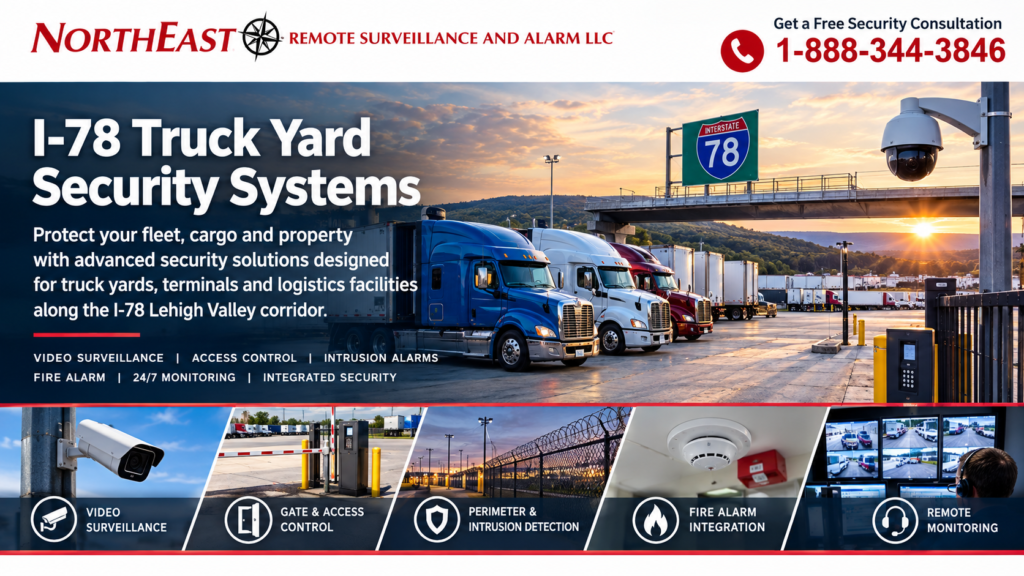
Security Systems Designed Around Truck Yard Operations
A truck yard should not be protected by simply mounting several cameras on a warehouse and assuming the entire property is covered.
A properly designed truck yard security system starts with understanding how the site actually operates.
NERSA evaluates:
- Truck entrance and exit lanes
- Employee and visitor vehicle entrances
- Guard stations and gatehouses
- Trailer staging areas
- Drop lots
- Fuel islands
- Loading docks
- Shipping and receiving lanes
- Exterior equipment storage
- Fence lines
- Remote corners of the property
- Pedestrian access points
- Driver waiting areas
- Contractor entrances
- After-hours delivery procedures
- Areas where trailers are disconnected or unattended
- Existing lighting and utility infrastructure
The objective is to build a layered security system capable of detecting, documenting, controlling, and responding to activity across the entire property.
Why Truck Yards Along I-78 Require Specialized Security
The I-78 corridor is one of the Lehigh Valley’s major transportation and logistics routes.
Warehouses, trucking terminals, distribution centers, manufacturing facilities, and fleet operations frequently depend on large exterior areas that remain active well beyond conventional business hours.
Those environments create several security challenges.
Large Exterior Areas
Truck yards may contain acres of open pavement, parking, staging, or storage areas. Camera placement and lens selection must account for significantly greater distances than typical indoor surveillance.
Constant Vehicle Movement
Security systems must distinguish between expected movement and events requiring attention.
That can include:
- Tractor-trailers entering the yard
- Drivers dropping trailers
- Employees arriving for shifts
- Vendors
- Contractors
- Delivery vehicles
- Unauthorized vehicles
- After-hours activity
Multiple Access Points
Many logistics properties have separate entrances for trucks, employees, visitors, and emergency access.
Each opening may require a different combination of surveillance, access control, intercom, and intrusion detection.
High-Value Assets
Truck yards may contain:
- Loaded trailers
- Empty trailers
- Fleet vehicles
- Construction equipment
- Fuel
- Tools
- Shipping containers
- Customer inventory
- High-value cargo
Protecting the warehouse while leaving the exterior yard poorly monitored creates a significant security gap.
AI Video Surveillance for Truck Yards
Modern truck yard surveillance should provide much more than recorded video.
NERSA can design AI-enabled commercial video surveillance systems capable of improving situational awareness across large outdoor properties.
Depending on system architecture and site requirements, analytics can assist with identifying activity involving:
- People
- Vehicles
- Defined perimeter areas
- Restricted zones
- Gate approaches
- Fence lines
- Loading areas
- Trailer staging zones
The goal is not to generate an alert every time a truck moves.
The goal is to configure surveillance around meaningful events and operational rules.
For example, activity in a trailer staging area at 2:00 PM may be completely normal.
The same activity at 2:00 AM in a restricted section of the yard may require immediate attention.
Perimeter Video Surveillance
Truck yard security begins at the perimeter.
Camera positions should provide overlapping observation of critical exterior areas instead of relying on one camera attempting to cover an entire property.
Potential camera locations include:
- Fence corners
- Vehicle entrances
- Gate lanes
- Building corners
- Pole-mounted positions
- Trailer staging areas
- Loading dock approaches
- Fuel islands
- Exterior equipment areas
- Employee parking lots
The final design depends on property geometry, lighting, distance, available network infrastructure, and the level of identification required.
License Plate and Vehicle Documentation
Vehicle documentation can be an important component of a truck yard surveillance strategy.
Where appropriate, dedicated cameras can be positioned at controlled vehicle entrances and exits to obtain better views of vehicles entering or leaving the property.
A complete design may combine:
- Overview cameras
- Dedicated vehicle cameras
- Entrance and exit views
- Gate activity recording
- Driver interaction cameras
- Access control events
This creates a more complete record of activity than relying on a single wide-angle camera.
Gate Access Control
Truck yard gates are often the most important control point on the property.
NERSA can integrate commercial access control with vehicle gates and pedestrian entrances where appropriate.
Possible credential technologies include:
- Proximity cards
- Smart credentials
- Mobile credentials
- Keypads
- Long-range vehicle credentials
- Intercom-based visitor authorization
- Remote gate release
The correct solution depends on who requires access and how frequently vehicles enter the property.
Employees may use credentials, while temporary drivers, vendors, and contractors may require a different entry process.
Visitor Entry and Video Intercom
Not every vehicle entering a truck yard should receive a permanent credential.
Video intercom systems can provide a controlled method for communicating with:
- Delivery drivers
- Vendors
- Contractors
- Visitors
- Service technicians
- Temporary personnel
Depending on system design, authorized personnel can visually verify the visitor and remotely release the gate.
This can reduce uncontrolled entry while allowing the facility to maintain efficient vehicle flow.
Trailer Yard Surveillance
Trailer staging areas require specific consideration because trailers may remain unattended for extended periods.
A properly designed surveillance system can provide coverage of:
- Trailer rows
- Dock approaches
- Drop locations
- Tractor parking
- Reefer areas
- Container storage
- Yard entrances
Camera placement should consider how parked trailers may obstruct the view.
Mounting cameras only at building height can create blind spots once the yard fills with trailers.
For larger properties, supplemental poles or strategically positioned exterior cameras may be necessary.
Loading Dock Security
Loading docks represent the connection point between exterior truck yard activity and the secured interior of the facility.
A comprehensive design may combine:
- Dock surveillance
- Interior shipping cameras
- Exterior trailer views
- Door position monitoring
- Access control
- Intercom communication
- Intrusion detection
This allows the security system to document activity from the arrival of the vehicle through loading or unloading operations.
Remote Video Monitoring
Facilities requiring greater after-hours protection may benefit from remote video monitoring.
Depending on the monitoring platform and system configuration, events detected by analytics can be reviewed by trained monitoring personnel.
Remote monitoring can be particularly valuable for:
- Closed facilities
- Unoccupied truck yards
- Trailer storage areas
- Construction equipment yards
- Remote sections of industrial properties
- Weekend and holiday coverage
Monitoring strategies should be designed around specific site conditions rather than treating every camera event as an alarm.
Live Audio and Talk-Down
Some properties may benefit from strategically deployed speakers or audio devices that allow monitoring personnel to address individuals detected in restricted areas.
When appropriate, live or prerecorded audio can provide an additional intervention layer between video detection and physical response.
Applications may include:
- Fence-line activity
- Restricted trailer areas
- Equipment yards
- Closed loading areas
- After-hours vehicle entrances
Audio systems should be designed according to the site’s operational and legal requirements.
Commercial Intrusion Detection
Video surveillance is only one component of truck yard security.
The warehouse, office, maintenance building, dispatch area, fuel building, and other structures may also require commercial intrusion detection.
NERSA can integrate intrusion protection for:
- Exterior doors
- Overhead doors
- Interior areas
- Offices
- Shipping departments
- Equipment rooms
- Maintenance shops
- Remote buildings
A layered system allows interior alarms and exterior surveillance to complement one another.
Fence-Line and Perimeter Protection
Certain high-risk truck yards may require additional detection beyond conventional cameras.
Depending on the site, security planning can evaluate methods for detecting activity near:
- Fence lines
- Remote gates
- Equipment storage areas
- Restricted zones
- Unoccupied corners of the property
The appropriate technology depends heavily on environmental conditions, vegetation, traffic, property size, and expected activity.
NERSA evaluates those conditions before recommending perimeter detection.
Security for Fuel Islands
Fuel theft and unauthorized fuel use can represent a significant operational concern for fleet operators.
Security coverage around fuel islands may include:
- High-resolution video
- Vehicle overview cameras
- Driver identification views
- Access control integration
- Lighting review
- Event documentation
Fuel areas should be included in the overall truck yard security design rather than treated as an isolated system.
Security System Integration
Truck yard security becomes significantly more useful when individual systems operate as part of a unified strategy.
NERSA can integrate combinations of:
- Video surveillance
- Access control
- Intrusion detection
- Gate control
- Video intercom
- Remote monitoring
- Network infrastructure
- Security management platforms
For example, an access control event at a gate can be associated with video from nearby cameras, providing additional context for the event.
Integration can also reduce the need for operators to manage several unrelated systems independently.
Network Infrastructure for Large Truck Yards
Large exterior properties frequently create infrastructure challenges.
Security cameras and gate systems may be located hundreds or thousands of feet from the primary network room.
Depending on the property, system architecture may require:
- Fiber-optic backbone
- Managed PoE switches
- Outdoor network enclosures
- Point-to-point wireless bridges
- Surge protection
- UPS backup
- Dedicated security networks
- Remote equipment cabinets
Network design is a critical part of reliable truck yard surveillance.
Installing advanced cameras without properly engineered communications infrastructure can create instability and maintenance problems.
Existing Truck Yard Security System Upgrades
NERSA can evaluate existing truck yard security systems that are outdated, unreliable, poorly positioned, or no longer capable of meeting operational requirements.
An upgrade does not automatically require replacing everything.
Where appropriate, we evaluate whether existing infrastructure can be reused, including:
- Fiber
- Network cabling
- Camera poles
- Equipment cabinets
- Power infrastructure
- Door hardware
- Gate equipment
- Existing cameras
- Access control wiring
The objective is to determine which components remain valuable and which components are limiting system performance.
Common Truck Yard Security Problems We Correct
NERSA frequently approaches exterior security as an engineering and design problem.
Common weaknesses include:
- Cameras mounted too low
- Cameras positioned where trailers block the view
- Excessive reliance on digital zoom
- Poor nighttime image quality
- Insufficient gate coverage
- No dedicated entrance or exit cameras
- Blind spots behind trailers
- Poor network connectivity
- Consumer-grade wireless links
- Unprotected outdoor network equipment
- Inadequate lighting
- No event-based alerts
- Too many false notifications
- Disconnected access control and video systems
- No usable video of critical events
Correcting those weaknesses can often improve security more than simply adding additional cameras.
Truck Yard Security for I-78 Warehouses and Distribution Centers
The I-78 Lehigh Valley corridor supports a wide range of logistics and industrial operations.
NERSA provides commercial security planning for facilities including:
- Distribution centers
- Truck terminals
- Freight operations
- Warehouses
- Manufacturing plants
- Fleet maintenance facilities
- Contractor yards
- Equipment storage yards
- Outdoor storage facilities
- Multi-building industrial campuses
- Transportation companies
Every site has different operating procedures, traffic patterns, and security priorities.
For that reason, NERSA designs the system around the property rather than applying a generic truck yard package.
Planning a New Truck Yard Security System
New construction and major facility expansions provide an opportunity to design security correctly from the beginning.
NERSA can participate in security planning involving:
- Camera locations
- Gate equipment
- Access control
- Fiber pathways
- Network closets
- Equipment rooms
- Door hardware
- Intercom stations
- Security poles
- Power requirements
- Monitoring strategy
Early planning can reduce expensive changes after pavement, fencing, gates, and buildings have already been completed.
Expanding an Existing Logistics Facility
Truck yards frequently expand as operations grow.
A security system should be designed with that possibility in mind.
Expansion planning may include:
- Additional camera capacity
- Spare fiber strands
- Additional network switch capacity
- Additional recording capacity
- Future gate connections
- Additional access control doors
- New trailer staging areas
Building expansion capacity into the original design can reduce future disruption.
Why NERSA for I-78 Truck Yard Security
Northeast Remote Surveillance and Alarm, LLC focuses on commercial and industrial security systems.
Our approach is centered on understanding the physical property, operational workflow, existing infrastructure, and security objective before selecting equipment.
Truck yard security requires coordination between:
- Cameras
- Gates
- Networks
- Access control
- Lighting
- Monitoring
- Recording
- Perimeter design
The strongest system is not necessarily the system with the greatest number of devices.
It is the system in which each component has a defined purpose.
I-78 Truck Yard Security Systems FAQs
What security systems are most important for a truck yard?
Most truck yards require some combination of video surveillance, gate control, access control, intrusion detection, vehicle documentation, perimeter coverage, and monitoring. The correct combination depends on property size and operation.
Where should cameras be installed in a truck yard?
Typical locations include vehicle entrances, exit lanes, gates, fence lines, trailer staging areas, loading docks, fuel islands, parking areas, and building corners. Camera locations should be determined after evaluating sightlines and trailer obstructions.
Can truck yard cameras identify vehicles entering the property?
Yes, when the system is designed with dedicated vehicle views rather than relying solely on general-purpose overview cameras. Camera position, distance, lighting, speed, and lens selection all affect image quality.
Can access control be installed on a truck yard gate?
Yes. Vehicle gates can often be integrated with commercial access control, credential readers, keypads, intercom systems, and remote release systems.
Can existing truck yard cameras be upgraded?
Often, yes. NERSA can evaluate the existing cameras, cabling, fiber, network switches, poles, recording system, and power infrastructure to determine which components can remain.
Can a truck yard be monitored after hours?
Yes. Depending on the surveillance and monitoring platform, selected video events can be transmitted for remote review and response according to the facility’s monitoring plan.
Can cameras cover an entire large truck yard?
Large yards generally require multiple strategically positioned cameras. Trailer placement, distance, lighting, and property geometry make single-camera coverage unreliable for most large logistics properties.
Does NERSA install residential security systems?
No. This page and the associated NERSA service architecture are focused on commercial and industrial security systems.
Request an I-78 Truck Yard Security Assessment
Protecting a truck yard requires more than placing cameras around the exterior of a warehouse.
NERSA can evaluate your facility’s gates, vehicle traffic, trailer staging areas, loading docks, perimeter, network infrastructure, and after-hours operations to develop a coordinated commercial security strategy.
Call 1-888-344-3846