
Plan I-78 corridor security for commercial camera systems, controlled entry, truck yards, and logistics facilities across the Lehigh Valley.

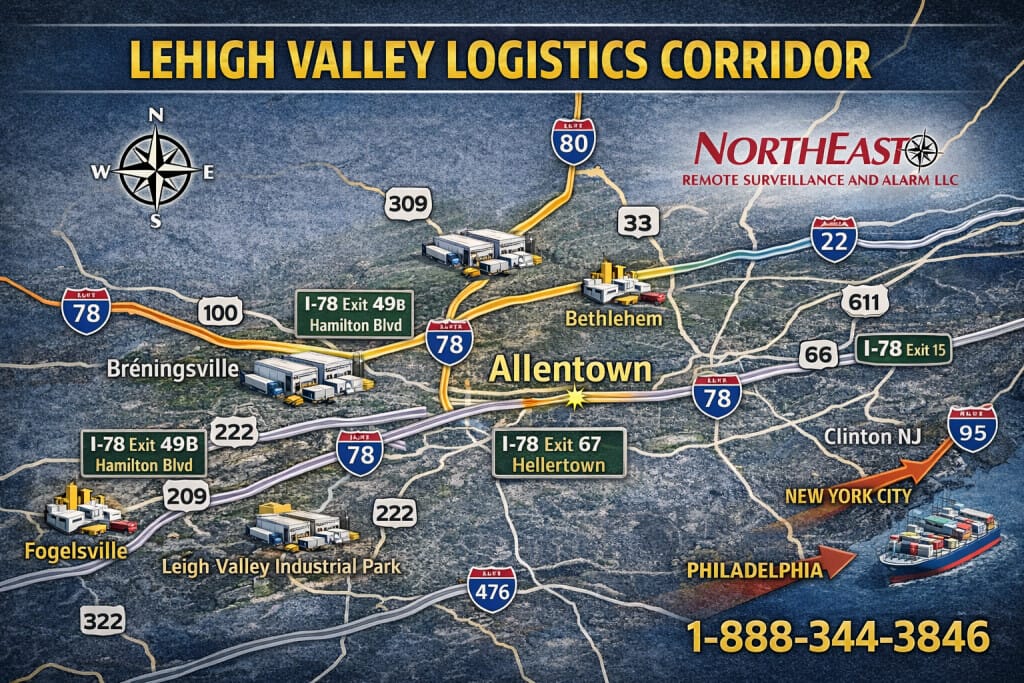
Use the Lehigh Valley commercial security guide for regional planning, then coordinate your facility’s freight, yard and entry requirements below.
I-78 Corridor Guides
- I-78 Commercial Video Surveillance Systems in the Lehigh Valley — Define camera views for vehicle arrivals, freight handoffs, nighttime playback and recorded evidence.
- I-78 Access Control Planning for Commercial & Industrial Facilities — Plan employee permissions, shift schedules, driver entry and the relationship between gate and building access.
- I-78 Truck Yard Security Systems — Coordinate trailer rows, gate lanes, outdoor coverage and after-hours response at an operating yard.
Plan around the movement of people and freight
A corridor facility is best understood as a sequence of transitions: the road approach, vehicle entrance, yard, loading position, and building entrance. A camera looking across the property may explain general activity while missing the detail needed at any one transition. Map where vehicles stop, where drivers leave their cabs, and where employees or visitors cross freight routes before choosing equipment.
For an I-78 warehouse or distribution operation, separate daytime logistics from unattended periods. Busy shipping lanes need useful event review without obstructing work. After-hours areas may need detection, verification, and a defined response. Multi-tenant sites also need clear boundaries between common-area oversight and individual occupier responsibilities.
Use the corridor guides in the right order
Begin with the video surveillance guide when the main question is what happened and whether recorded detail is usable. Choose access control planning when the problem concerns who may enter, which entrance they use, and how permissions change. The truck yard guide brings these questions together for gates, trailers, and exterior activity.
Continue to the loading dock and license plate guides for specific capture tasks. A general overview image and a readable plate image are different objectives, so assess each separately under the actual approach angle and lighting. Remote monitoring introduces another decision: which events require attention, when coverage operates, and what action the monitoring team is expected to take.
Define a practical project boundary
Document the entrances, buildings, tenant boundaries, operating shifts, and existing network paths included in the work. Identify any remote gate or detached structure that needs power and communications. An acceptance review should follow a representative vehicle and employee route, confirm recorded playback at the relevant points, and check that authorized staff can retrieve the evidence they need. This makes the corridor plan a connected workflow rather than a collection of isolated devices.
Coordinate arrivals, shifts and after-hours exceptions
Walk through a normal delivery from the driver’s first stop to departure. Decide where an expected carrier checks in, who confirms the appointment, how an unannounced arrival reaches staff, and where a driver waits while approval is pending. A gate intercom, camera view and release control should support that same process. Document what staff should do when the receiving office is closed or the primary contact cannot answer.
Shift changes create a different pattern from freight arrivals. Review employee parking entrances, pedestrian routes and contractor access separately from truck movements. Permissions should reflect job responsibilities and work schedules, with an assigned owner for temporary access and prompt removal when an assignment ends. At shared properties, confirm which decisions belong to the landlord and which belong to each tenant.
Upgrade an operating facility in manageable phases
Start by inventorying existing cameras, recorders, readers, gate controls, cabling and network equipment. Record who owns the system, which accounts are available, what still works and where recorded detail or entry control falls short. Equipment reuse depends on condition, compatibility and support; it should be confirmed before a budget assumes that every existing device can remain.
Sequence work around receiving hours and operational priorities.
One phase may address an unreliable entrance or missing yard coverage, while a later phase improves recording, remote administration or detached-building connections.
Agree on temporary entry procedures, expected interruptions and a fallback before changing a working gate or door.
For long cable routes, remote poles or separate buildings, include power, fiber and security-network planning in the initial assessment.
Make the handover useful to operations
Acceptance should demonstrate the agreed tasks under representative operating conditions. Review a vehicle arrival and departure, an employee access event, an after-hours exception and the process for finding and exporting the related video. Confirm that timestamps agree closely enough to follow events between systems. Identify any nighttime or seasonal conditions that still need a follow-up check.
- Document camera views, entrance names, administrator roles and the people authorized to approve changes.
- Confirm recording and retention settings against the agreed requirements and available storage.
- Test the planned response to a lost credential, unavailable network connection or equipment fault.
- Provide an equipment list, relevant network and cable records, staff training and a clear service contact.
These records help the next shift operate the system and make later expansion easier to scope. Keep the corridor plan focused on the property’s freight and access workflows; use the linked service guides for detailed camera, door and yard decisions.
Logistics and Vehicle Areas
- Warehouse Security Systems Lehigh Valley — Explore warehouse-security planning in the Lehigh Valley.
- Loading Dock Security Systems — Review loading-dock security needs.
- Truck Yard Security Systems — Explore broader truck-yard security planning.
- License Plate Recognition Camera Systems — Plan license-plate capture at defined vehicle entry points.
Related Services
- Industrial Video Surveillance Systems — Explore industrial video-surveillance services.
- Commercial & Industrial Access Control Systems — Review access-control installation services.
- Commercial Intrusion Alarm Installation in the Lehigh Valley — Plan new intrusion detection for I-78 warehouses, manufacturing facilities and commercial buildings.
- Remote Video Monitoring and Live Talk-Down — Review remote video monitoring and live talk-down.
Match the scope to your I-78 property
A shared warehouse, a manufacturing campus and a truck terminal can use similar equipment while needing different operating rules. Start with the part of the property you control. Identify leased areas, common entrances, shared roads and the person who can approve work at each location. The plan should state which buildings, yards and access points belong to this project.
Warehouse with a separate receiving office
Trace the route from the vehicle entrance to the receiving contact and assigned dock. Confirm where an early driver waits, how staff authorize entry and which door separates visitors from warehouse activity. Link the important arrival and handoff views to a consistent location name. The project should make it possible to review the relevant sequence without assuming every driver follows the same route.
Manufacturing site with several shifts
Separate employee, contractor and freight routines. A contractor may need temporary access to a maintenance area while production staff need a different entrance and schedule. Identify the person who approves those permissions and the person who removes them. Review installation hours with operations so planned work does not unexpectedly interrupt a shift change or a critical entrance.
Truck yard with overnight trailer storage
Map normal trailer positions, waiting lanes and areas that remain unattended. Camera locations should account for parked vehicles as well as an empty yard. Decide which after-hours events require review, who receives them and what happens when the first contact does not answer. Gate authorization, video review and any monitoring service should support that agreed process.
Compare corridor security proposals on the same basis
Give each provider the same property boundaries, operating hours and priority problems. Ask proposals to explain the purpose of each camera view or controlled entrance, the proposed work on existing equipment and any assumptions about usable cabling. A lower device count or a higher camera resolution does not by itself explain whether a scope addresses the task.
- Equipment and reuse: identify retained devices, replacements, compatibility checks and known limitations.
- Installation: identify mounting, cable pathways, power, network work, access equipment and agreed work windows.
- Configuration: define recording requirements, user roles, entry schedules and event handling.
- Acceptance: list the operating tasks staff will demonstrate before the affected work is accepted.
- Ongoing costs: separate monitoring, software, connectivity and maintenance from installation charges.
For phased work, describe a usable result for each phase and the capacity needed for later expansion. List exclusions and the conditions that could change the price. Keep the person responsible for daily operations involved in that review; they can identify a missing workflow that an equipment schedule may not show.
I-78 corridor security questions
Do we need a separate system for every building?
That depends on ownership, compatibility, connectivity and management needs. Begin with the tasks that must work across buildings, then evaluate shared administration and local responsibilities. Confirm the behavior of each proposed system during a communications interruption before choosing the architecture.
Can existing cameras and access equipment remain?
Some equipment may remain useful after condition, account access, support and compatibility checks. Ask the scope to state what will be reused and how each retained function will be tested. Include a plan for equipment that fails those checks.
What should we bring to an initial assessment?
Provide the property address, a site plan if available, operating shifts and a short list of problems. Photos of affected areas, sample footage, equipment records and known installation restrictions help define the work. Identify the facilities, operations and IT contacts who can answer questions about the site.
Request an I-78 Corridor Security Assessment
Request an assessment to review your property, vehicle activity, access needs, and existing equipment.
Compliance, Codes & Project Standards
NERSA plans commercial and industrial security work with applicable code, documentation, inspection and authority-having-jurisdiction requirements in mind. Requirements vary by system, property and jurisdiction. These resources support project planning; they do not establish legal compliance, certification or AHJ approval.
Related guidance: Regulatory compliance & inspection readiness · NERSA project standards · Documentation, testing & inspection readiness