Industrial and manufacturing intrusion protection in Easton, PA requires more than placing alarm contacts on exterior doors. Facilities with multiple shifts, production areas, loading docks, warehouses, tool rooms, maintenance departments, exterior equipment, restricted spaces, and after-hours personnel need alarm systems designed around the way the property actually operates.
Northeast Remote Surveillance and Alarm, LLC designs, installs, monitors, upgrades, expands, and supports commercial intrusion alarm systems for manufacturing plants, industrial facilities, warehouses, logistics operations, contractor facilities, equipment yards, multi-building properties, and commercial campuses throughout Easton and surrounding Northampton County communities.
NERSA focuses on commercial and industrial security systems only and can coordinate intrusion detection with professional monitoring, video surveillance, access control, and other security technologies where appropriate.
Businesses planning a complete intrusion-alarm system can begin with Commercial & Industrial Intrusion Alarm Systems in Easton, PA.
Request an Industrial Security Assessment or call 1-888-344-3846.
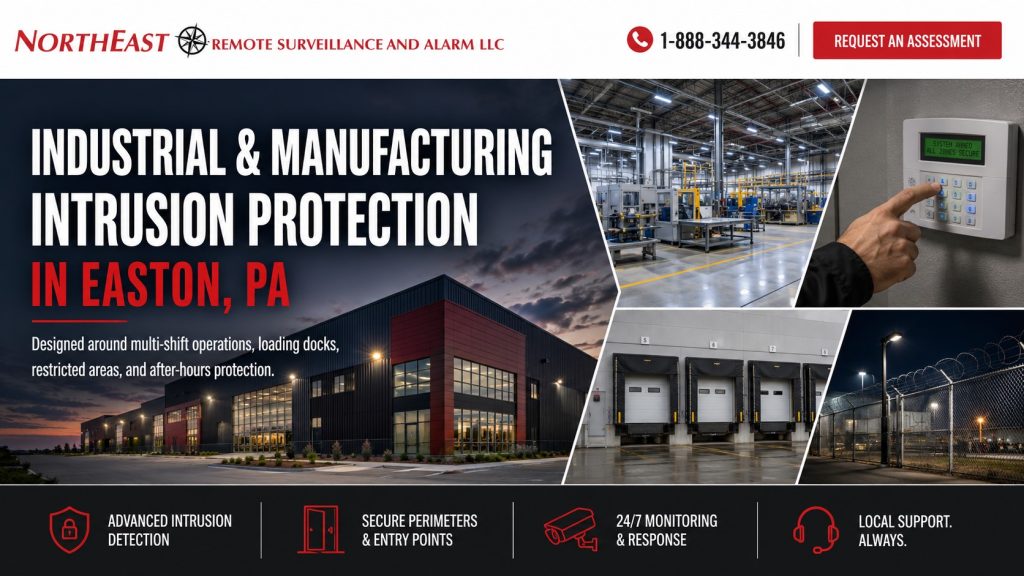
Intrusion Protection Designed Around Industrial Operations
Manufacturing and industrial facilities rarely follow the simple operating pattern of a traditional office.
A plant may operate multiple shifts while administrative offices close overnight. Shipping personnel may arrive before production employees. Maintenance technicians may work after hours. Contractors may need temporary access. Certain departments may remain active while warehouses, offices, or restricted spaces are armed.
An industrial intrusion system should accommodate those conditions.
System planning may need to consider:
- First-, second-, and third-shift operations
- Employee entrances
- Contractor entrances
- Loading docks
- Overhead doors
- Shipping and receiving
- Production areas
- Warehouse areas
- Tool rooms
- Maintenance departments
- Electrical and mechanical rooms
- Parts storage
- Finished-goods storage
- Restricted areas
- Exterior buildings
- Equipment yards
- Multiple buildings
The objective is to protect inactive areas without interfering unnecessarily with legitimate operations elsewhere on the property.
Why Industrial Alarm Systems Require Different Planning
Industrial properties can be difficult to protect because activity may continue long after the traditional workday ends.
A conventional alarm system that treats the entire building as one protected area may not work well when:
- Production continues overnight
- Shipping operates on a different schedule
- Maintenance staff enters after hours
- Contractors use separate entrances
- Warehouse areas close before manufacturing areas
- Administrative offices are vacant while the plant remains occupied
- Multiple buildings operate independently
The system should be planned around those differences.
Properly configured partitions, users, schedules, detection devices, and communication methods can allow the alarm system to reflect actual facility operations.
Alarm Partitions for Manufacturing Facilities
Partitions allow different sections of an alarm system to be armed and disarmed independently.
For an industrial property, partitions may separate:
- Production from administrative offices
- Warehouse from manufacturing
- Shipping from receiving
- Maintenance from production
- Main building from detached buildings
- Tenant areas
- Restricted rooms
- Tool storage
- Exterior structures
For example, a manufacturing floor may remain occupied during a second shift while administrative offices and warehouse storage areas remain armed.
This can reduce unnecessary system disarming and help maintain protection in areas that are not being used.
Individual User Codes and Accountability
Shared alarm codes make it difficult to determine who armed or disarmed a protected area.
Industrial facilities can benefit from individual user credentials where supported by the equipment.
Individual users may help management identify:
- Who armed an area
- Who disarmed an area
- When activity occurred
- Which partition was controlled
- Whether activity occurred outside an expected schedule
Permissions can also be adjusted as responsibilities change.
Employees may require access to specific areas while contractors, temporary personnel, or outside service providers may require more limited permissions.
User privileges should be reviewed when employees:
- Change departments
- Change shifts
- Take on new responsibilities
- Leave the company
- No longer require after-hours access
Good user management is an important part of maintaining an industrial alarm system.
Employee and Contractor Entrances
Industrial properties often have more than one type of entrance.
Possible entry points include:
- Main employee entrances
- Administrative entrances
- Shipping doors
- Maintenance doors
- Contractor entrances
- Rear service doors
- Emergency exits
- Exterior equipment-room doors
These openings may operate on different schedules and may require different detection or access procedures.
Alarm planning should determine which doors are normally used, which should remain protected after hours, and how authorized personnel enter without creating unnecessary alarm events.
Overhead Door and Loading Dock Protection
Overhead doors can be among the most important intrusion points in a warehouse or manufacturing facility.
They may also be among the most challenging to monitor reliably.
Loading areas can experience:
- Repeated door movement
- Vibration
- Temperature changes
- Moisture
- Vehicle traffic
- Forklift activity
- Physical impact
- Irregular operating schedules
Detection devices should be selected and installed for the actual environment.
Proper zone descriptions are equally important.
A monitoring event labeled:
Shipping Dock – Overhead Door 6
is considerably more useful than a generic alarm labeled:
Zone 18
Clear descriptions help facility personnel, monitoring staff, and technicians understand exactly where activity occurred.
Warehouse and Inventory Protection
Many manufacturing properties include substantial warehouse space.
Protection may be needed for:
- Raw materials
- Finished goods
- Parts
- Tools
- Equipment
- High-value inventory
- Shipping areas
- Receiving areas
- Storage cages
- Restricted inventory rooms
Warehouse areas may close earlier than production or operate on completely different schedules.
Partitions and strategically selected detection can allow warehouse areas to remain protected even while other parts of the facility continue operating.
Tool Rooms and Restricted Areas
Industrial facilities often contain smaller high-value or sensitive areas within a much larger building.
These may include:
- Tool cribs
- Server rooms
- Electrical rooms
- Maintenance shops
- Parts rooms
- Chemical storage areas
- Records rooms
- IT spaces
- Control rooms
- High-value inventory rooms
These areas may require additional protection even when the surrounding building is occupied.
A restricted room can sometimes be treated as its own alarm area or protected with additional detection depending on the system and operational requirements.
Interior Motion Detection in Industrial Environments
Motion detection can provide an additional layer of protection after unauthorized entry occurs.
Industrial environments require careful detector placement because normal building conditions can differ greatly from office environments.
Planning should consider:
- High ceilings
- Warehouse racking
- Machinery
- Moving equipment
- HVAC airflow
- Temperature changes
- Dust
- Vibration
- Animals or pests
- After-hours maintenance activity
A detector should be selected and positioned for the environment rather than installed simply because an open wall or ceiling location is available.
Poor detector placement can create nuisance alarms or leave important areas inadequately protected.
Perimeter and Exterior Building Protection
Manufacturing properties frequently include detached structures or exterior assets.
Examples may include:
- Maintenance buildings
- Storage buildings
- Guard buildings
- Utility structures
- Equipment rooms
- Detached warehouses
- Exterior storage areas
These areas should be evaluated separately from the main building.
Communication availability, power, distance, environmental exposure, and expected use may affect the appropriate protection strategy.
Multi-Building Industrial Properties
Some Easton industrial facilities include several buildings operating as one property.
Treating every building as one alarm area can make the system difficult to operate.
A multi-building design may use separate partitions or systems to distinguish:
- Main production facility
- Warehouse
- Maintenance building
- Administrative offices
- Detached storage
- Utility buildings
- Security or gate buildings
Authorized personnel may then control only the portion of the property they need to access.
This can improve usability while maintaining protection elsewhere.
Multi-Shift Intrusion Protection
Facilities operating multiple shifts require special attention.
A first-shift office employee may leave while production continues.
Second-shift warehouse personnel may need access to shipping areas but not administrative offices.
Third-shift maintenance personnel may require access to equipment spaces while the majority of the facility remains protected.
The alarm system should support these operating patterns whenever the equipment and building layout allow it.
Possible tools include:
- Alarm partitions
- User permissions
- Schedules
- Individual codes
- Access-control coordination
- Opening and closing activity
- Monitoring procedures
The goal is to protect unoccupied areas without unnecessarily disrupting active portions of the plant.
Opening and Closing Activity
Industrial facilities may benefit from reviewing when protected areas are armed and disarmed.
Depending on system capabilities, management may be able to identify situations such as:
- A department opening unexpectedly early
- An area remaining disarmed after operations end
- A restricted section being accessed outside expected hours
- A warehouse not being armed at closing
- An employee entering during an unusual period
This information should support internal management procedures rather than replace them.
Professional Alarm Monitoring
A monitored industrial alarm system provides a defined process for handling alarm events transmitted from the property.
Effective monitoring depends on:
- Proper alarm programming
- Clear zone descriptions
- Reliable communications
- Accurate contact lists
- Appropriate escalation procedures
- Current user information
- Periodic testing
NERSA can provide professionally monitored commercial alarm systems for Easton industrial and manufacturing facilities.
Businesses requiring more detail about communication paths, event processing, central-station response, and Alarm.com capabilities can review Commercial Alarm Monitoring in Easton, PA.
Cellular and Dual-Path Alarm Communication
Industrial alarm systems should use communications appropriate for the property and equipment.
Modern commercial alarm systems may support:
- Cellular communication
- Internet communication
- Dual-path communication
- Supervised communication methods
Industrial buildings can present unique communication challenges because of:
- Metal construction
- Large building footprints
- Equipment
- Mechanical rooms
- Cellular signal conditions
- Network infrastructure
- Remote buildings
Communication equipment should be located and configured with these conditions in mind.
Backup power for communication-related equipment should also be considered when appropriate.
Video Verification for Industrial Alarm Events
Video surveillance can provide additional context when an alarm occurs.
For example, video may help authorized personnel review:
- Activity around loading docks
- Movement inside warehouse areas
- People near restricted entrances
- Vehicles on the property
- Activity before an intrusion event
- Movement after an alarm occurs
Effective video verification depends on proper system design.
Camera placement, lighting, image quality, recording reliability, and the relationship between the protected alarm zone and camera view all matter.
Video should provide additional context rather than be treated as absolute proof of identity or intent.
Coordinating Intrusion Alarms With Access Control
Industrial facilities frequently use electronic access control in addition to intrusion detection.
These technologies serve different functions.
Access control manages authorized entry.
Intrusion alarms identify protected conditions and potential unauthorized activity.
When appropriately coordinated, the information from both systems may help facility managers understand:
- Which credential was used
- Which door was accessed
- When the access occurred
- Whether an area was armed
- What alarm event followed
- What associated video shows
Access-control records indicate which credential was presented but do not necessarily prove which person physically used it.
Coordination between systems can nevertheless provide valuable operational context.
Panic and Duress Protection
Certain industrial environments may also benefit from panic or duress devices.
Potential locations include:
- Reception areas
- Shipping offices
- Guard stations
- Administrative areas
- Customer-service areas
- Security offices
- Remote employee workspaces
Response procedures should be planned at the same time as device placement.
Employees expected to use panic or duress devices should understand their purpose and the organization’s response procedures.
Reducing Nuisance Alarms in Industrial Facilities
Industrial environments contain many conditions capable of creating preventable alarm events.
Common causes may include:
- Damaged door contacts
- Misaligned overhead-door devices
- Doors that do not fully close
- Vibration
- Equipment movement
- Airflow
- Temperature changes
- Poor detector placement
- Incorrect schedules
- Employees entering the wrong area
- Shared user codes
- Outdated permissions
Repeated nuisance alarms should be investigated.
The objective should be to identify the cause and correct it rather than routinely bypassing protection or ignoring alarm events.
Existing Industrial Alarm System Takeovers
An older industrial alarm system does not automatically need complete replacement.
NERSA can evaluate existing commercial alarm equipment to determine whether components can reasonably be:
- Retained
- Reprogrammed
- Expanded
- Modernized
- Repaired
- Connected to updated communications
- Incorporated into a larger upgrade
An evaluation may consider:
- Control-panel manufacturer and model
- Age and condition
- Programming access
- Existing detection devices
- Available zones
- Partition capability
- Existing wiring
- Communication equipment
- Power supplies
- Backup batteries
- Documentation
- Expansion requirements
Retaining usable infrastructure can sometimes reduce unnecessary replacement.
When existing technology creates reliability, compatibility, or support problems, an organized migration may be a better long-term solution.
Expanding Protection as the Facility Changes
Industrial properties evolve.
A facility may add:
- Warehouse space
- Production lines
- New offices
- Additional loading docks
- Storage rooms
- Exterior buildings
- New departments
- Additional shifts
- New tenants
- Restricted areas
The intrusion-alarm system should be reviewed when those changes occur.
A system designed years ago for a smaller facility may no longer provide appropriate protection after the building or operations have expanded.
Planning for future capacity can make later expansion easier.
Easton Industrial and Manufacturing Applications
NERSA provides commercial intrusion solutions for industrial and manufacturing properties throughout Easton and surrounding Northampton County communities, including facilities in Easton, Palmer Township, Forks Township, Williams Township, and the Route 33 commercial and industrial corridor.
Applications may include:
- Manufacturing plants
- Warehouses
- Distribution centers
- Logistics facilities
- Industrial buildings
- Machine shops
- Contractor facilities
- Equipment yards
- Fabrication facilities
- Multi-building industrial properties
- Storage facilities
- Commercial campuses
- Maintenance operations
- Production and assembly facilities
Each facility requires a different approach based on its layout, workforce, operating hours, assets, existing equipment, and security requirements.
Why Easton Industrial Facilities Choose NERSA
Northeast Remote Surveillance and Alarm, LLC concentrates on commercial and industrial security systems.
NERSA does not install residential alarm systems.
Our industrial intrusion capabilities include:
- Facility-specific intrusion design
- Manufacturing alarm systems
- Warehouse intrusion protection
- Multi-shift security planning
- Alarm partitions
- Individual user management
- Overhead-door protection
- Loading-dock protection
- Professional alarm monitoring
- Cellular communication upgrades
- Video verification
- Access-control coordination
- Existing-system takeovers
- Alarm-system expansion
- Multi-building security planning
- Ongoing commercial service and support
The objective is not simply to install more alarm devices.
It is to build a system that fits the way the industrial property operates, provides meaningful information when events occur, and can continue to evolve as the facility changes.
Request an Easton Industrial Intrusion Assessment
If your Easton manufacturing plant, warehouse, industrial property, contractor facility, logistics operation, or commercial campus needs improved intrusion protection, additional alarm zones, better after-hours security, professional monitoring, or an upgrade to an existing alarm system, Northeast Remote Surveillance and Alarm, LLC can evaluate the property and existing equipment.
Request a Security Assessment or call 1-888-344-3846.
Frequently Asked Questions
What is an industrial intrusion alarm system?
An industrial intrusion alarm system is designed to detect unauthorized entry or activity within manufacturing plants, warehouses, industrial buildings, equipment facilities, and other commercial properties.
How is an industrial alarm different from a basic commercial alarm?
Industrial systems often need to account for larger buildings, overhead doors, loading docks, multiple shifts, multiple departments, high ceilings, production areas, detached buildings, restricted spaces, and more complex operating schedules.
Can a manufacturing plant remain partially armed while employees are working?
Yes. Properly configured alarm partitions can allow inactive portions of a facility to remain protected while authorized personnel continue working elsewhere.
Can production and office areas be controlled separately?
Yes. Depending on the alarm equipment and design, production areas, offices, warehouses, shipping departments, and other sections can be configured as separate partitions.
Can employees have individual alarm codes?
Yes. Compatible commercial systems can provide individual user credentials, improving accountability and simplifying employee permission management.
How should loading docks and overhead doors be protected?
The appropriate method depends on the door, environment, frequency of use, building conditions, and alarm equipment. Industrial-grade detection should be selected and installed for the actual application.
Can detached industrial buildings be protected?
Yes. Detached warehouses, maintenance buildings, storage buildings, and other structures can often be incorporated into the overall security strategy.
Can an industrial alarm system use cellular monitoring?
Yes. Compatible commercial alarm systems can use cellular communications, and some systems can support multiple communication paths.
Can cameras work with an industrial intrusion alarm?
Yes. Compatible video surveillance systems can provide additional context around alarm events.
Can access control be coordinated with the alarm system?
Yes. Access control and intrusion alarms can be coordinated to provide additional information about door activity, credential use, schedules, and alarm events.
Can NERSA take over an existing industrial alarm system?
In many cases, yes. NERSA can evaluate the existing panel, devices, wiring, communications, programming access, and overall condition to determine what equipment can reasonably remain in service.
Does an older manufacturing facility need a complete alarm replacement?
Not necessarily. Some systems can be expanded or modernized while retaining compatible existing equipment.
Does NERSA work with multi-building industrial properties?
Yes. NERSA can design and support intrusion protection for facilities containing multiple buildings, departments, warehouses, offices, and operating areas.
Does NERSA install residential alarm systems?
No. NERSA focuses on commercial and industrial security systems.
Where can I learn about Easton’s complete commercial intrusion-alarm options?
Visit Commercial & Industrial Intrusion Alarm Systems in Easton, PA for broader information about detection, alarm zones, monitoring, user management, system upgrades, and commercial intrusion protection.