
Security performance in Lancaster facilities depends on the low-voltage infrastructure beneath the cameras, doors and alarm equipment.

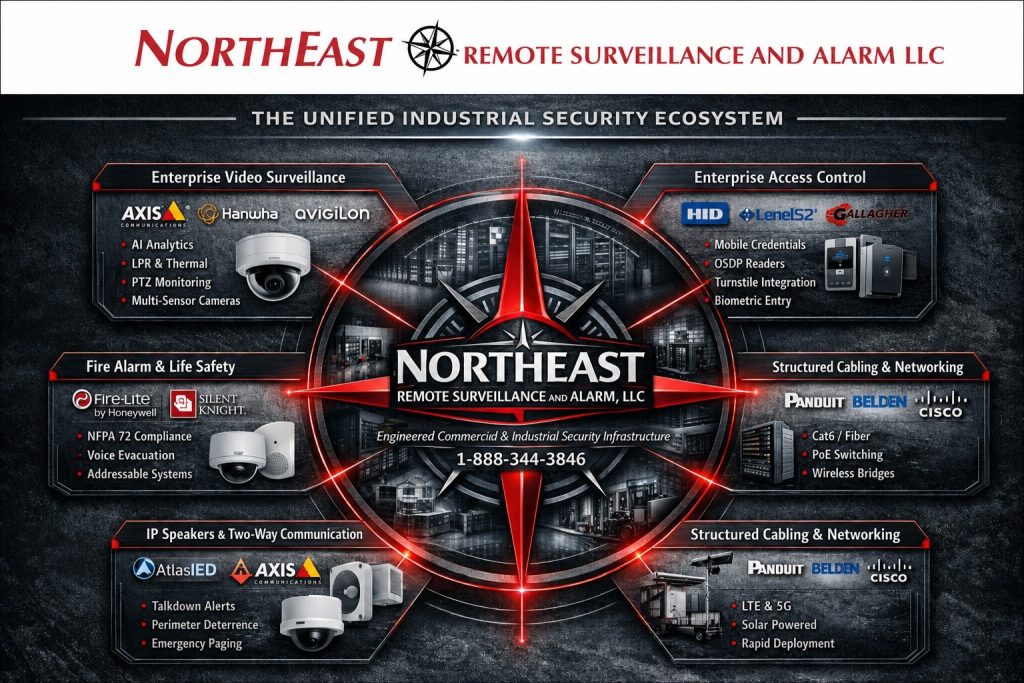
Cabling, fiber, switching, wireless links, power and equipment locations should be planned as one supportable system.
Explore related commercial security services in Lancaster and security planning across Central Pennsylvania.
Infrastructure scope
Review Cat6 and Cat6A runs, fiber connections, PoE budgets, network cabinets, UPS equipment, surge protection, wireless bridges, labeling, pathways and expansion capacity. Damaged cabling or weak power can appear to be a camera or access-control failure.
Design and documentation
Document cable routes, terminations, rack locations, device names, network requirements and ownership. Separate security traffic appropriately and keep customer-controlled credentials and service records available to the operating team.
Cabling and Pathways for Security Systems
Security cabling should be planned around distance, pathway, environment, serviceability, and the equipment it supports. Camera, access-control, intercom, and alarm projects can involve copper data cabling, low-voltage control cable, fiber, wireless bridges, equipment cabinets, power supplies, and network connections. Existing pathways should be inspected before assuming they can support new cable counts or device locations.
Label both ends of installed cabling and keep the naming consistent with device and network documentation. Clear labeling reduces troubleshooting time and makes future expansion easier for the customer and service team.
IDF, MDF, Rack, and PoE Planning
Network closets and equipment locations need adequate rack space, power, ventilation, grounding where applicable, patching, switching, and backup-power planning. PoE budgets should account for the actual connected devices and reasonable expansion rather than only the first-day load.
Long runs or separate buildings may require fiber or a properly engineered wireless link instead of extending copper beyond appropriate limits. The physical path, environmental conditions, surge exposure, and maintenance access should be considered with the network design.
Fiber and Building-to-Building Connectivity
Fiber can support security systems between buildings, distant network rooms, or areas where copper distance and electrical conditions make another medium more appropriate. Plan strand count, termination locations, protection, labeling, transceivers, and spare capacity around the site rather than treating fiber as an isolated cable pull.
Existing Infrastructure and Upgrade Projects
Before reusing existing cable, confirm its type, condition, termination, labeling, route, and performance. An undocumented cable that happens to pass traffic is not automatically a good foundation for a new security system. Where reuse is appropriate, document what remains and correct damaged, unsupported, or poorly terminated infrastructure as part of the project.
For phased upgrades, identify which infrastructure improvements unlock later camera, access-control, or monitoring work. That can allow a facility to correct the backbone first without replacing every endpoint in the same phase.
Testing, Documentation, and Handoff
Completed infrastructure should be tested according to the project scope and documented so the operating team understands rack locations, cable identifiers, network responsibilities, power dependencies, and customer-owned credentials. Keep diagrams, test results, device names, and service information with the rest of the security-system records.
Coordinate Security Infrastructure With Other Trades
Low-voltage pathways often intersect with electrical, fire-stopping, network, door-hardware, ceiling, and construction work. Define who provides pathways, sleeves, backboxes, dedicated power, grounding, patching, fire-stopping, and network configuration before installation begins. Clear boundaries reduce delays and prevent finished work from depending on assumptions between contractors.
For occupied facilities, plan cable pulls and equipment-room work around business operations. Protect existing systems during cutovers and document temporary conditions when an upgrade cannot be completed in a single phase.
Project coordination
Coordinate infrastructure with installation, testing, commissioning and future maintenance.
See the commercial infrastructure and cabling resource and request a security assessment.