
Lancaster businesses and facilities need security planning that fits the property, the people who use it and the way goods, visitors and vehicles move through it.

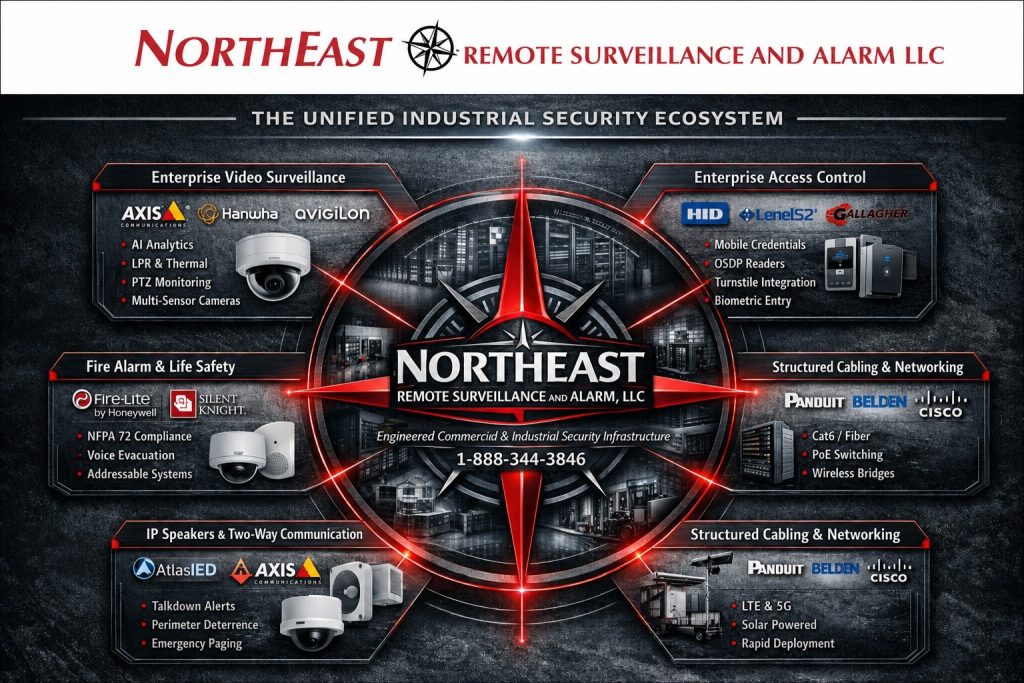
For projects across several locations, explore commercial security systems in Central Pennsylvania alongside these Lancaster planning resources.
Lancaster security planning by property
Commercial offices, healthcare properties, warehouses, manufacturing sites, schools, municipal facilities and multi-tenant buildings can have different requirements for cameras, controlled doors, intrusion detection, monitoring, communications and network infrastructure. A useful plan starts with entrances, parking, loading areas, restricted rooms, operating schedules, lighting, existing equipment and response procedures.
Security services for Lancaster properties
- Commercial video surveillance systems for camera purpose, lens selection, recording, storage, retention, analytics and evidence review.
- Commercial and industrial security services for access control, intrusion alarms, monitoring, intercoms and coordinated systems.
- Infrastructure and cabling for Cat6, fiber, PoE, racks, wireless links, power and network pathways supporting security systems.
- Upgrades, retrofits and takeovers for evaluating existing cameras, panels, recorders, wiring, accounts and expansion options.
- Cloud, on-premises and hybrid video surveillance for comparing administration, bandwidth, retention and lifecycle needs.
Applications in the Lancaster corridor
Warehouse and logistics properties may need loading-dock, yard, gate and trailer visibility. Manufacturing sites may need production-area, restricted-room and contractor access controls. Offices and healthcare facilities may prioritize visitor entry, privacy-aware camera placement and clear incident review. Schools and municipal properties may need coordinated entry, intercom, paging or emergency communication. The right security system depends on the risk and operating purpose rather than the equipment brand.
How Lancaster connects to Central Pennsylvania
For organizations operating across Lancaster, Harrisburg, York, Lebanon and other Central Pennsylvania markets, plan consistent security standards across locations while documenting the operating differences at each property. Review infrastructure, equipment upgrades, commissioning and assessment requirements for each site.
Plan the Lancaster Project Around Operations
A commercial security project should begin with how the property works. Document employee and visitor entrances, parking, vehicle routes, loading areas, shipping and receiving, restricted rooms, equipment or inventory storage, operating hours, late shifts, contractors, and the people responsible for responding to an event. Those details determine which security functions are useful and where they belong.
Existing systems should be reviewed before replacement is assumed. Cameras, recorders, controllers, locks, alarm panels, cabling, network equipment, power supplies, accounts, and documentation may have different remaining value. A practical assessment separates reusable infrastructure from unsupported or unreliable components and identifies what should be corrected first.
Commercial Video Surveillance in Lancaster
Camera planning should define the purpose of each important view. Entrances may require recognizable detail, loading docks may need activity and trailer context, parking areas may need vehicle and pedestrian coverage, and interior operational areas may need a wider overview. Lighting, distance, mounting height, obstructions, recording, retention, user permissions, and evidence export all affect whether recorded video will be useful later.
For camera planning, use Lancaster Commercial Video Surveillance Systems.
Commercial Access Control in Lancaster
Access control should be planned around the complete opening: door and frame condition, lock or exit hardware, closer, reader, request-to-exit, door-position monitoring, power, cabling, credentials, schedules, and the people who administer permissions. Employee entrances, restricted rooms, office suites, tool rooms, IT spaces, and gates can require different operating rules.
For controlled doors and credential management, use Lancaster Commercial Access Control Systems.
Commercial Intrusion Alarms in Lancaster
Intrusion protection should reflect after-hours operation, perimeter openings, overhead doors, interior areas, partitions, user schedules, monitoring, panic or duress needs, and any existing equipment that may be retained. Clear zone names and response procedures make the system more useful when an event occurs.
For the dedicated alarm owner, use Lancaster Commercial Intrusion Alarm Systems.
Low-Voltage Infrastructure for Lancaster Security Systems
Cameras, access control, intercoms, and connected security systems depend on cabling, fiber, PoE capacity, equipment locations, network paths, power, labeling, and documentation. Infrastructure should be evaluated with the security scope so a new system is not built on damaged, undocumented, or undersized pathways.
For cabling, fiber, racks, pathways, and supporting network infrastructure, use Lancaster Low-Voltage Security Infrastructure.
Security Planning by Lancaster Property Type
Warehouses and Distribution Facilities
Warehouse projects may involve employee entrances, docks, overhead doors, trailer areas, shipping offices, inventory, parking, yards, and after-hours activity. Camera, access-control, alarm, and infrastructure decisions should be coordinated around freight movement and shift schedules.
Manufacturing and Industrial Facilities
Manufacturing properties may need different controls around production, maintenance, tool rooms, material storage, offices, contractor access, and restricted spaces. Environmental conditions and equipment movement should be considered when selecting camera views and intrusion detection.
Offices, Healthcare, and Multi-Tenant Properties
Office and healthcare properties often place more emphasis on visitor entry, staff-only areas, records or supply rooms, shared entrances, parking, and clear user administration. Multi-tenant buildings also require agreement about which systems and openings are controlled by the tenant, landlord, or property manager.
New Systems, Upgrades, and Takeovers
A takeover should begin with ownership and supportability. Confirm administrator access, service accounts, programming rights, existing warranties or licenses, equipment condition, and the customer’s ability to control its own users and data. Retain useful equipment where it makes technical and operational sense; replace unsupported components when they create reliability or ownership problems.
For phased work, document the intended end state before starting the first phase. That helps avoid replacing a recorder, controller, switch, or power supply with something that cannot support the next stage of expansion.
Commissioning and Customer Handoff
Before completion, test representative camera views, recorded playback, controlled openings, credentials, alarm zones, communication paths, monitoring signals, and any supported integrations included in the scope. The operating team should receive understandable device names, administrator access, service contacts, retained-equipment notes, and documentation appropriate to the project.
The goal is a system the customer can operate and maintain after installation—not a collection of devices that only the installer understands.
Assessment questions
Which entrances, vehicle routes and restricted areas need identification?
How long should records be retained?
Which doors need schedules or visitor handling?
Can existing cabling and equipment be reused safely?
Who receives alerts after hours, and how will an event be verified?
A documented security assessment can organize these decisions before equipment is selected.
Explore Lancaster Security Services
Use the Lancaster guide to plan your project, then explore the service that matches your needs.
- Lancaster Commercial Video Surveillance Systems for camera placement, recording, retention and evidence review.
- Lancaster Commercial Access Control for controlled doors, credentials, door hardware and entry management.
- Lancaster Commercial Intrusion Alarm Systems for intrusion detection, monitoring, panic/duress, partitions and alarm takeovers.
- Lancaster Low-Voltage Security Infrastructure for cabling, fiber, PoE, racks, pathways and supporting network infrastructure.