
Healthcare employees sometimes work in environments where a threatening, violent, robbery-related, medical, or other defined emergency condition requires a fast and discreet way to request assistance.

Request a Healthcare Panic & Duress Security Assessment
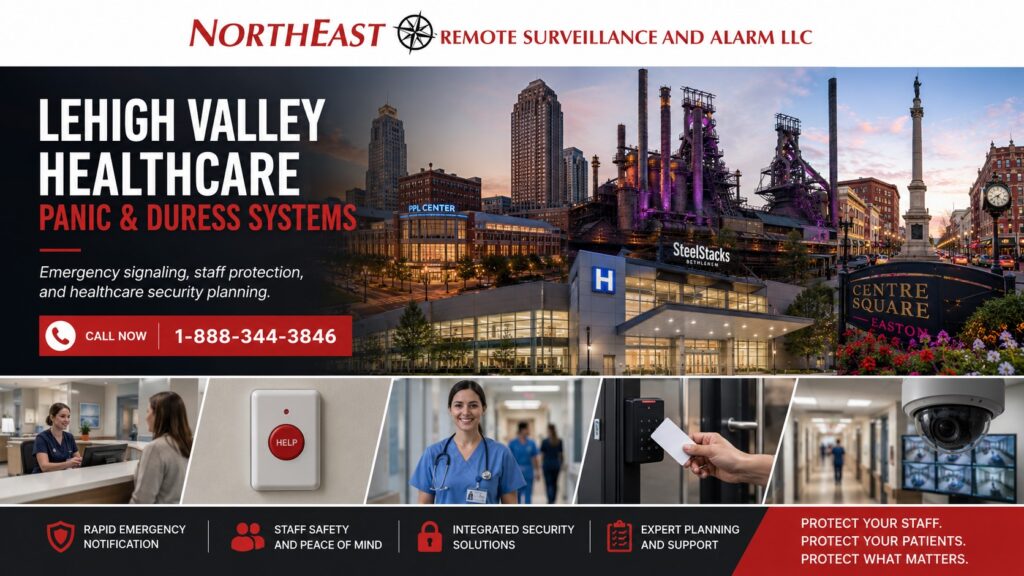
Northeast Remote Surveillance and Alarm, LLC (NERSA) designs, installs, upgrades, monitors, tests and supports healthcare panic and duress systems. We serve Allentown, Bethlehem, Easton, Lehigh County, Northampton County and the surrounding Lehigh Valley.
Healthcare panic and duress systems may include:
- fixed panic buttons;
- wireless panic devices;
- under-counter buttons;
- desk-mounted devices;
- wall-mounted devices;
- wearable devices where appropriate;
- keypad duress codes;
- silent alarm activation;
- audible emergency signaling where appropriate;
- professional monitoring;
- cellular and internet communication;
- video-assisted event review;
- event documentation;
- staff testing procedures;
- defined escalation instructions.
For broader healthcare-security planning, visit Lehigh Valley Healthcare Security Systems.
Commercial and institutional systems only.
Call NERSA: 1-888-344-3846
What Is a Healthcare Panic or Duress System?
A panic or duress system gives an authorized employee a direct method of signaling that a defined emergency condition exists.
Unlike a typical intrusion alarm, panic and duress activation is generally initiated intentionally by a person rather than automatically by a door contact, motion detector or other intrusion sensor.
Depending on the facility and response plan, activation may:
- transmit a silent alarm;
- activate an audible local signal;
- notify a professional monitoring center;
- notify designated personnel;
- identify the device or area that was activated;
- associate the event with nearby video where appropriate;
- create an event record for later review.
The intended response should be established during system planning.
A panic button should never be treated as an isolated device without a defined operating and response procedure.
Healthcare Environments Where Panic and Duress May Be Appropriate
Healthcare organizations contain many different working environments.
Potential applications may include:
- medical-office reception desks;
- behavioral-health reception areas;
- pharmacies;
- medication areas;
- billing offices;
- patient-intake locations;
- administrative offices;
- isolated employee workspaces;
- staff entrances;
- cash-handling locations;
- laboratories;
- after-hours work areas;
- security desks;
- controlled clinical areas.
The appropriate device type and response procedure depend on the actual risk, physical environment and operating requirements of the facility.
NERSA evaluates the environment before recommending equipment.
Fixed Panic Buttons
Fixed panic buttons are commonly used where employees work at predictable locations.
Potential locations may include:
- beneath a reception counter;
- under a desk;
- beside a workstation;
- inside an administrative office;
- near a pharmacy work area;
- at a security station;
- within another defined staff-accessible location.
Placement matters.
A fixed device should be:
- accessible to authorized staff;
- difficult to activate accidentally;
- discreet where appropriate;
- protected from normal workplace activity;
- clearly identified in system documentation;
- included in a controlled testing program.
Employees should know where the device is located and what happens after it is activated.
Wireless Panic and Duress Devices
Wireless devices may be appropriate where employees move throughout a work area or where new wiring is impractical.
Possible formats may include:
- portable panic buttons;
- wall-mounted wireless devices;
- desk-mounted wireless devices;
- supported wearable devices.
Wireless systems should be evaluated for:
- signal coverage;
- battery supervision;
- interference;
- device range;
- building construction;
- maintenance requirements;
- testing procedures.
A wireless device should not be assumed reliable simply because it operates correctly near the alarm panel or receiver.
Actual deployment conditions should be tested before the system is relied upon.
Silent vs Audible Panic Operation
Not every panic system should respond in the same way.
Silent Panic
A silent panic signal may be appropriate where drawing attention to the activation could increase risk.
Depending on the system design, the event may be transmitted without activating a local siren.
Audible Panic
Other environments may benefit from local audible notification.
Audible operation may:
- alert nearby personnel;
- initiate an internal response;
- discourage threatening behavior in some circumstances.
The appropriate response depends on:
- facility policy;
- employee procedures;
- the nature of the protected area;
- monitoring requirements;
- emergency-response plans.
NERSA establishes the intended response before programming the system.
Duress Codes
Some access-control or alarm platforms can support a duress code or similar special credential procedure.
A duress code may allow a user to appear to operate a system normally while generating a separate emergency event.
Planning should establish:
- who may use the code;
- where it can be used;
- what event it creates;
- who receives the event;
- how it is handled;
- how staff are trained;
- how accidental activation is addressed.
Duress-code procedures should be documented and periodically reviewed.
Behavioral Healthcare Panic and Duress Systems
Behavioral-health environments may have particularly strong requirements for staff-initiated emergency signaling.
Potential locations may include:
- reception areas;
- intake locations;
- consultation rooms;
- administrative offices;
- controlled staff zones;
- isolated workspaces;
- employee entrances.
System planning should consider:
- device accessibility;
- employee movement;
- patient environment;
- silent versus audible operation;
- monitoring;
- staff response procedures;
- nearby camera coverage where appropriate;
- accidental-activation prevention.
For broader facility-security planning, visit Lehigh Valley Behavioral Healthcare Security Systems.
Pharmacy and Medication-Area Panic Protection
Pharmacy and medication areas can present different operating risks from normal administrative spaces.
A panic or duress design may be coordinated with:
- access control;
- intrusion detection;
- restricted employee access;
- video surveillance;
- monitoring;
- door-position supervision.
The panic device should be positioned around the actual employee workflow rather than simply installed at the nearest convenient wall.
For broader medication-area security planning, visit Lehigh Valley Pharmacy & Medication-Room Security Systems.
Reception and Patient-Intake Panic Systems
Reception and intake areas are often the first point of interaction between healthcare employees and the public.
Personnel may interact with:
- patients;
- family members;
- visitors;
- delivery personnel;
- vendors;
- contractors;
- unfamiliar individuals.
A reception panic device should be:
- reachable without obvious movement where appropriate;
- positioned to reduce accidental activation;
- tested on a defined schedule;
- included in employee procedures;
- clearly identified in monitoring records.
Reception-area panic signaling may also be coordinated with entrance cameras or visitor-entry systems where useful.
Panic and Duress with Video Support
Video surveillance can sometimes provide additional context around a panic or duress event.
Possible workflows may include:
- displaying nearby cameras;
- flagging video around the event time;
- providing authorized personnel with visual context;
- supporting post-event review.
Video should support the response process.
A panic event should not depend on video review where doing so could delay or conflict with the organization’s intended emergency-response procedure.
Professional Panic and Duress Monitoring
A professionally monitored panic or duress system can transmit defined events to a monitoring center.
Monitoring documentation should identify:
- the facility;
- the alarm type;
- the specific device or zone;
- the physical area;
- responsible contacts;
- notification instructions;
- escalation procedures.
Monitoring information should be reviewed whenever:
- personnel change;
- emergency contacts change;
- devices are moved;
- departments or areas are renamed;
- response procedures change.
A technically functional device is not enough.
The monitoring information must also be current, clear and operationally useful.
Dual-Path Alarm Communication
Healthcare organizations should consider how emergency signals reach the monitoring center.
Depending on the platform, supported communication may use:
- internet;
- cellular;
- multiple communication paths.
Where appropriate, dual-path communication can reduce dependence on a single connection.
Planning should consider:
- internet availability;
- cellular coverage;
- network policies;
- backup power;
- communication supervision;
- equipment compatibility.
The communication architecture should match the seriousness of the events being transmitted.
Panic and Duress Device Identification
Every panic or duress device should have a meaningful identity within the system.
Descriptions such as:
Panic 1
or
Zone 14
provide limited operational value.
Better descriptions identify the actual function or location, such as:
- Main Reception Duress;
- Behavioral Health Intake Panic;
- Pharmacy Counter Panic;
- Administration Office Duress;
- Security Desk Panic.
Device naming should remain consistent across:
- alarm programming;
- monitoring records;
- staff documentation;
- system drawings;
- service records.
Clear naming becomes increasingly important as the number of devices grows.
Staff Training
A panic and duress system is only useful if employees understand how it is intended to operate.
Training should explain:
- where devices are located;
- who should use them;
- what types of situations justify activation;
- whether operation is silent or audible;
- what happens after activation;
- whether personnel should expect a monitoring-center call;
- how accidental activation should be handled;
- how faults should be reported.
Training should be reviewed when:
- employees change;
- devices are relocated;
- programming changes;
- response procedures change.
Testing Healthcare Panic and Duress Systems
Panic devices should be tested under controlled procedures.
Testing may include:
- placing the account on test with monitoring;
- activating each device;
- confirming the correct device or zone description;
- verifying communication;
- checking wireless signal conditions;
- checking battery status;
- reviewing monitoring records;
- documenting results.
Testing procedures should be designed to prevent an unnecessary emergency response.
Employees should not casually press a monitored panic device simply to see whether it works.
Existing-System Panic and Duress Upgrades
Healthcare organizations may already have panic devices connected to older alarm platforms.
NERSA can evaluate existing:
- wired panic buttons;
- wireless panic devices;
- alarm panels;
- receivers;
- communication paths;
- monitoring arrangements;
- wiring;
- device descriptions;
- batteries;
- response instructions.
Existing devices may sometimes remain when they are:
- compatible;
- properly located;
- reliable;
- supportable;
- clearly documented.
Other systems may require:
- device replacement;
- communication upgrades;
- wireless receiver replacement;
- panel replacement;
- monitoring changes;
- documentation improvements;
- reprogramming.
The objective is not automatically to replace every existing component.
The objective is to establish a dependable, supportable emergency-signaling system.
Healthcare Panic and Duress System Takeovers
A system takeover should involve more than changing the monitoring provider.
NERSA can review:
- device locations;
- device condition;
- device descriptions;
- communication paths;
- alarm-panel programming;
- monitoring instructions;
- employee procedures;
- backup power;
- wireless signal conditions;
- available testing records.
Unidentified or undocumented panic devices should be corrected before the organization relies on them.
Panic and Duress Integration with Access Control
Access control can sometimes provide useful context for panic or duress events.
Potential integrations may include:
- identifying the controlled area associated with an event;
- coordinating defined emergency door procedures;
- associating nearby access events with incident review;
- using centralized security-management interfaces.
Emergency door behavior must be designed around:
- life safety;
- required egress;
- facility policy;
- applicable code requirements;
- actual emergency procedures.
Panic and Duress vs Intrusion Alarms
Panic and duress systems and intrusion alarms serve different primary purposes.
Intrusion Alarm
Generally detects conditions such as:
- unauthorized door opening;
- movement;
- glass breakage;
- perimeter activity.
Panic or Duress Alarm
Generally begins when an authorized person intentionally signals a defined emergency condition.
The same alarm platform may support both functions, but the operating and response procedures can be very different.
New Healthcare Facility Planning
Panic and duress planning should begin during construction or renovation whenever possible.
Early planning can establish:
- panic-device locations;
- concealed wiring;
- mounting;
- alarm-panel locations;
- network requirements;
- communication paths;
- monitoring requirements;
- nearby camera locations;
- power requirements;
- future expansion.
Installing appropriate infrastructure during construction may be simpler than retrofitting finished clinical and administrative spaces later.
Multi-Site Healthcare Panic and Duress Systems
Healthcare organizations operating several Lehigh Valley facilities may benefit from consistent panic and duress standards.
A multi-site program may standardize:
- device naming;
- device types;
- testing procedures;
- monitoring instructions;
- staff training;
- event reporting;
- documentation;
- responsible-party information.
Standardization can make a growing healthcare organization easier to administer and support.
For broader multi-building healthcare security planning, visit Lehigh Valley Healthcare Campus Security Systems.
Healthcare Panic and Duress Assessment
NERSA should evaluate the facility and operating procedures before equipment is selected.
Staff Locations
Where employees interact with patients, visitors, vendors, contractors or the public.
Risk Areas
Where employees may require rapid emergency signaling.
Employee Movement
Whether staff remain at predictable workstations or move throughout the facility.
Existing Alarm Infrastructure
Current alarm panels, receivers, wiring, communication paths, monitoring and panic devices.
Response Requirements
What should occur after a panic or duress event is generated.
Monitoring
How events should be transmitted and handled.
Video Coverage
Whether nearby video can provide useful context without delaying response.
Documentation
How device names, locations, monitoring instructions and response procedures will be recorded.
Testing
How the organization will maintain confidence that the devices continue to operate correctly.
The result should become a practical emergency-signaling plan rather than simply a panic-button equipment list.
Request a Lehigh Valley Healthcare Panic & Duress Assessment
Healthcare panic and duress systems should be designed around the people who may need to use them, the environments where emergencies may occur and the response that should follow activation.
NERSA can evaluate an existing healthcare facility, upgrade older panic devices, add emergency signaling to selected work areas, standardize several locations or incorporate panic and duress protection into a new healthcare security system.
The goal is to create a clearly documented, reliably communicated and properly tested emergency-signaling system rather than simply installing panic buttons without an operating plan.
Northeast Remote Surveillance and Alarm, LLC
Commercial & Institutional Security Systems
Allentown • Bethlehem • Easton • Lehigh County • Northampton County
Call 1-888-344-3846
Request a Healthcare Panic & Duress Security Assessment
Compliance, Codes & Project Standards
NERSA plans commercial and industrial security work with applicable code, documentation, inspection and authority-having-jurisdiction requirements in mind. Requirements vary by system, property and jurisdiction. These resources support project planning; they do not establish legal compliance, certification or AHJ approval.
Related guidance: Regulatory compliance & inspection readiness · Healthcare security compliance · NERSA project standards