Low-voltage cabling for commercial security systems provides the physical pathway that allows cameras, access control readers, intrusion devices, intercoms, monitoring equipment, and related security infrastructure to communicate reliably. This page focuses specifically on cabling, pathways, terminations, labeling, protection, service access, and documentation for commercial and industrial security systems. For broader infrastructure planning across PoE switching, fiber, UPS backup, retention, communication paths, and network segmentation, use Commercial Security Infrastructure Planning.
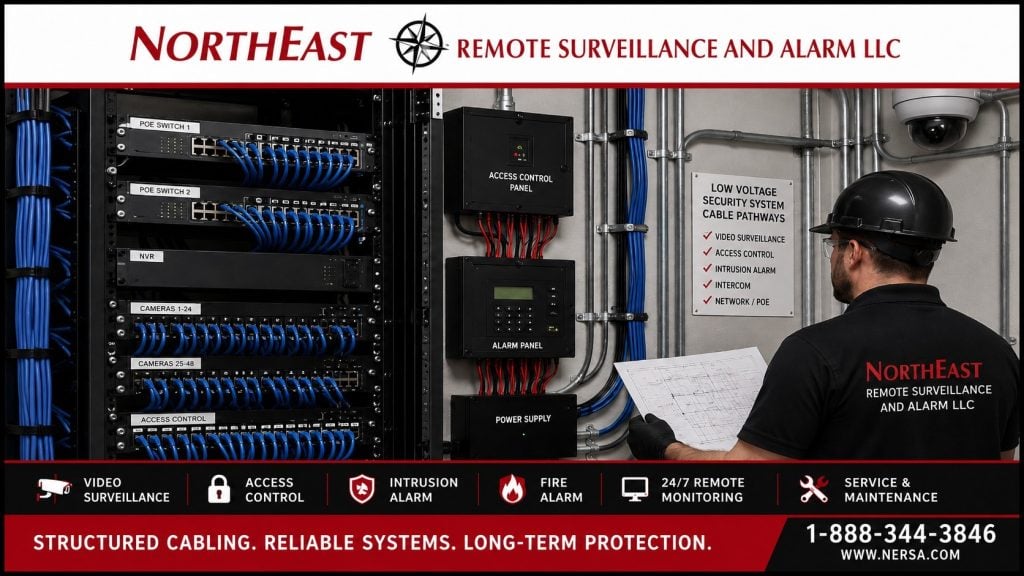
Low-Voltage Cabling for Security Infrastructure
Commercial security systems depend on clean, organized, and properly planned low-voltage cabling. A camera, card reader, alarm contact, motion detector, intercom, or monitoring device may be the visible part of the system, but the cabling behind it determines whether that device can operate reliably over time.
Poor cabling can create intermittent outages, weak device performance, difficult troubleshooting, messy equipment rooms, undocumented pathways, service delays, and expensive rework. In commercial and industrial buildings, cabling should be treated as part of the facility’s security infrastructure, not as an afterthought.
Northeast Remote Surveillance and Alarm, LLC plans low-voltage cabling around the building layout, system requirements, pathway conditions, equipment locations, future expansion needs, and long-term serviceability.
What Low-Voltage Cabling Supports
Low-voltage cabling may support IP cameras, network video recorders, PoE switches, access control readers, door controllers, request-to-exit devices, door position contacts, intrusion alarm devices, keypads, glass-break detectors, motion detectors, intercom stations, paging equipment, monitoring communicators, and other commercial security devices.
The exact wiring design depends on the system being installed. Video surveillance may require Cat6 cabling, PoE switch planning, uplink capacity, and network cabinet coordination. Access control may require reader wiring, lock power, door contact wiring, request-to-exit wiring, controller cabling, and power supply planning. Intrusion alarm systems may require door contacts, motion detectors, keypads, sirens, communication paths, and zone wiring.
This page does not replace dedicated security system design. It focuses on the cabling infrastructure that allows those systems to function correctly.
Why Cabling Planning Matters Before Installation
Many security system problems begin before the first device is installed. If cable pathways are not reviewed, equipment rooms are not planned, cable distances are ignored, or future service access is not considered, the system may become harder to maintain and expand.
Commercial cabling planning should consider:
- Device locations
- Cable distance limits
- Pathway availability
- Ceiling conditions
- Conduit needs
- Penetrations and sleeves
- Cable protection
- Equipment-room layout
- Rack or cabinet placement
- Labeling and documentation
- Future expansion capacity
- Service access
A clean cabling plan helps the installation look better, perform better, and remain easier to troubleshoot years later.
Camera Cabling for Commercial Video Surveillance
IP video surveillance systems often depend on properly installed network cabling and PoE infrastructure. Camera cabling must be planned around camera placement, distance limits, pathway protection, exterior exposure, ceiling height, equipment room location, and switch capacity.
A camera can only be useful if it remains online, records reliably, and transmits usable video back to the recording system. Cabling issues can cause camera dropouts, power problems, weak connections, slow troubleshooting, and difficult expansion.
For broader camera system planning, use Commercial and Industrial Video Surveillance Systems. That service page covers system-level camera design, while this page stays focused on the cabling infrastructure that supports those systems.
Access Control Wiring for Commercial Doors
Access control cabling is more complex than simply running a wire to a reader. A controlled door may require wiring for the card reader, electric strike, electrified trim, lock power, request-to-exit device, door position contact, controller, power supply, fire alarm interface, and monitoring inputs.
Poor access control wiring can make a door unreliable, difficult to troubleshoot, or hard to expand later. Commercial door wiring should be planned around the opening, hardware type, controller location, power requirements, door condition, pathway protection, and service access.
For system-level planning around credentials, readers, doors, permissions, and access management, use Commercial Access Control Systems. This cabling page supports that system by focusing on wiring pathways, device cabling, terminations, and documentation.
Intrusion Alarm Device Wiring
Commercial intrusion systems may include door contacts, overhead door contacts, motion detectors, glass-break detectors, keypads, panic devices, sirens, strobes, communicators, and zone expanders. These devices need clean wiring, proper routing, secure terminations, and clear labeling.
Alarm wiring should be planned around how the building is used. Employee entrances, rear doors, warehouse personnel doors, storage rooms, offices, restricted spaces, and after-hours zones may all require different device placement.
A well-wired intrusion system is easier to test, service, expand, and verify. A poorly documented alarm system can become difficult to maintain when devices are moved, doors are changed, or the business expands.
Cabling Pathways, Conduit, and Protection
Commercial buildings often require different pathway methods depending on the environment. Office spaces may allow above-ceiling cable routes, while warehouses, industrial areas, mechanical rooms, exterior walls, and production spaces may require conduit, sleeves, supports, or protected pathways.
Cabling should be protected from damage, heat, moisture, vibration, forklift traffic, moving equipment, sharp edges, and areas where future construction may disturb it. In exposed commercial and industrial environments, pathway planning is especially important.
Low-voltage cabling should be installed in a way that supports long-term reliability and serviceability. That means clean routing, proper supports, protected transitions, clear labeling, and accessible equipment locations.
Equipment Rooms, Racks, and Cabinets
Security cabling usually terminates somewhere. That may be a network rack, equipment cabinet, access control enclosure, alarm panel, NVR location, PoE switch cabinet, or dedicated low-voltage space.
Poor equipment-room planning can create cluttered wiring, heat issues, weak backup power planning, limited expansion space, and difficult service access. Proper planning should consider cable entry points, patch panels, switch locations, access control panels, UPS backup, ventilation, labeling, and future expansion.
A clean head-end or equipment area helps facility managers, IT teams, and service technicians understand and support the system.
Labeling and Documentation
Low-voltage cabling should be labeled and documented so the system can be serviced later. Without labeling, every service call becomes harder. Technicians may need to trace wires manually, guess device locations, or spend extra time identifying cable paths.
Useful documentation may include cable labels, device names, door numbers, camera numbers, panel locations, switch ports, rack locations, conduit paths, as-built notes, and system diagrams.
Documentation is especially important for larger commercial buildings, warehouses, manufacturing facilities, healthcare properties, municipal buildings, schools, and multi-site operations.
Low-Voltage Cabling for Warehouses and Industrial Facilities
Warehouses and industrial buildings often require stronger cabling planning than smaller commercial spaces. Long cable distances, high ceilings, loading docks, open warehouse areas, exterior doors, metal structures, equipment movement, dust, temperature changes, and exposed pathways can all affect the installation.
Security cabling in these environments may need protected routing, distributed equipment locations, fiber uplinks, PoE switch planning, conduit, weather-resistant pathways, and clear labeling. Exterior cameras, dock cameras, yard cameras, employee doors, and restricted-area access points must be planned around real facility conditions.
The goal is to build cabling infrastructure that supports the system today and can still be understood, serviced, and expanded later.
Low-Voltage Cabling for Offices, Healthcare, Schools, and Municipal Buildings
Office buildings, healthcare facilities, schools, municipal properties, and multi-tenant commercial buildings also need clean security cabling. These environments may have stricter expectations for appearance, documentation, user access, and future changes.
Access-controlled doors, lobby cameras, hallway cameras, parking lot cameras, intrusion devices, intercoms, and monitoring equipment should be wired in a way that supports daily use and future service.
In these settings, neat cabling and clear documentation are not just technical details. They help reduce disruption, support professional building operation, and make future upgrades easier.
Future Expansion Planning
A low-voltage cabling plan should account for growth. Businesses may add more cameras, more doors, more alarm zones, more monitoring devices, more network equipment, or additional buildings later.
Planning ahead may include leaving rack space, documenting pathways, allowing for additional switch capacity, sizing conduit thoughtfully, labeling spare cables, and avoiding equipment locations that will be difficult to reach in the future.
Security infrastructure should be built so it can grow with the facility instead of requiring unnecessary rework every time the system expands.
Frequently Asked Questions
What is low-voltage cabling for commercial security systems?
Low-voltage cabling is the wiring infrastructure used to connect security devices such as cameras, card readers, door contacts, motion detectors, intercoms, alarm keypads, controllers, PoE switches, and monitoring equipment.
Why does low-voltage cabling matter for security systems?
Low-voltage cabling affects system reliability, serviceability, documentation, device performance, and future expansion. Poor cabling can cause outages, troubleshooting problems, and unreliable security devices.
What type of cabling is used for security cameras?
Many IP camera systems use network cabling such as Cat6 or similar structured cabling connected to PoE switches. The exact cabling depends on the camera system, distance, pathway, environment, and equipment design.
Does access control require special wiring?
Access control doors often require wiring for readers, locks, door contacts, request-to-exit devices, controllers, and power supplies. The wiring plan depends on the door hardware, access control platform, door type, and egress requirements.
Can low-voltage cabling support intrusion alarm systems?
Yes. Intrusion alarm systems often use low-voltage wiring for door contacts, motion detectors, glass-break detectors, keypads, sirens, communicators, and zone expanders.
Should commercial security cabling be labeled?
Yes. Labeling helps technicians identify devices, cable paths, switch ports, door locations, camera numbers, and panel connections. Proper labeling reduces troubleshooting time and supports future expansion.
When is conduit needed for low-voltage security cabling?
Conduit may be needed when cabling is exposed, vulnerable to damage, located in industrial areas, routed through mechanical spaces, run outdoors, or required for protection and appearance. The building conditions determine the best pathway method.
Can security cabling be added to an existing building?
In many cases, yes. Existing commercial buildings can often be upgraded with new low-voltage cabling, but pathway conditions, ceiling access, wall construction, distance limits, and equipment-room locations should be reviewed first.
Why is documentation important for security cabling?
Documentation helps facility managers, IT teams, and service technicians understand how the system is wired. It supports service, inspections, troubleshooting, upgrades, and future system expansion.
Who installs low-voltage cabling for commercial security systems?
Northeast Remote Surveillance and Alarm, LLC plans and installs low-voltage cabling for commercial and industrial security systems, including surveillance, access control, intrusion alarm, intercom, monitoring, and related security infrastructure.
Request Low-Voltage Cabling Planning for Commercial Security Systems
If your facility needs cabling for cameras, access control doors, intrusion devices, intercoms, monitoring equipment, PoE infrastructure, equipment racks, or future security expansion, Northeast Remote Surveillance and Alarm, LLC can help plan the system from the infrastructure outward. Request a commercial security assessment using the Request a Security Assessment page or call 1-888-344-3846.