
Control commercial doors, gates, users, schedules, and credentials with access systems designed around the complete opening and daily operation.

Request a commercial access-control assessment
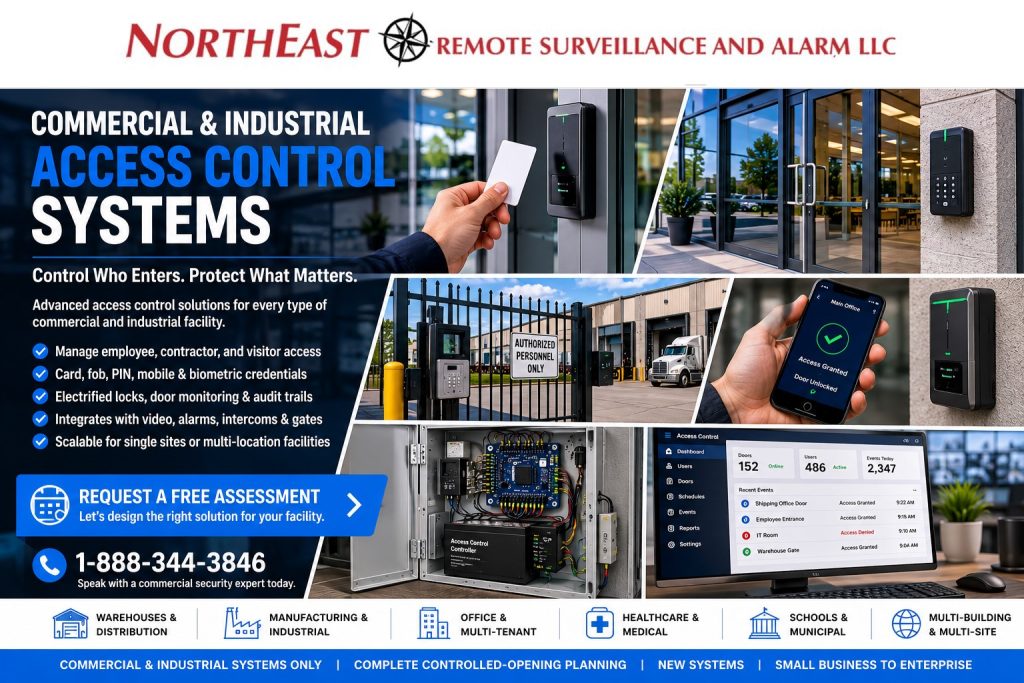
Complete Hardware Installation and Door Adjustments Included
NERSA installs all access-control hardware specified for your system and fine-tunes the complete door opening as part of the installation. This includes door, hinge, latch and closer adjustments so the door closes, latches and operates reliably with the access-control system.
Before handover, we test credential operation, authorized entry, door closing, latching and required exit operation. Hardware installation and these door adjustments are part of our installation work.
Explore Access Control by System or Location
Use these guides to choose the next part of your access-control plan.
- Hayward turnstile sales, installation, and integration — plan full-height and optical pedestrian lanes, accessible gates, and credential-controlled entry with an authorized dealer and installer.
- Door access control and card-reader systems — review controlled entry, credentials, and day-to-day administration.
- Access-control door hardware guide — understand the hardware and installation considerations behind a controlled opening.
- Electrified door hardware lifecycle planning — prepare for maintenance, replacement, and future changes.
- Allentown access control, Bethlehem access control, and Easton access control — explore local commercial installation and upgrade options.
Plan Who Can Enter, Where, and When
Northeast Remote Surveillance and Alarm, LLC designs, installs, upgrades, integrates, and supports business and facility access control for warehouses, manufacturers, offices, healthcare properties, schools, municipalities, industrial sites, contractor operations, commercial campuses, multi-tenant buildings, and multi-location organizations.
Planning begins with people and operations: employees, visitors, contractors, tenants, administrators, delivery personnel, restricted areas, operating schedules, emergency procedures, and employee turnover. Access control replaces some key-management problems with a system that must still be administered responsibly.
Choose Credentials, Users, and Permissions
Systems may use cards, fobs, PINs, mobile credentials, smart credentials, or selected biometric methods depending on the platform, property, risk, privacy requirements, and operating workflow. The credential should be chosen after user volume, issuance, replacement, revocation, shared-device practices, and recurring costs are understood.
- Assign individual users when practical instead of sharing credentials.
- Limit access by door, area, schedule, role, tenant, department, or location.
- Define temporary access and automatic expiration for contractors or visitors.
- Remove former users promptly and review administrator privileges regularly.
- Use understandable door names, event descriptions, reports, and audit history.
Design the Complete Controlled Opening
A reader alone does not make a controlled door. The complete opening can include the door, frame, hinges, closer, latch, panic device, electric strike, electrified trim, magnetic lock, power transfer, request-to-exit device, position switch, controller, power supply, backup battery, cabling, pathways, fire-alarm interface, and emergency release.
Locking hardware and behavior must suit the opening, occupancy, fire rating, accessibility, required egress, emergency operation, and applicable requirements.
Fail-safe and fail-secure describe how specific locks behave when power is removed; the correct choice depends on the opening and approved design.
Review commercial security code and compliance planning.
Choose Cloud, On-Premise, or Hybrid Management
Cloud-managed access control can simplify browser or mobile administration, software updates, multi-site management, and remote support, but may require recurring licenses and dependable communications. On-premise systems can provide local operation and customer-controlled infrastructure, with different server, software, backup, remote-access, and maintenance responsibilities. Hybrid designs combine selected local and cloud functions.
Internet loss should not automatically unlock doors or erase permissions, but remote administration, notifications, and cloud functions may be affected. The proposal should explain controller behavior, cached credentials, communication supervision, backup power, hosting, data ownership, account access, cybersecurity responsibilities, and service renewal terms.
Coordinate Video, Alarms, Visitors, and Gates
For accessible visitor entrances, intercom placement, and release workflows, review Visitor Entry and Intercom Access Control Planning.
Compatible access control may work with video surveillance, intrusion alarms, intercoms, visitor workflows, elevators, and vehicle gates when integration solves a defined problem.
An access event records the credential presented; it does not necessarily prove which physical person entered.
- Video can associate a door event with a relevant camera view.
- Alarm coordination can support approved arming, forced-door, or after-hours workflows.
- Intercoms can help staff communicate with visitors before releasing a suitable entrance.
- Gate systems may coordinate vehicle credentials, intercoms, position monitoring, cameras, and safe operating controls.
Plan Cost, Infrastructure, and Existing-System Reuse
Cost depends on the opening and installed scope—not only the reader. Door hardware, frames, exit devices, pathways, cable distance, controllers, power, credentials, software, integrations, permits, inspections, site conditions, and working hours can change the price substantially.
Use the commercial access-control cost guide for per-door planning ranges.
Existing readers, locks, controllers, cabling, power supplies, credentials, software, and accounts should be evaluated for condition, ownership, compatibility, capacity, cybersecurity, documentation, and support before replacement.
Project Process and Customer Control
- Review openings, hardware, users, schedules, visitors, restricted areas, infrastructure, existing systems, and future needs.
- Define credentials, permissions, door behavior, controller architecture, hosting, integrations, and life-safety coordination.
- Document equipment, general locations, pathways, software, recurring services, customer responsibilities, exclusions, testing, and training.
- Install, program, label, commission, test, and provide role-appropriate instruction and documentation.
Authorized customers should retain administrator access and understand user management, schedules, credentials, reports, backups, remote access, licensing, support contacts, and emergency procedures. Multi-site organizations may use consistent standards without forcing every location into an identical design.
Plan the Access-Control Installation by Opening
Two doors with identical readers can require different installation work. One may already have suitable electrified hardware and a clear cable path; another may need a hardware correction, a protected pathway, or coordination with a door contractor. Build the scope around the complete opening and its intended operation. The reader count should follow that review rather than define it.
Prepare a door and user schedule
Give each opening a unique name and record the area it serves, normal users, operating hours, visitor procedure, and existing hardware. Identify the owner of each decision. In a leased building, a tenant may administer employee credentials while the owner controls the main entrance and common-area hardware. Resolve those responsibilities before ordering equipment or changing an existing service.
Include the less frequent tasks that still need to work: a maintenance contractor arriving early, a delivery after reception closes, or an employee temporarily assigned to another building. Describe who approves each exception and when the permission ends. These examples help the installer evaluate schedules and administration without making every user a permanent administrator.
Separate workplace entry from equipment authorization
Industrial access control can refer to entry into a plant or restricted room, but it can also mean permission to operate equipment. Those are different requirements. This service guide addresses building doors, gates, credentials, and related security administration. If a project involves machine operation, process controls, or safety interlocks, identify that requirement explicitly and involve the responsible equipment and safety professionals.
For a production facility, map employee entrances, contractor routes, storage rooms, and areas restricted to designated staff. Ask how shift changes and approved after-hours work affect the plan. A warehouse entrance may need a different arrangement from a public reception door, even when both use the same credential platform. Keep those differences in the documented scope.
Plan the installation sequence for an occupied building
Agree on work windows, access to ceilings and equipment rooms, and the people responsible for temporary arrangements. Record which existing security functions could be interrupted and how the property will manage that period. A door should not become an unmanaged transition simply because one contractor has finished the cable while another has not completed the hardware.
Identify dependencies before the installation date. These may include approved network connections, electrical work, landlord consent, hardware availability, or coordination with another building system. Ask the provider to distinguish confirmed scope from work that depends on further inspection. Keep revisions visible so the operations team knows when the plan changes.
Make the proposal comparable
Ask for equipment and installation to be described separately from recurring software, communication, support, or credential charges. Confirm which openings and users are included, what customer-provided infrastructure is assumed, and which work is excluded. A proposal that lists only a price per door can leave important differences hidden, especially when exterior entrances and interior office doors share the same total.
- Hardware: identify the existing components to retain and the changes proposed at each opening.
- Infrastructure: describe cable pathways, power, controller locations, network coordination, and any work assigned to others.
- Administration: define user setup, schedules, permissions, account ownership, and training.
- Ongoing costs: state recurring services, renewal terms, and the process for adding doors or users.
- Acceptance: name the tasks the customer will demonstrate before the project is closed.
Use the linked cost guide for budgeting questions, then compare site-specific proposals against the same opening schedule. Ask for the reason when two proposals recommend different equipment quantities or architectures. Differences may reflect valid operating requirements, but those assumptions should be understandable to the property owner.
Upgrade or Take Over an Existing Access System
Begin with an authorized inventory of controllers, readers, credentials, locks, power supplies, cabling, software, and accounts. Collect available drawings and identify who owns the equipment and subscriptions. Mark unknown items for review. A reader that works today does not by itself establish that it can be retained with a new controller or a different credential arrangement.
Group the findings into components to retain, repair, investigate, or replace. For retained components, specify what the installer will test and document any limits. If the business wants to keep existing credentials, confirm that requirement before choosing a platform. The decision affects daily administration as well as equipment selection and should be part of the proposal.
Plan the transition with the people who manage employees and visitors. Identify when permissions will change, who checks the user list, and who responds if a person cannot enter as expected. Avoid carrying outdated access forward simply because it exists in an older database. The customer should approve the intended permissions and maintain responsibility for future changes.
Demonstrate the daily tasks at handover
Acceptance should use the agreed site schedule, representative users, and the actual installed openings. Have the authorized administrator perform the routine tasks they will own. Record any limitation or unresolved issue with a responsible contact. A successful demonstration is more useful than a statement that all devices are online.
- Add an approved user and assign only the required areas and hours.
- Remove or expire a temporary credential and confirm the intended result.
- Review a relevant access event using clear door and site names.
- Demonstrate the approved visitor or intercom procedure where included.
- Review the documented behavior and support process for a communication or power fault.
- Locate equipment records, administrative instructions, recurring-service details, and support contacts.
Coordinate tests affecting alarms, emergency interfaces, or occupied entrances with the qualified people responsible for those systems. The acceptance plan should identify who conducts each test and how results are recorded. Do not improvise a building-system interruption simply to demonstrate a general feature.
Keep access administration current
Assign responsibility for employee departures, contractor expiration, changes in operating hours, and administrator reviews. Revisit permissions when a department moves or a tenant changes. Keep equipment names and drawings aligned with the physical property so a manager can identify the correct opening without guessing.
For multiple buildings, define which decisions belong to local staff and which require central approval. Common naming and documentation help, but each location may need distinct schedules and procedures. A review of actual administration tasks will show whether the system remains manageable as doors, users, and sites are added.
Frequently Asked Questions
How is access control different from mechanical keys?
Credentials can be assigned, scheduled, logged, and revoked without rekeying every affected opening. The system still requires correct hardware, administration, monitoring, maintenance, and user procedures.
Can access control work if internet service fails?
Many properly designed systems retain approved local door functions and cached permissions, while cloud administration, notifications, or remote access may be interrupted. Exact behavior depends on the architecture.
Can existing access-control equipment be reused?
Sometimes. Hardware, controllers, readers, cabling, credentials, software, accounts, and power should be evaluated for ownership, condition, compatibility, capacity, security, documentation, and supportability.
How much does commercial access control cost?
Simple openings may cost much less than exterior, storefront, warehouse, panic-device, gate, or multi-building applications. Accurate pricing requires an opening-by-opening review; use our linked cost guide for practical planning ranges.
Commercial & Industrial Security Services · Commercial Gate Access Control Systems
Request an Access-Control Assessment
Tell us which doors or gates are involved, who needs access, what hardware is present, and what the finished system must accomplish.
Request a commercial access-control assessment.
Related Case Study: Rolling Hills Apartments
Explore the access-control component of NERSA’s Rolling Hills Apartments project for a 232-unit residential community in Pottstown.