
Northeast Remote Surveillance and Alarm, LLC follows commercial project delivery standards designed to keep security, alarm, monitoring, access control, camera, life-safety coordination, and low-voltage projects organized from assessment through installation and support.

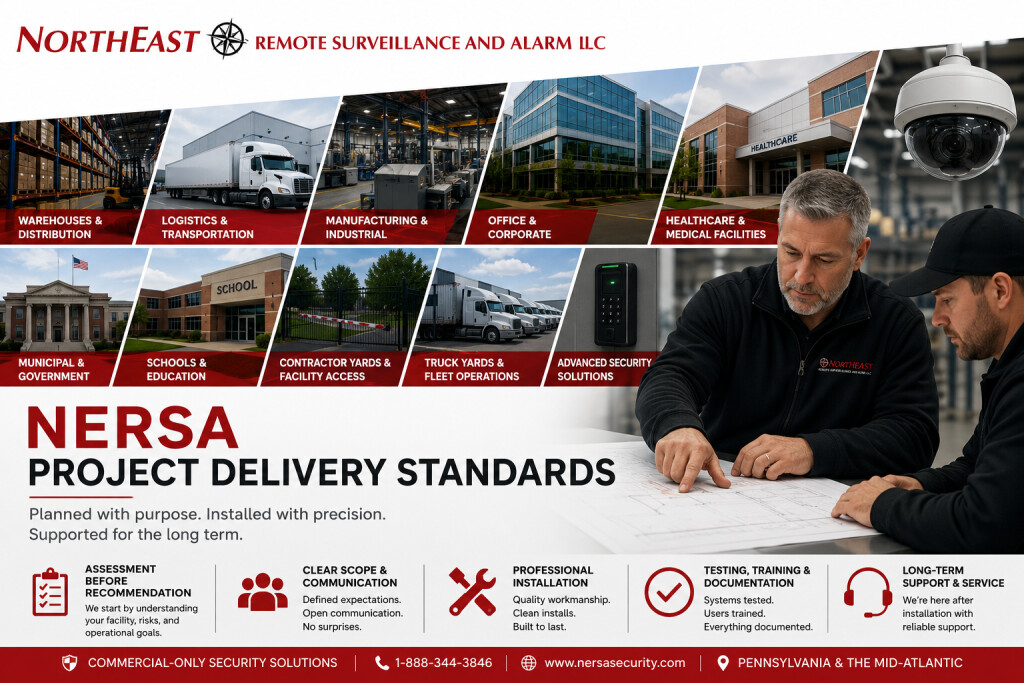
This resource explains how NERSA approaches planning, communication, documentation, installation quality, testing, training, and long-term service for commercial and industrial clients.
For company background and our work with businesses, institutions, and professionally managed apartment communities, start with About Northeast Remote Surveillance and Alarm, LLC
Commercial Security Projects Need a Delivery Standard
Commercial and industrial security projects are not simple equipment drop-offs. A camera system, access control installation, intrusion alarm upgrade, gate control project, fire/life-safety coordination item, or low-voltage infrastructure buildout can affect daily operations, employees, vendors, IT teams, facility managers, safety personnel, and business continuity.
That is why NERSA uses a project delivery mindset instead of treating each installation as an isolated task. The goal is to move from assessment to design, installation, testing, training, documentation, and support with a clear process.
A strong delivery standard helps reduce confusion, avoid missed details, protect the customer’s operation, and create a system that can be used, maintained, and expanded after installation.
Built for Commercial and Industrial Environments
NERSA’s project delivery standards are built around business and professionally managed properties, including:
- Warehouses
- Logistics facilities
- Distribution centers
- Manufacturing plants
- Office buildings
- Medical and healthcare facilities
- Municipal buildings
- Schools
- Contractor yards
- Truck yards
- Industrial parks
- Multi-tenant commercial buildings
- Commercial properties with multiple systems, users, doors, cameras, or buildings
These environments require more planning than single-family home alarm work or consumer camera installation. Commercial projects often involve building access, employee movement, operating schedules, IT coordination, alarm response, documentation, inspection awareness, and future expansion.
NERSA’s delivery standards are designed around those real operating conditions.
Standard 1: Assessment Before Recommendation
NERSA starts by understanding the property before recommending equipment. The assessment stage helps identify how the site operates, where risk exists, which systems are outdated, and what the customer actually needs the system to accomplish.
The assessment may review:
- Entrances and exits
- Employee access points
- Visitor and vendor flow
- Loading docks
- Truck yards
- Parking areas
- Exterior doors
- Restricted rooms
- Camera blind spots
- Alarm coverage
- Gate access points
- Existing wiring and infrastructure
- Monitoring expectations
- Future expansion needs
- Life-safety coordination concerns
This prevents one-size-fits-all system design.
For a deeper explanation of this step, use Security Assessment Process as the supporting process page.
Standard 2: Clear Scope Before Installation
A commercial security project should have a clear scope before installation begins. NERSA works to define what is being installed, where it is being installed, what existing conditions affect the work, and what the customer should expect.
A clear scope may include:
- System type
- Device locations
- Access-controlled doors
- Camera coverage areas
- Alarm zones
- Monitoring requirements
- Cabling needs
- Network requirements
- Power requirements
- Equipment locations
- Installation phases
- Customer responsibilities
- Known limitations
- Future expansion considerations
Clear scope protects both the customer and the project. It helps prevent confusion, uncontrolled change, missed expectations, and disconnected system decisions.
Standard 3: Operationally Practical System Design
NERSA designs systems around how the property actually operates. A system may look good on paper, but if it interferes with workflow, fails to document useful events, or creates unnecessary friction for employees, it is not a strong commercial security solution.
Operational system design considers:
- How employees enter and leave
- Where visitors and vendors report
- How trucks and deliveries move
- Which doors need restricted access
- Where cameras need usable views
- Which areas are active after hours
- How managers will review incidents
- How alarm users will interact with the system
- Whether the system can grow with the property
- How security equipment affects doors, egress, emergency access, or life-safety systems
The goal is not just to install equipment. The goal is to deliver a security system that supports the business.
Standard 4: Professional Installation Practices
Commercial security installation requires attention to workmanship, site conditions, safety, system reliability, and long-term serviceability. NERSA approaches installation with the expectation that systems should be clean, understandable, and supportable after the project is complete.
Project installation standards may include:
- Organized device placement
- Proper mounting locations
- Clean low-voltage wiring practices
- Attention to exterior conditions
- Secure equipment locations
- Practical cable pathways
- Coordination with business operations
- Protection of active work areas
- Respect for occupied commercial spaces
- Clear labeling where appropriate
- Serviceable equipment layouts
Installation quality matters because poor workmanship can create future service problems, weak system performance, and unnecessary downtime.
Standard 5: Coordination With Customer Operations
Most commercial security projects happen inside active buildings. Employees may be working, trucks may be moving, customers may be entering, tenants may be occupying space, and business operations may continue during installation.
NERSA plans project delivery around operational coordination when needed.
That may include:
- Scheduling around business hours
- Coordinating access to locked areas
- Planning work near loading docks or active yards
- Working around production areas
- Coordinating with office managers or facility teams
- Communicating work areas before installation
- Reducing unnecessary disruption
- Planning phased work where appropriate
A strong delivery standard respects the fact that commercial security work happens inside real businesses, not empty showrooms.
Standard 6: IT, Network, and Infrastructure Awareness
Modern security systems often depend on network infrastructure, low-voltage cabling, internet connectivity, power, switches, recorders, cloud services, servers, monitoring paths, and remote access.
NERSA’s project delivery approach includes infrastructure awareness so the system is not treated as disconnected equipment.
Infrastructure planning may involve:
- Low-voltage cable pathways
- Network closet conditions
- Switch locations
- Recorder or server locations
- Internet and remote access requirements
- Power supply locations
- Backup power considerations
- Camera bandwidth
- Video retention needs
- Door controller locations
- Alarm communicator paths
- Future cabling capacity
For broader system planning across cameras, access control, alarms, monitoring, life-safety coordination, and infrastructure, use Commercial & Industrial Security Systems in Pennsylvania and the Mid-Atlantic
Commercial security projects can affect more than security. Access control, electrified door hardware, gate control, fire alarm coordination, emergency egress, low-voltage wiring, backup power, monitoring paths, and protected openings may connect to larger building and life-safety requirements.
NERSA’s project delivery standards include code-aware planning where security work touches:
- Door function
- Emergency egress
- Access-controlled openings
- Fire alarm interfaces
- Low-voltage wiring
- Backup power
- Emergency responder access
- Inspection readiness
- Documentation expectations
This does not replace the authority having jurisdiction, engineer, architect, code consultant, legal advisor, or insurance provider where formal review is required. It does help commercial clients avoid treating security devices as isolated equipment when they may affect building operation or life-safety expectations.
Standard 8: Testing Before Turnover
A commercial security system should be tested before the project is considered complete. Testing helps confirm that devices, permissions, alarms, camera views, communication paths, and user functions are working as intended.
Depending on the project, testing may include:
- Camera views
- Recording
- Remote access
- Door reader operation
- Lock release
- Request-to-exit devices
- Alarm contacts
- Motion detection
- Alarm communication
- User codes
- Access permissions
- Schedules
- Gate operation
- Intercom function
- Monitoring signals
- Notification workflows
Testing is where the project moves from installed equipment to usable security.
Standard 9: Customer Training and System Handoff
A security system is only valuable if the customer understands how to use it. NERSA’s project delivery standards include practical system handoff so the customer knows how to operate the system after installation.
Training may include:
- How to view cameras
- How to search recorded video
- How to manage users
- How to arm or disarm an alarm system
- How access schedules work
- How to add or remove credentials
- How to understand basic alerts
- How to contact NERSA for support
- What information to provide when service is needed
The goal is to reduce confusion and help the customer use the system confidently.
Standard 10: Documentation and Long-Term Serviceability
Commercial security systems need to remain serviceable after installation. Documentation helps future service, troubleshooting, upgrades, user changes, and system expansion.
Depending on the project, documentation may include:
- Device locations
- System descriptions
- User information
- Basic operating guidance
- Equipment records
- Monitoring details
- Access control notes
- Alarm zone information
- Camera naming conventions
- Service notes
- Future expansion considerations
Good documentation helps the system remain useful beyond the day it is installed.
Standard 11: Phased Growth When Needed
Not every commercial security project needs to be completed in one phase. Some properties need immediate corrections first, then future improvements as budget, operations, or infrastructure allow.
A phased project may address:
- Highest-risk entrances first
- Critical cameras first
- Outdated alarm equipment first
- Priority access-controlled doors first
- Gate control before broader yard expansion
- Infrastructure upgrades before additional devices
- Monitoring improvements before advanced analytics
- Warehouse or yard expansion in later phases
Phased delivery helps customers make practical decisions without losing sight of the long-term security plan.
Standard 12: Support After Installation
Project delivery does not end when the last device is mounted. Commercial security systems need support as users change, buildings expand, equipment ages, and business needs evolve.
NERSA supports customers through needs such as:
- System service
- User changes
- Camera adjustments
- Access control updates
- Alarm troubleshooting
- Monitoring changes
- Equipment replacement
- Expansion planning
- System upgrades
- Documentation review
- Future project phases
A commercial system should be built with the expectation that it will need service, adjustment, and growth over time.
Why Project Delivery Standards Matter
Project delivery standards create a better experience for the customer and a stronger final system. They help make sure the project is planned, communicated, installed, tested, documented, and supported with commercial expectations in mind.
Without project delivery standards, businesses can end up with:
- Poorly placed cameras
- Confusing access control
- Alarm gaps
- Weak documentation
- Unclear responsibilities
- Installation delays
- Disconnected systems
- Unusable footage
- Infrastructure problems
- Systems that cannot expand easily
NERSA’s standards are designed to reduce those risks and deliver security systems that match real business environments.
Request a Commercial Security Assessment
A successful commercial security project starts before installation. It starts with understanding the property, defining the scope, planning around operations, coordinating infrastructure, testing the system, and supporting the customer after turnover.
Northeast Remote Surveillance and Alarm, LLC provides project delivery standards for commercial and industrial clients that need organized security planning, dependable installation, practical communication, and long-term support.
To review your facility and plan the next security project, call 1-888-344-3846 or use Request a Security Assessment
Frequently Asked Questions About NERSA Project Delivery Standards
What are NERSA project delivery standards?
NERSA project delivery standards are the planning, communication, installation, testing, training, documentation, and support practices used to deliver commercial and industrial security projects in an organized and dependable way.
Why do commercial security projects need delivery standards?
Commercial security projects need delivery standards because they often involve active buildings, employees, vendors, IT coordination, access control, cameras, alarms, monitoring, infrastructure, life-safety considerations, and future expansion needs.
Does NERSA assess the property before installation?
Yes. NERSA uses an assessment-first approach to understand the property, identify risk areas, review existing systems, and recommend security solutions based on real operating conditions.
Does NERSA provide a clear project scope?
Yes. NERSA works to define the system scope, device locations, equipment needs, infrastructure requirements, installation expectations, and project priorities before work begins.
Does NERSA coordinate with business operations during installation?
Yes. NERSA considers business operations, building access, work areas, schedules, and site conditions so security installation can be completed with practical coordination.
Does NERSA test systems before turnover?
Yes. Depending on the system, NERSA may test camera views, access control operation, alarm devices, monitoring communication, user functions, schedules, remote access, and other system components before turnover.
Does NERSA train customers after installation?
Yes. NERSA provides practical system handoff so customers understand how to use the installed system, manage basic functions, and request support when needed.
Does NERSA document commercial security projects?
Yes. Documentation may include device locations, system notes, user information, access control details, alarm zone information, monitoring details, and future expansion considerations depending on the project.
Can NERSA support phased security projects?
Yes. Some commercial properties need phased improvements. NERSA can help prioritize urgent needs first while planning future cameras, doors, alarms, gates, monitoring, or infrastructure upgrades.
How does a business start a project with NERSA?
The best starting point is a commercial security assessment. NERSA can review the facility, identify project priorities, discuss operational needs, and recommend a practical delivery plan based on the property’s real conditions.