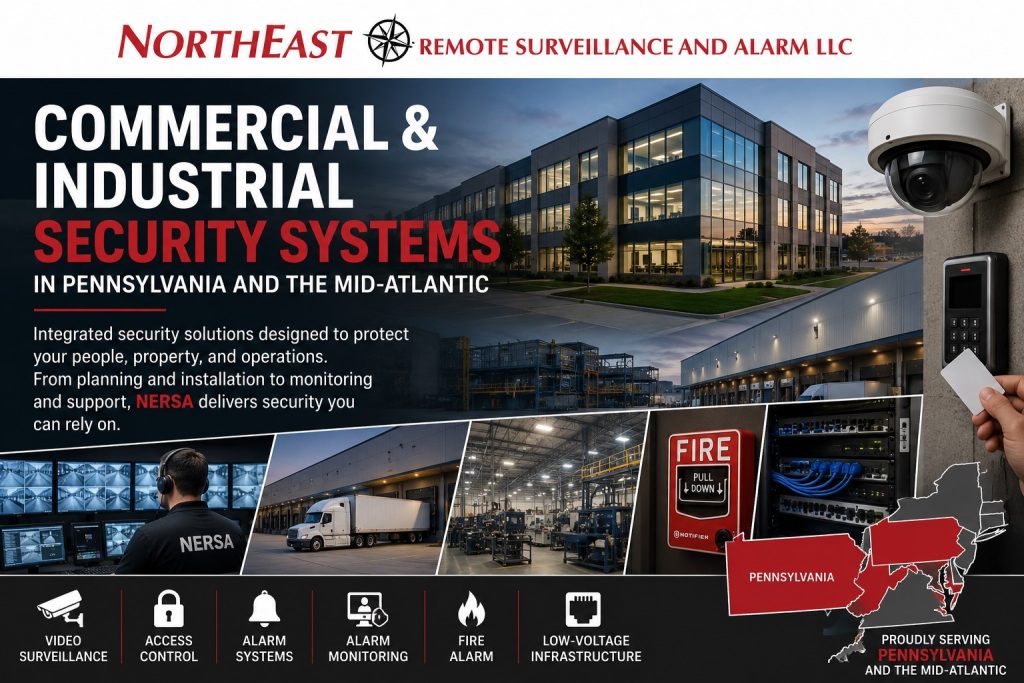
Commercial and Industrial Security Systems in Pennsylvania and the Mid-Atlantic

Commercial and industrial security systems should be planned around how a facility actually operates. Employees, visitors, contractors, vehicles, materials, doors, loading docks, parking areas, production spaces, restricted rooms, alarm response, fire and life-safety systems, network infrastructure, documentation, and future expansion all influence the correct design.

Northeast Remote Surveillance and Alarm, LLC designs, installs, integrates, monitors, upgrades, and supports non-residential security systems for warehouses, manufacturing plants, distribution centers, logistics operations, offices, healthcare buildings, schools, municipal properties, contractor facilities, industrial parks, commercial campuses, multi-tenant properties, and multi-site organizations.

NERSA’s primary service footprint is Pennsylvania. Qualifying commercial and industrial projects may also be supported in New Jersey, Delaware, and Maryland depending on location, system requirements, project scope, licensing and permitting responsibilities, travel, scheduling, technical complexity, inspection requirements, and long-term service needs.

NERSA does not install residential security systems. Our work is focused on commercial, industrial, institutional, municipal, healthcare, educational, logistics, and enterprise environments that need professionally planned and supportable systems.

Review the complete Commercial and Industrial Security Services, explore NERSA Service Areas, or request a commercial security assessment.

Call 1-888-344-3846 to discuss a commercial or industrial property.

Commercial and industrial facility with security cameras, access control, fire alarm, monitoring, and low-voltage infrastructure

Choose the Right Commercial Security Planning Resource

A business may begin its security planning based on location, system type, facility use, operational exposure, or the condition of an existing system.

Plan by Location

Use NERSA Service Areas when the primary question is where NERSA supports commercial and industrial projects.

Location resources help businesses move from a state or regional overview into the market that most closely matches the property without repeating every system and facility type on every geographic page.

For a Pennsylvania property, begin with Commercial and Industrial Security Systems in Pennsylvania.

Plan by Security System

Use Commercial and Industrial Security Services when evaluating video surveillance, access control, intrusion alarms, fire alarms, monitoring, remote video monitoring, communication systems, integration, or supporting infrastructure.

Each service resource addresses the design considerations, operating requirements, limitations, and project conditions associated with that system.

Plan by Facility Type

Use Industries We Serve when the property’s operation is the main planning factor.

A warehouse, manufacturing plant, medical office, school, municipal building, contractor yard, professional office, cold-storage facility, and multi-tenant industrial campus may use similar equipment, but they do not use it in the same way.

Plan Around Operational Exposure

A project may be driven by a particular area or recurring concern, such as:

  • Loading docks
  • Truck courts and trailer rows
  • Vehicle gates
  • Parking areas
  • Exterior equipment
  • Employee entrances
  • Visitor and contractor movement
  • Restricted rooms
  • Freight transfer
  • After-hours activity
  • Weak incident evidence
  • Uncontrolled credentials
  • False alarms
  • Aging infrastructure

The system should address the underlying operating problem rather than simply add more devices.

Plan by Project Stage

A property may require:

  • A new installation
  • An independent system assessment
  • A camera or access-control expansion
  • An existing-system takeover
  • A recorder or controller modernization
  • An alarm communicator replacement
  • A network or cabling upgrade
  • A multi-building connection
  • A phased migration
  • Multi-site standardization
  • Improved documentation
  • Preparation for future construction

For an existing property, visit Commercial Security System Upgrades, Retrofits, and Takeovers.

Security Planning Built Around Real Facilities

A complete security plan begins with the property, its users, and its operating conditions—not with a predetermined camera, card-reader, sensor, or panel count.

A facility assessment may review:

  • Building use and occupancy
  • Operating hours and employee shifts
  • Visitors, vendors, contractors, drivers, and temporary workers
  • Main entrances and secondary doors
  • Overhead doors and loading docks
  • Gates, service roads, and vehicle entrances
  • Parking, pedestrian approaches, and exterior storage
  • Shipping, receiving, staging, and freight movement
  • Production, inventory, tools, equipment, and restricted rooms
  • Camera objectives and required evidence quality
  • Video recording, retention, export, and user access
  • Credentials, schedules, permissions, and audit records
  • Locking hardware and controlled-door operation
  • Intrusion-alarm zones, partitions, users, and communication paths
  • Fire alarm and life-safety interfaces
  • Monitoring contacts, verification, notification, and escalation
  • Intercom and communication requirements
  • Cabling, fiber, PoE, wireless connectivity, and network capacity
  • Power, backup power, equipment rooms, and environmental conditions
  • Administrator ownership, passwords, and cybersecurity
  • Existing equipment and reusable infrastructure
  • Future additions, renovations, tenants, and expansion

The objective is to create a dependable and manageable system that improves visibility, access accountability, alarm response, incident review, and long-term control without creating unnecessary operational complexity.

Technology should support the organization’s procedures. It does not replace management, supervision, employee training, visitor policies, safety programs, emergency procedures, physical maintenance, or responsible response planning.

Commercial Security Project Coverage

Pennsylvania

Pennsylvania is NERSA’s primary commercial and industrial service state.

Use Commercial and Industrial Security Systems in Pennsylvania for statewide planning, Pennsylvania market coverage, and access to regional resources.

NERSA’s established Pennsylvania coverage includes the Lehigh Valley, Greater Reading and Berks County, Northeastern Pennsylvania, Greater Philadelphia, Central Pennsylvania, and connected industrial and freight markets.

Lehigh Valley

Use Lehigh Valley Commercial and Industrial Security Systems for properties throughout Allentown, Bethlehem, Easton, Lehigh County, Northampton County, and the surrounding Route 22, Route 33, and I-78 commercial and industrial markets.

The region includes warehouses, manufacturing facilities, distribution operations, healthcare properties, schools, municipal buildings, offices, contractor facilities, industrial parks, and multi-site organizations.

Greater Reading and Berks County

Use Greater Reading Area Commercial and Industrial Security Installation for facilities throughout Reading and Berks County.

Regional planning may involve manufacturing plants, warehouses, distribution centers, healthcare properties, offices, schools, municipalities, industrial parks, logistics facilities, and businesses connected to the PA 61, US 222, US 422, I-176, and I-78 markets.

Greater Philadelphia

Use Greater Philadelphia Commercial and Industrial Security Installation for qualifying projects throughout Philadelphia and surrounding southeastern Pennsylvania commercial and industrial markets.

Project availability is evaluated around location, scope, required systems, permitting and inspection responsibilities, scheduling, technical complexity, travel, and long-term support.

Northeastern Pennsylvania

Use the Northeastern Pennsylvania Logistics Hub Security Directory for warehouses, distribution centers, manufacturing facilities, industrial parks, trucking operations, contractor properties, trailer yards, and connected freight markets throughout the Scranton, Wilkes-Barre, Pittston, Hazleton, Wyoming Valley, and Pocono regions.

Central Pennsylvania

Use Harrisburg and Central Pennsylvania Commercial Security Installation for qualifying commercial and industrial projects throughout Harrisburg, Carlisle, Mechanicsburg, Camp Hill, Hershey, Middletown, and surrounding Central Pennsylvania markets.

New Jersey, Delaware, and Maryland

Selected projects may be supported through the following state resources:

Availability outside Pennsylvania depends on the property, requested systems, project size, licensing and permitting requirements, inspection responsibility, scheduling, travel, technical complexity, and long-term service expectations.

Commercial and Industrial Security Services

Most commercial and industrial properties require several security layers working together.

Cameras, controlled doors, intrusion detection, fire alarms, monitoring, intercoms, gates, and infrastructure should be coordinated around the facility’s operating needs rather than designed as unrelated systems.

Visit Commercial and Industrial Security Services for the complete service structure.

Commercial Video Surveillance

Commercial and Industrial Video Surveillance Systems should be designed around the images and evidence the organization actually needs.

General awareness, facial identification, vehicle identification, license-plate capture, loading-dock review, production visibility, perimeter detection, and alarm verification are different objectives that may require different cameras, lenses, positions, lighting, recording settings, and retention periods.

Planning may include:

  • Interior and exterior cameras
  • Video management
  • On-premises or cloud-connected recording
  • Remote access
  • User permissions
  • AI-assisted search
  • Analytics
  • Health monitoring
  • Time synchronization
  • Evidence export
  • Recording retention
  • Multi-site administration
  • Cybersecurity-aware configuration

Resolution alone does not determine whether a camera will provide usable evidence. Distance, angle, lens, lighting, movement, obstructions, frame rate, compression, mounting height, recording settings, and maintenance all affect performance.

Commercial Access Control

Commercial and Industrial Access Control Systems help organizations manage doors, credentials, users, schedules, restricted rooms, visitor entry, tenant permissions, gates, and multi-building access.

A controlled opening may involve:

  • Management software
  • Controllers
  • Readers
  • Credentials
  • Door contacts
  • Request-to-exit devices
  • Locks
  • Panic hardware
  • Door closers
  • Power supplies
  • Network connections
  • Emergency operation
  • Fire-alarm interfaces
  • Administrator permissions

The complete opening should be evaluated as one system. A card reader does not correct a damaged frame, unsuitable lock, poorly adjusted closer, or door that does not latch consistently.

Access-control history generally identifies the credential, controlled opening, and time associated with an event. It does not necessarily prove which physical person used the credential. Nearby video may provide additional context.

Commercial Intrusion Alarm Systems

Commercial and Industrial Intrusion Alarm Systems may protect exterior doors, overhead openings, offices, warehouses, production areas, restricted rooms, detached buildings, sensitive storage, and vulnerable after-hours spaces.

Commercial alarm planning may include:

  • Individual user codes
  • Separate partitions
  • Scheduled operation
  • Door and window protection
  • Motion detection
  • Glass-break detection
  • Overhead-door contacts
  • Panic and duress devices
  • Environmental signals
  • Video verification
  • Cellular or IP communication
  • Clear point descriptions
  • Monitoring instructions
  • Nuisance-alarm reduction
  • Documented response procedures

Alarm devices should be selected for the actual environment. Machinery, air movement, temperature changes, insects, large doors, changing occupancy, and industrial processes may affect device performance.

Commercial Fire Alarm and Life-Safety Systems

Commercial and Industrial Fire Alarm Systems are regulated life-safety systems that must be planned around the building, occupancy, required detection, occupant notification, sprinkler supervision, emergency interfaces, monitoring, documentation, testing, adopted requirements, approved plans, and the Authority Having Jurisdiction.

Work may involve:

  • Fire alarm control equipment
  • Smoke and heat detection
  • Manual pull stations
  • Notification appliances
  • Alarm communicators
  • Sprinkler waterflow and supervisory signals
  • Remote annunciation
  • Elevator recall interfaces
  • HVAC shutdown
  • Controlled-door release
  • Monitoring
  • Testing coordination
  • System upgrades
  • Inspection preparation

Electronic security systems do not replace required fire-alarm systems, approved designs, professional responsibilities, permits, inspections, testing, emergency procedures, documentation, or AHJ acceptance.

Commercial Security Monitoring

Commercial and Industrial Security Monitoring adds a structured response layer to approved security and facility events.

Monitoring may support:

  • Intrusion alarms
  • Fire-alarm signals
  • Supervisory conditions
  • Trouble signals
  • Communication-path failures
  • Environmental alerts
  • Panic and duress events
  • Video verification
  • Access-related alerts

A monitoring plan should define which events are transmitted, who is contacted, how information is maintained, what verification is available, how escalation occurs, and which procedures apply during nights, weekends, holidays, maintenance, deliveries, shutdowns, or changing shifts.

Remote Video Monitoring and Live Talk-Down

Remote Video Monitoring and Live Talk-Down may support selected parking areas, loading docks, truck courts, gates, contractor yards, fence lines, exterior storage, rear entrances, trailer rows, and other locations with after-hours exposure.

Depending on the approved system and response plan, monitoring may include:

  • Analytics-generated alerts
  • Operator review
  • Visual verification
  • Authorized customer notification
  • Documented escalation
  • Live audio warnings
  • Requests for an appropriate response

Monitoring performance depends on camera placement, lighting, analytics, communication, schedules, activity zones, contact information, and response instructions.

No security or monitoring system can guarantee that every event will be detected, prevented, interrupted, or stopped.

Unified Security and System Integration

Commercial and Enterprise Unified Security Systems may coordinate compatible video surveillance, access control, intrusion alarms, intercoms, monitoring, analytics, sensors, and reporting around a defined operating objective.

Useful integration may connect:

  • Door events with associated camera footage
  • Intrusion events with video verification
  • Intercom calls with remote release
  • Gate activity with vehicle views
  • Alarm events with response procedures
  • Several properties with centralized administration

Integration should solve a real operating, investigative, or response problem. Combining every available platform is not automatically better when it produces excessive alerts, confusing permissions, unsupported dependencies, or difficult long-term service.

Commercial Infrastructure and Cabling

Commercial and Industrial Infrastructure and Cabling supports the communication, power, and pathways on which security systems depend.

Planning may include:

  • Structured cabling
  • Fiber-optic backbones
  • Managed PoE switches
  • Wireless bridges
  • Network cabinets
  • Equipment racks
  • Weather-rated enclosures
  • UPS support
  • Surge-protection coordination
  • Bandwidth
  • Network segmentation
  • Cable testing
  • Labeling
  • Building-to-building connectivity
  • Future expansion capacity

A dependable camera, access-control, intercom, or monitoring platform can still fail operationally when cabling, power, network capacity, equipment locations, administrator access, or documentation are poorly planned.

Facilities and Industries NERSA Supports

Visit Industries We Serve to select a resource based on the facility’s use and operating environment.

Warehouses and Logistics Facilities

Warehouse and Logistics Security Systems may address:

  • Employee and driver entrances
  • Loading docks
  • Shipping and receiving
  • Freight staging
  • Inventory
  • Overhead doors
  • Truck courts
  • Trailer rows
  • Vehicle gates
  • Parking
  • Temporary workers
  • After-hours exterior activity
  • Recording retention
  • Alarm verification

Camera views should help management connect activity across entrances, yards, docks, warehouse thresholds, and interior staging areas.

Manufacturing and Industrial Facilities

Manufacturing Plant Security Systems may address production areas, employee entrances, contractor access, tool rooms, maintenance areas, raw materials, finished goods, shipping, utilities, laboratories, quality-control areas, exterior yards, and restricted processes.

Security systems can improve visibility, access accountability, and incident review. They do not replace safety programs, employee training, supervision, equipment safeguards, process controls, or emergency procedures.

Industrial Parks and Commercial Campuses

The Industrial Park Security Systems Directory supports planning for business parks, warehouse districts, manufacturing zones, logistics areas, commercial campuses, shared roadways, multi-tenant properties, common parking, gates, loading areas, and exterior storage.

A coordinated design should distinguish between property-management responsibilities, common-area systems, individual tenant systems, shared infrastructure, and appropriate access to video and administrative records.

Offices, Healthcare, Schools, Municipalities, and Institutions

Office, healthcare, educational, municipal, and institutional properties may require:

  • Controlled public and employee entry
  • Visitor communication
  • Reception-area visibility
  • Staff-only access
  • Parking and building-approach cameras
  • Restricted-room protection
  • After-hours alarms
  • Fire-alarm coordination
  • Emergency communication
  • Privacy-aware permissions
  • Dependable documentation

Begin with Industries We Serve and select the resource that most closely matches the facility.

Smaller Commercial Properties

Small Business Security Systems are intended for professional offices, medical practices, service companies, contractor shops, light-commercial buildings, and other businesses that need commercial-grade security without being forced into a residential-style package or an unnecessarily large enterprise platform.

A smaller property may begin with several cameras, a monitored alarm, one or two controlled doors, an intercom, or a fire-alarm upgrade.

Smaller projects still require appropriate planning around users, evidence quality, alarm response, door operation, life-safety conditions, cybersecurity, documentation, and future expansion.

Enterprise and Multi-Site Organizations

Multi-site organizations may require consistent standards for:

  • Camera names
  • Recording retention
  • Credential formats
  • Access permissions
  • Alarm-zone descriptions
  • Monitoring instructions
  • Administrator roles
  • Network requirements
  • Documentation
  • Equipment selection
  • Service procedures

Standardization should simplify administration while preserving the operational, regulatory, and life-safety differences of each property.

Security Planning Around Operational Risk

Loading Docks and Shipping Areas

Loading docks combine employees, drivers, vendors, forklifts, freight, overhead doors, paperwork, changing lighting, and after-hours exposure.

Security planning should distinguish between broad dock awareness and focused evidence views intended to document trailers, doors, people, freight, and vehicle activity.

Truck Yards, Trailer Areas, and Gates

Truck courts, trailer rows, drop lots, fleet areas, contractor yards, and exterior storage extend exposure beyond the building.

These areas may require:

  • Fixed or panoramic cameras
  • Vehicle-identification views
  • License plate recognition
  • Gate access
  • Intercoms
  • Lighting review
  • Analytics
  • Remote monitoring
  • Fiber or wireless connectivity
  • Clearly defined response procedures

Trailer positions and changing yard conditions can obstruct camera views. A responsible design should not promise uninterrupted visibility through every trailer row under every condition.

Vehicle Entrances and Parking Areas

Vehicle observation, vehicle identification, and license-plate capture are different objectives.

Dependable plate documentation generally requires a dedicated view planned around:

  • Distance
  • Camera angle
  • Vehicle speed
  • Lane position
  • Headlights
  • Plate reflectivity
  • Traffic direction
  • Day and night lighting

Parking-area planning should consider vehicle entrances, pedestrian paths, building approaches, lighting, parked-vehicle obstructions, landscaping, and the times employees and visitors use the property.

Visitors, Vendors, Contractors, and Deliveries

Visitor and contractor management may include:

  • Registration
  • Host notification
  • Video intercom communication
  • Temporary credentials
  • Time-limited permissions
  • Approved entrances
  • Automatic expiration
  • Camera review
  • Defined travel routes
  • Documented entry procedures

Technology should support—not replace—the organization’s visitor, contractor, vendor, driver, delivery, escort, and supervision policies.

After-Hours and Exterior Exposure

Parking areas, gates, loading docks, exterior equipment, trailer storage, fence lines, service yards, rear doors, and remote property areas may require a different response strategy from occupied interior spaces.

A property may use passive recording, intrusion detection, video verification, remote video monitoring, or a combination based on staffing, exposure, communication, realistic response options, and operating schedules.

Compliance-Aware Security and Life-Safety Planning

Regulatory Compliance for Commercial Security, Fire Alarm, and Life Safety provides broader planning for security projects that interact with:

  • Emergency egress
  • Controlled-door operation
  • Fire alarm and life-safety systems
  • Accessible entry
  • Electrical and low-voltage requirements
  • Fire-rated doors
  • Panic hardware
  • Inspection and documentation requirements
  • Workplace procedures
  • Government or contract standards
  • Network administration
  • Privacy and retention policies

Security equipment does not automatically make a property compliant with every building code, fire code, accessibility requirement, workplace rule, insurance condition, contract, privacy requirement, or industry standard.

Applicable requirements depend on adopted codes, authorities having jurisdiction, approved project documents, responsible design professionals, insurers, contracts, property conditions, and the organization’s policies and procedures.

Assessments, Upgrades, and Project Delivery

Physical Plant Security Assessment

Use Physical Plant Security Assessment for larger or technically complex facilities requiring a structured review of physical security, operational exposure, fire and life-safety coordination, infrastructure, existing-system condition, documentation, and scalability.

Existing-System Upgrades and Takeovers

Use Commercial Security System Upgrades, Retrofits, and Takeovers when a property has installed cameras, recorders, readers, controllers, locks, alarms, communicators, cabling, fiber, switches, networks, power supplies, users, permissions, or monitoring services that need evaluation.

Existing equipment may sometimes be:

  • Retained
  • Repaired
  • Reconfigured
  • Expanded
  • Integrated
  • Modernized
  • Replaced in phases

Reuse should be based on condition, compatibility, supportability, cybersecurity, testing, performance, documentation, and the objectives of the completed system.

Assessment Process

The NERSA Security Assessment Process explains how facility conditions, operating requirements, existing systems, infrastructure, project priorities, and long-term plans are reviewed before a recommendation is developed.

Project Delivery and Turnover

A commercial security project should move through:

  1. Facility and operational review
  2. Existing-system evaluation
  3. Scope development
  4. Equipment and infrastructure planning
  5. Installation coordination
  6. Programming and configuration
  7. Testing and commissioning
  8. User training
  9. Documentation
  10. Project turnover
  11. Long-term service preparation

A completed project should leave the customer with a practical understanding of:

  • What was installed
  • How the system is organized
  • Who administers it
  • How users and permissions are managed
  • How events are handled
  • How footage is reviewed and exported
  • How monitoring instructions are maintained
  • What information will be needed for future service or expansion

Why Commercial and Industrial Clients Choose NERSA

Since 2008, Northeast Remote Surveillance and Alarm, LLC has focused on commercial and industrial security design, installation, upgrades, integration, monitoring, and long-term support.

NERSA’s approach emphasizes:

  • Commercial and industrial work rather than residential packages
  • Facility-first planning
  • Video surveillance, access control, intrusion alarms, fire alarms, and monitoring
  • Warehouse, logistics, manufacturing, office, institutional, municipal, and multi-site experience
  • New installations, expansions, upgrades, retrofits, and takeovers
  • Loading-dock, yard, gate, parking, and vehicle-documentation planning
  • Structured cabling, fiber, PoE, wireless, and network infrastructure
  • Compliance-aware recommendations
  • Fire and life-safety coordination
  • Existing-equipment evaluation before replacement
  • Testing, training, documentation, and project turnover
  • Small-commercial through enterprise capability
  • Long-term serviceability and expansion planning

NERSA begins with the property, users, operating conditions, current systems, infrastructure, exposure, response expectations, and long-term objectives. Equipment is selected after the project requirements are understood.

Request a Commercial and Industrial Security Assessment

A commercial security project should begin with the facility rather than a predetermined device count.

An assessment may review:

  • Property use and operating hours
  • Employee shifts and visitor activity
  • Entrances, doors, gates, loading docks, and vehicle routes
  • Parking, yards, exterior storage, and restricted areas
  • Existing cameras, access control, intrusion alarms, monitoring, and fire-alarm equipment
  • Camera objectives, image quality, recording, retention, and evidence needs
  • Credentials, schedules, permissions, and door hardware
  • Alarm coverage, partitions, communication paths, and response procedures
  • Emergency egress and life-safety interfaces
  • Remote-monitoring needs and realistic response options
  • Cabling, fiber, switching, wireless connectivity, power, and bandwidth
  • Existing-system supportability and documentation
  • Administrator access and cybersecurity
  • Renovations, tenant changes, future additions, and multi-site standards

The objective is to identify the most important requirements, evaluate existing equipment, establish infrastructure needs, and develop a practical path for installation, expansion, modernization, takeover, or phased improvement.

Request a Commercial and Industrial Security Assessment or call 1-888-344-3846.

Frequently Asked Questions About Commercial and Industrial Security Systems

What information can businesses find on this page?

This page provides an overview of NERSA’s commercial and industrial security capabilities and helps businesses select the appropriate location, service, facility, compliance, assessment, upgrade, or project-planning resource.

What areas does NERSA serve?

Pennsylvania is NERSA’s primary commercial and industrial service state. Qualifying projects may also be supported in New Jersey, Delaware, and Maryland depending on location, system type, project scope, licensing and permitting requirements, inspection responsibilities, technical complexity, scheduling, travel, and long-term service needs.

Should a Pennsylvania business begin here or on the Pennsylvania page?

Begin here when comparing several systems, facility types, project stages, regions, or multi-state requirements.

Use Commercial and Industrial Security Systems in Pennsylvania when the project is specifically focused on a Pennsylvania property and the business needs statewide or regional planning.

What types of facilities does NERSA support?

NERSA supports qualifying warehouses, distribution centers, manufacturing facilities, industrial properties, logistics operations, offices, healthcare buildings, schools, municipal properties, institutions, contractor facilities, industrial parks, commercial campuses, multi-tenant buildings, smaller businesses, and multi-site organizations.

What security systems may a commercial facility need?

A property may need video surveillance, access control, intrusion detection, fire alarm, monitoring, remote video monitoring, intercoms, IP speakers, gate access, license plate recognition, structured cabling, fiber, wireless connectivity, or unified management.

The correct combination depends on the property, users, risks, current equipment, infrastructure, response procedures, life-safety conditions, and long-term plans.

Can NERSA evaluate an existing security system?

Yes. NERSA can review existing cameras, recorders, access control, intrusion alarms, monitoring, fire-alarm equipment, communicators, intercoms, gates, cabling, switches, networks, power supplies, credentials, permissions, documentation, and system condition.

Does an existing system always need complete replacement?

No. Existing equipment may sometimes be retained, repaired, reconfigured, integrated, expanded, or modernized.

Reuse depends on condition, compatibility, supportability, cybersecurity, testing, performance, documentation, and the requirements of the completed system.

Can video surveillance, access control, alarms, and monitoring work together?

Yes. Compatible systems may connect controlled-door events with video, intrusion events with camera verification, intercom calls with remote release, gate activity with vehicle documentation, and several locations with centralized administration.

Integration should solve a defined operational or response need.

Does an access-control record prove which person entered?

No. Access-control records generally identify the credential, controlled door, and time associated with an event. They do not necessarily prove which physical person used the credential. Video and other records may provide additional context.

When should a facility consider remote video monitoring?

Remote video monitoring may be appropriate for properties with recurring after-hours exposure involving parking areas, loading docks, truck courts, trailer storage, gates, contractor yards, exterior equipment, fence lines, rear entrances, or remote property sections.

The monitoring schedule and response process should reflect normal activity and realistic response options.

Does remote monitoring guarantee that every incident will be detected or prevented?

No. Monitoring depends on camera placement, lighting, analytics, communications, schedules, contact information, activity zones, and response instructions.

No security or monitoring system can guarantee that every event will be detected, prevented, interrupted, or stopped.

How are fire-alarm and life-safety requirements handled?

Fire alarms, access control, door hardware, emergency egress, accessibility, video surveillance, and related building interfaces should be coordinated according to applicable project requirements and the approved design and inspection process.

Electronic security does not replace required fire-alarm systems, professional design responsibilities where applicable, permits, approved plans, testing, inspections, emergency procedures, or Authority Having Jurisdiction acceptance.

Can NERSA support small businesses and enterprise facilities?

Yes. NERSA supports qualifying projects ranging from smaller offices, medical practices, service businesses, contractor properties, and light-commercial buildings to warehouses, manufacturing plants, industrial campuses, institutions, municipalities, and multi-site enterprise organizations.

Does NERSA install residential security systems?

No. Northeast Remote Surveillance and Alarm, LLC focuses on commercial, industrial, institutional, municipal, healthcare, educational, warehouse, logistics, manufacturing, office, contractor, multi-tenant, campus, and other non-residential environments.

How does a commercial security project begin?

A project begins with a facility-specific assessment. NERSA reviews the property, operations, users, entrances, vehicles, restricted areas, current systems, cameras, access control, alarms, monitoring, fire-alarm conditions, infrastructure, documentation, priorities, and long-term support needs before recommending an approach.


Scroll to Top
1-888-344-3846