OSHA Compliance & Access Control Systems
An Enterprise Access Control Deep-Dive by Northeast Remote Surveillance and Alarm, LLC
OSHA compliance is fundamentally about controlling risk, preventing exposure, and documenting enforcement. While OSHA regulations do not mandate specific access control technologies, many violations, citations, and incidents stem from unauthorized access, poor accountability, and lack of enforcement controls.
Modern electronic access control systems—when properly designed and integrated—play a critical role in supporting OSHA safety objectives across industrial, commercial, and enterprise environments.
Access Control Supports U.S. Department of Labor – OSHA 29 U.S.C. § 654(a)(1) Compliance. Thid is achieve by using access control to prevent untrained employees in dangerous areas and monitoring any attempts to enter said areas.
Northeast Remote Surveillance and Alarm, LLC (NERSA) designs and installs enterprise-grade access control systems that directly support OSHA compliance by enforcing safety policies, restricting access to hazardous areas, and providing verifiable audit trails.
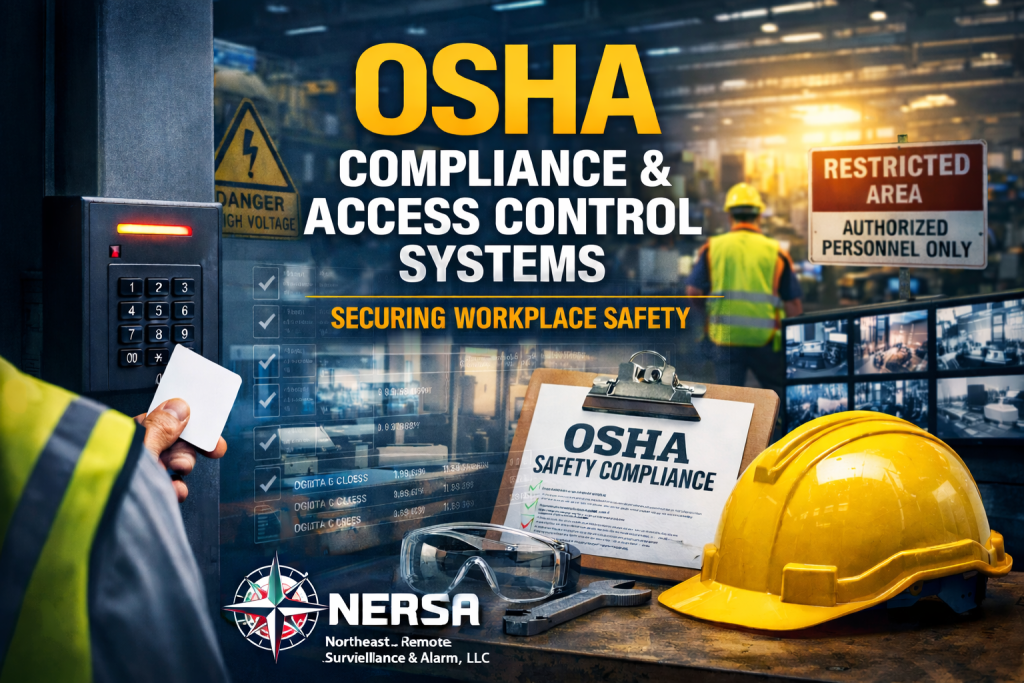
Understanding OSHA’s Relationship to Access Control
OSHA’s regulatory framework focuses on:
- Hazard identification and mitigation
- Exposure prevention
- Training enforcement
- Incident documentation
- Accountability and supervision
Access control systems directly support these principles by preventing unqualified or unauthorized personnel from entering dangerous environments and by documenting compliance actions automatically.
Why OSHA Compliance Often Fails Without Access Control
Facilities relying on:
- Mechanical keys
- Shared credentials
- Manual sign-in logs
- Honor-based safety policies
often struggle to demonstrate:
- Who accessed restricted areas
- Whether training requirements were enforced
- Whether safety violations were preventable
- Whether corrective actions were taken
Electronic access control eliminates these gaps.
How Access Control Supports OSHA Hazard Prevention
1. Restricting Access to High-Risk Areas
OSHA requires employers to prevent unnecessary exposure to hazards such as:
- Heavy machinery
- Electrical systems
- Chemical storage
- Confined spaces
- Active loading docks
Access control systems enforce:
- Role-based access
- Training-dependent permissions
- Time-based access windows
- Contractor restrictions
This ensures only authorized and trained personnel can enter high-risk zones.
2. Enforcing Training & Certification Requirements
Many OSHA standards require employees to be trained or certified before performing specific tasks.
Access control systems can:
- Tie credentials to training status
- Prevent access when certifications expire
- Restrict contractors to approved areas
- Automatically enforce safety policy changes
This moves training enforcement from policy to system-level control.
3. Improving Accountability & Supervision
Access control creates automatic accountability by logging:
- Who entered
- Where they entered
- When access occurred
- Whether access was attempted or denied
These logs help demonstrate active enforcement, a key factor during OSHA inspections.
Access Control & OSHA Incident Investigations
After an incident, OSHA investigations often focus on:
- Who was present
- Whether access was authorized
- Whether safety rules were enforced
- Whether the incident was foreseeable
Access control systems provide:
- Verifiable access logs
- Time-stamped entry data
- Correlation with video surveillance
- Proof of restricted access enforcement
This documentation can significantly reduce liability exposure.
Reducing OSHA Citations Through Proactive Access Control
OSHA citations often stem from:
- Unauthorized access
- Lack of supervision
- Inadequate enforcement
- Failure to restrict hazards
Access control systems demonstrate:
- Proactive risk management
- Enforced safety boundaries
- Continuous compliance monitoring
- Documented corrective action
This positions organizations favorably during inspections.
Access Control & Emergency Response
OSHA requires clear emergency action planning.
Access control supports emergency response by:
- Automatically unlocking egress doors
- Restricting access during incidents
- Supporting lockdown or evacuation protocols
- Providing real-time access visibility during emergencies
Integrated systems improve situational awareness and coordination.
Enterprise Access Control also meets NFPA 101 / NFPA 72 by controlling door locks in emergency situations.
Life Safety & Alarm Integration
Use to support:
- Emergency unlock behavior
- Alarm integration
- Life-safety alignment
Access Control & Workplace Violence Prevention
OSHA increasingly recognizes workplace violence as a serious safety concern.
Access control helps mitigate risk by:
- Verifying visitors and contractors
- Restricting unauthorized entry
- Logging interactions and access attempts
- Supporting investigations if incidents occur
This is critical for healthcare, logistics, education, and public-facing facilities.
Industrial & High-Risk Environments That Benefit Most
Access control systems are especially valuable in:
- Manufacturing plants
- Warehouses & distribution centers
- Logistics terminals
- Energy & utilities
- Construction sites
- Multi-tenant industrial campuses
These environments carry elevated OSHA exposure risk.
Integrating Access Control Into Unified Security Systems
Access control is most effective when integrated with:
- Video surveillance
- Alarm systems
- Centralized security management platforms
Unified systems allow:
- Visual verification of access events
- Automated incident timelines
- Cross-system reporting
- Enterprise-level compliance oversight
This integration significantly strengthens OSHA support.
How NERSA Designs OSHA-Supportive Access Control Systems
NERSA follows a structured, enterprise-focused approach:
- OSHA exposure point assessment
- Hazard zone identification
- Access zoning and credential design
- Integration with surveillance and alarms
- Professional, code-compliant installation
- Testing and validation
- Training and documentation support
- Ongoing system optimization
Each system is tailored to operational risk, not generic templates.
Long-Term OSHA Compliance Benefits of Access Control
Properly deployed access control systems:
- Reduce workplace injuries
- Improve safety culture
- Support audits and inspections
- Strengthen incident defense
- Scale as regulations evolve
They transform access control from a security tool into a compliance asset.
Why Choose Northeast Remote Surveillance and Alarm, LLC
NERSA specializes in enterprise and industrial access control systems, not residential installations.
What Sets NERSA Apart
- OSHA-aware system design
- Commercial & industrial focus
- Unified security expertise
- Clean, code-compliant installations
- Scalable enterprise platforms
- Service across PA, NJ, and DE
Call to Action
If your organization needs controlled access, documented enforcement, and defensible OSHA compliance, access control must be part of your safety strategy.
📞 Schedule an OSHA-focused access control assessment with
Northeast Remote Surveillance and Alarm, LLC
OSHA + Access Control Systems — Enterprise FAQ
1. Does OSHA require access control systems?
OSHA does not mandate specific access control technologies, but it requires employers to control hazards, restrict unauthorized access, and prevent exposure. Electronic access control systems directly support these obligations.
2. How does access control support OSHA compliance?
Access control supports OSHA compliance by preventing untrained or unauthorized personnel from entering hazardous areas, enforcing safety policies automatically, and creating verifiable access records.
3. What OSHA issues are most commonly linked to poor access control?
Common OSHA issues related to access control include:
- Unauthorized access to machinery
- Untrained personnel entering restricted areas
- Inadequate supervision
- Lack of enforcement documentation
4. Can access control systems help prevent OSHA citations?
Yes. Access control systems demonstrate proactive hazard mitigation and enforcement, which can reduce the likelihood of OSHA citations related to unauthorized access or inadequate controls.
5. How does access control help with OSHA inspections?
During inspections, access control provides:
- Access logs
- Time-stamped entry records
- Proof of restricted access
- Documentation of enforcement actions
These records help demonstrate active compliance efforts.
6. Can access control enforce OSHA training requirements?
Yes. Access credentials can be tied to training status or certifications, preventing access when training is incomplete or expired.
7. How does access control improve workplace accountability?
Access control systems log who entered, where, and when, creating accountability for safety compliance and supporting investigations.
8. Is access control useful for OSHA incident investigations?
Absolutely. Access logs help establish:
- Who was present
- Whether access was authorized
- Whether exposure was preventable
This information is critical during OSHA investigations.
9. How does access control reduce unauthorized access to hazardous areas?
Electronic access control eliminates shared keys and manual sign-in logs, replacing them with credential-based, enforceable entry rules.
10. Can access control systems reduce workplace accidents?
Yes. By preventing unauthorized or untrained access, access control reduces the likelihood of accidents, near misses, and unsafe interactions with equipment.
11. How does access control support OSHA emergency procedures?
Access control systems can:
- Automatically unlock egress doors
- Restrict access during emergencies
- Support evacuation and lockdown protocols
These functions support OSHA emergency action planning.
12. Is access control important for industrial OSHA environments?
Yes. Industrial facilities have higher OSHA exposure risk due to machinery, electrical systems, and hazardous materials. Access control is especially critical in these environments.
13. Can access control help manage contractor OSHA compliance?
Yes. Access control restricts contractors to approved areas and timeframes, reducing liability and ensuring OSHA contractor safety rules are enforced.
14. How does access control support OSHA recordkeeping?
Access logs provide digital, time-stamped records that support OSHA documentation and record retention requirements.
15. Does access control help with OSHA near-miss reporting?
Yes. Access data combined with video surveillance helps organizations identify and document near-miss events, which OSHA encourages as part of proactive safety programs.
16. Can access control systems integrate with video surveillance for OSHA purposes?
Yes. When integrated, access control and video surveillance provide visual verification of access events, strengthening compliance documentation and investigations.
17. How does access control support OSHA accountability requirements?
Access control ensures that safety rules are enforced consistently, not left to manual supervision or policy alone.
18. Are access control systems scalable as OSHA requirements change?
Yes. Enterprise access control systems can be updated to reflect new hazard zones, new training requirements, or regulatory changes.
19. Can access control help prevent workplace violence OSHA issues?
Yes. Access control restricts unauthorized entry, verifies visitors, and logs interactions—important measures as OSHA increasingly addresses workplace violence risks.
20. What types of facilities benefit most from OSHA-focused access control?
Facilities with elevated OSHA exposure, including:
- Manufacturing plants
- Warehouses and distribution centers
- Logistics hubs
- Energy and utility sites
- Construction and infrastructure projects
21. Does OSHA accept access control data during inspections?
While not required, access control records are commonly used as supporting evidence during OSHA inspections and investigations.
22. How does access control improve coordination between safety and security teams?
Access control provides shared data that allows EHS, operations, HR, and security teams to work from a single source of truth.
23. Can access control systems reduce insurance and liability risk?
Yes. Enforced access controls and documented compliance can reduce insurance claims, liability exposure, and dispute risk following incidents.
24. How does access control fit into a unified security strategy?
Access control is a core component of unified security systems, working alongside cameras, alarms, and centralized management to support OSHA compliance holistically.
25. Who installs OSHA-supportive access control systems?
Northeast Remote Surveillance and Alarm, LLC (NERSA) specializes in enterprise and industrial access control systems designed to support OSHA safety objectives and long-term compliance.
This page closes the loop between policy, enforcement, and proof — exactly what OSHA-driven enterprises need.