
Control commercial doors, gates, users, schedules, and credentials with access systems designed around the complete opening and daily operation.
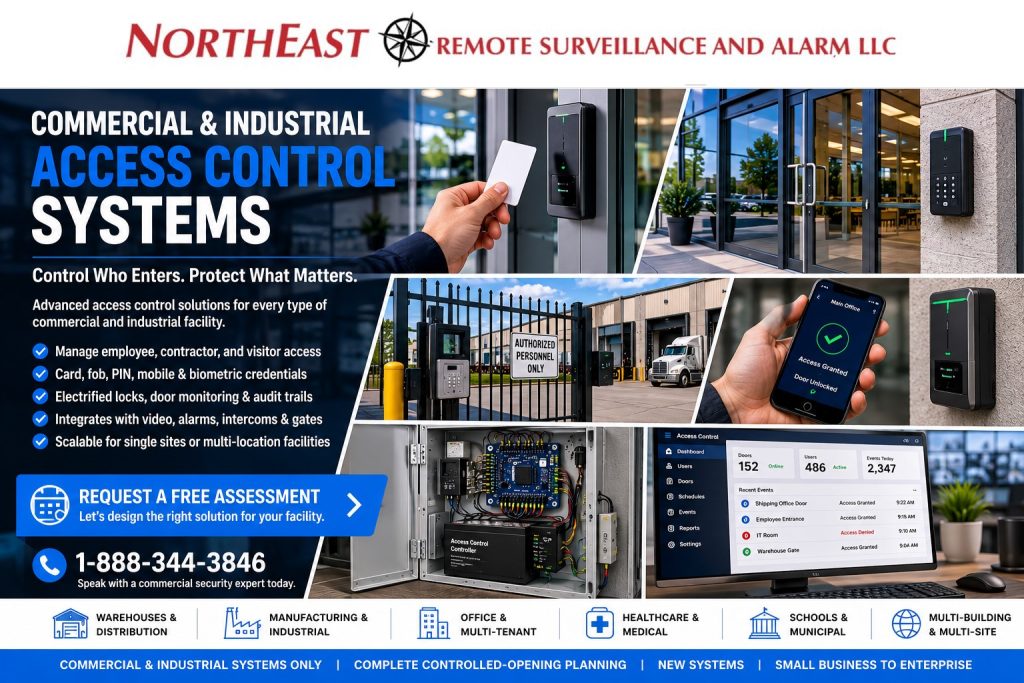
Plan Who Can Enter, Where, and When
Northeast Remote Surveillance and Alarm, LLC designs, installs, upgrades, integrates, and supports nonresidential access control for warehouses, manufacturers, offices, healthcare properties, schools, municipalities, industrial sites, contractor operations, commercial campuses, multi-tenant buildings, and multi-location organizations.
Planning begins with people and operations: employees, visitors, contractors, tenants, administrators, delivery personnel, restricted areas, operating schedules, emergency procedures, and employee turnover. Access control replaces some key-management problems with a system that must still be administered responsibly.
Choose Credentials, Users, and Permissions
Systems may use cards, fobs, PINs, mobile credentials, smart credentials, or selected biometric methods depending on the platform, property, risk, privacy requirements, and operating workflow. The credential should be chosen after user volume, issuance, replacement, revocation, shared-device practices, and recurring costs are understood.
- Assign individual users when practical instead of sharing credentials.
- Limit access by door, area, schedule, role, tenant, department, or location.
- Define temporary access and automatic expiration for contractors or visitors.
- Remove former users promptly and review administrator privileges regularly.
- Use understandable door names, event descriptions, reports, and audit history.
Design the Complete Controlled Opening
A reader alone does not make a controlled door. The complete opening can include the door, frame, hinges, closer, latch, panic device, electric strike, electrified trim, magnetic lock, power transfer, request-to-exit device, position switch, controller, power supply, backup battery, cabling, pathways, fire-alarm interface, and emergency release.
Locking hardware and behavior must suit the opening, occupancy, fire rating, accessibility, required egress, emergency operation, and applicable requirements. Fail-safe and fail-secure describe how specific locks behave when power is removed; the correct choice depends on the opening and approved design. Review commercial security code and compliance planning.
Choose Cloud, On-Premise, or Hybrid Management
Cloud-managed access control can simplify browser or mobile administration, software updates, multi-site management, and remote support, but may require recurring licenses and dependable communications. On-premise systems can provide local operation and customer-controlled infrastructure, with different server, software, backup, remote-access, and maintenance responsibilities. Hybrid designs combine selected local and cloud functions.
Internet loss should not automatically unlock doors or erase permissions, but remote administration, notifications, and cloud functions may be affected. The proposal should explain controller behavior, cached credentials, communication supervision, backup power, hosting, data ownership, account access, cybersecurity responsibilities, and service renewal terms.
Coordinate Video, Alarms, Visitors, and Gates
Compatible access control may work with video surveillance, intrusion alarms, intercoms, visitor workflows, elevators, and vehicle gates when integration solves a defined problem. An access event records the credential presented; it does not necessarily prove which physical person entered.
- Video can associate a door event with a relevant camera view.
- Alarm coordination can support approved arming, forced-door, or after-hours workflows.
- Intercoms can help staff communicate with visitors before releasing a suitable entrance.
- Gate systems may coordinate vehicle credentials, intercoms, position monitoring, cameras, and safe operating controls.
Plan Cost, Infrastructure, and Existing-System Reuse
Cost depends on the opening and installed scope—not only the reader. Door hardware, frames, exit devices, pathways, cable distance, controllers, power, credentials, software, integrations, permits, inspections, site conditions, and working hours can change the price substantially.
Use the commercial access-control cost guide for per-door planning ranges. Existing readers, locks, controllers, cabling, power supplies, credentials, software, and accounts should be evaluated for condition, ownership, compatibility, capacity, cybersecurity, documentation, and support before replacement.
Project Process and Customer Control
- Review openings, hardware, users, schedules, visitors, restricted areas, infrastructure, existing systems, and future needs.
- Define credentials, permissions, door behavior, controller architecture, hosting, integrations, and life-safety coordination.
- Document equipment, general locations, pathways, software, recurring services, customer responsibilities, exclusions, testing, and training.
- Install, program, label, commission, test, and provide role-appropriate instruction and documentation.
Authorized customers should retain administrator access and understand user management, schedules, credentials, reports, backups, remote access, licensing, support contacts, and emergency procedures. Multi-site organizations may use consistent standards without forcing every location into an identical design.
Frequently Asked Questions
How is access control different from mechanical keys?
Credentials can be assigned, scheduled, logged, and revoked without rekeying every affected opening. The system still requires correct hardware, administration, monitoring, maintenance, and user procedures.
Can access control work if internet service fails?
Many properly designed systems retain approved local door functions and cached permissions, while cloud administration, notifications, or remote access may be interrupted. Exact behavior depends on the architecture.
Can existing access-control equipment be reused?
Sometimes. Hardware, controllers, readers, cabling, credentials, software, accounts, and power should be evaluated for ownership, condition, compatibility, capacity, security, documentation, and supportability.
How much does commercial access control cost?
Simple openings may cost much less than exterior, storefront, warehouse, panic-device, gate, or multi-building applications. Accurate pricing requires an opening-by-opening review; use our linked cost guide for practical planning ranges.
Request an Access-Control Assessment
Tell us which doors or gates are involved, who needs access, what hardware is present, and what the finished system must accomplish. Request a commercial access-control assessment or call 1-888-344-3846.