Contractor yards create a unique security problem.
Unlike a conventional office or warehouse, these properties often contain work trucks, trailers, tools, heavy equipment, building materials, fuel, outdoor storage, gates, and large perimeter areas that may remain exposed after normal business hours.
Northeast Remote Surveillance and Alarm, LLC (NERSA) designs and installs professional contractor yard video surveillance systems in Scranton, Pennsylvania for commercial and industrial businesses that need better visibility across outdoor assets, vehicle entrances, storage areas, and facility perimeters.
This spindle is intentionally focused on one primary intent: video surveillance for contractor yards and exterior commercial equipment areas in Scranton, PA.
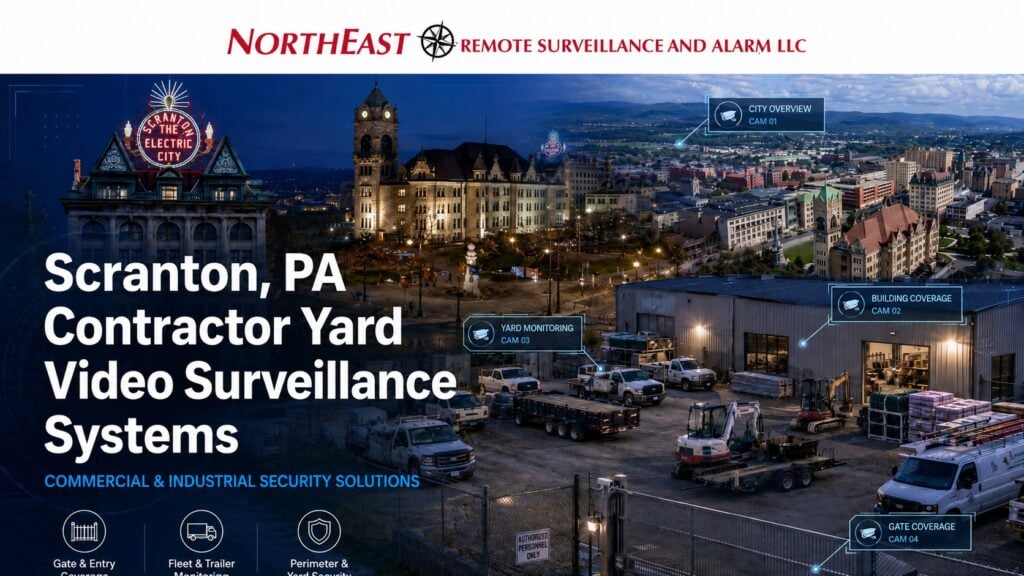
Contractor Yard Video Surveillance in Scranton, PA
A properly designed contractor yard surveillance system should help management answer questions such as:
- Who entered the property?
- What vehicle entered or left?
- Was equipment removed after hours?
- Was a trailer moved?
- Who approached a storage area?
- Was fuel or material taken?
- Was a gate left open?
- Did a vehicle strike equipment or fencing?
- Was someone inside the yard after operating hours?
- What happened before an alarm was triggered?
The goal is not simply to record a large outdoor area.
The goal is to create usable visual evidence and actionable situational awareness across the parts of the property where valuable assets are stored.
Why Contractor Yards Require Specialized Surveillance Design
Outdoor contractor yards are difficult environments for conventional security cameras.
Common challenges include:
- Large open areas
- Long viewing distances
- Changing equipment locations
- Trucks and trailers blocking camera views
- Limited exterior lighting
- Weather exposure
- Perimeter fencing
- Vehicle headlights
- Seasonal darkness
- Remote sections of the property
- Multiple entrances or gates
- Materials stacked at different heights
A camera that works well at a building entrance may perform poorly when asked to monitor a distant excavator, trailer, or gate.
Contractor yard surveillance should therefore be designed around specific security objectives rather than camera quantity alone.
Yard Perimeter Surveillance
The perimeter is often one of the first areas that should be evaluated.
Important locations may include:
- Fence lines
- Rear property boundaries
- Side access areas
- Remote storage sections
- Adjacent roads
- Tree lines
- Uncontrolled pedestrian approaches
Perimeter cameras can help establish when and where a person or vehicle entered the property.
Depending on the site, surveillance may use a combination of fixed cameras, long-range cameras, analytics, or other technologies.
Vehicle Gate Surveillance
Vehicle entrances are among the highest-value surveillance points in a contractor yard.
Camera design may need to document:
- Incoming trucks
- Employee vehicles
- Vendor vehicles
- Delivery drivers
- Trailers
- Service vehicles
- After-hours vehicle activity
A gate surveillance design may combine an overview camera with a closer vehicle identification view.
Where license plates must be reliably captured, a dedicated LPR camera should be considered.
License Plate Recognition for Contractor Yards
License plate recognition can provide additional vehicle documentation at controlled entrances and exits.
Reliable plate capture depends on:
- Vehicle speed
- Camera angle
- Lane width
- Capture distance
- Mounting height
- Lighting
- Headlight glare
- Lens selection
- Exposure configuration
A general yard camera should not automatically be expected to capture readable license plates.
Where vehicle identification is important, the capture point should be engineered specifically for LPR.
Work Truck and Fleet Monitoring
Many contractor yards contain significant fleet assets.
Video surveillance can help monitor:
- Service trucks
- Utility vehicles
- Vans
- Dump trucks
- Pickup trucks
- Specialty vehicles
- Fleet parking areas
Recorded video may help investigate:
- Unauthorized vehicle use
- After-hours movement
- Vehicle damage
- Theft
- Property collisions
- Entry and exit activity
Fleet surveillance should be coordinated with gate coverage whenever possible so vehicle movement can be followed through the property.
Trailer Surveillance
Trailers are frequently stored outdoors and may contain valuable tools, equipment, or materials.
Camera coverage may include:
- Trailer rows
- Hitch areas
- Storage locations
- Gate approaches
- High-value trailers
- Remote sections of the yard
Surveillance can help determine when trailers were moved and what activity occurred around them.
Heavy Equipment Surveillance
Contractor yards may contain high-value equipment such as:
- Excavators
- Skid steers
- Loaders
- Lifts
- Compressors
- Generators
- Trenchers
- Specialized construction machinery
Equipment may move throughout the property as operations change.
Camera design should account for changing storage locations and avoid relying on a single narrow viewing angle.
Wide-area coverage can provide context while dedicated cameras may be used for high-value areas.
Tool and Material Storage Areas
Exterior storage can include:
- Copper
- Wire
- Pipe
- Conduit
- Lumber
- Electrical equipment
- HVAC equipment
- Construction materials
- Tools
- Job boxes
These areas may require more detailed camera coverage because individual items can be smaller than vehicles or heavy machinery.
The camera should provide enough detail to document meaningful activity rather than simply showing that someone was present.
AI Video Analytics for Contractor Yards
Modern video-surveillance systems may use analytics to classify activity.
Depending on the platform, analytics may identify:
- People
- Vehicles
- Movement direction
- Restricted-area entry
- Line crossing
- Loitering
- After-hours activity
Analytics can help reduce the amount of routine footage requiring manual review.
They may also support proactive notification when activity occurs in selected areas during defined schedules.
After-Hours Yard Security
Many contractor yards are most vulnerable when normal operations stop.
Potential after-hours concerns include:
- Trespassing
- Equipment theft
- Trailer theft
- Tool theft
- Fuel theft
- Material theft
- Fence breaches
- Unauthorized vehicle entry
- Vandalism
A surveillance system may be configured around defined nighttime or weekend detection zones.
The system should distinguish as accurately as possible between relevant activity and ordinary environmental movement.
Remote Video Monitoring
Remote video monitoring may add another layer of protection for selected contractor yards.
Depending on the surveillance platform and monitoring strategy, analytics may identify defined activity and present selected events for review.
Potential monitoring areas include:
- Gates
- Perimeters
- Equipment storage
- Trailer rows
- Fuel areas
- Remote sections of the yard
Remote monitoring works best when detection zones and response procedures are clearly defined.
Nighttime and Low-Light Surveillance
Contractor yards frequently have uneven exterior lighting.
Some sections may be brightly illuminated while others remain extremely dark.
Camera planning should consider:
- Existing pole lights
- Building-mounted lighting
- Headlights
- Shadows
- Distance
- Reflective materials
- Seasonal lighting conditions
Depending on the location, cameras may use:
- Infrared illumination
- Enhanced low-light imaging
- Wide dynamic range
- Supplemental lighting
Camera selection should be based on actual nighttime conditions.
Thermal Cameras for Perimeter Applications
Some large or difficult exterior environments may benefit from thermal surveillance.
Thermal cameras detect differences in heat rather than relying entirely on visible light.
Potential applications may include:
- Long perimeter areas
- Poorly illuminated sections
- Remote property boundaries
- Large equipment yards
Thermal technology can be useful for detection, but a visible-light camera may still be required when visual identification is needed.
Contractor Yard Camera Placement
Effective placement depends on what the camera must accomplish.
Important factors include:
- Mounting height
- Distance
- Lens selection
- Lighting
- Equipment obstructions
- Fence lines
- Gate location
- Vehicle direction
- Property layout
Cameras mounted extremely high may provide impressive overview images but insufficient detail for identification.
A properly designed system often combines overview cameras with targeted identification cameras.
Building Exterior Coverage
Contractor yards frequently contain an office, shop, warehouse, or maintenance building.
Exterior coverage may include:
- Employee entrances
- Overhead doors
- Shop entrances
- Material storage
- Service areas
- Building corners
- Utility equipment
Building-mounted cameras can also support broader yard coverage when mounting positions provide appropriate viewing angles.
Video Surveillance and Access Control
Contractor facilities may use access control on offices, warehouses, shops, or controlled gates.
Video integration can provide context around access events.
An investigation may include:
- Credential used
- Gate or door accessed
- Event time
- Associated video footage
This can be particularly useful when multiple employees, subcontractors, or drivers use the property.
Video-Verified Intrusion Detection
Video surveillance can also support intrusion protection.
When an alarm occurs at a building, gate, or perimeter area, associated video may provide additional information about what caused the event.
Potential events include:
- Gate activation
- Door alarm
- Motion detection
- Perimeter breach
- After-hours movement
Video verification can help authorized personnel evaluate the event more efficiently.
Network Infrastructure for Outdoor Camera Systems
Contractor yards can create significant networking challenges.
Cameras may be located:
- On buildings
- On poles
- At gates
- Along fences
- Across large open areas
- On remote structures
Infrastructure may include:
- Cat6 cabling
- Fiber-optic cabling
- PoE switches
- Wireless bridges
- Equipment enclosures
- Surge protection
- UPS backup
- Outdoor-rated hardware
Fiber or properly engineered wireless connections may be appropriate where remote camera locations are beyond practical Ethernet distances.
Surge and Environmental Protection
Exterior surveillance equipment is exposed to harsher conditions than indoor cameras.
System planning should account for:
- Rain
- Snow
- Ice
- Temperature changes
- Lightning
- Electrical surges
- Wind
- Dust
Outdoor enclosures, appropriate mounting hardware, grounding, and surge protection should be considered where required.
Recording and Video Retention
Contractor-yard incidents may not be discovered immediately.
An organization may therefore require enough retention to investigate activity that occurred days or weeks earlier.
Storage requirements depend on:
- Camera count
- Resolution
- Frame rate
- Compression
- Scene activity
- Recording schedule
- Retention requirements
Storage should be calculated during system design.
Existing Contractor Yard Camera Upgrades
Older surveillance systems may not require complete replacement.
An assessment can determine whether existing:
- IP cameras
- Cabling
- Fiber
- Poles
- Network switches
- Recording servers
- Storage infrastructure
can continue to be used.
Upgrade projects may focus on:
- Poor nighttime images
- Blind spots
- Obsolete cameras
- Outdated recording platforms
- Insufficient storage
- Weak remote access
- Lack of analytics
- Poor cybersecurity
- Perimeter gaps
Common Contractor Yard Surveillance Mistakes
Common design problems include:
- Trying to cover the entire yard with one camera
- Cameras mounted too far from the target
- No dedicated gate coverage
- No license plate camera where plates are important
- Blind spots behind trailers or equipment
- Poor nighttime performance
- Insufficient perimeter coverage
- Cameras mounted where equipment regularly blocks the view
- No recording-retention planning
- Inadequate network or PoE capacity
Correcting these issues after installation can be significantly more difficult than addressing them during the design phase.
Scranton Contractor Yard Video Surveillance Planning Checklist
Before installing or upgrading a contractor-yard surveillance system, evaluate:
- How many property entrances exist?
- Is there one controlled vehicle gate?
- Are license plates important?
- Which equipment is highest value?
- Where are trailers stored?
- Are tools or materials stored outdoors?
- Which perimeter areas are most vulnerable?
- Is after-hours activity a major concern?
- Are AI analytics required?
- Is remote video monitoring needed?
- How much nighttime lighting exists?
- Are remote camera poles required?
- Is fiber or wireless connectivity required?
- How long should video be retained?
- Should surveillance integrate with access control or intrusion detection?
- How much future yard expansion is anticipated?
Contractor Yard Surveillance for Scranton Commercial Operations
A well-designed contractor-yard surveillance system should coordinate multiple security functions rather than treating every camera independently.
A complete strategy may include:
gate cameras + fleet surveillance + equipment coverage + trailer monitoring + perimeter cameras + LPR + analytics + recording + intrusion verification + network infrastructure.
The system should be designed around the actual property, operating schedule, vehicle flow, asset locations, and risk profile.
Northeast Remote Surveillance and Alarm, LLC
Northeast Remote Surveillance and Alarm, LLC (NERSA) designs and installs professional commercial and industrial security systems throughout Scranton and Northeastern Pennsylvania.
NERSA contractor-yard solutions may incorporate:
- Commercial video surveillance
- AI video analytics
- Perimeter surveillance
- License plate recognition
- Remote video monitoring
- Access control
- Intrusion detection
- Network infrastructure
- Fiber and wireless connectivity
For broader Scranton video surveillance planning, continue to the primary:
Scranton, PA Commercial Video Surveillance Systems
For the broader regional security architecture, continue to:
Northeastern Pennsylvania Commercial & Industrial Security Systems
Request a Contractor Yard Video Surveillance Assessment
For professional contractor-yard surveillance design and installation in Scranton, Pennsylvania, contact Northeast Remote Surveillance and Alarm, LLC (NERSA) at 1-888-344-3846.
Frequently Asked Questions
What cameras are best for contractor yards?
The correct camera depends on the surveillance objective. Contractor yards may use fixed, multi-sensor, long-range, low-light, thermal, PTZ, and dedicated LPR cameras in different parts of the property.
How should a contractor yard gate be monitored?
A strong gate design may combine an overview camera with a closer vehicle-identification view. Dedicated LPR may be appropriate when reliable license plate capture is required.
Can cameras monitor construction equipment after hours?
Yes. Cameras and properly configured analytics can monitor selected equipment and storage areas for defined after-hours activity.
Can video surveillance protect trailers?
Video surveillance can document activity around trailer storage areas, hitches, gates, and yard access points and can support investigations if trailers are moved or tampered with.
Can contractor yard cameras detect people at night?
Modern low-light, infrared, thermal, and analytics-enabled systems can improve nighttime detection, depending on the environment and system design.
Can AI analytics identify vehicles and people?
Many commercial surveillance platforms can classify people and vehicles and apply rules to selected areas. Capabilities vary by platform and configuration.
Can contractor-yard surveillance include license plate recognition?
Yes. Dedicated LPR cameras can be installed at appropriately designed entrances or exits when plate capture is required.
Can yard cameras integrate with access control?
Yes. Video can be associated with gate and door events to provide additional context during investigations.
Can cameras be installed far from the main building?
Yes. Remote cameras may use fiber, properly engineered wireless connectivity, or other network infrastructure depending on distance and site conditions.
Can an older contractor-yard camera system be upgraded?
Often it can. Existing cameras, cabling, fiber, poles, network equipment, and recording infrastructure may sometimes be retained when they remain compatible and serviceable.
Scranton, PA Contractor Yard Video Surveillance Systems
Contractor yards create a unique security problem.
Unlike a conventional office or warehouse, these properties often contain work trucks, trailers, tools, heavy equipment, building materials, fuel, outdoor storage, gates, and large perimeter areas that may remain exposed after normal business hours.
Northeast Remote Surveillance and Alarm, LLC (NERSA) designs and installs professional contractor yard video surveillance systems in Scranton, Pennsylvania for commercial and industrial businesses that need better visibility across outdoor assets, vehicle entrances, storage areas, and facility perimeters.
This spindle is intentionally focused on one primary intent: video surveillance for contractor yards and exterior commercial equipment areas in Scranton, PA.
Contractor Yard Video Surveillance in Scranton, PA
A properly designed contractor yard surveillance system should help management answer questions such as:
- Who entered the property?
- What vehicle entered or left?
- Was equipment removed after hours?
- Was a trailer moved?
- Who approached a storage area?
- Was fuel or material taken?
- Was a gate left open?
- Did a vehicle strike equipment or fencing?
- Was someone inside the yard after operating hours?
- What happened before an alarm was triggered?
The goal is not simply to record a large outdoor area.
The goal is to create usable visual evidence and actionable situational awareness across the parts of the property where valuable assets are stored.
Why Contractor Yards Require Specialized Surveillance Design
Outdoor contractor yards are difficult environments for conventional security cameras.
Common challenges include:
- Large open areas
- Long viewing distances
- Changing equipment locations
- Trucks and trailers blocking camera views
- Limited exterior lighting
- Weather exposure
- Perimeter fencing
- Vehicle headlights
- Seasonal darkness
- Remote sections of the property
- Multiple entrances or gates
- Materials stacked at different heights
A camera that works well at a building entrance may perform poorly when asked to monitor a distant excavator, trailer, or gate.
Contractor yard surveillance should therefore be designed around specific security objectives rather than camera quantity alone.
Yard Perimeter Surveillance
The perimeter is often one of the first areas that should be evaluated.
Important locations may include:
- Fence lines
- Rear property boundaries
- Side access areas
- Remote storage sections
- Adjacent roads
- Tree lines
- Uncontrolled pedestrian approaches
Perimeter cameras can help establish when and where a person or vehicle entered the property.
Depending on the site, surveillance may use a combination of fixed cameras, long-range cameras, analytics, or other technologies.
Vehicle Gate Surveillance
Vehicle entrances are among the highest-value surveillance points in a contractor yard.
Camera design may need to document:
- Incoming trucks
- Employee vehicles
- Vendor vehicles
- Delivery drivers
- Trailers
- Service vehicles
- After-hours vehicle activity
A gate surveillance design may combine an overview camera with a closer vehicle identification view.
Where license plates must be reliably captured, a dedicated LPR camera should be considered.
License Plate Recognition for Contractor Yards
License plate recognition can provide additional vehicle documentation at controlled entrances and exits.
Reliable plate capture depends on:
- Vehicle speed
- Camera angle
- Lane width
- Capture distance
- Mounting height
- Lighting
- Headlight glare
- Lens selection
- Exposure configuration
A general yard camera should not automatically be expected to capture readable license plates.
Where vehicle identification is important, the capture point should be engineered specifically for LPR.
Work Truck and Fleet Monitoring
Many contractor yards contain significant fleet assets.
Video surveillance can help monitor:
- Service trucks
- Utility vehicles
- Vans
- Dump trucks
- Pickup trucks
- Specialty vehicles
- Fleet parking areas
Recorded video may help investigate:
- Unauthorized vehicle use
- After-hours movement
- Vehicle damage
- Theft
- Property collisions
- Entry and exit activity
Fleet surveillance should be coordinated with gate coverage whenever possible so vehicle movement can be followed through the property.
Trailer Surveillance
Trailers are frequently stored outdoors and may contain valuable tools, equipment, or materials.
Camera coverage may include:
- Trailer rows
- Hitch areas
- Storage locations
- Gate approaches
- High-value trailers
- Remote sections of the yard
Surveillance can help determine when trailers were moved and what activity occurred around them.
Heavy Equipment Surveillance
Contractor yards may contain high-value equipment such as:
- Excavators
- Skid steers
- Loaders
- Lifts
- Compressors
- Generators
- Trenchers
- Specialized construction machinery
Equipment may move throughout the property as operations change.
Camera design should account for changing storage locations and avoid relying on a single narrow viewing angle.
Wide-area coverage can provide context while dedicated cameras may be used for high-value areas.
Tool and Material Storage Areas
Exterior storage can include:
- Copper
- Wire
- Pipe
- Conduit
- Lumber
- Electrical equipment
- HVAC equipment
- Construction materials
- Tools
- Job boxes
These areas may require more detailed camera coverage because individual items can be smaller than vehicles or heavy machinery.
The camera should provide enough detail to document meaningful activity rather than simply showing that someone was present.
AI Video Analytics for Contractor Yards
Modern video-surveillance systems may use analytics to classify activity.
Depending on the platform, analytics may identify:
- People
- Vehicles
- Movement direction
- Restricted-area entry
- Line crossing
- Loitering
- After-hours activity
Analytics can help reduce the amount of routine footage requiring manual review.
They may also support proactive notification when activity occurs in selected areas during defined schedules.
After-Hours Yard Security
Many contractor yards are most vulnerable when normal operations stop.
Potential after-hours concerns include:
- Trespassing
- Equipment theft
- Trailer theft
- Tool theft
- Fuel theft
- Material theft
- Fence breaches
- Unauthorized vehicle entry
- Vandalism
A surveillance system may be configured around defined nighttime or weekend detection zones.
The system should distinguish as accurately as possible between relevant activity and ordinary environmental movement.
Remote Video Monitoring
Remote video monitoring may add another layer of protection for selected contractor yards.
Depending on the surveillance platform and monitoring strategy, analytics may identify defined activity and present selected events for review.
Potential monitoring areas include:
- Gates
- Perimeters
- Equipment storage
- Trailer rows
- Fuel areas
- Remote sections of the yard
Remote monitoring works best when detection zones and response procedures are clearly defined.
Nighttime and Low-Light Surveillance
Contractor yards frequently have uneven exterior lighting.
Some sections may be brightly illuminated while others remain extremely dark.
Camera planning should consider:
- Existing pole lights
- Building-mounted lighting
- Headlights
- Shadows
- Distance
- Reflective materials
- Seasonal lighting conditions
Depending on the location, cameras may use:
- Infrared illumination
- Enhanced low-light imaging
- Wide dynamic range
- Supplemental lighting
Camera selection should be based on actual nighttime conditions.
Thermal Cameras for Perimeter Applications
Some large or difficult exterior environments may benefit from thermal surveillance.
Thermal cameras detect differences in heat rather than relying entirely on visible light.
Potential applications may include:
- Long perimeter areas
- Poorly illuminated sections
- Remote property boundaries
- Large equipment yards
Thermal technology can be useful for detection, but a visible-light camera may still be required when visual identification is needed.
Contractor Yard Camera Placement
Effective placement depends on what the camera must accomplish.
Important factors include:
- Mounting height
- Distance
- Lens selection
- Lighting
- Equipment obstructions
- Fence lines
- Gate location
- Vehicle direction
- Property layout
Cameras mounted extremely high may provide impressive overview images but insufficient detail for identification.
A properly designed system often combines overview cameras with targeted identification cameras.
Building Exterior Coverage
Contractor yards frequently contain an office, shop, warehouse, or maintenance building.
Exterior coverage may include:
- Employee entrances
- Overhead doors
- Shop entrances
- Material storage
- Service areas
- Building corners
- Utility equipment
Building-mounted cameras can also support broader yard coverage when mounting positions provide appropriate viewing angles.
Video Surveillance and Access Control
Contractor facilities may use access control on offices, warehouses, shops, or controlled gates.
Video integration can provide context around access events.
An investigation may include:
- Credential used
- Gate or door accessed
- Event time
- Associated video footage
This can be particularly useful when multiple employees, subcontractors, or drivers use the property.
Video-Verified Intrusion Detection
Video surveillance can also support intrusion protection.
When an alarm occurs at a building, gate, or perimeter area, associated video may provide additional information about what caused the event.
Potential events include:
- Gate activation
- Door alarm
- Motion detection
- Perimeter breach
- After-hours movement
Video verification can help authorized personnel evaluate the event more efficiently.
Network Infrastructure for Outdoor Camera Systems
Contractor yards can create significant networking challenges.
Cameras may be located:
- On buildings
- On poles
- At gates
- Along fences
- Across large open areas
- On remote structures
Infrastructure may include:
- Cat6 cabling
- Fiber-optic cabling
- PoE switches
- Wireless bridges
- Equipment enclosures
- Surge protection
- UPS backup
- Outdoor-rated hardware
Fiber or properly engineered wireless connections may be appropriate where remote camera locations are beyond practical Ethernet distances.
Surge and Environmental Protection
Exterior surveillance equipment is exposed to harsher conditions than indoor cameras.
System planning should account for:
- Rain
- Snow
- Ice
- Temperature changes
- Lightning
- Electrical surges
- Wind
- Dust
Outdoor enclosures, appropriate mounting hardware, grounding, and surge protection should be considered where required.
Recording and Video Retention
Contractor-yard incidents may not be discovered immediately.
An organization may therefore require enough retention to investigate activity that occurred days or weeks earlier.
Storage requirements depend on:
- Camera count
- Resolution
- Frame rate
- Compression
- Scene activity
- Recording schedule
- Retention requirements
Storage should be calculated during system design.
Existing Contractor Yard Camera Upgrades
Older surveillance systems may not require complete replacement.
An assessment can determine whether existing:
- IP cameras
- Cabling
- Fiber
- Poles
- Network switches
- Recording servers
- Storage infrastructure
can continue to be used.
Upgrade projects may focus on:
- Poor nighttime images
- Blind spots
- Obsolete cameras
- Outdated recording platforms
- Insufficient storage
- Weak remote access
- Lack of analytics
- Poor cybersecurity
- Perimeter gaps
Common Contractor Yard Surveillance Mistakes
Common design problems include:
- Trying to cover the entire yard with one camera
- Cameras mounted too far from the target
- No dedicated gate coverage
- No license plate camera where plates are important
- Blind spots behind trailers or equipment
- Poor nighttime performance
- Insufficient perimeter coverage
- Cameras mounted where equipment regularly blocks the view
- No recording-retention planning
- Inadequate network or PoE capacity
Correcting these issues after installation can be significantly more difficult than addressing them during the design phase.
Scranton Contractor Yard Video Surveillance Planning Checklist
Before installing or upgrading a contractor-yard surveillance system, evaluate:
- How many property entrances exist?
- Is there one controlled vehicle gate?
- Are license plates important?
- Which equipment is highest value?
- Where are trailers stored?
- Are tools or materials stored outdoors?
- Which perimeter areas are most vulnerable?
- Is after-hours activity a major concern?
- Are AI analytics required?
- Is remote video monitoring needed?
- How much nighttime lighting exists?
- Are remote camera poles required?
- Is fiber or wireless connectivity required?
- How long should video be retained?
- Should surveillance integrate with access control or intrusion detection?
- How much future yard expansion is anticipated?
Contractor Yard Surveillance for Scranton Commercial Operations
A well-designed contractor-yard surveillance system should coordinate multiple security functions rather than treating every camera independently.
A complete strategy may include:
gate cameras + fleet surveillance + equipment coverage + trailer monitoring + perimeter cameras + LPR + analytics + recording + intrusion verification + network infrastructure.
The system should be designed around the actual property, operating schedule, vehicle flow, asset locations, and risk profile.
Northeast Remote Surveillance and Alarm, LLC
Northeast Remote Surveillance and Alarm, LLC (NERSA) designs and installs professional commercial and industrial security systems throughout Scranton and Northeastern Pennsylvania.
NERSA contractor-yard solutions may incorporate:
- Commercial video surveillance
- AI video analytics
- Perimeter surveillance
- License plate recognition
- Remote video monitoring
- Access control
- Intrusion detection
- Network infrastructure
- Fiber and wireless connectivity
For broader Scranton video surveillance planning, continue to the primary:
Scranton, PA Commercial Video Surveillance Systems
For the broader regional security architecture, continue to:
Northeastern Pennsylvania Commercial & Industrial Security Systems
Request a Contractor Yard Video Surveillance Assessment
For professional contractor-yard surveillance design and installation in Scranton, Pennsylvania, contact Northeast Remote Surveillance and Alarm, LLC (NERSA) at 1-888-344-3846.
Frequently Asked Questions
What cameras are best for contractor yards?
The correct camera depends on the surveillance objective. Contractor yards may use fixed, multi-sensor, long-range, low-light, thermal, PTZ, and dedicated LPR cameras in different parts of the property.
How should a contractor yard gate be monitored?
A strong gate design may combine an overview camera with a closer vehicle-identification view. Dedicated LPR may be appropriate when reliable license plate capture is required.
Can cameras monitor construction equipment after hours?
Yes. Cameras and properly configured analytics can monitor selected equipment and storage areas for defined after-hours activity.
Can video surveillance protect trailers?
Video surveillance can document activity around trailer storage areas, hitches, gates, and yard access points and can support investigations if trailers are moved or tampered with.
Can contractor yard cameras detect people at night?
Modern low-light, infrared, thermal, and analytics-enabled systems can improve nighttime detection, depending on the environment and system design.
Can AI analytics identify vehicles and people?
Many commercial surveillance platforms can classify people and vehicles and apply rules to selected areas. Capabilities vary by platform and configuration.
Can contractor-yard surveillance include license plate recognition?
Yes. Dedicated LPR cameras can be installed at appropriately designed entrances or exits when plate capture is required.
Can yard cameras integrate with access control?
Yes. Video can be associated with gate and door events to provide additional context during investigations.
Can cameras be installed far from the main building?
Yes. Remote cameras may use fiber, properly engineered wireless connectivity, or other network infrastructure depending on distance and site conditions.
Can an older contractor-yard camera system be upgraded?
Often it can. Existing cameras, cabling, fiber, poles, network equipment, and recording infrastructure may sometimes be retained when they remain compatible and serviceable.