Thermal cameras for industrial facilities help detect people, vehicles, and activity in dark, low-visibility, exterior, and high-risk areas where standard cameras may struggle. Northeast Remote Surveillance and Alarm, LLC designs thermal camera systems for industrial properties, manufacturing sites, utility areas, equipment yards, restricted zones, fence lines, and perimeter approaches across Pennsylvania and the Mid-Atlantic. For broader industrial camera system planning, start with Industrial Video Surveillance Systems.
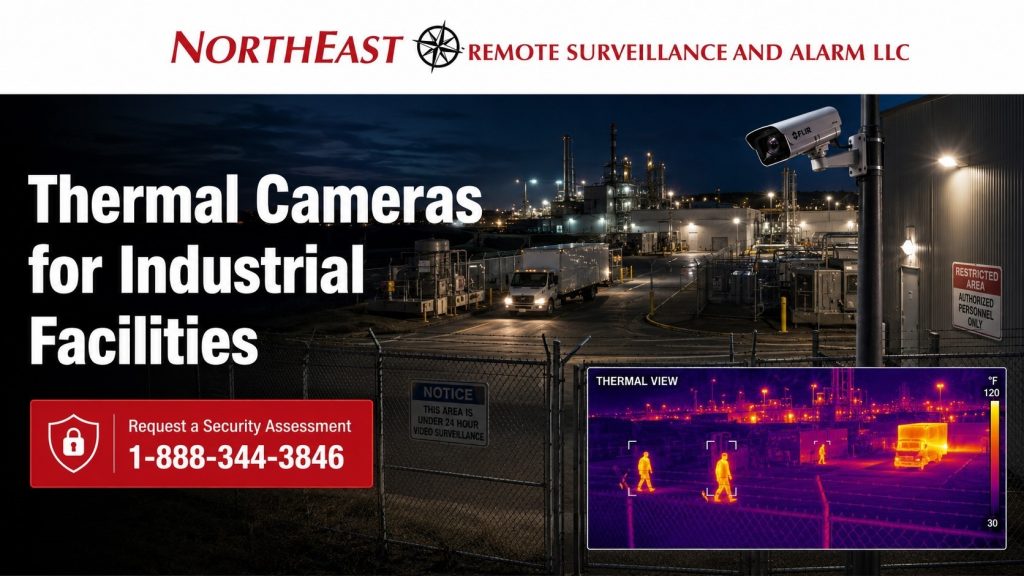
Thermal Surveillance for Industrial Security
Industrial facilities often have exterior areas that are difficult to monitor with standard cameras alone. Long fence lines, dark rear approaches, utility areas, outdoor storage zones, equipment yards, truck courts, wooded edges, and remote corners of a property can create serious blind spots after hours.
Thermal cameras help detect heat signatures from people, vehicles, and equipment movement. They do not depend on the same visible light conditions as standard cameras, which makes them valuable for areas where lighting is poor, inconsistent, blocked, or impractical to install.
A properly designed thermal camera system can improve detection, reduce blind spots, support remote monitoring, and help security teams identify activity before it reaches doors, docks, equipment, or critical infrastructure.
Where Thermal Cameras Are Useful in Industrial Facilities
Thermal cameras are most useful when the goal is detection across difficult areas, not detailed identification. They can help identify movement in places where standard video may be limited by darkness, distance, glare, shadows, weather, vegetation, or inconsistent lighting.
Common thermal camera applications include:
- Industrial fence lines
- Rear building approaches
- Equipment yards
- Outdoor storage areas
- Utility areas
- Remote service roads
- Truck courts and trailer yards
- Rail-adjacent industrial properties
- Dark perimeter corners
- Restricted exterior zones
- Large open industrial lots
- High-risk after-hours approach paths
- Solar, cellular, or remote camera locations
- Critical infrastructure and mechanical areas
For industrial sites focused on exterior property boundaries, the supporting resource is Industrial Perimeter Security Cameras.
What Thermal Cameras Do Well
Thermal cameras are strong detection tools. They are especially helpful when a facility needs to know whether a person or vehicle is moving through an area where visible-light cameras may not provide reliable awareness.
Thermal cameras can help with:
- After-hours perimeter detection
- Human and vehicle detection in low light
- Activity detection near fence lines
- Movement detection near equipment yards
- Detection across open outdoor areas
- Reduced dependence on visible lighting
- Support for remote monitoring alerts
- Early warning before someone reaches the building
- Detection around utility and service areas
- Monitoring exterior restricted zones
Thermal cameras are not magic, and they are not always the right tool for every view. They work best when the system is designed around the property layout, target distance, camera angle, detection goal, mounting height, and response workflow.
What Thermal Cameras Do Not Replace
Thermal cameras should not be treated as a complete replacement for standard video surveillance. They are usually better for detection than identification.
A thermal camera may show that a person or vehicle is present, but it may not provide the same visible details as a standard camera. It may not capture facial detail, clothing color, license plate numbers, company markings, or small identifying features.
For many industrial facilities, the strongest design combines thermal cameras with standard IP cameras. Thermal cameras detect activity across difficult areas, while visible-light cameras help document details at gates, doors, docks, drive lanes, and controlled approach points.
Thermal Cameras for Perimeter and Yard Detection
Industrial yards and perimeters are often the best fit for thermal camera design. These areas may include long distances, dark approaches, parked trailers, stored materials, changing outdoor conditions, and after-hours exposure.
A thermal camera can help detect movement before the activity reaches a dock door, rear entrance, equipment storage area, or fence opening. This early detection layer can be especially valuable for properties with repeated trespassing, copper theft, fuel theft, equipment theft, trailer break-ins, or unauthorized after-hours access.
For facilities where thermal cameras support broader yard coverage, use Industrial Yard Video Surveillance.
Pairing Thermal Cameras with Remote Monitoring
Thermal cameras can be especially effective when paired with remote video monitoring. Instead of only recording an event, the system can generate alerts when people or vehicles move through defined zones after hours.
When designed correctly, thermal detection can help monitoring teams review activity, verify whether a real event is occurring, issue live audio warnings where appropriate, and escalate according to the site’s response plan.
For facilities that need active alert review instead of passive recording only, the next planning step is Industrial Remote Video Monitoring.
Thermal Cameras and Artificial Intelligence Analytics
Thermal cameras may be used with analytics to help detect people, vehicles, line crossing, restricted-zone activity, and after-hours movement. The value depends on the camera model, site layout, distance, detection zones, mounting position, and environmental conditions.
Analytics should be configured around real facility operations. A loading yard with moving trucks, a fenced utility area, and a quiet rear property line may each require different rules.
Good analytics planning can help reduce unnecessary alerts caused by shadows, headlights, wildlife, weather, or routine industrial movement. Poor analytics planning can create alert fatigue and make the system harder to use.
Camera Placement and Design Considerations
Thermal camera placement should be planned carefully. The camera must be selected and aimed based on the distance, field of view, detection target, property layout, and expected response.
Important design considerations include:
- Detection distance
- Mounting height
- Field of view
- Fence line layout
- Vehicle movement
- Building corners
- Outdoor storage obstructions
- Weather exposure
- Pole or building mounting
- Network connectivity
- Power availability
- Recording retention
- Alert rules and monitoring workflow
- Visible-camera pairing for identification
A thermal camera placed too far away, aimed too broadly, or installed without a response plan may not deliver the expected security value. The design should begin with the question the facility needs answered: detect movement, verify people, detect vehicles, protect a perimeter, support monitoring, or document activity near a specific industrial asset.
Infrastructure for Industrial Thermal Camera Systems
Industrial thermal camera systems depend on reliable infrastructure. Exterior locations may require PoE switching, fiber, wireless bridges, camera poles, weather-rated enclosures, conduit, surge protection, UPS backup, secure recording, and properly segmented network access.
Large industrial properties may also require coordination between facilities, IT, operations, and security stakeholders. Thermal cameras should be documented clearly so users know which areas are monitored, what the camera is intended to detect, how alerts are handled, and who can access the video.
The system should be built for long-term serviceability, not just initial installation.
Compliance, Safety, and Documentation Considerations
Thermal cameras should support security, safety, operational awareness, and documentation without being confused with code-required fire detection or life-safety systems unless a specific listed and approved system is designed for that purpose. In most industrial security applications, thermal cameras are used for intrusion detection, exterior monitoring, perimeter awareness, restricted-zone detection, and after-hours security support.
For broader code-aware planning in warehouse and industrial environments, use Industrial and Warehouse Security Compliance.
A well-documented thermal camera system should identify camera locations, coverage intent, detection zones, alert schedules, user permissions, recording retention, and monitoring procedures. That documentation helps ownership, facility managers, IT teams, safety leaders, and operations personnel maintain control of the system over time.
Thermal Cameras for Pennsylvania and Mid-Atlantic Industrial Facilities
Northeast Remote Surveillance and Alarm, LLC designs thermal camera systems for industrial and commercial facilities across Pennsylvania and the Mid-Atlantic. These systems are built for real operating environments, including manufacturing plants, equipment yards, logistics properties, utility areas, fenced industrial sites, contractor yards, outdoor storage zones, and multi-building industrial facilities.
The right design depends on the property layout, lighting conditions, detection distance, risk exposure, infrastructure, monitoring requirements, and whether the facility needs thermal detection alone or a combined thermal and visible-camera strategy.
Frequently Asked Questions
What are thermal cameras for industrial facilities?
Thermal cameras for industrial facilities are security cameras that detect heat signatures from people, vehicles, and objects. They are commonly used for perimeter detection, low-light monitoring, equipment yards, utility areas, restricted zones, and after-hours industrial security.
Are thermal cameras good for industrial security?
Yes. Thermal cameras can be very useful for industrial security when the goal is detection in dark, low-light, exterior, or hard-to-monitor areas. They are especially valuable around fence lines, yards, service roads, utility areas, and perimeter approaches.
Do thermal cameras need light to work?
Thermal cameras do not rely on visible light the same way standard cameras do. They detect heat signatures, which can make them useful in darkness or low-visibility areas where standard cameras may struggle.
Can thermal cameras identify faces or license plates?
Thermal cameras are generally better for detection than identification. They may detect that a person or vehicle is present, but visible-light cameras are usually needed for faces, clothing detail, vehicle markings, license plates, and other identifying details.
Should thermal cameras replace standard security cameras?
Usually no. Thermal cameras work best as part of a layered system. They can detect activity in difficult areas, while standard cameras help provide visible detail at gates, doors, docks, drive lanes, and other key points.
Where should thermal cameras be installed?
Thermal cameras are often installed along fence lines, rear approaches, equipment yards, outdoor storage areas, utility zones, restricted exterior areas, dark perimeter corners, and remote parts of industrial properties.
Can thermal cameras work with remote monitoring?
Yes. Thermal cameras can support remote monitoring by generating alerts when people or vehicles move through defined areas after hours. Monitoring teams can then review video and escalate events according to the site’s response plan.
Are thermal cameras useful for large industrial yards?
Yes. Thermal cameras can be useful for large yards when the system is designed around detection distance, camera angle, field of view, lighting conditions, and the specific areas that need protection.
Do thermal cameras reduce false alarms?
Thermal cameras may help reduce false alarms in certain applications, especially when paired with properly configured analytics. Results depend on the camera model, detection zones, mounting position, environment, and monitoring workflow.
Who installs thermal cameras for industrial facilities in Pennsylvania and the Mid-Atlantic?
Northeast Remote Surveillance and Alarm, LLC designs and installs thermal camera systems for industrial and commercial facilities across Pennsylvania and the Mid-Atlantic, including manufacturing plants, equipment yards, logistics sites, utility areas, restricted zones, and multi-building industrial properties.
Request a Thermal Camera Security Assessment
Thermal cameras should be designed around the facility’s actual perimeter exposure, lighting conditions, detection distance, restricted areas, yard layout, infrastructure, and after-hours risk. Northeast Remote Surveillance and Alarm, LLC helps commercial and industrial facilities plan thermal camera systems that improve detection, monitoring, documentation, and long-term security performance. To evaluate your thermal camera coverage, blind spots, infrastructure, monitoring options, and visible-camera pairing strategy, request a Security Assessment.