
Keep Wilkes-Barre plant security focused on who enters work areas, how materials move, and who handles events after hours.

Request a Wilkes-Barre security assessment
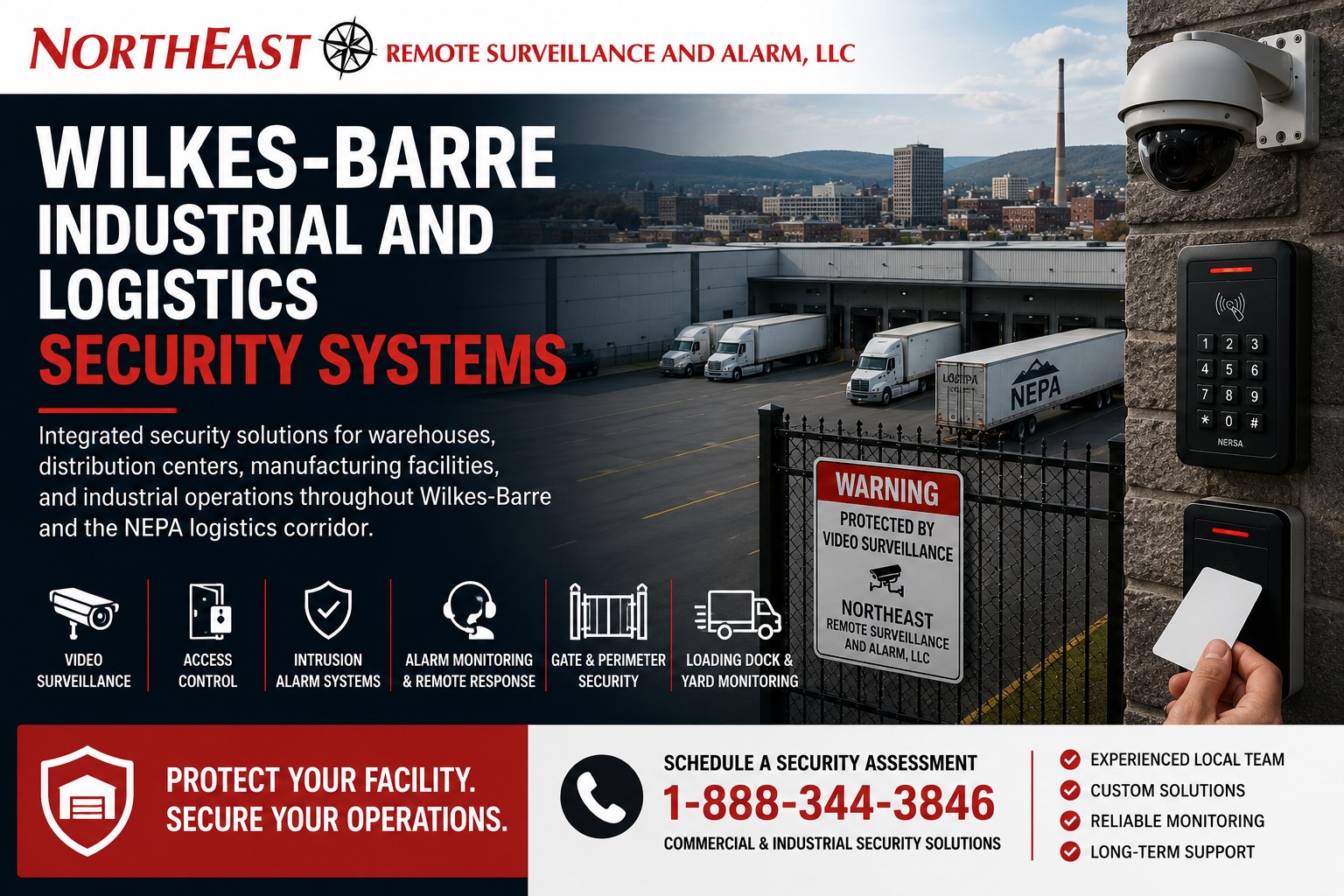
Permission to enter an area must stay separate from permission to carry out work there.
For security across the building and surrounding property, see Wilkes-Barre commercial security systems.
Define the boundaries inside the plant
Production, stores, offices, equipment rooms and dispatch do not all require the same permissions. Mark the boundaries between those areas and identify the manager responsible for each. Begin with the actual use of the space rather than assigning identical access to everyone who works in the building.
A clear boundary helps answer two questions: who may enter and what activity needs to be reviewable. Those questions may lead to different equipment or procedures. A reader can control a door, while a useful camera view can help explain movement near it; neither automatically documents everything happening inside the room.
Connect materials to recognizable transitions
Review how incoming components reach storage, move into production and leave as finished goods. Identify transfers that create recurring questions, particularly where different teams take responsibility. Use area names that match production and inventory records so staff can find the corresponding recording.
Decide what the camera is expected to show. A view may establish that material moved between areas without confirming quantity, quality or the contents of packaging. Process and inventory records remain essential. Avoid presenting recorded images as proof of information that was never visible.
Separate controlled rooms from general access
Parts stores, network spaces, tool rooms and sensitive records areas may need more limited permissions than the main production floor. Define access by role, time and business need. Assign an approver who can explain and review each permission group.
Review access after personnel changes and room changes. A former supervisor’s permissions or an old project exception should not remain active indefinitely. Make temporary access straightforward to issue and remove, rather than relying on shared credentials whose users are difficult to identify.
Prepare for maintenance and contractor visits
Contractors need a reporting point, a plant sponsor and clear instructions about where they may go. Determine whether they require an escort and how the sponsor is contacted outside office hours. Avoid placing the admission decision on an employee who has no knowledge of the work.
Security admission is separate from authorization to work on equipment. Qualified plant personnel control safety procedures and task approvals. A credential should never be represented as a substitute for those responsibilities. If a job extends, renew access deliberately and confirm the areas still required.
Make after-hours ownership clear
List legitimate activity that may occur when ordinary production is closed, including cleaning, service work and management visits. Decide who can verify an unexpected entry and who receives an unresolved report. The contact needs current schedules, not merely a phone that rings.
If active observation or alarm response is expected, confirm the service separately from recording. Agree on hours, escalation contacts, permitted actions and limitations. A camera installation by itself does not mean someone is continuously watching or will intervene immediately.
Observe shift overlap and shared openings
Several employees arriving together can make access events difficult to interpret. A successful credential use does not necessarily show every person who passed through the opening. Review the entrance arrangement and staff procedures with normal shift activity in mind.
Overtime and temporary assignments may require schedule changes, but those changes should have an owner and an end point. Required exits, door hardware and any unusual locking arrangement need appropriate professional review. Do not solve an administrative inconvenience by improvising physical restrictions.
Specify suitable equipment locations
Tell the installer about moisture, cleaning methods, temperature, dust, vibration and impact exposure near proposed equipment. Suitability depends on the actual conditions. A product that works in an office may not be appropriate beside a production process.
Coordinate cable routes and service access with facilities, IT and production. Identify any special environment requiring qualified assessment. Equipment should remain supportable after installation, with clear responsibility for network connections and a practical way to report faults without interrupting ordinary work unnecessarily.
Make records usable across departments
Synchronize time references where access events and recordings will be compared. Use clear room and camera names. An authorized supervisor should be able to find a known event from an ordinary plant record rather than needing the installer to interpret the system.
Set retention according to investigation needs and define who may export recordings. Restrict administration to designated people. Preserve relevant incidents through an agreed process and test playback on an approved device before an urgent situation makes those details important.
Test the plant’s real situations
Acceptance should include a normal shift arrival, a contractor permission that has expired, a maintenance visit and review of a material transfer. Involve the staff who will administer permissions and investigate events. Check that exceptions reach the correct contact and that ordinary activity remains practical.
Bring area responsibilities, operating schedules, contractor procedures and examples of difficult investigations to NERSA. Request documented camera names, permission ownership, support contacts and training. Review the plan when production changes or a room takes on a different purpose.
A useful initial discussion also identifies equipment that may be retained. Existing cameras, readers or cabling should be evaluated for condition, compatibility and supportability before assuming everything requires replacement. The proposal should distinguish usable equipment from components that cannot meet the agreed requirements.
Include the people responsible for approving future changes in the final training session.
Discuss your property
For facilities in surrounding communities, see Northeastern Pennsylvania commercial security guide.
Request a Wilkes-Barre security assessment to discuss your property, existing equipment, and priorities.
Compliance, Codes & Project Standards
NERSA plans commercial and industrial security work with applicable code, documentation, inspection and authority-having-jurisdiction requirements in mind. Requirements vary by system, property and jurisdiction. These resources support project planning; they do not establish legal compliance, certification or AHJ approval.
Related guidance: Regulatory compliance & inspection readiness · Manufacturing compliance planning · NERSA project standards