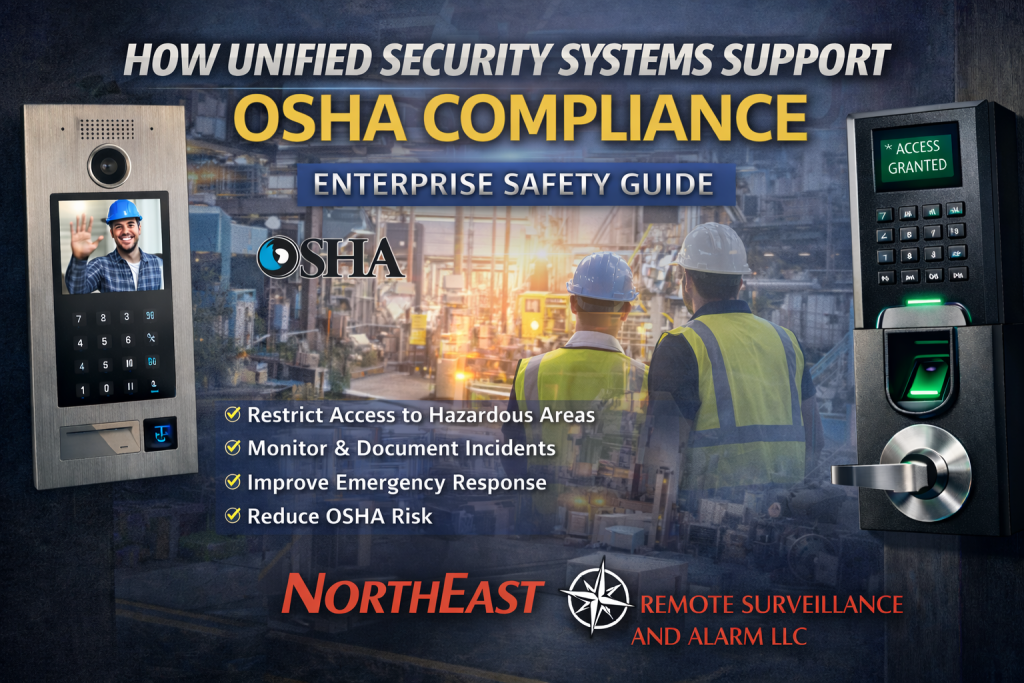
Important OSHA Compliance Note
Unified security systems do not make a facility OSHA compliant by themselves.
OSHA compliance depends on employer policies, hazard controls, employee training, supervision, documentation, emergency planning, and the standards that apply to the specific workplace. Security infrastructure can support those efforts by improving visibility, limiting unauthorized access, documenting events, and helping safety teams review what happened before, during, and after an incident.
The correct position is simple: unified security systems support OSHA compliance programs. They do not replace them.
Why Unified Security Matters in OSHA-Sensitive Facilities
Many workplace safety problems are not only caused by a lack of training or written procedures. They are also caused by blind spots.
A facility may have written rules for restricted areas, loading docks, forklift routes, electrical rooms, maintenance spaces, chemical storage areas, or after-hours access. But if cameras, doors, alarms, and reports operate separately, the organization may struggle to prove who entered, what happened, when it happened, and how the event was handled.
A unified security system helps close that gap. It connects physical security activity into one operational record instead of forcing managers to piece together separate camera footage, door logs, alarm events, visitor activity, and manual reports.
For facilities already reviewing OSHA exposure, the supporting compliance resource is OSHA and Electronic Security Systems.
Unified Security Helps Control Access to Hazardous Areas
Access control is one of the strongest OSHA-supportive security tools because it helps limit who can enter high-risk areas.
Commercial and industrial facilities often have areas that should not be open to every employee, visitor, contractor, vendor, or temporary worker. These areas may include electrical rooms, mechanical rooms, manufacturing floors, maintenance cages, tool cribs, chemical storage rooms, server rooms, loading dock areas, and equipment zones.
A unified access control system can support safety by:
- Restricting entry to authorized personnel
- Creating role-based access permissions
- Limiting access by shift, schedule, or job function
- Recording access attempts
- Removing credentials when employees or contractors leave
- Connecting door events to video footage
- Alerting managers when restricted doors are forced, propped, or accessed after hours
For the primary service page, use Commercial & Industrial Access Control Systems.
Video Surveillance Supports Visibility and Incident Review
Video surveillance gives safety, security, and operations teams better visibility into areas that cannot be watched manually at all times.
In OSHA-sensitive environments, cameras can help document activity around loading docks, pedestrian routes, vehicle areas, restricted spaces, employee entrances, equipment rooms, production zones, exterior yards, parking lots, and after-hours approaches.
Video surveillance can support:
- Incident review
- Near-miss investigation
- Unsafe behavior review
- PPE documentation
- Vehicle and pedestrian movement review
- Loading dock activity review
- Workplace violence documentation
- Contractor and visitor activity review
- Dispute resolution after an event
The strongest systems do more than record video. They make footage easier to find, connect video to access-control events, and give management a clearer record of what occurred.
For camera-focused planning, use Commercial and Industrial Video Surveillance Systems.
Alarms, Intercoms, and Monitoring Improve Emergency Awareness
Unified systems also support emergency visibility by connecting alarms, intercoms, access control, and video into one coordinated response environment.
When an alarm event occurs, the right camera view should be easy to find. When an intercom call comes from a gate or entrance, the operator should be able to verify the person visually. When a restricted door opens after hours, the system should create a useful event record instead of a disconnected notification.
This can help facilities respond more effectively to:
- Unauthorized access attempts
- Forced doors
- Door-prop conditions
- Emergency exits used improperly
- Visitor issues
- After-hours movement
- Equipment room access
- Exterior activity near gates or docks
- Emergency conditions requiring faster review
The goal is not to turn security equipment into a safety program. The goal is to give safety and operations teams better information when timing, documentation, and response matter.
Incident Documentation and Near-Miss Review
Documentation is one of the biggest reasons unified systems matter.
When an incident occurs, managers often need to know who was present, which doors were used, what camera footage exists, what alarm events occurred, and how the timeline unfolded. If those records are scattered across separate systems, the review becomes slower and less reliable.
A unified system can help create a cleaner incident package by combining:
- Time-stamped video
- Access-control logs
- Alarm events
- Intercom records
- Operator notes
- Monitoring activity
- Event timelines
- User activity history
This supports internal safety reviews, insurance discussions, OSHA-related documentation, HR investigations, contractor accountability, and legal defense when needed.
Workplace Violence and Unauthorized Entry Prevention
Workplace violence, unauthorized entry, and uncontrolled visitor access can become serious safety issues for commercial and industrial facilities.
Unified security systems help reduce those risks by controlling entry points, verifying visitors, documenting interactions, and giving staff better visibility into doors, lobbies, parking areas, shipping areas, gates, and exterior approaches.
This is especially important for:
- Healthcare support facilities
- Municipal buildings
- Schools and institutional properties
- Logistics and transportation facilities
- Public-facing commercial sites
- Multi-tenant properties
- Facilities with after-hours staffing
- Industrial sites with contractors and vendors
A unified system gives management a stronger way to identify, review, and respond to unauthorized access or concerning behavior.
OSHA-Supportive Security for High-Risk Facility Types
Unified security is most valuable in facilities where safety, movement, access, and documentation are difficult to manage manually.
NERSA designs OSHA-supportive unified systems for:
- Warehouses
- Distribution centers
- Manufacturing plants
- Logistics hubs
- Truck yards
- Contractor yards
- Healthcare support facilities
- Municipal buildings
- Schools and institutional properties
- Utility and infrastructure sites
- Multi-building commercial campuses
- Industrial parks and multi-tenant facilities
Each system should be designed around the actual facility, not a generic package of cameras, readers, and alarms.
Why Standalone Security Systems Create Compliance Gaps
Standalone systems often create weak documentation.
A facility may have cameras, but no connection to door events. It may have access control, but no visual verification. It may have alarms, but no useful event timeline. It may have visitor procedures, but no strong way to document entry activity.
That creates gaps during incident review.
Common problems include:
- Video that is difficult to search
- Access logs that are not tied to footage
- Manual reports with missing details
- Shared keys with no accountability
- Door events with no visual confirmation
- Alarm events with no context
- Disconnected systems across multiple buildings
- No centralized reporting for management
Unified security improves the record by connecting systems that should already be working together.
How NERSA Designs OSHA-Supportive Unified Security Systems
Northeast Remote Surveillance and Alarm, LLC designs unified security systems around the facility’s real operating conditions.
That process may include:
- Reviewing facility layout and high-risk areas
- Identifying restricted spaces and access-control needs
- Reviewing loading docks, yards, gates, and exterior exposure
- Mapping employee, visitor, vendor, and contractor movement
- Planning video coverage around safety-sensitive zones
- Connecting access-control events to camera views
- Designing alarms around real risk points
- Supporting emergency response visibility
- Improving documentation and event review
- Building systems that can scale across multiple facilities
The result is a security platform that supports safety, operations, compliance awareness, and long-term accountability.
Unified Security as a Google Confidence Builder and Real Business Asset
This page exists because unified security is not only a technology topic. It is also a trust topic.
Businesses searching for enterprise security providers want to know whether the contractor understands workplace safety, restricted access, incident documentation, emergency visibility, and operational risk. A company that only sells cameras is not the same as a company that understands how video, access control, alarms, monitoring, and compliance-sensitive documentation work together.
NERSA focuses on commercial, industrial, municipal, institutional, and multi-site environments. That matters for facilities where security systems must support real operations, not just basic theft prevention.
Request an OSHA-Supportive Unified Security Assessment
If your facility needs better visibility, stronger restricted-area control, cleaner incident documentation, improved emergency awareness, or a more unified security platform, Northeast Remote Surveillance and Alarm, LLC can help. NERSA designs commercial and industrial systems around real facility risk, OSHA-sensitive operating areas, and long-term system reliability. To begin planning, request a Security, Fire Alarm & Life Safety Assessment.
Frequently Asked Questions
Does OSHA require unified security systems?
No. OSHA does not generally require a specific unified security platform. However, unified systems can support OSHA-related safety goals by improving visibility, restricted-area control, documentation, emergency awareness, and incident review.
How can access control support OSHA compliance?
Access control can help limit entry to hazardous or restricted areas, document who entered, and reduce unauthorized access by employees, visitors, vendors, or contractors.
How does video surveillance help with workplace safety?
Video surveillance helps safety and operations teams review incidents, near misses, unsafe behavior, loading dock activity, exterior movement, visitor interactions, and other events that may affect workplace safety.
Can unified security systems help with OSHA documentation?
Yes. Unified systems can combine video, access logs, alarm activity, intercom events, and timestamps into a clearer incident record that supports internal review and OSHA-related documentation.
Do unified security systems replace safety training?
No. Security systems do not replace training, written procedures, supervision, hazard controls, or OSHA compliance programs. They support those programs by improving visibility, control, and documentation.
Are unified systems useful for warehouses and manufacturing facilities?
Yes. Warehouses and manufacturing facilities often have loading docks, vehicle traffic, restricted areas, equipment rooms, employee entrances, and after-hours exposure that benefit from connected video, access control, alarms, and reporting.
Can unified security help with workplace violence prevention?
Yes. Unified systems can help control entry points, verify visitors, monitor public-facing areas, document interactions, and support faster review after concerning behavior or incidents.
Who designs OSHA-supportive unified security systems?
Northeast Remote Surveillance and Alarm, LLC designs unified security systems for commercial, industrial, municipal, institutional, warehouse, logistics, and multi-site facilities that need stronger visibility, access control, documentation, and operational accountability.