
Use cameras, access control, alarms, and event records to support workplace safety without confusing security technology with OSHA compliance.

Request a commercial security assessment
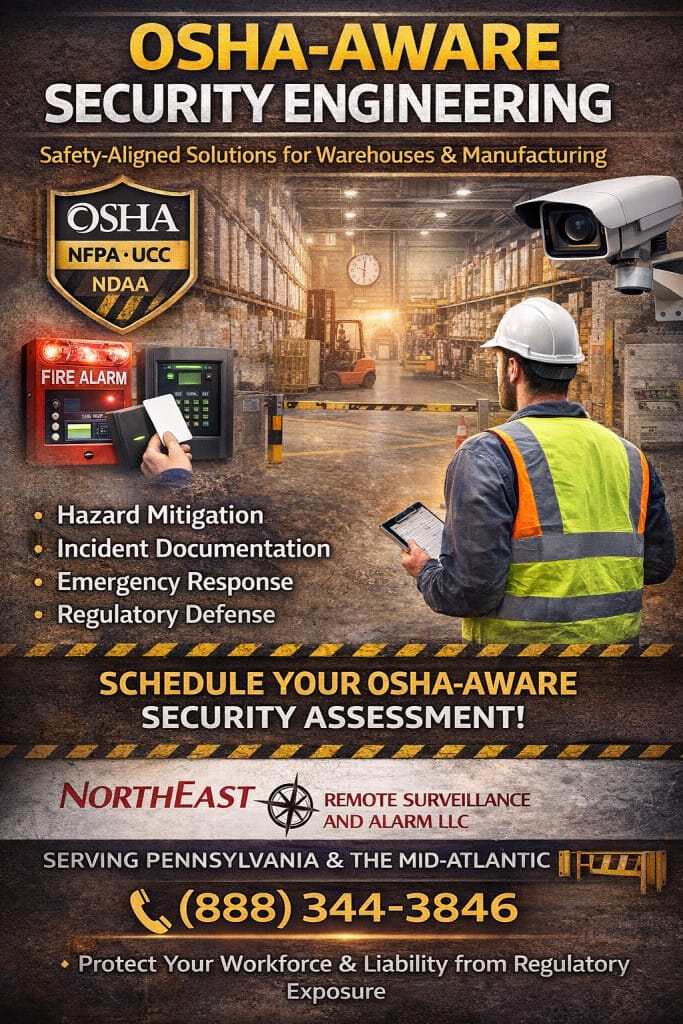
What Electronic Security Can Support
Electronic security can improve visibility, control entry to selected areas, document events, and help authorized personnel review what occurred before and after an incident or near miss.
Depending on the facility, that may involve video surveillance, access control, intrusion alarms, intercoms, emergency notification, remote monitoring, or properly maintained event records.
For incident records and review procedures, see warehouse and industrial safety documentation.
These systems are supporting tools.
They do not replace hazard identification, training, supervision, machine guarding, traffic controls, emergency planning, required protective equipment, worker participation, or any employer responsibility under applicable law.
OSHA’s Recommended Practices for Safety and Health Programs provide a broader framework for proactive safety management.
Where Security Technology May Help
- Forklift and pedestrian intersections, docks, staging areas, aisles, and material-handling zones
- Hazardous, restricted, production, utility, server, pharmaceutical, or high-value areas
- Employee, contractor, vendor, and temporary-worker entrances
- After-hours operations, lone-worker locations, remote buildings, and exterior approaches
- Incident reconstruction, near-miss review, access history, and timeline verification
Video for Incident and Near-Miss Review
Well-placed cameras can provide an objective visual record of movement, equipment interaction, access, and conditions within the recorded field of view. Camera purpose should be defined before placement: an overview view shows flow, while a focused view may be needed for a doorway, workstation, intersection, or loading position.
Lighting, distance, obstructions, frame rate, image detail, retention, privacy, user permissions, and accurate timestamps affect whether recorded video is useful.
Cameras should not discourage workers from reporting hazards, injuries, or near misses.
For a focused discussion of analytics, visit AI video analytics and workplace safety.
Access Control for Restricted Areas
Access control can assign permissions by person, role, door, area, and schedule. This may help a facility limit entry to trained or authorized personnel, remove access promptly when responsibilities change, and review credential activity after an event.
Credentials alone do not prove who passed through a door or whether a safe procedure was followed. Door rules, anti-passback, visitor processes, tailgating controls, training, and supervision must match the operating environment.
Controlled Doors Must Preserve Safe Egress
Electronic locks, magnetic locks, delayed-egress devices, request-to-exit hardware, intercoms, and automatic operators can affect how people enter or leave a building. Door operation must be reviewed against the adopted building, fire, life-safety, and accessibility requirements for the specific occupancy and location. Security objectives must not create unsafe exit conditions.
The authority having jurisdiction, code officials, fire officials, and qualified design professionals determine project-specific requirements. Security planning should coordinate with them when permits, inspections, listed hardware, emergency release, fire-alarm interfaces, or accessibility conditions apply.
Alarms, Monitoring, and Emergency Communication
Intrusion alarms, duress devices, intercoms, mass-notification features, and remote monitoring can support defined emergency or after-hours procedures. Their value depends on clear zone names, user training, current call lists, tested communications, practical escalation instructions, backup power, and coordination with the facility’s written plans.
Plan the System Around the Safety Program
- Identify the event, area, or operational question the system should address.
- Involve safety, operations, facilities, HR, IT, legal, and worker representatives as appropriate.
- Review privacy, labor, retention, access, cybersecurity, code, and documentation requirements.
- Define who receives alerts, who can review records, and how an event is escalated.
- Test the complete workflow and document device names, accounts, permissions, schedules, and responsibilities.
- Reevaluate the design when the facility, staffing, equipment, hazards, or procedures change.
For broader code and life-safety planning, visit our commercial security compliance guide.
Frequently Asked Questions
Can cameras make a facility OSHA compliant?
No. Cameras may support visibility and review, but compliance depends on the laws, standards, hazards, programs, controls, training, records, and workplace conditions that apply to the facility.
Can access control restrict hazardous areas?
It can help limit credentialed entry, but it must be combined with appropriate physical safeguards, procedures, training, supervision, signage, and code-compliant egress.
Can video analytics identify unsafe behavior?
Some analytics can detect defined visual events under suitable conditions. Performance varies, so every use case needs testing, human review, privacy planning, and a clear response procedure.
Who decides which codes and OSHA requirements apply?
The facility should consult the appropriate authority having jurisdiction, regulators, code officials, fire officials, safety professionals, legal counsel, and qualified designers for project-specific determinations.
Request an OSHA-Aware Security Assessment
Northeast Remote Surveillance and Alarm, LLC can assess how electronic security may support a commercial or industrial facility’s documented safety and security objectives.