
Coordinate distribution and logistics security around freight movement, loading docks, stored inventory, staff access, vehicle routes, and after-hours response.

Request a Commercial Security Assessment
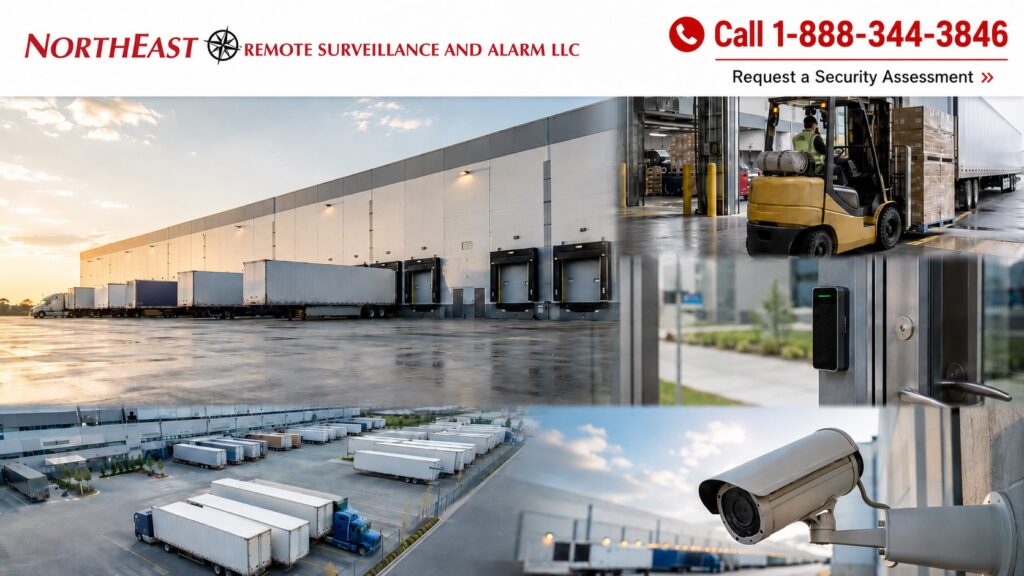
Inbound trailers, outbound freight, loading docks, employee shift changes, temporary labor, third-party drivers, forklifts, shipping offices, receiving areas, trailer staging, high-value inventory, and around-the-clock operations can all exist within the same facility.
Those conditions create security requirements that cannot be solved effectively by placing a few cameras around the building or installing a basic alarm system.
Northeast Remote Surveillance and Alarm, LLC designs commercial and industrial security systems for distribution centers, logistics facilities, warehouses, 3PL operations, fulfillment centers, cross-dock facilities, and other freight-intensive properties.
The objective is to provide useful visibility, stronger access accountability, better incident documentation, dependable after-hours protection, and security infrastructure that can expand as the operation changes.
Call 1-888-344-3846 to request a distribution or logistics facility security assessment.
Security Built Around the Flow of the Facility
A distribution center should be evaluated according to how people, vehicles, freight, and equipment move through the property.
The security plan may need to follow activity from:
- Property entrance
- Truck gate
- Guard or check-in point
- Trailer staging
- Loading dock
- Receiving area
- Warehouse floor
- High-value storage
- Shipping area
- Employee entrances
- Parking areas
- Exterior yard
- Final vehicle exit
Each stage creates different security questions.
Who entered the property?
Which vehicle arrived?
Which trailer was assigned to a dock?
Who entered a restricted area?
When was an overhead door opened?
Which employee accessed a controlled room?
What occurred around a shipment before an incident was discovered?
A well-designed system should help facility management answer those questions without making normal logistics operations unnecessarily difficult.
Loading Dock Security
Loading docks are among the most active and vulnerable parts of a distribution facility.
A dock area may involve:
- Trailers
- Drivers
- Warehouse personnel
- Forklifts
- Pallets
- Staged freight
- Shipping documents
- Open overhead doors
- Temporary workers
- Contractors
- After-hours activity
Security planning should consider both the exterior trailer side and the interior staging side of the dock.
Useful video may need to show trailer arrival, loading or unloading activity, employee interaction, pallet movement, door activity, and the areas immediately surrounding shipping and receiving operations.
Alarm devices can also provide useful information when dock doors or related openings should remain secured outside approved operating periods.
For dock-specific planning, visit Loading Dock Security Systems.
Employee Entrances and Controlled Access
Distribution centers often have employee entrances that experience intense traffic during shift changes and minimal activity during the rest of the day.
Mechanical keys and shared entry codes can become difficult to manage in facilities with:
- Large workforces
- Temporary labor
- Multiple shifts
- Contractors
- Cleaning personnel
- Seasonal employees
- Supervisors working different schedules
Commercial access control can help assign individual permissions according to person, door, department, schedule, or responsibility.
Controlled areas may include:
- Employee entrances
- Shipping offices
- Receiving offices
- IT rooms
- Tool rooms
- Maintenance areas
- High-value inventory
- Management offices
- Restricted cages
- Warehouse-to-office transitions
When an employee or contractor leaves, electronic credentials can generally be removed without replacing mechanical locks throughout the property.
Access records can also provide useful documentation during investigations.
Video Surveillance for Distribution Centers
Distribution-center camera systems should be designed around the information the business may need later.
Simply seeing that activity occurred is not always enough.
Different views may need to answer different questions:
- Who entered the building?
- Which employee handled a shipment?
- Which vehicle arrived?
- Which trailer approached the dock?
- What happened during loading?
- Which direction did someone travel?
- What occurred before an incident?
- Was a restricted area entered?
This often requires a combination of camera views.
Broad overview cameras can establish context.
Tighter identification views can provide more useful detail at doors, gates, shipping desks, or other important points.
Exterior cameras may cover truck courts, trailer areas, parking, building approaches, and perimeter sections.
Interior cameras may support shipping, receiving, staging, warehouse operations, and selected high-value areas.
Camera placement should be based on the evidence objective rather than simply attempting to cover the largest possible area with each camera.
Trailer Yards and Truck Courts
Large distribution properties frequently have substantial security exposure outside the building.
Trailer staging areas, truck courts, fleet parking, drop lots, fenced sections, exterior storage, and drive lanes may remain active long after office areas have closed.
These environments can also be difficult to observe because of:
- Large distances
- Trailer obstructions
- Changing vehicle positions
- Limited nighttime lighting
- Remote property boundaries
- Few employees nearby
Security planning should identify useful choke points and decision areas such as entrances, exits, intersections, trailer rows, gate approaches, and building transitions.
For facilities where exterior truck and trailer operations are the primary concern, visit Truck Yard Security Systems.
Vehicle Entry and Documentation
Vehicle activity is central to logistics operations.
A facility may receive company vehicles, tractor-trailers, third-party carriers, employee vehicles, vendors, contractors, and unexpected visitors through the same property entrance.
Security planning may include documentation around:
- Main gates
- Truck entrances
- Employee parking entrances
- Guard stations
- Scale areas
- Yard intersections
- Trailer lanes
- Exit points
Some properties require only general vehicle visibility.
Others may benefit from dedicated vehicle-identification or license-plate views.
The appropriate design depends on lane position, traffic speed, entrance geometry, lighting, distance, and the level of identification management actually requires.
Intrusion Detection for Logistics Facilities
Video surveillance and access control do not replace intrusion detection.
Distribution centers frequently contain exterior doors, overhead doors, warehouse sections, shipping offices, maintenance areas, roof access, glass areas, and restricted rooms that should remain protected when those portions of the facility are closed.
A commercial intrusion system may include:
- Door contacts
- Overhead-door contacts
- Motion detection
- Glass-break detection
- Panic or duress devices
- Separate alarm partitions
- Individual users
- Cellular or dual-path communication
- Professional monitoring
- Mobile notifications
- Video verification where supported
A large facility should not necessarily be treated as one alarm area.
Separate office, warehouse, shipping, or operational sections may follow different schedules.
The alarm design should reflect those schedules so legitimate activity does not create unnecessary alarm events.
After-Hours Monitoring
Distribution properties rarely transition cleanly from “occupied” to “empty.”
One area may close while another remains active.
Trucks may arrive early.
Cleaning personnel may work overnight.
Maintenance may occur on weekends.
Some loading docks may remain active while others are secured.
After-hours monitoring should therefore be designed around expected operations.
Depending on the property, monitored activity may involve:
- Exterior doors
- Dock doors
- Trailer areas
- Gates
- Employee entrances
- Perimeter locations
- Parking areas
- Restricted rooms
- Exterior storage
The goal is to improve awareness when something unusual occurs without overwhelming management with routine activity.
Shipping, Receiving and Freight Accountability
Shipping and receiving areas are particularly important because they connect outside carriers with the internal warehouse operation.
A useful security design can help document:
- Driver arrival
- Check-in
- Trailer positioning
- Dock assignment
- Door activity
- Pallet movement
- Employee interaction
- Freight staging
- Departure
This documentation may support theft investigations, shipment disputes, damage claims, workplace incidents, and internal operational reviews.
Security should support the freight-handling process rather than attempt to redesign it.
High-Value and Restricted Interior Areas
Not every part of a distribution center carries the same risk.
Certain spaces may justify stronger access accountability or targeted video because of the material, information, or equipment stored inside.
Examples may include:
- High-value inventory
- Returns areas
- Tool cribs
- Maintenance cages
- IT rooms
- Network rooms
- Server spaces
- Management areas
- Controlled documentation
- Specialty product storage
The system should apply stronger controls where risk justifies them rather than treating every warehouse aisle identically.
Forklift and Workplace Incident Documentation
Distribution centers often contain continuous interaction between forklifts, pedestrians, trailers, pallets, conveyors, and warehouse equipment.
Video surveillance can provide valuable documentation when management needs to understand what occurred during an incident or near miss.
Useful coverage may help establish:
- Employee movement
- Forklift movement
- Trailer position
- Material location
- Sequence of events
- Visibility conditions
- Activity immediately before and after an incident
Security cameras do not replace employee training, supervision, workplace procedures, or required safety controls.
Their role is to provide objective documentation that can support internal review and investigation.
Visitor, Vendor and Driver Entry
Distribution centers routinely receive people who are not permanent employees.
That may include:
- Delivery drivers
- Contractors
- Vendors
- Maintenance technicians
- Temporary workers
- Cleaning personnel
- Service providers
These users may need access to specific portions of the property without receiving unrestricted access to the entire facility.
A controlled entry process may use combinations of:
- Intercoms
- Video
- Access credentials
- Temporary permissions
- Reception workflows
- Driver check-in
- Gate control
The system should reflect the actual visitor and freight process at the facility.
Security Network and Infrastructure
Large distribution centers can place significant demands on security infrastructure.
Camera systems, access-control controllers, intercoms, network video recorders, wireless links, monitoring equipment, and other devices may depend on:
- CAT6 cabling
- Fiber
- Managed PoE switches
- Equipment racks
- Network segmentation
- Wireless bridges
- UPS backup
- Surge protection
- Internet connectivity
- Secure remote access
Warehouse size matters because cable distances may exceed ordinary Ethernet limits or require several network distribution points.
Remote yards or detached structures may require fiber or properly engineered wireless links.
Switches must also provide enough PoE power and network capacity for the equipment connected to them.
Infrastructure should be designed around the full security system and reasonable future expansion.
Cybersecurity-Aware Physical Security
Cameras, access-control controllers, intercoms, recorders, and cloud-managed security devices are also network devices.
A professional security deployment should account for:
- Administrator ownership
- Individual accounts
- Strong credentials
- Multi-factor authentication where supported
- Network segmentation
- Supported firmware
- Controlled remote access
- Removal of former users
- Cloud-account ownership
- System documentation
The customer should retain clear ownership and recovery control over primary security-system accounts whenever the platform permits it.
Security equipment should not be connected to business or production networks without approved coordination with the customer’s authorized IT personnel.
Life-Safety and Door Coordination
Security systems should never create unsafe emergency conditions.
Access-controlled doors, electrified locks, magnetic locks, delayed-egress arrangements, gate systems, and other controlled openings may require coordination with applicable egress, fire alarm, accessibility, door hardware, and Authority Having Jurisdiction requirements.
A credential system may control entry while the opening still has to provide the required emergency and occupant-exit behavior.
Fire alarm and required life-safety systems remain separate from ordinary intrusion and video security functions.
Existing Distribution Center Security System Upgrades
Many distribution facilities already contain security systems that were installed over several phases.
A property may have:
- Older cameras
- Newer IP cameras
- Multiple recorders
- Legacy alarm panels
- Several access-control platforms
- Unmanaged network switches
- Undocumented cabling
- Aging wireless links
- Shared user accounts
A modernization project should begin by identifying what remains serviceable.
Possible improvements may include:
- Repositioning cameras
- Replacing obsolete recorders
- Improving nighttime visibility
- Adding controlled entrances
- Modernizing alarm communication
- Improving trailer-yard coverage
- Adding managed PoE infrastructure
- Extending video retention
- Removing insecure remote access
- Documenting existing equipment
- Consolidating administration
The goal is not automatically to replace every existing device.
It is to create a reliable and supportable security system around the facility’s current operations.
Multi-Site Distribution and Logistics Security
Organizations operating several distribution centers may benefit from standardizing parts of the security environment across locations.
Standardization may include:
- Camera naming
- User permissions
- Credential administration
- Alarm-zone descriptions
- Monitoring procedures
- Network architecture
- Equipment standards
- Incident-export procedures
- Administrator roles
- System documentation
Each facility may still need a different physical design based on dock count, property size, yard configuration, staffing, network conditions, and operational requirements.
Standardization should improve administration without forcing different properties into identical layouts.
Distribution Center Security Planning Process
1. Facility Assessment
The process begins with the way the operation functions, including dock activity, shift schedules, vehicle movement, employee entrances, freight flow, restricted areas, yard exposure, and existing security systems.
2. Security Priorities
The business identifies where better visibility, control, detection, documentation, or response will provide meaningful operational value.
3. System Design
Camera views, controlled doors, alarm points, monitoring requirements, infrastructure, storage, user permissions, and communication requirements are designed around those priorities.
4. Installation
Equipment is installed using appropriate mounting, cabling, network, power, and environmental practices for the property.
5. Commissioning
Critical camera views, door events, alarm points, communication paths, remote access, recording, and notification functions are tested.
6. Customer Turnover
Authorized personnel receive system access, basic operating instruction, administrative information, and relevant project documentation.
Frequently Asked Questions
Why is distribution-center security different from ordinary commercial security?
Distribution centers generally combine large building footprints, freight, loading docks, trailer yards, third-party drivers, multiple employee shifts, temporary labor, exterior vehicle activity, and large volumes of inventory.
Are cameras alone enough for a distribution center?
Usually not. Many facilities benefit from a combination of surveillance, access control, intrusion detection, monitoring, controlled entry, and supporting infrastructure.
Should every loading dock have a camera?
The correct camera layout depends on dock arrangement and the information the business needs to document. Important dock positions frequently benefit from both contextual and targeted video coverage.
Should employee entrances use access control?
Many distribution facilities use electronic credentials to improve accountability and reduce dependence on mechanical keys or shared entry codes.
Can overhead dock doors be alarmed?
Yes. Commercial intrusion systems can monitor overhead doors using devices appropriate for the door and operating environment.
Should trailer yards have dedicated security?
Often. Trailer areas can have different visibility, lighting, perimeter, vehicle, and after-hours conditions from the warehouse itself.
Can security cameras help investigate forklift incidents?
Recorded video can provide useful documentation for authorized internal review, although cameras do not replace required safety programs, supervision, or employee training.
Can several distribution centers use one security platform?
Many enterprise systems support multi-site administration, but each facility still requires appropriate network connectivity, permissions, infrastructure, and site-specific design.
Can existing security equipment be reused?
Often. Cameras, wiring, access-control hardware, alarm devices, network infrastructure, and other equipment can be evaluated for compatibility, condition, and continued supportability.
Can the system expand when additional dock doors or warehouse space are added?
Yes. Recording capacity, network infrastructure, controller capacity, alarm zones, cabling pathways, and platform licensing can be planned with future growth in mind.
Request a Distribution & Logistics Center Security Assessment
Distribution centers depend on constant movement.
Employees, freight, trailers, drivers, forklifts, contractors, visitors, and equipment may move through the property twenty-four hours a day.
Security should support that operation rather than become an obstacle to it.
Northeast Remote Surveillance and Alarm, LLC designs commercial and industrial security systems around loading docks, employee entrances, warehouse interiors, truck courts, trailer areas, gates, restricted rooms, after-hours activity, and the infrastructure connecting the entire system.
If your distribution center, warehouse, 3PL facility, fulfillment operation, or logistics property needs stronger visibility, better access accountability, improved intrusion protection, better monitoring, or modernization of an existing system, NERSA can evaluate the property and develop a practical security plan.
Request a Commercial Security Assessment.
Northeast Remote Surveillance and Alarm, LLC
Commercial & Industrial Security Systems
Distribution Centers • Warehouses • 3PL • Logistics Facilities