
Warehouse security systems combine cameras, access control, intrusion alarms and monitoring around receiving, storage, shipping and after-hours operations.

Request a Warehouse Security Assessment
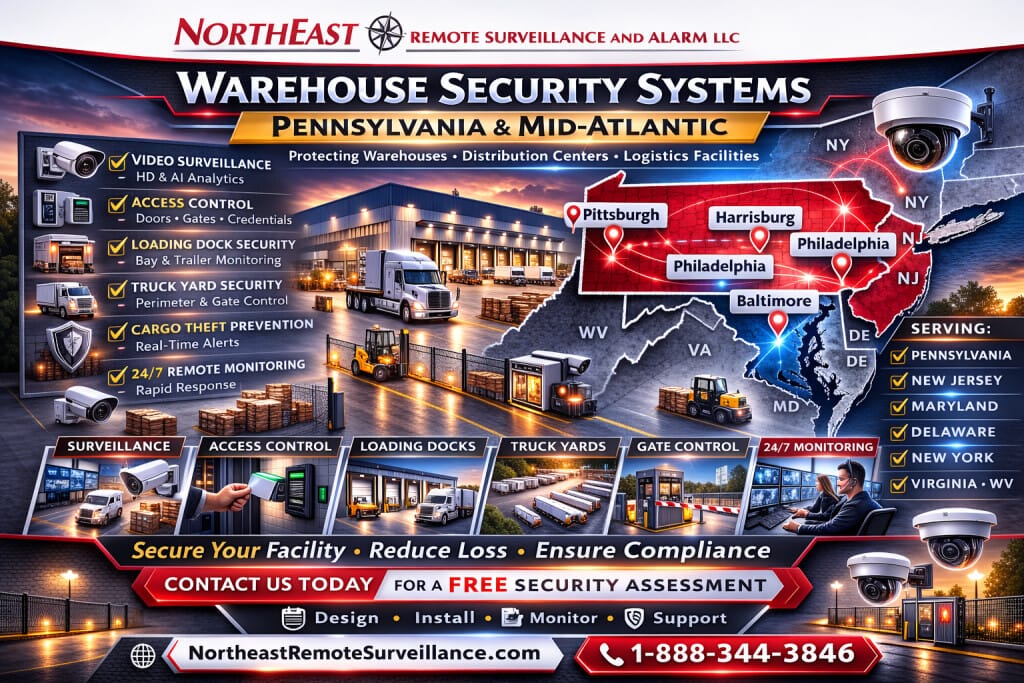
NERSA plans installation and upgrades for warehouses, distribution centers, fulfillment facilities and freight operations across Pennsylvania and the Mid-Atlantic.
This guide is part of our commercial and industrial security by industry resources.
Choose the guide that matches the freight workflow
A warehouse, distribution center, fulfillment operation, and freight yard share some security concerns but organize work differently.
Start with the part of the operation driving the project: internal inventory movement, a dock transfer, employee access, or vehicles outside.
Then use the focused guide for that area.
For facilities in the Anthracite region, review manufacturing and warehouse security planning.
Camera planning addresses the evidence needed to understand activity. Access control addresses permissions at doors and gates. Alarm and monitoring guidance addresses selected events and the response outside the expected routine. Combining those functions requires a defined operating process, not simply equipment from several categories.
Connect interior and exterior responsibilities
Map the route from arrival through receiving, staging, storage, and departure. Identify where the business, landlord, carrier, or another party controls access or activity. Establish which areas are included in the security scope and who can approve changes.
Document shifts, visitor routines, current equipment, communication paths, and recording needs. For multiple facilities, agree common naming and administration standards while keeping local exceptions visible. Verify the completed work using representative routes and events, and retain clear records for system support as stock layouts or operations change.
Warehouse Security by Operating Zone
Employee and Visitor Entrances
Separate routine employee entry from visitor, contractor, and driver workflows. Access-control permissions, intercoms, visitor procedures, camera views, and alarm schedules should reflect who uses each entrance and when. A controlled door should also close and latch reliably; electronic credentials do not correct worn or misaligned hardware.
Receiving and Loading Docks
Docks combine people, freight, trailers, overhead doors, paperwork, and changing visibility. Define which events the business may need to reconstruct: a trailer arrival, a pallet handoff, an open dock door, an after-hours entry, or activity around staged freight. Camera views, door monitoring, and alarm zones should be planned around those tasks.
Storage, Inventory, and Restricted Areas
High-value inventory, cages, tool rooms, IT spaces, pharmaceutical or regulated storage, and other restricted areas may need different permissions and evidence requirements than the general warehouse floor. Use clear door and camera names so staff can identify an event without translating installer shorthand.
Truck Yards, Trailer Areas, and Vehicle Gates
Exterior logistics areas require their own plan for vehicle flow, gate authorization, intercom or driver communication, trailer parking, perimeter activity, lighting, weather, and after-hours response. Wide yard coverage and focused gate or plate views solve different problems and should not be treated as interchangeable.
Warehouse Video Surveillance and Evidence
Plan cameras around the evidence the operating team may need later. An overview can explain movement through a dock or aisle, while a closer view may be needed at an entrance, gate, transaction point, or other location where identification matters. Evaluate representative nighttime conditions for yards, parking and exterior doors.
Recording design should define retention goals, storage, user permissions, time synchronization, remote access, and evidence export. Authorized staff should be able to locate and export a representative incident without relying on an installer for routine review.
Warehouse Access Control and Alarm Areas
Warehouses often operate on different schedules across offices, shipping, receiving, production support, and storage. Where supported, access schedules and alarm partitions can reflect those differences. Define employee, supervisor, contractor, cleaner, and temporary-worker permissions rather than relying on shared credentials or a single building-wide routine.
Intrusion protection should account for personnel doors, overhead openings, selected interior areas, communication paths, monitoring contacts, and the response expected outside normal operations.
Infrastructure for Active Distribution Facilities
Camera, access-control, intercom, and alarm systems depend on cable pathways, fiber or building-to-building connectivity, network switching, PoE capacity, power, equipment rooms, and documentation. Inspect existing infrastructure before assuming it can support a larger camera count or additional controlled openings.
For active facilities, plan installation and cutovers around receiving schedules, shift changes, forklift routes, occupied offices, and other work that cannot simply stop for the security project.
Multi-Site Warehouse and Distribution Standards
Organizations with several warehouses can use consistent names, administrator roles, credential policies, monitoring contacts and records. They can also set shared retention targets and acceptance procedures. Each site should still account for its own doors, yard layout, freight volume and hours.
Use Multi-Site Commercial Security Systems for cross-location administration and Enterprise Security Systems Integration when the program requires broader governance or integrations.
Upgrades, Takeovers, and Phased Modernization
An existing warehouse system does not automatically require complete replacement. Review cameras, recorder, storage, controllers, readers, locks, alarm equipment, cabling, switches, power supplies, software access, account ownership and documentation separately. Retain useful infrastructure when it is supportable and appropriate to the new scope.
For phased work, define the intended end state before replacing the first recorder, controller, switch or power supply. That reduces the risk of installing a first-phase component that limits later expansion.
Commissioning a Warehouse Security Project
Before handoff, test representative camera views and playback, evidence export, controlled openings, credentials, alarm zones, communication paths, monitoring signals, gate or intercom workflows where included, and administrator functions. The operating team should receive current accounts, service contacts, equipment records, retained-system notes and documentation appropriate to the completed work.
Warehouse Security Guides
Warehouse Video Surveillance — Plan camera coverage for warehouse activity and incident review.
Warehouse Access Control — Manage employee entrances, restricted storage and controlled openings.
Loading Dock Security — Coordinate coverage around dock doors, personnel entry and freight movement.
Truck Yard Security — Review vehicle access, trailer areas and outdoor security requirements.
Cargo Theft Prevention — Plan security around freight handoffs, yard activity and shipment exposure.
Remote Video Monitoring and Live Talk-Down — Evaluate monitored camera events and after-hours response.
Security Upgrades, Retrofits and Takeovers — Review modernization options for an existing warehouse system.
Regional and Industry Planning
Lehigh Valley Warehouse Security — Explore local warehouse and logistics security planning.
For a project focused on freight doors and loading lanes, review Allentown loading dock security planning.
Review freight, yard, and staff-area protection in the Easton warehouse security guide.
Plan coverage around warehouse operations with the Allentown warehouse security guide.
Coordinate entrances, storage, and loading areas with the Bethlehem warehouse security guide.
Warehouse planning in Northeastern Pennsylvania
For a facility in the regional logistics corridor, use the local warehouse guide for Scranton, Pittston, Wilkes-Barre.
Pair local site conditions with the loading, storage, vehicle-entry, and response checks in this guide.
Frequently Asked Questions
Which security systems should a warehouse prioritize?
Prioritize the systems that address your warehouse’s operating gaps. Cameras support incident review; access control manages doors and gates; intrusion alarms and monitoring address selected events and response. Map receiving, storage, shipping, employee entry, and the yard before choosing equipment.
Should warehouse employee entry and driver check-in use the same access process?
Employee entry and driver check-in usually need different workflows. Define where drivers contact staff, wait, and receive approval, while setting employee permissions around shifts and assigned work areas. Clarify who controls shared entrances, docks, and exterior routes before including them in the project.
What should a warehouse security handover demonstrate?
Handover should demonstrate the agreed routes and events, including useful camera recordings, intended door behavior, alarm handling, and staff access. Include the employees responsible for shifts, deliveries, credentials, and incident review. Retain equipment records and note any unresolved limitations.
Plan Your Warehouse Project
Request a Warehouse Security Assessment to review your facility, operations and priorities.
Compliance, Codes & Project Standards
NERSA plans commercial and industrial security work with applicable code, documentation, inspection and authority-having-jurisdiction requirements in mind. Requirements vary by system, property and jurisdiction. These resources support project planning; they do not establish legal compliance, certification or AHJ approval.
Related guidance: Regulatory compliance & inspection readiness · Warehouse & logistics compliance · NERSA project standards