
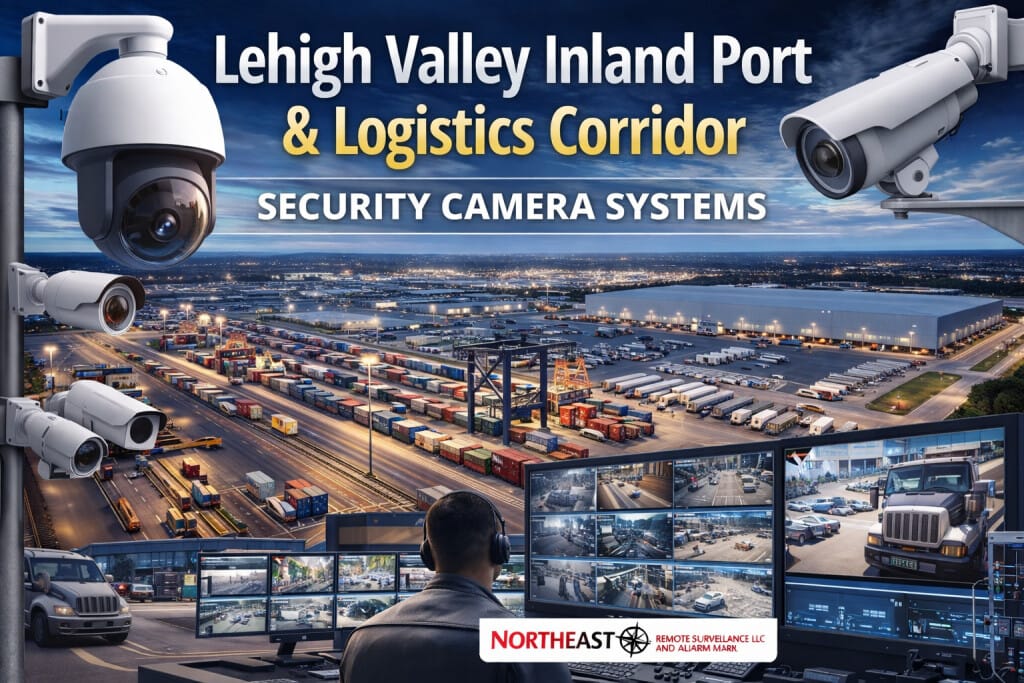
Lehigh Valley logistics facilities require security camera systems designed around freight movement, loading activity, trailer staging, employee entrances, vehicle traffic, overnight operations and large exterior areas.
Request a Security Camera Assessment
Northeast Remote Surveillance and Alarm, LLC (NERSA) designs and installs commercial security camera systems for warehouses, distribution centers, truck yards, cross-dock terminals, manufacturing distribution operations and logistics facilities throughout the Lehigh Valley supply-chain corridor.
Facilities around Allentown, Bethlehem, Easton, I-78, Route 22, Route 33, LVIP, airport cargo operations and regional industrial parks may experience constant truck traffic, shift changes, freight transfers, trailer movement and after-hours activity.
A dependable logistics camera system should therefore be designed around how the property actually works—not simply around where cameras are easiest to mount.
For broader regional commercial-security planning, visit Lehigh Valley Commercial and Industrial Security Systems.
For broader regional camera planning, visit Lehigh Valley Commercial Video Surveillance Systems.
Commercial and industrial systems only.
Security Camera Planning for Lehigh Valley Logistics Facilities
A warehouse or logistics camera system should not be planned like a conventional office installation.
Large facilities can combine warehouse interiors, loading areas, truck entrances, trailer rows, employee parking, restricted areas, exterior storage and operating zones that remain active after normal office hours.
A camera assessment may consider:
- Loading-dock visibility
- Trailer movement
- Truck entrances and exits
- Shipping and receiving
- Warehouse interiors
- Employee entrances
- Parking areas
- Exterior yards
- Fence lines
- Restricted storage
- Equipment areas
- Vehicle approaches
- Lighting conditions
- Camera mounting locations
- Recording requirements
- Video retention
- Remote viewing
- Existing camera infrastructure
- Future expansion
The objective is not simply to record activity.
The objective is to provide usable video that helps authorized personnel understand what happened when an incident needs to be reviewed.
Camera Coverage Around Logistics Operations
Camera placement should follow the movement of people, vehicles, freight and materials throughout the property.
Important areas may include:
- Loading docks
- Trailer approach lanes
- Shipping and receiving areas
- Truck gates
- Employee entrances
- Parking lots
- Trailer staging areas
- Warehouse aisles
- High-value inventory locations
- Restricted rooms
- Equipment storage
- Exterior yards
- Fence lines
- Dispatch entrances
- Service drives
Not every location requires the same camera view.
A broad overview camera may be appropriate for understanding general yard movement, while an entrance, dock position, vehicle lane or restricted area may require a more focused view.
The system should be designed around the information the organization may need later.
Usable Video Evidence
One of the most common problems with commercial surveillance is having recorded footage that does not provide enough detail when an incident occurs.
A camera may technically cover an area while still failing to provide useful evidence because of:
- Excessive distance
- Poor lighting
- Incorrect camera angle
- Excessive mounting height
- Backlighting
- Obstructions
- Insufficient resolution for the intended view
- Poor nighttime performance
- Inadequate recording retention
NERSA plans camera views around the purpose of each location.
The goal is to help management answer practical questions such as:
- What happened?
- Where did it happen?
- When did it happen?
- Which direction did a person or vehicle travel?
- What activity occurred before and after the incident?
- Is the footage clear enough to support review or investigation?
Loading Areas & Shipping Operations
Loading docks are important camera locations because employees, drivers, trailers, forklifts, freight and shipping activity frequently intersect in the same area.
A logistics camera system may provide visibility around dock approaches, individual loading positions, shipping offices and adjacent warehouse areas.
For projects where loading-dock security itself is the primary requirement, visit Loading Dock Security Systems.
Camera planning should coordinate loading-dock views with coverage across the larger logistics property.
Trailer Yards & Exterior Camera Coverage
Large trailer yards and exterior logistics properties can require camera coverage across distances substantially greater than those found inside a conventional commercial building.
Camera planning may need to account for:
- Trailer rows
- Truck circulation
- Exterior storage
- Fence lines
- Remote sections of the property
- Detached structures
- Employee and driver parking
- Lighting
- Available mounting locations
- Changing trailer positions
Camera locations should be selected around the actual visibility requirement rather than assuming that building-mounted cameras can provide useful coverage across an entire yard.
For projects where the primary requirement is dedicated yard or trailer protection, visit Truck Yard Security Systems.
Vehicle Visibility at Logistics Properties
Truck entrances, delivery lanes, fleet areas and employee parking may require stronger vehicle documentation than a general property overview camera can provide.
Where vehicle identification is important, camera placement should account for direction of travel, distance, lighting, lane geometry and vehicle speed.
A general camera and a dedicated license-plate camera perform different jobs.
For a project specifically requiring plate capture or dedicated vehicle identification, visit License Plate Recognition Camera Systems.
Warehouse Interior Camera Coverage
Warehouse interiors require camera placement based on actual activity rather than attempting to cover every square foot equally.
Useful coverage may include:
- Main aisles
- Shipping and receiving
- Inventory areas
- Employee entrances
- Conveyor areas
- Restricted spaces
- High-value storage
- Equipment areas
- Dispatch or management entrances
- Internal traffic routes
Camera design should support practical incident review while avoiding unnecessary camera density.
The right system provides useful coverage where information is most likely to matter.
Video Search & Analytics
Modern commercial camera systems may include analytics that help authorized users locate relevant video more efficiently.
Depending on the selected platform and camera system, analytics may assist with searches involving people, vehicles, movement or activity within defined areas.
Analytics should support the camera system rather than substitute for proper camera placement.
Camera angle, field of view, distance, lighting and image quality remain fundamental to obtaining useful results.
Remote Access to Logistics Camera Systems
Authorized personnel may need camera access from offices, operations centers or approved remote devices.
A commercial camera system should provide practical access without unnecessarily exposing the system or making administration difficult.
System planning may therefore consider:
- User permissions
- Administrator ownership
- Remote viewing
- Secure account management
- Evidence export
- Recording access
- Multi-site visibility
For facilities requiring an active professional monitoring service rather than normal camera viewing, visit Remote Video Monitoring and Live Talk-Down.
Video for Incident & Operational Review
Logistics camera systems can provide useful documentation when organizations need to review events involving:
- Freight movement
- Property damage
- Vehicle activity
- Shipping discrepancies
- Loading activity
- Equipment incidents
- Unauthorized entry
- After-hours activity
- Employee or contractor movement
- Exterior property events
Security cameras are not a replacement for safety programs, operating procedures, supervision or regulatory responsibilities.
Their role is to provide useful visual documentation when an event needs to be understood after it occurs.
Recording & Video Retention
The camera itself is only one part of a useful surveillance system.
Recording should be designed around how long the organization may reasonably need to retain footage before an incident is discovered.
Retention requirements can vary depending on:
- Camera count
- Resolution
- Frame rate
- Operating schedule
- Investigation practices
- Customer requirements
- Storage architecture
- Available bandwidth
- Risk exposure
The system should also allow authorized personnel to locate, review and export footage when required.
A long retention period is not useful if recordings are difficult to find or retrieve.
Infrastructure Supporting Logistics Camera Systems
Large logistics properties can require substantial infrastructure to support dependable cameras.
That may include PoE switching, fiber, wireless links, equipment cabinets, backup power and secure network connectivity.
Plan the infrastructure around the camera system’s needs.
For dedicated cabling, fiber, wireless-bridge or network planning, visit the appropriate NERSA infrastructure resource.
Existing Logistics Camera Systems & Upgrades
Many warehouses and distribution facilities already have security cameras installed.
Existing equipment does not automatically require complete replacement.
NERSA can evaluate:
- Existing cameras
- Recording equipment
- Coverage gaps
- Image quality
- Night performance
- Camera positioning
- Storage capacity
- Remote access
- Network infrastructure
- Equipment condition
- Administrator access
- Documentation
- Expansion requirements
Where existing equipment remains compatible and serviceable, portions of the system may sometimes remain useful.
The objective is to correct deficiencies while preserving practical infrastructure where appropriate.
What NERSA Reviews During a Logistics Camera Assessment
A camera assessment should be based on real operating conditions at the property.
NERSA may review:
- Dock-door visibility
- Trailer-yard coverage
- Vehicle entrances
- Building entrances
- Employee parking
- Warehouse interiors
- Shipping and receiving
- Fence lines
- Exterior exposure
- Lighting
- Camera mounting locations
- Existing camera coverage
- Network infrastructure
- Recording requirements
- Video retention
- Remote access
- Future expansion
The purpose is to identify blind spots, weak footage, poor camera locations and other conditions that could prevent the finished system from providing useful video.
For a broader physical-property review extending beyond cameras, visit Physical Plant Security Assessment.
Frequently Asked Questions About Lehigh Valley Logistics Security Camera Systems
Why do logistics facilities need specialized security cameras?
Warehouses and logistics facilities can include large yards, loading docks, truck traffic, trailer staging, warehouse interiors, freight movement and after-hours activity that require different camera views from a conventional office property.
Where should cameras be installed at a logistics facility?
Camera locations depend on the property, but common areas include loading docks, truck entrances, trailer yards, employee entrances, warehouse interiors, shipping and receiving, parking, fence lines and restricted areas.
Should every area use the same type of camera?
No. Different locations may require different fields of view, mounting positions and image characteristics depending on the information the organization needs to capture.
Can existing warehouse cameras be upgraded?
Yes. Existing cameras, recording equipment, network infrastructure and mounting locations can be evaluated to determine what remains usable and where improvements are needed.
Can logistics camera systems be viewed remotely?
Yes. Authorized users can typically access properly configured commercial video systems remotely, depending on the selected platform and security configuration.
How much video retention does a logistics facility need?
Retention should be determined from operating schedules, incident-discovery patterns, investigation requirements, camera count, image quality and available storage rather than from a single universal number.
Can cameras document truck and vehicle movement?
Yes. Properly positioned cameras can provide useful vehicle documentation. Dedicated plate identification requires more specialized camera and lane planning.
Are AI analytics useful at logistics facilities?
They can be. Analytics may help authorized users search recorded video or identify defined types of activity when the cameras, lighting and system design support the feature.
Can cameras help review shipping or loading incidents?
Yes. Proper camera placement can provide useful visual documentation around loading areas, trailer positions, freight movement and related activity.
Does NERSA install single-family home camera systems?
No. NERSA does not provide security installations for individual homes or single-family residences. We serve businesses, industrial and institutional facilities, and professionally managed apartment communities, including shared entrances, common areas, and grounds.
How does a logistics camera project begin?
A project begins with a review of the facility, operating conditions, important activity areas, existing cameras, lighting, infrastructure and the video evidence the organization needs.
Request a Lehigh Valley Logistics Security Camera Assessment
Warehouses, distribution centers, truck yards and freight facilities throughout the Lehigh Valley need camera systems designed around real industrial operations.
NERSA can assess camera coverage based on how your facility operates. We serve Allentown, Bethlehem, Easton and surrounding Lehigh Valley industrial areas, including LVIP, airport cargo sites and properties near I-78, Route 22 and Route 33.
Request a Security Camera Assessment.
Commercial and industrial systems only • New installations • Upgrades • Retrofits • Takeovers
Compliance, Codes & Project Standards
NERSA plans commercial and industrial security work with applicable code, documentation, inspection and authority-having-jurisdiction requirements in mind. Requirements vary by system, property and jurisdiction. These resources support project planning; they do not establish legal compliance, certification or AHJ approval.
Related guidance: Regulatory compliance & inspection readiness · Video surveillance compliance · NERSA project standards